


Japan’s AI Surgery Revolution and the Rise of Software as a Medical Device
Artificial intelligence is moving deeper into Japan’s healthcare system, and the operating room is emerging as an important frontier for software-driven medical innovation. From medical imaging and surgical planning to intraoperative visualization and clinical decision support, AI is increasingly being integrated into technologies designed to help clinicians make faster, more informed decisions.
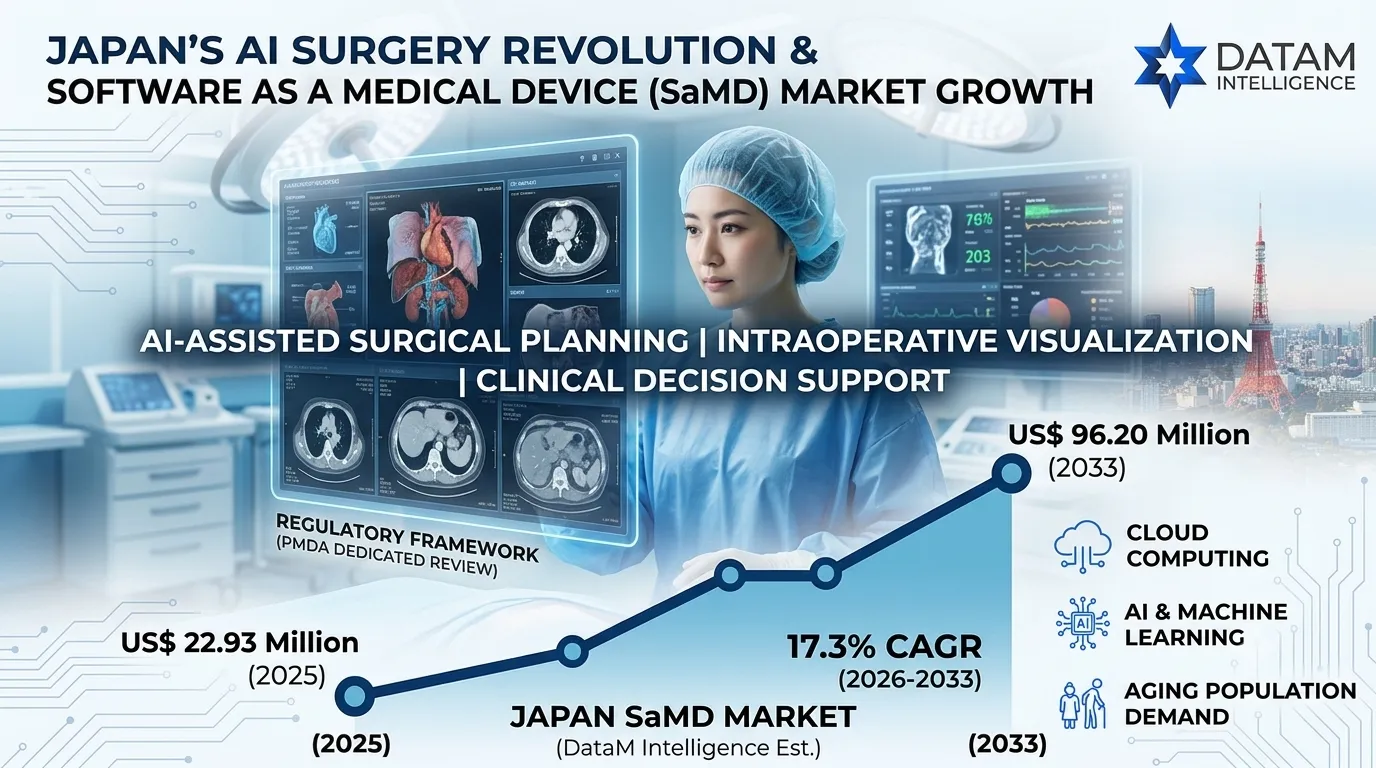
This transformation is closely connected to the growth of Software as a Medical Device (SaMD) in Japan. DataM Intelligence estimates that the Japan Software as a Medical Device Market reached US$22.93 million in 2025 and is projected to reach US$96.20 million by 2033, expanding at a CAGR of 17.3% during 2026 - 2033.
Explore the Japan Software as a Medical Device Market
For detailed analysis of market size, growth drivers, application segments, indications, competitive dynamics, recent developments and strategic opportunities, explore the Japan Software as a Medical Device Market report by DataM Intelligence.
Request a Sample Report Today!
The growth of AI-powered diagnostics, cloud computing, connected healthcare technologies and clinical analytics is creating a broader ecosystem in which medical software can support healthcare professionals before, during and after treatment.
What Is AI-Assisted Surgery?
AI-assisted surgery refers to the use of artificial intelligence, machine learning, computer vision, medical imaging and data analytics to support surgical teams throughout the clinical workflow.
AI does not necessarily replace the surgeon. Instead, AI-based software can process large volumes of clinical and imaging data and provide information that may support human decision-making.
Depending on the application, AI can support:
- Preoperative planning and risk assessment
- Medical image analysis
- Identification of anatomical structures
- Surgical navigation
- Intraoperative image visualization
- Real-time decision support
- Procedure documentation and analysis
- Postoperative monitoring
- Surgical training and performance analysis
This distinction is important. The commercial opportunity is not simply about creating an “AI surgeon.” It is about developing validated software that can become a reliable component of the clinical workflow.
Why Is Japan Investing in AI Medical Software?
Japan has several structural factors supporting the development of AI-enabled medical software.
Its aging population is increasing demand for technologies that can improve healthcare efficiency, support earlier diagnosis and help clinicians manage increasingly complex patient needs. At the same time, Japan has a highly developed medical-device industry, advanced manufacturing capabilities and a regulatory ecosystem specifically addressing software-based medical technologies.
Cloud computing and the Internet of Things are also becoming important growth drivers for Japan’s SaMD market. Cloud-based platforms can provide secure access to medical information and analytics, while connected devices can facilitate continuous monitoring and remote healthcare services.
For hospitals, the attraction is straightforward: software can potentially improve workflow efficiency without requiring every innovation to depend on entirely new physical medical hardware.
How AI Can Transform the Operating Room
1. AI-Powered Surgical Planning
Before a procedure begins, surgeons can work with large volumes of medical imaging and patient information.
AI-based software can help analyze imaging data, identify relevant anatomical structures and organize information that may support surgical planning.
This can be particularly valuable for complex procedures where small anatomical differences can influence the surgical approach.
2. Real-Time Intraoperative Visualization
One of the most important opportunities for medical AI is the ability to analyze information while a procedure is taking place.
Computer vision systems can potentially identify anatomical structures or abnormalities within surgical images and provide additional visual information to clinicians.
Japan’s PMDA specifically identifies SaMD intended to support visualization from intraoperative images within its SaMD review activities, demonstrating the regulatory relevance of software supporting intraoperative workflows.
3. Surgical Decision Support
AI can process information much faster than a human can manually review large datasets.
In a surgical environment, decision-support software could combine imaging, patient history and other clinical information to provide relevant insights to the surgical team.
The objective is not to remove clinical judgment but to augment it.
4. AI-Assisted Surgical Navigation
Navigation technologies can help surgeons understand the position of instruments or anatomical structures during complex procedures.
When AI, imaging and navigation technologies are combined, software can potentially provide a more dynamic view of the surgical environment.
This creates opportunities for companies developing AI algorithms, imaging platforms, cloud infrastructure and medical-device software.
5. Surgical Training and Performance Analysis
AI can also support the development of the next generation of surgeons.
Recorded surgical data can be analyzed to identify procedural patterns, provide structured feedback and support simulation-based training.
This creates another commercial opportunity for healthcare software providers beyond direct clinical decision support.
Japan’s SaMD Regulatory Environment Is Becoming More Important
The growth of AI medical software also increases the importance of regulation.
Japan’s Pharmaceuticals and Medical Devices Agency (PMDA) regulates software that meets the criteria for medical-device software under the Pharmaceutical and Medical Device Act. PMDA states that software intended for medical purposes and presenting significant potential risk to life or health when it does not function as intended can fall within medical-device regulation.
Japan has also established dedicated regulatory activities around AI-based SaMD. PMDA’s Science Board has examined issues including machine-learning bias, training-data construction, post-marketing learning and medical information databases.
This matters for developers because an AI algorithm that performs well technically is not automatically ready for clinical deployment.
Developers must consider:
Clinical validity + safety + data quality + explainability + cybersecurity + regulatory compliance + post-market monitoring.
The regulatory environment is therefore becoming a competitive factor in Japan’s medical AI market.
Japan Is Building a More Supportive SaMD Ecosystem
Japan has been working to accelerate the practical use of SaMD.
PMDA notes that DASH for SaMD 2, introduced by Japan’s Ministry of Health, Labour and Welfare and Ministry of Economy, Trade and Industry, was designed to promote practical use and international expansion of SaMD. PMDA also reorganized its SaMD review structure in July 2024 to strengthen consultation and review capabilities.
In 2026, Japan also moved toward continuous implementation of priority review measures for innovative SaMD products, with applications accepted on a rolling basis from FY2026.
For developers and investors, this creates a more structured pathway for evaluating the commercial potential of AI-enabled medical software.
AI Surgery Is Part of a Much Larger Japan SaMD Opportunity
The surgical AI opportunity should not be viewed in isolation.
The broader Japan SaMD market includes:
- Disease management software
- Diagnostic software
- Treatment monitoring
- Predictive health analytics
- AI-powered medical imaging
- Remote patient monitoring
- Clinical decision-support systems
- Digital therapeutics
- Connected healthcare platforms
DataM Intelligence identifies diagnostics as the leading application segment in Japan’s SaMD market, supported by demand for early disease detection, AI-driven imaging and data analytics.
This creates an important pathway for companies entering the market.
A company developing AI for surgical visualization, for example, can potentially build capabilities that are also relevant to medical imaging, diagnostics, clinical analytics and remote healthcare.
What Is Driving Investment in Japan’s AI Medical Software Market?
Several factors are likely to influence investment and commercialization.
Aging Population
Japan's aging population is creating demand for technologies that can support healthcare delivery while improving efficiency.
AI and Machine Learning
Advances in machine learning and computer vision are expanding the capabilities of medical software.
Cloud Computing
Cloud infrastructure enables medical software to process and access data across connected healthcare environments.
IoT and Remote Monitoring
Connected devices can generate continuous patient data that supports monitoring and predictive analytics.
Regulatory Development
A clearer framework for SaMD can reduce uncertainty for developers working toward commercialization.
Hospital Digital Transformation
Healthcare providers are increasingly evaluating technologies that can improve clinical workflows, data management and operational efficiency.
Together, these factors create opportunities across the medical software value chain.
What Are the Challenges?
The growth opportunity does not eliminate the barriers.
Data Quality
AI requires high-quality, representative clinical datasets. Poor or biased data can affect model performance.
Clinical Validation
Medical AI needs evidence demonstrating that it provides meaningful clinical value in the intended use case.
Cybersecurity
Connected medical software creates additional cybersecurity requirements because sensitive health information must be protected.
Workflow Integration
Even technically advanced software can struggle to gain adoption if it disrupts established clinical workflows.
Digital Literacy
DataM Intelligence identifies limited digital literacy among some elderly patients and healthcare professionals as a restraint on SaMD adoption in Japan.
Regulatory Compliance
Developers must understand whether their software qualifies as a medical device and what evidence and review pathway may apply.
These challenges mean that successful companies will need more than strong AI models. They will need clinical, regulatory, cybersecurity and commercialization capabilities.
Competitive Landscape: Where Are the Opportunities?
Japan’s SaMD ecosystem includes medical-device manufacturers, healthcare technology companies, AI developers, imaging specialists and digital-health providers.
DataM Intelligence identifies companies including Japan Medical Device Corporation, Nipro Corporation, Micron, Inc., Olympus Medical Systems and Anaut Inc. among the major players in the Japan SaMD market.
The market is also seeing strategic collaboration around AI-enabled diagnostics. For example, DataM Intelligence reports that Monitor Corporation partnered with Japanese digital healthcare provider Doctor-NET to commercialize AI-powered lung-cancer diagnostic software in Japan.
Such partnerships highlight an important trend: commercialization may increasingly depend on combining AI capabilities with local regulatory knowledge, clinical networks and healthcare distribution.
What Does the Future of AI-Assisted Surgery Look Like in Japan?
The next phase of medical AI is likely to move beyond standalone algorithms toward integrated clinical platforms.
The future operating room could increasingly connect:
Medical imaging → AI analytics → surgical planning → intraoperative visualization → clinical decision support → postoperative monitoring.
This creates opportunities for software companies that can connect multiple stages of the healthcare workflow.
However, the strongest solutions are likely to be those that remain clinically useful, transparent and compatible with surgeon-led decision-making.
The goal is not necessarily autonomous surgery.
The more immediate opportunity is intelligent surgical assistance.
Analyst View: Why Japan’s SaMD Market Matters
Japan's SaMD market is entering a phase in which AI capabilities, regulatory infrastructure and healthcare digitalization are converging.
The market's projected expansion from US$22.93 million in 2025 to US$96.20 million by 2033 indicates a rapidly developing commercial opportunity.
For technology companies, the opportunity extends beyond developing AI algorithms. Successful market strategies will increasingly require:
- Regulatory pathway assessment
- Clinical validation
- Local partnerships
- Data governance
- Cybersecurity
- Hospital workflow integration
- Reimbursement and market-access planning
- Post-market surveillance
- Scalable cloud infrastructure
For investors, this creates opportunities across the broader ecosystem rather than only among companies developing surgical robots.
For healthcare providers, the key question will increasingly be how AI-enabled SaMD can deliver measurable improvements in clinical outcomes, efficiency and patient experience.
Conclusion
Japan’s AI surgery revolution is part of a much larger transformation in software-driven healthcare.
AI-assisted surgical planning, medical imaging, intraoperative visualization, decision support and postoperative monitoring demonstrate how software can increasingly complement clinical expertise.
At the same time, Japan's evolving SaMD regulatory framework is helping establish the infrastructure required to move innovative medical software from development toward practical use.
With Japan’s Software as a Medical Device Market projected to grow at 17.3% CAGR through 2033, the opportunity extends well beyond the operating room.
For medical-device manufacturers, AI developers, healthcare technology companies and investors, Japan represents an increasingly important market to watch as AI, cloud computing, IoT and clinical software converge to reshape healthcare delivery.
FAQS
How is AI transforming surgery in Japan?
AI is transforming surgery in Japan by supporting preoperative planning, medical-image analysis, intraoperative visualization, surgical navigation, clinical decision-making and postoperative monitoring. These capabilities are part of the broader growth of Software as a Medical Device (SaMD), which Japan is supporting through evolving regulatory and review frameworks.
What is AI-assisted surgery in Japan?
AI-assisted surgery uses artificial intelligence, machine learning, computer vision and medical software to support surgeons with planning, imaging, navigation, visualization and clinical decision-making.
What is Software as a Medical Device in Japan?
SaMD is software intended for medical purposes that can function as a medical device independently of traditional physical hardware. Japan regulates qualifying SaMD under its medical-device framework.
What is driving Japan’s Software as a Medical Device market?
Key drivers include AI-powered diagnostics, cloud computing, IoT integration, remote monitoring, healthcare digitalization and regulatory support for innovative medical software.
How large is Japan’s SaMD market?
According to DataM Intelligence, the Japan SaMD market reached US$22.93 million in 2025 and is projected to reach US$96.20 million by 2033, growing at a 17.3% CAGR from 2026 to 2033.
Does AI replace surgeons?
The more immediate role of AI is to augment surgeons rather than replace them. AI can analyze images, identify patterns and provide decision-support information while final clinical decisions remain with qualified healthcare professionals.
What role does PMDA play in AI medical software in Japan?
PMDA provides regulatory consultation and review for qualifying SaMD and has dedicated activities addressing AI-based SaMD, including issues such as machine-learning bias, training data and post-marketing learning.