


Japan Software as a Medical Device Market Size
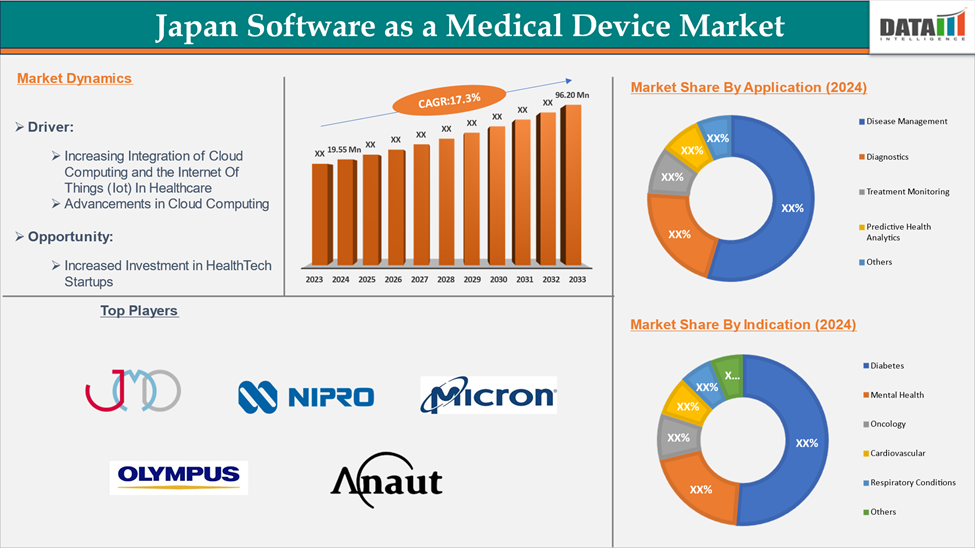
The Japan Software as a Medical Device Market reached US$ 22.93 million in 2025 and is expected to reach US$ 96.20 million in 2033, growing at a CAGR of 17.3% during the forecast period (2026 - 2033).
Software as a Medical Device (SaMD) is designed for medical purposes, enabling disease diagnosis, treatment recommendations, patient monitoring, and clinical decision-making. It uses advanced technologies like AI, machine learning, and cloud computing to improve healthcare delivery and patient outcomes. SaMD operates independently on platforms like smartphones, tablets, or cloud-based systems, making it highly accessible and scalable.
Japan Software as a Medical Device Market Executive Summary
Japan Software as a Medical Device Market Dynamics: Drivers & Restraints
Increasing Integration of Cloud Computing and the Internet of Things (IoT) in Healthcare
Japan's Software as a Medical Device (SaMD) market is being significantly transformed by the integration of cloud computing and IoT. Cloud-based platforms offer secure storage, real-time access, and advanced analytics for medical data, improving efficiency and decision-making. IoT devices enable continuous patient monitoring, remote diagnostics, and early disease detection, reducing hospital visits and improving patient outcomes. The synergy between cloud computing and IoT is accelerating innovation, expanding market opportunities, and improving healthcare accessibility.
Limited Digital Literacy Among Elderly Patients and Healthcare Professionals
The adoption of Software as a Medical Device (SaMD) solution in Japan faces challenges due to limited digital literacy among elderly patients and healthcare professionals. The aging population struggles with digital health applications, limiting the benefits of remote monitoring and AI-driven diagnostics. Traditional healthcare providers may also struggle to integrate SaMD tools into their workflows. This lack of digital proficiency can lead to resistance to new technologies, improper software utilization, and reduced trust in digital healthcare solutions, slowing the market's growth.
Japan Software as a Medical Device Market Segment Analysis
The Japan software as a medical device market is segmented based on application and indication.
by Application:
The diagnostics from application segment is expected to dominate the software as a medical device market with the highest market share
Diagnostics is the process of identifying diseases, conditions, or medical abnormalities through various tests, assessments, and analyses. It includes imaging, laboratory testing, and clinical evaluations. Advancements in digital health now include AI-driven and software-based solutions, enhancing accuracy and efficiency. Effective diagnostics are crucial for preventive care, early intervention, and improving patient outcomes, guiding treatment decisions.
The diagnostics segment in this market is driven by the need for early disease detection, chronic conditions, AI-driven imaging, and data analytics. Remote diagnostics and telemedicine expansion improve healthcare accessibility. Regulatory approvals for AI-powered tools and cloud-based platforms support market growth.
The demand for cost-effective, accurate diagnostic solutions is driving SaMD adoption in precision medicine and personalized healthcare. Several companies are forming strategic partnerships to expand their diagnostic businesses. For instance, in January 2025, Monitor Corporation, a Korean medical AI company, partnered with Japanese digital healthcare provider Doctor-NET to sell its lung cancer diagnosis software in Japan. The AI-powered tool, MONCAD CTLN, aids radiologists in detecting lung cancer using chest CT scans. Doctor-NET has obtained manufacturing and sales certification for the software in Japan.
Japan Software as a Medical Device Major Japan Players
The major Japan players in the software as a medical device market include Japan Medical Device Corporation, Nipro Corporation, Micron, Inc., Olympus Medical Systems and Anaut Inc. among others.
Recent Developments in the Japan Software as a Medical Device Market
May 2026 – Advancement of Nationwide Medical Information Platform Integration
Japan continued expanding its Nationwide Medical Information Platform, encouraging interoperability between electronic health records (EHRs), telehealth systems, and Software as a Medical Device applications. The initiative is expected to improve healthcare data sharing and support broader adoption of digital therapeutics and AI-based clinical software.
April 2026 – Growing Adoption of AI-Based Diagnostic SaMD Solutions
Japan's healthcare sector witnessed increased deployment of AI-powered diagnostic software for disease detection, imaging analysis, and clinical decision support. The trend is supported by government-led healthcare digitalization initiatives and growing demand for efficient diagnostic workflows.
April 2026 – Expansion of Cloud-Based and IoT-Integrated Patient Monitoring Platforms
Healthcare providers across Japan accelerated the adoption of cloud-enabled and IoT-connected SaMD solutions for remote patient monitoring and chronic disease management. These platforms enable real-time data collection, predictive analytics, and improved healthcare accessibility, particularly for elderly patients.
March 2026 – Fujitsu and DT-Axis Collaborate to Accelerate SaMD Development
Fujitsu entered into a strategic collaboration with DT-Axis to provide comprehensive support for Software as a Medical Device (SaMD) development, including regulatory approval assistance, commercialization, and market access services. The partnership aims to accelerate digital health innovation and expand AI-enabled medical software adoption across Japan.
In March 2026, Fujitsu expanded its SaMD portfolio with AI-powered diagnostic and monitoring software. The innovation focuses on improving clinical decision-making and patient outcomes. This supports digital transformation in Japan’s healthcare system.
In February 2026, Sony Corporation introduced advanced medical imaging software solutions integrated with AI analytics. The development enhances diagnostic accuracy and workflow efficiency. This benefits hospitals and diagnostic centers.
In January 2026, NTT Data strengthened its digital health platforms with SaMD solutions for remote patient monitoring. The focus is on telehealth and data integration. This supports care delivery for Japan’s aging population.
Japan Software as a Medical Device Market Scope
| Metrics | Details | |
| CAGR | 17.3% | |
| Market Size Available for Years | 2023-2033 | |
| Estimation Forecast Period | 2026-2033 | |
| Revenue Units | Value (US$ Mn) | |
| Segments Covered | Application | Disease Management, Diagnostics, Treatment Monitoring Predictive Health Analytics, Others |
| Indication | Diabetes, Mental Health, Oncology, Cardiovascular, Respiratory Conditions, Others
| |
Why Purchase the Report?
- Technological Innovations: Reviews ongoing clinical trials, product pipelines, and forecasts upcoming advancements in medical devices and pharmaceuticals.
- Product Performance & Market Positioning: Analyzes product performance, market positioning, and growth potential to optimize strategies.
- Real-World Evidence: Integrates patient feedback and data into product development for improved outcomes.
- Physician Preferences & Health System Impact: Examines healthcare provider behaviors and the impact of health system mergers on adoption strategies.
- Market Updates & Industry Changes: Covers recent regulatory changes, new policies, and emerging technologies.
- Competitive Strategies: Analyzes competitor strategies, market share, and emerging players.
- Pricing & Market Access: Reviews pricing models, reimbursement trends, and market access strategies.
- Market Entry & Expansion: Identifies optimal strategies for entering new markets and partnerships.
- Supply Chain Optimization: Assesses supply chain risks and distribution strategies for efficient product delivery.
- Sustainability & Regulatory Impact: Focuses on eco-friendly practices and evolving regulations in healthcare.
- Post-market Surveillance: Uses post-market data to enhance product safety and access.
- Pharmacoeconomics & Value-Based Pricing: Analyzes the shift to value-based pricing and data-driven decision-making in R&D.
Target Audience 2026
- Manufacturers: Pharmaceutical, Medical Device, Biotech Companies, Contract Manufacturers, Distributors, Hospitals.
- Regulatory & Policy: Compliance Officers, Government, Health Economists, Market Access Specialists.
- Application & Innovation: AI/Robotics Providers, R&D Professionals, Clinical Trial Managers, Pharmacovigilance Experts.
- Investors: Healthcare Investors, Venture Fund Investors, Pharma Marketing & Sales.
- Consulting & Advisory: Healthcare Consultants, Industry Associations, Analysts.
- Supply Chain: Distribution and Supply Chain Managers.
- Consumers & Advocacy: Patients, Advocacy Groups, Insurance Companies.
- Academic & Research: Academic Institutions.




























































