


Introduction: The AI Boom Is Creating an Infrastructure Challenge
Artificial intelligence is changing the shape of digital infrastructure.
For years, data centers were built mainly to support cloud applications, enterprise software, streaming platforms, databases, and storage. That model is now being stretched by generative AI, large language models, AI copilots, multimodal systems, and real-time inference workloads. These applications require massive amounts of computing power, and that computing power is being concentrated inside increasingly dense AI data centers.
The result is a new infrastructure challenge. The industry is no longer asking only how many servers can be deployed. It is asking how much power can be delivered to a rack, how much heat can be removed from a chip, and how much cooling capacity can be added without driving up energy costs, water use, or carbon emissions.
This is why cooling has become one of the most important bottlenecks in AI data center infrastructure. A facility may have access to land, capital, networking, and cloud demand, but if it cannot cool dense GPU clusters, it cannot fully support modern AI computing power.
In the AI era, cooling is no longer a back-end facility concern. It is becoming a strategic layer of the data center business model.
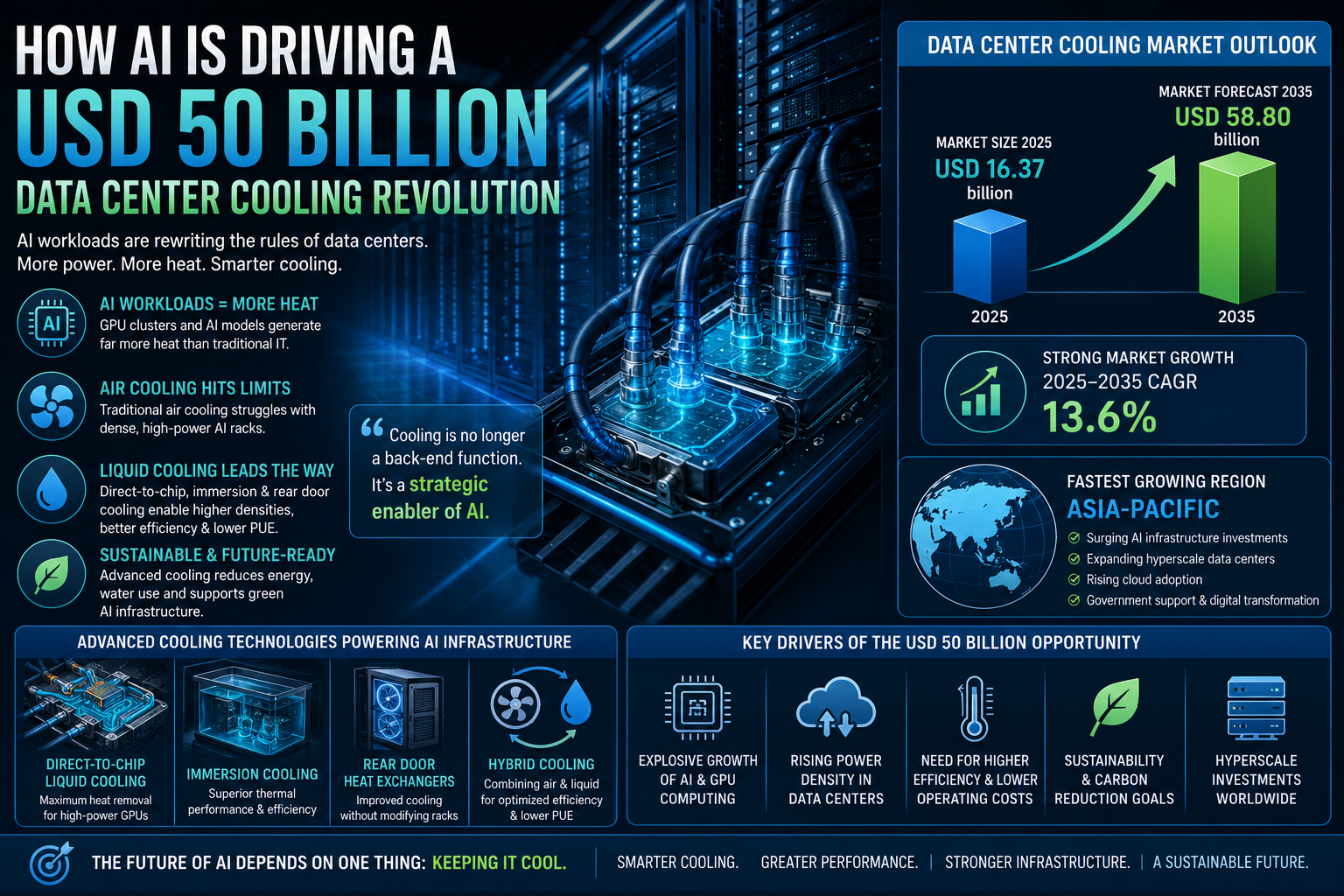
According to research report published by DataM Intelligence, “Data Center Cooling Market size 2026 is estimated at USD 18.60 billion and is forecast to reach USD 58.80 billion by 2035, driven by AI workloads, liquid cooling adoption, high-density rack cooling, PUE optimization, water-efficient infrastructure and sustainable data center cooling.”
Cooling Technology Comparison
| Cooling Technology | Best Fit | Strength | Limitation |
| CRAC and CRAH units | Enterprise and legacy data centers | Mature, widely available and easy to maintain | Limited for very high rack density |
| In-row cooling | Colocation and medium-density facilities | Better airflow control near heat source | Requires layout planning |
| Free cooling | Cooler climates and efficiency-focused sites | Reduces mechanical cooling cost | Climate-dependent |
| Direct-to-chip liquid cooling | High-density racks and compute-heavy workloads | Removes heat close to processors | Requires plumbing and CDU integration |
| Immersion cooling | Extreme density and specialized workloads | Strong thermal performance | Higher retrofit complexity |
| Hybrid cooling | Transitional facilities | Combines air and liquid systems | Requires careful system design |
1. Why AI Workloads Generate More Heat Than Traditional Computing
Traditional data center workloads are usually distributed across many CPU-based servers. These servers handle web hosting, enterprise applications, email, storage, databases, and cloud services. Their power draw can be significant, but heat is usually spread across the data hall in a way that traditional air cooling systems can manage.
Training a large language model or running high-volume AI inference requires specialized accelerators, especially GPUs. These chips are designed to process huge volumes of data in parallel. When thousands of GPUs are connected into training clusters, the facility must support intense power consumption, high-speed networking, dense cabling, and continuous heat removal.
A conventional rack often operates around 5 kW to 15 kW. AI racks commonly move into the 50 kW to 150 kW range, and some next-generation deployments are pushing beyond 200 kW per rack.
| Rack Type | Typical Power Density | Cooling Requirement |
| Conventional enterprise rack | 5 kW to 15 kW | Air cooling is usually sufficient |
| Cloud and mixed workload rack | 15 kW to 30 kW | Advanced airflow management may be needed |
| AI GPU rack | 50 kW to 150 kW | Liquid-assisted cooling is increasingly required |
| Next-generation AI rack | 200 kW and above | Direct liquid cooling or more advanced systems become critical |
The heat problem is not just about total energy use. It is about concentration.
A hyperscale data center can be enormous, but AI compute is often clustered into specific zones. These zones contain GPU servers, high-bandwidth networking, memory-intensive systems, and power equipment packed tightly together. This creates hot spots that are difficult to manage with conventional air movement.
That is why AI server cooling, GPU cooling, and high-density computing are now central to AI infrastructure planning. Without better cooling, the most expensive AI hardware cannot operate at full efficiency.
2. Why Traditional Air Cooling Is Reaching Its Limits
Air cooling has served the data center industry for decades. The traditional model is simple: cool air is supplied to the front of servers, hot air exits from the back, and the facility separates cold aisles from hot aisles to prevent mixing.
This design works well when rack density is moderate. It becomes harder to manage when racks are filled with high-power GPUs.
Air is a weak heat-transfer medium compared with liquid. To remove more heat, operators must move more air. That means larger fans, more fan energy, stronger airflow controls, and more space for air movement. At very high rack densities, the system becomes inefficient and difficult to scale.
Signs That Air Cooling Is Becoming Obsolete for Dense AI Workloads
| Warning Sign | What It Means for Operators |
| Rising PUE | More facility energy is being used for cooling instead of computing |
| Higher operating cost | Fans, chillers, and air handling systems consume more power |
| Hot spots near GPU clusters | Cooling is not reaching high-density equipment evenly |
| Performance throttling | GPUs may reduce performance to stay within safe temperatures |
| Shorter hardware life | Constant heat stress can affect reliability |
| Space pressure | More room is needed for airflow, containment, and cooling equipment |
The debate around air cooling vs liquid cooling is therefore no longer only about energy efficiency. It is about whether a facility can support the next generation of AI infrastructure at all.
For many operators, the future will not be purely air-cooled or purely liquid-cooled. It will be hybrid. Air cooling will continue to support lower-density IT systems, while liquid cooling will be used for GPUs, accelerators, AI training clusters, and other high-heat components.
3. The Rise of Liquid Cooling Technologies
Liquid cooling is becoming one of the most important shifts in data center infrastructure.
The reason is simple: liquid can move heat away from chips far more efficiently than air. Instead of cooling the entire room first and hoping enough cold air reaches the hottest hardware, liquid cooling removes heat closer to the source.
Three technologies are leading this transition: direct-to-chip cooling, immersion cooling, and rear door heat exchangers.
Direct-to-Chip Cooling
Direct-to-chip cooling uses cold plates attached directly to high-heat components such as GPUs, CPUs, and AI accelerators. Coolant flows through the cold plate, absorbs heat from the chip, and carries that heat away through a closed-loop system.
This is one of the most practical cooling methods for AI data centers because it can be integrated into rack-scale systems without fully submerging servers in fluid.
How Direct-to-Chip Cooling Works
| Component | Function |
| Cold plate | Sits on the chip and absorbs heat |
| Coolant | Carries heat away from the server |
| Pump or CDU | Moves coolant through the system |
| Heat exchanger | Transfers heat out of the coolant loop |
| Monitoring system | Tracks temperature, flow, pressure, and leak risk |
Why It Matters
Direct-to-chip cooling helps operators increase rack density, reduce server fan energy, stabilize GPU performance, and support hotter AI accelerators.
For AI workloads, this is extremely important. A GPU cluster that runs cooler can operate more consistently. That consistency improves utilization, protects expensive hardware, and reduces the risk of thermal throttling during heavy model training or inference.
Immersion Cooling
Immersion cooling takes a more radical approach. Instead of attaching liquid-cooled plates to chips, servers or components are placed in a dielectric fluid that does not conduct electricity.
The fluid absorbs heat directly from the equipment.
There are two main types of immersion cooling.
| Type | How It Works | Best Use Case |
| Single-phase immersion | Fluid absorbs heat but remains liquid | Dense compute environments needing simpler fluid handling |
| Two-phase immersion | Fluid boils, turns into vapor, then condenses back into liquid | Very high thermal loads and specialized deployments |
Immersion cooling can support very high heat loads and reduce the need for server fans. It can also improve space utilization by allowing more computing hardware in a smaller footprint.
However, it is not a simple plug-and-play upgrade. Operators must consider hardware compatibility, maintenance procedures, fluid handling, safety standards, warranty policies, and technician training. This is why immersion cooling is powerful, but adoption may be slower than direct-to-chip cooling in many hyperscale environments.
Rear Door Heat Exchangers
Rear door heat exchangers are another important cooling option, especially for facilities that want to support higher rack density without completely redesigning the data hall.
These systems are mounted on the back of server racks. As hot exhaust air leaves the rack, it passes through a liquid-cooled coil. Heat moves from the air into the liquid before the air enters the room.
This reduces the heat load inside the data hall and allows operators to manage denser racks more effectively.
Benefits of Rear Door Heat Exchangers
| Benefit | Impact |
| Easier retrofitting | Existing facilities can support higher-density racks |
| Lower heat release into the room | Data hall temperatures become easier to control |
| Better rack-level cooling | Dense GPU systems receive more targeted thermal support |
| Lower mechanical stress | Central air systems do not need to carry the full heat load |
Rear door heat exchangers may become a practical bridge technology for operators moving from conventional air cooling toward broader liquid cooling adoption.
4. Figure: How AI Changes the Cooling Equation
| Infrastructure Layer | Traditional Data Center | AI Data Center |
| Main processor type | CPU-heavy | GPU and accelerator-heavy |
| Rack density | Moderate | High to extreme |
| Cooling model | Room-level air cooling | Chip-level and rack-level cooling |
| Main constraint | Space and power | Power, heat, and cooling capacity |
| Design approach | Facility first, servers second | Rack-scale compute, power, and cooling designed together |
| Strategic priority | Uptime and cost efficiency | Uptime, density, energy efficiency, and sustainability |
This is the core reason AI is reshaping the cooling market. AI does not simply add more servers. It changes how data centers are planned, built, and operated.
5. How NVIDIA and AI Accelerators Are Accelerating Cooling Innovation
AI accelerators are forcing a major redesign of data center cooling.
NVIDIA, AMD, and Intel are all competing in a market where performance depends on dense computing, high memory bandwidth, fast interconnects, and efficient thermal design. These chips are more powerful than traditional CPUs, but they also create far more heat.
NVIDIA’s rack-scale AI systems show where the market is moving. Instead of selling isolated chips into standard server racks, the industry is moving toward full rack-scale AI systems that integrate GPUs, CPUs, networking, memory, power delivery, and liquid cooling.
An AI factory is not just a data center with GPUs. It is a purpose-built compute environment designed to train, fine-tune, and run AI models at scale. Cooling must be built into the architecture from the beginning.
AMD is also expanding its role in AI and high-performance computing through its Instinct accelerator portfolio. These systems are being deployed in air-cooled and liquid-cooled configurations depending on workload density and facility design.
Intel’s AI accelerator and data center platforms also support the broader shift toward specialized compute. As more vendors push higher-performance accelerators into the market, cooling innovation becomes a shared industry requirement rather than a single-vendor trend.
The message is clear: the next generation of AI hardware cannot be separated from the next generation of cooling infrastructure.
6. Why Hyperscale Operators Are Investing Billions in Cooling Infrastructure
Hyperscale operators are at the center of this transformation. Microsoft, Google, Amazon Web Services, and Meta are expanding AI data center capacity while also trying to manage power, water, emissions, and community pressure.
Microsoft
Microsoft has been redesigning data center infrastructure for AI workloads, including chip-level liquid cooling and new approaches that reduce or eliminate water use for cooling in future facilities.
This matters because Microsoft is one of the largest buyers and builders of AI infrastructure. Its cooling choices influence the entire supply chain, from server design to coolant distribution systems.
Amazon Web Services
AWS has described cooling as one of the core systems required to prevent servers from overheating and has acknowledged the industry shift from air-based to liquid-based cooling.
For AWS, cooling is not only an operational issue. It affects cloud capacity, AI service availability, and the economics of running high-density infrastructure at global scale.
Google has focused heavily on water stewardship, data center efficiency, and local water restoration projects. As AI workloads increase, Google’s cooling strategy is tied to broader sustainability commitments.
This is important because water is becoming a site-selection and community-acceptance issue. Data centers that rely heavily on water in stressed regions may face more scrutiny, even if they are energy efficient.
Meta
Meta has been redesigning data centers around AI workloads and high-density infrastructure. Its AI systems require more advanced thermal management than traditional social media and cloud workloads.
Meta’s shift reflects a broader market reality: companies building large-scale AI models need facilities that can support dense GPU clusters, not just general-purpose server rooms.
7. The Sustainability Factor: Cooling Without Increasing Carbon Emissions
AI data centers create a difficult sustainability challenge.
More AI adoption means more computing demand. More computing demand means higher electricity consumption. Higher electricity consumption can increase emissions if the power comes from carbon-intensive grids. Cooling adds another layer because facilities must manage both electricity use and water consumption.
This is why sustainable data centers and green data centers are becoming central to AI infrastructure strategy.
Key Sustainability Priorities
| Priority | Why It Matters |
| Energy-efficient cooling | Reduces electricity use and operating cost |
| Water-efficient cooling | Helps facilities expand in water-stressed regions |
| Renewable energy integration | Reduces carbon impact from rising power demand |
| Waste heat recovery | Turns rejected heat into a usable resource |
| Real-time monitoring | Prevents overcooling and improves operational efficiency |
Water-Efficient Cooling
Water use is becoming one of the most sensitive issues in data center development. Evaporative cooling can reduce electricity consumption, but it may increase water consumption. Dry cooling can reduce water use, but it may require more energy in certain climates.
The best solution depends on location. A facility in a cold region may use outside air and free cooling for part of the year. A facility in a hot or water-stressed region may need closed-loop liquid cooling, dry coolers, or hybrid systems.
Waterless Cooling Systems
Waterless or near-zero-water cooling is becoming more attractive for AI facilities. Closed-loop direct-to-chip cooling can move heat efficiently without relying heavily on evaporation.
This is especially valuable where water availability affects permits, local trust, and long-term expansion.
Renewable Energy Integration
Cooling strategy cannot be separated from power strategy. As data centers consume more electricity, operators must pair cooling innovation with renewable power, low-carbon energy procurement, grid partnerships, and energy storage.
Waste Heat Recovery
Waste heat recovery may become an important part of future data center design. Instead of rejecting heat into the environment, operators can reuse it for district heating, industrial processes, greenhouses, or nearby buildings.
This approach is still developing, but it could help turn AI’s thermal output into a useful energy resource.
8. Emerging Technologies Shaping the Future of Data Center Cooling
The future of cooling will not be defined only by pipes, pumps, and fluids. Software, sensors, simulation, and automation will also play a major role.
AI-Powered Thermal Management
AI-powered thermal management uses data from servers, racks, cooling units, sensors, and workloads to optimize cooling in real time.
Instead of overcooling the entire facility, operators can adjust cooling based on actual demand. This improves efficiency and reduces unnecessary energy use.
Predictive Cooling
Predictive cooling uses historical and real-time data to forecast heat loads before they happen. For example, if a GPU cluster is scheduled for a large training job, the cooling system can prepare in advance.
This reduces hot spots and improves system reliability.
Digital Twins
Digital twins allow data center operators to simulate cooling designs before construction or retrofitting. Engineers can test airflow, coolant flow, rack placement, heat rejection, and failure scenarios in a virtual environment.
This is especially useful for AI data centers because design mistakes are expensive. A poorly cooled GPU zone can limit performance, delay deployment, and increase operating costs.
Smart Sensors and Automation
High-density liquid-cooled environments require constant monitoring. Operators need to track temperature, pressure, coolant flow, humidity, pump health, and leak risk.
Smart sensors help detect problems early and prevent small issues from becoming outages.
Advanced Coolants
Advanced coolants are becoming important as chip temperatures rise. These include dielectric fluids for immersion cooling, engineered fluids for direct-to-chip systems, and new formulations designed for safety, compatibility, and better heat transfer.
Coolant performance will become a competitive factor as AI systems become denser and more expensive.
9. Market Opportunity: Why Data Center Cooling Is Becoming a USD 50 Billion Industry
The cooling market is expanding because AI changes the economics of data center infrastructure.
In the past, cooling was often treated as a facility cost. In the AI era, cooling is directly linked to revenue capacity. A data center that can cool dense AI racks can host more high-value workloads. A facility that cannot cool them may lose business to competitors.
The global data center cooling market has been projected to surpass USD 50 billion by 2030, supported by rising rack densities, AI infrastructure growth, cloud expansion, and edge computing demand.
Major Growth Drivers
| Growth Driver | Cooling Market Impact |
| AI infrastructure spending | Increases demand for direct liquid cooling and high-density thermal systems |
| Cloud growth | Expands large-scale data center capacity |
| Edge computing | Creates demand for compact and efficient cooling |
| Higher rack densities | Requires liquid cooling, CDUs, and advanced monitoring |
| Sustainability pressure | Boosts demand for water-efficient and energy-efficient systems |
| Retrofitting existing facilities | Creates opportunities for rear door heat exchangers and hybrid cooling |
The opportunity is not limited to hardware. It includes cooling software, digital twins, monitoring tools, maintenance services, coolant distribution units, immersion tanks, cold plates, leak detection systems, and consulting.
This is why the data center cooling revolution is larger than one product category. It is becoming a complete infrastructure ecosystem.
10. Regional Analysis: Where Cooling Demand Is Growing Fastest
North America
North America is one of the strongest markets for AI data center cooling. The United States leads in hyperscale cloud infrastructure, AI model development, semiconductor partnerships, and colocation demand.
Cooling demand is rising quickly in major data center regions because power availability, grid connection timelines, land constraints, and high rack densities are all becoming major challenges.
For U.S. operators, cooling is now part of competitive site selection. Locations with reliable power, lower climate risk, better water strategy, and renewable energy access will attract more AI infrastructure investment.
Europe
Europe’s cooling demand is strongly shaped by sustainability rules, energy efficiency expectations, grid pressure, and public scrutiny.
Countries such as Germany, France, Ireland, the Netherlands, and the Nordics are important data center markets, but operators must balance growth with carbon targets and local environmental concerns.
Europe is likely to be a major region for energy-efficient cooling, waste heat recovery, water-conscious design, and green data center innovation.
Asia-Pacific
Asia-Pacific is one of the fastest-growing data center regions due to cloud adoption, digital services, AI investments, 5G expansion, e-commerce, and data localization.
China remains a major AI infrastructure market. Japan is investing in advanced compute capacity and AI-ready infrastructure. India is becoming a fast-growing data center market as cloud providers, enterprises, and digital platforms expand capacity.
Cooling in Asia-Pacific is complex because the region includes hot climates, humid environments, dense cities, and water-stressed zones. This creates strong demand for efficient, climate-specific cooling designs.
11. Competitive Landscape
The data center cooling market includes established infrastructure companies, HVAC specialists, power management firms, and liquid cooling innovators.
| Company | Cooling Position |
| Vertiv | Thermal management, coolant distribution units, direct-to-chip support, and high-density cooling systems |
| Schneider Electric | AI-ready data center reference designs, power management, liquid cooling controls, and energy efficiency solutions |
| Johnson Controls | HVAC systems, chillers, building automation, and energy management for mission-critical facilities |
| STULZ | Precision cooling systems for data centers and high-availability environments |
| CoolIT Systems | Direct liquid cooling, cold plates, and liquid cooling systems for AI and high-performance computing |
| Asetek | Liquid cooling systems and data center thermal technology |
| Submer | Immersion cooling and sustainable high-density infrastructure |
| LiquidStack | Immersion cooling and liquid cooling solutions for high-performance data centers |
| Motivair | Liquid cooling systems, CDUs, and thermal solutions for AI infrastructure |
The winners in this market will not simply sell cooling equipment. They will help operators solve the full AI infrastructure equation: power, cooling, density, uptime, sustainability, and serviceability.
12. Practical Checklist for AI Data Center Cooling Strategy
Before upgrading or building an AI data center, operators should answer these questions.
| Question | Why It Matters |
| What rack densities must the facility support today and in five years? | Avoids underbuilding cooling capacity |
| Will workloads be training-heavy, inference-heavy, or mixed? | Different workloads create different heat patterns |
| Can the facility support direct-to-chip cooling? | Determines upgrade complexity |
| Is water availability a constraint? | Influences cooling technology choice |
| What is the target PUE? | Links cooling design to energy efficiency |
| Can waste heat be reused? | Improves sustainability performance |
| How will leaks be monitored? | Protects high-value AI hardware |
| Can existing racks be retrofitted? | Reduces capital cost and deployment time |
This checklist is becoming more important as AI infrastructure moves from experimental deployments to large-scale production environments.
Conclusion: Cooling Is Becoming the Hidden Engine of AI Growth
AI is often discussed through models, chips, software, and applications. But the next phase of AI growth will depend just as much on physical infrastructure.
The industry needs more AI computing power, but that power must be delivered, cooled, monitored, and operated responsibly. As rack densities move from traditional levels to 50 kW, 150 kW, 200 kW, and beyond, traditional air cooling alone cannot support the next generation of AI data centers.
Liquid cooling, direct-to-chip systems, immersion cooling, rear door heat exchangers, AI-powered thermal management, digital twins, and advanced coolants are becoming the foundation of high-density data center infrastructure.
That is the real story behind the USD 50 billion data center cooling revolution.
Cooling is no longer hidden in the background. It is becoming one of the most important technologies powering the AI economy.
Read Related Report to Data Center Cooling: