


The GLP-1 Revolution: How Next-Generation Obesity Drugs Are Reshaping Global Healthcare
Obesity now affects more than 1 billion people globally, making it one of the most urgent public health and pharmaceutical market opportunities of this decade. What began as a diabetes treatment story has rapidly evolved into a broader metabolic health transformation. GLP-1 analogues, once viewed mainly as glucose-lowering drugs, are now redefining obesity treatment, cardiovascular risk management, chronic kidney disease care, MASH/NASH research, and long-term metabolic disease prevention.
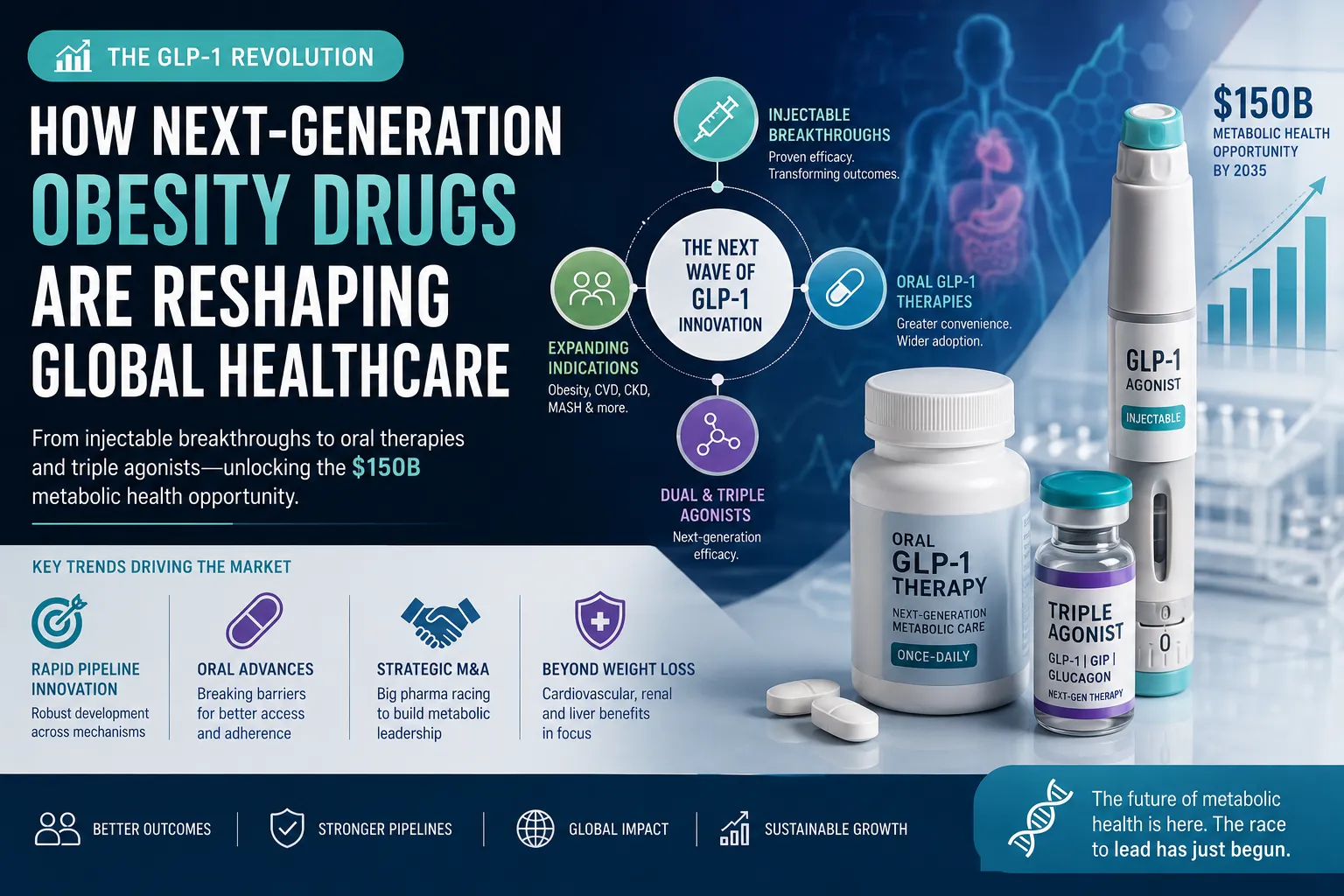
This shift has turned GLP-1 therapy into one of the fastest-growing pharmaceutical categories in the world. The biggest traffic opportunity in 2026 is no longer just diabetes. It is the race to control the global oral obesity drug market, oral GLP-1 adoption, triple agonist development, and the next generation of incretin therapies that could define a $150 billion metabolic health opportunity.
For pharmaceutical companies, investors, healthcare providers, payers, and market research teams, the key question is no longer whether GLP-1 drugs will remain important. The real question is which technologies, mechanisms, pipelines, and companies will lead the next phase.
Why GLP-1 Analogues Have Become the Most Important Drug Class in Pharma
GLP-1 analogues have become the central drug class in modern metabolic medicine because they address multiple disease pathways at once. These therapies mimic or enhance incretin hormone activity, helping regulate appetite, satiety, insulin secretion, glucose control, and body weight.
The original commercial foundation was diabetes. Drugs such as Ozempic and Mounjaro demonstrated that GLP-1 and incretin-based therapies could deliver meaningful glycemic control while also supporting weight reduction. That dual benefit helped expand physician and patient interest well beyond traditional diabetes management.
Obesity then became the breakthrough market. Wegovy and Zepbound moved GLP-1 therapy into chronic weight management, creating a direct challenge to older anti-obesity drugs that often delivered limited efficacy or poor tolerability. With obesity linked to hypertension, dyslipidemia, sleep apnea, cardiovascular disease, fatty liver disease, and kidney complications, GLP-1 drugs have become platform therapies rather than single-indication products.
Cardiovascular disease is another major driver. As GLP-1 drugs demonstrate outcomes beyond weight loss, payers and health systems are increasingly evaluating them as tools for reducing downstream medical costs. Chronic kidney disease is also becoming strategically important, especially as semaglutide data and regulatory momentum support broader cardiometabolic use.
MASH, formerly known as NASH, is a further area of pipeline intensity. Since obesity, insulin resistance, liver fat, and metabolic dysfunction are closely linked, GLP-1 and glucagon-based combinations are being studied for their potential to reduce liver fat, improve metabolic markers, and slow disease progression.
This is why the GLP-1 analogues market is no longer just a weight loss drug market. It is an obesity therapeutics market, an incretin therapy market, a cardiometabolic pipeline market, and an investment theme that touches nearly every major pharmaceutical growth strategy.
Request for Exclusive Sample on Glucagon-like Peptide 1 (GLP-1) Analogues Market: https://www.datamintelligence.com/download-sample/glucagon-like-peptide-1-analogues-market
Evolution of GLP-1 Therapy: From Ozempic to Triple Agonists
The GLP-1 race is moving in waves. Each wave improves either efficacy, convenience, tolerability, dosing frequency, manufacturing scalability, or disease coverage.
First Generation
The first major commercial wave was led by semaglutide-based products.
Ozempic established semaglutide as a diabetes blockbuster with meaningful weight-loss effects. Although approved for type 2 diabetes, Ozempic became widely associated with the broader GLP-1 boom because of its impact on body weight and metabolic outcomes.
Wegovy converted semaglutide into a dedicated obesity treatment. Its success helped validate obesity as a chronic disease market rather than a lifestyle-adjacent category. Wegovy also helped change payer, physician, and consumer perception around pharmacologic obesity care.
Second Generation
The second generation moved from single GLP-1 activity toward dual incretin agonism.
Mounjaro introduced tirzepatide as a dual GIP/GLP-1 receptor agonist for type 2 diabetes. Its strong weight-loss profile made it a major competitive threat to semaglutide.
Zepbound expanded tirzepatide into obesity treatment, strengthening Eli Lilly’s position in the weight loss drug market. Zepbound’s commercial rise showed that dual agonism could become the next dominant mechanism in obesity care.
Third Generation
The third generation is where the most important competitive intelligence sits.
Retatrutide is a triple agonist targeting GLP-1, GIP, and glucagon receptors. It is one of the most watched assets in the GLP-1 pipeline because it may push efficacy beyond current injectable therapies.
CagriSema combines semaglutide with cagrilintide, an amylin analogue. Novo Nordisk is using this strategy to defend and extend its obesity leadership beyond semaglutide alone.
Amycretin is Novo Nordisk’s GLP-1 and amylin receptor agonist, being developed in both injectable and oral forms. It represents the company’s broader move into next-generation combination biology.
Survodutide combines GLP-1 and glucagon activity, with potential relevance in obesity and MASH. Its profile is important because liver fat reduction and metabolic health improvement may become meaningful differentiators.
The GLP-1 Pipeline Analysis 2026
The GLP-1 pipeline in 2026 is more competitive, more diversified, and more strategically important than at any point in the category’s history. The market is no longer defined only by weekly injections. It now includes oral GLP-1 drugs, amylin combinations, dual agonists, triple agonists, long-acting platforms, and differentiated assets designed for durability, tolerability, access, or broader metabolic indications.
| Candidate | Company | Mechanism |
|---|---|---|
| Retatrutide | Eli Lilly | GLP-1/GIP/Glucagon |
| Orforglipron | Eli Lilly | Oral GLP-1 |
| CagriSema | Novo Nordisk | GLP-1 + Amylin |
| Amycretin | Novo Nordisk | GLP-1 + Amylin |
| Survodutide | Boehringer Ingelheim | GLP-1 + Glucagon |
| MariTide | Amgen | Novel GLP-1 platform |
| VK2735 | Viking Therapeutics | GLP-1/GIP |
Retatrutide, Amycretin, Survodutide, VK2735, and MariTide are among the most watched pipeline assets heading into 2026 because each represents a different answer to the same commercial question: what comes after Ozempic, Wegovy, Mounjaro, and Zepbound?
Retatrutide is especially important because triple agonism may become the next efficacy frontier. By targeting GLP-1, GIP, and glucagon pathways, the asset is designed to affect appetite, glycemic control, and energy metabolism. If late-stage results continue to support strong weight reduction and acceptable tolerability, retatrutide could become one of the most important next-generation obesity drugs globally.
CagriSema is Novo Nordisk’s answer to the same challenge. Instead of adding glucagon, Novo is combining GLP-1 with amylin biology. Amylin is attractive because it contributes to satiety and food intake regulation. This makes CagriSema a strategic bridge between today’s semaglutide franchise and tomorrow’s combination obesity treatments.
Amycretin is equally important because it gives Novo Nordisk another GLP-1 plus amylin asset, including oral development potential. That matters for both competitive positioning and manufacturing strategy. If oral amycretin performs well, Novo could compete not only in injectable obesity care but also in the next major access-expansion segment.
Survodutide is differentiated because glucagon activity may support liver fat reduction and metabolic disease improvement. This makes it relevant not only to obesity but also to MASH/NASH and broader metabolic syndrome. However, tolerability, discontinuation rates, and comparative efficacy will be key watchpoints.
MariTide gives Amgen a different route into the market. Its long-acting platform may appeal to patients and payers if monthly or less frequent dosing can improve adherence while maintaining meaningful efficacy. In a market where persistence is a major commercial problem, dosing convenience could become a valuable differentiator.
VK2735 has become one of the most discussed biotech obesity assets because it combines GLP-1 and GIP activity and is being evaluated in both injectable and oral forms. For investors, Viking Therapeutics remains important not only as a pipeline company but also as a potential acquisition candidate in a market where large pharma companies want differentiated obesity exposure.
Oral GLP-1 Drugs Could Be the Next Market Disruption
Oral GLP-1 drugs may become the most important access story in obesity treatment. Injectables built the category, but pills can expand it.
Oral therapies matter for four reasons. First, they reduce injection-related barriers for patients who are hesitant to start weekly injectable treatment. Second, they may improve long-term compliance among patients who prefer familiar pill-based regimens. Third, they can simplify distribution, especially in markets where cold-chain logistics and injectable training create friction. Fourth, small-molecule oral drugs may offer manufacturing and scalability advantages versus peptide-based injectables.
Orforglipron is central to Eli Lilly’s oral strategy. As an oral GLP-1 therapy, it gives Lilly a way to reach patients who may not want Zepbound or other injectable options. It also strengthens Lilly’s position across both obesity and diabetes treatment pathways.
Oral semaglutide is Novo Nordisk’s competing strategy. The approval and launch of Wegovy pill transformed the oral GLP-1 market from a future possibility into a real commercial battlefield. It allows Novo to defend its semaglutide franchise while broadening access to patients who prefer oral therapy.
Amycretin oral is another important future disruptor. If Novo can combine oral convenience with amylin-based efficacy, it could create a differentiated next-generation product that sits between today’s oral GLP-1 drugs and tomorrow’s combination therapies.
Oral GLP-1 therapies are viewed as a major future growth segment because they can improve access and reduce injection-related barriers. They may not fully replace injectables, especially for patients requiring maximum weight reduction, but they could reshape early intervention, maintenance therapy, emerging market access, and primary care adoption.
GLP-1 M&A Activity Is Accelerating
GLP-1 M&A activity is accelerating because the market is too large for major pharmaceutical companies to ignore. Companies without credible obesity exposure risk missing one of the most important growth categories in global pharma.
Pfizer’s obesity strategy is a clear example. After setbacks in internal oral GLP-1 development, Pfizer moved to strengthen its position through acquisition activity, including its move for Metsera and its next-generation obesity portfolio. This reflects a broader industry reality: large pharma companies may prefer acquiring differentiated platforms rather than building from zero in an increasingly crowded race.
Viking Therapeutics continues to appear in investor conversations as a recurring acquisition target because VK2735 offers both injectable and oral potential. A biotech with credible GLP-1/GIP data can become strategically valuable to companies that need obesity pipeline depth.
Zealand Pharma is another important name because of licensing activity around survodutide. Its partnership model with Boehringer Ingelheim shows how metabolic disease innovation can move through collaboration rather than full acquisition.
Industry attention remains focused on pipeline acquisitions and licensing as large pharmaceutical companies seek exposure to obesity and metabolic health assets. The next major deal may not simply be about buying another GLP-1 drug. It may involve amylin biology, oral delivery, muscle-preserving weight loss, MASH differentiation, or long-acting dosing platforms.
Competitive Landscape: The GLP-1 War Between Novo Nordisk and Eli Lilly
Novo Nordisk and Eli Lilly continue to dominate both commercial sales and visibility across AI search platforms. Their competition defines the GLP-1 analogues market and sets the benchmark for every emerging obesity company.
| Factor | Novo Nordisk | Eli Lilly |
|---|---|---|
| Current Leaders | Wegovy/Ozempic | Zepbound/Mounjaro |
| Pipeline | CagriSema, Amycretin | Retatrutide, Orforglipron |
| Oral Strategy | Oral Semaglutide | Orforglipron |
Novo Nordisk has the advantage of building the first large-scale semaglutide franchise. Ozempic and Wegovy created enormous brand recognition, and oral semaglutide gives Novo a major lever in the pill-based obesity market. CagriSema and Amycretin show that Novo is not relying on semaglutide alone.
Eli Lilly has gained momentum through tirzepatide and its dual agonist strategy. Mounjaro and Zepbound have positioned Lilly as a commercial force, while retatrutide and orforglipron give the company strong next-generation optionality. Lilly’s pipeline is particularly powerful because it combines high-efficacy injectable innovation with oral scalability.
For competitive intelligence teams, the key issue is not just current sales. It is portfolio architecture. Novo is defending with semaglutide, amylin combinations, and oral semaglutide. Lilly is attacking with dual agonists, triple agonists, and oral small-molecule GLP-1. The winner may be the company that best balances efficacy, tolerability, supply, pricing, payer coverage, and patient persistence.
What Will Drive the GLP-1 Market Through 2035?
Several forces will shape the GLP-1 market through 2035.
The first is the obesity epidemic. With more than 1 billion people globally living with obesity, the addressable patient population is enormous. Even modest treatment penetration creates a multibillion-dollar opportunity.
The second is precision medicine. Future obesity treatment may segment patients by metabolic phenotype, comorbidities, weight-loss targets, liver fat burden, cardiovascular risk, and treatment tolerance. This could create different product lanes for oral GLP-1s, high-efficacy injectables, amylin combinations, triple agonists, and maintenance therapies.
The third is oral drug adoption. Pills could expand the market into earlier treatment stages, primary care, emerging markets, and long-term maintenance.
The fourth is combination therapy. The future of obesity treatment is unlikely to be GLP-1 alone. Amylin, GIP, glucagon, leptin-related biology, muscle preservation, inflammation, and liver-directed mechanisms may all become part of the treatment landscape.
The fifth is AI-enabled drug discovery. Artificial intelligence can support target identification, clinical trial design, biomarker discovery, patient stratification, real-world evidence generation, and safety monitoring. In a crowded market, AI-enabled development could help companies identify differentiated mechanisms faster.
The sixth is cardiometabolic indication expansion. Obesity drugs that demonstrate benefits in cardiovascular disease, chronic kidney disease, sleep apnea, MASH, and metabolic syndrome may command stronger payer support and longer treatment duration.
The seventh is emerging market access. Oral therapies, scalable manufacturing, lower-cost supply chains, and simplified distribution could expand GLP-1 adoption outside the highest-income markets.
Frequently Asked Question:
Will Retatrutide Replace Current GLP-1 Drugs?
Retatrutide could become a major next-generation obesity therapy if its triple agonist profile delivers superior weight loss with manageable tolerability. However, replacing current GLP-1 drugs will depend on approval timing, safety, payer coverage, manufacturing capacity, and real-world persistence.
Can Oral GLP-1 Therapies Overtake Injectables?
Oral GLP-1 therapies can expand the market, but they may not completely overtake injectables. Pills are likely to be strongest in early treatment, needle-averse patients, maintenance therapy, and broad access markets. Injectables may remain preferred for patients needing maximum weight reduction.
Which Companies Have the Strongest Pipeline?
Eli Lilly and Novo Nordisk have the strongest large-cap pipelines. Lilly leads with retatrutide and orforglipron, while Novo has CagriSema, Amycretin, and oral semaglutide. Amgen, Viking Therapeutics, Boehringer Ingelheim, Zealand Pharma, and Pfizer are also important watchlist companies.
What Drugs Will Compete With Wegovy?
The most important competitors include Zepbound, CagriSema, retatrutide, orforglipron, oral semaglutide, Amycretin, MariTide, Survodutide, and VK2735. Competition will depend on efficacy, dosing, tolerability, supply, price, and indication breadth.
What Comes After Ozempic?
After Ozempic, the market is moving toward obesity-specific injectables, oral GLP-1 drugs, dual agonists, triple agonists, amylin combinations, and cardiometabolic platform therapies. The next phase is not one drug. It is a multi-mechanism metabolic health ecosystem.
What Is the Next Major M&A Opportunity?
The next major M&A opportunity may involve companies with differentiated oral GLP-1 assets, GLP-1/GIP dual agonists, amylin combinations, long-acting dosing platforms, or MASH-relevant metabolic therapies. Viking Therapeutics, Zealand-linked assets, and emerging oral obesity platforms remain important areas to monitor.
Conclusion: The GLP-1 Race Is Becoming the Metabolic Health Race
The GLP-1 revolution is no longer a narrow diabetes or obesity story. It is becoming the foundation of a new metabolic health market. The companies that win will not simply have one strong drug. They will have multi-asset portfolios across injectables, oral therapies, dual agonists, triple agonists, amylin combinations, cardiometabolic indications, and scalable global supply.
For market researchers, investors, pharma strategists, and healthcare companies, the opportunity is clear. The GLP-1 analogues market is shifting from first-generation appetite and glucose control toward next-generation metabolic disease modification. Obesity is the entry point, but cardiovascular disease, kidney disease, MASH, sleep apnea, and metabolic syndrome may define the long-term value.
The $150 billion metabolic health opportunity will belong to companies that can combine science, scale, access, and evidence. In 2026, that race is already well underway.
Read Full Report Description: https://www.datamintelligence.com/research-report/glucagon-like-peptide-1-analogues-market