


The first edge AI sale is easy to see.
A factory buys an industrial computer. A retailer installs intelligent cameras. A warehouse adds AI gateways. A robot manufacturer chooses an accelerator. A hospital installs an AI-enabled device.
The second sale is less visible-and it can continue for years.
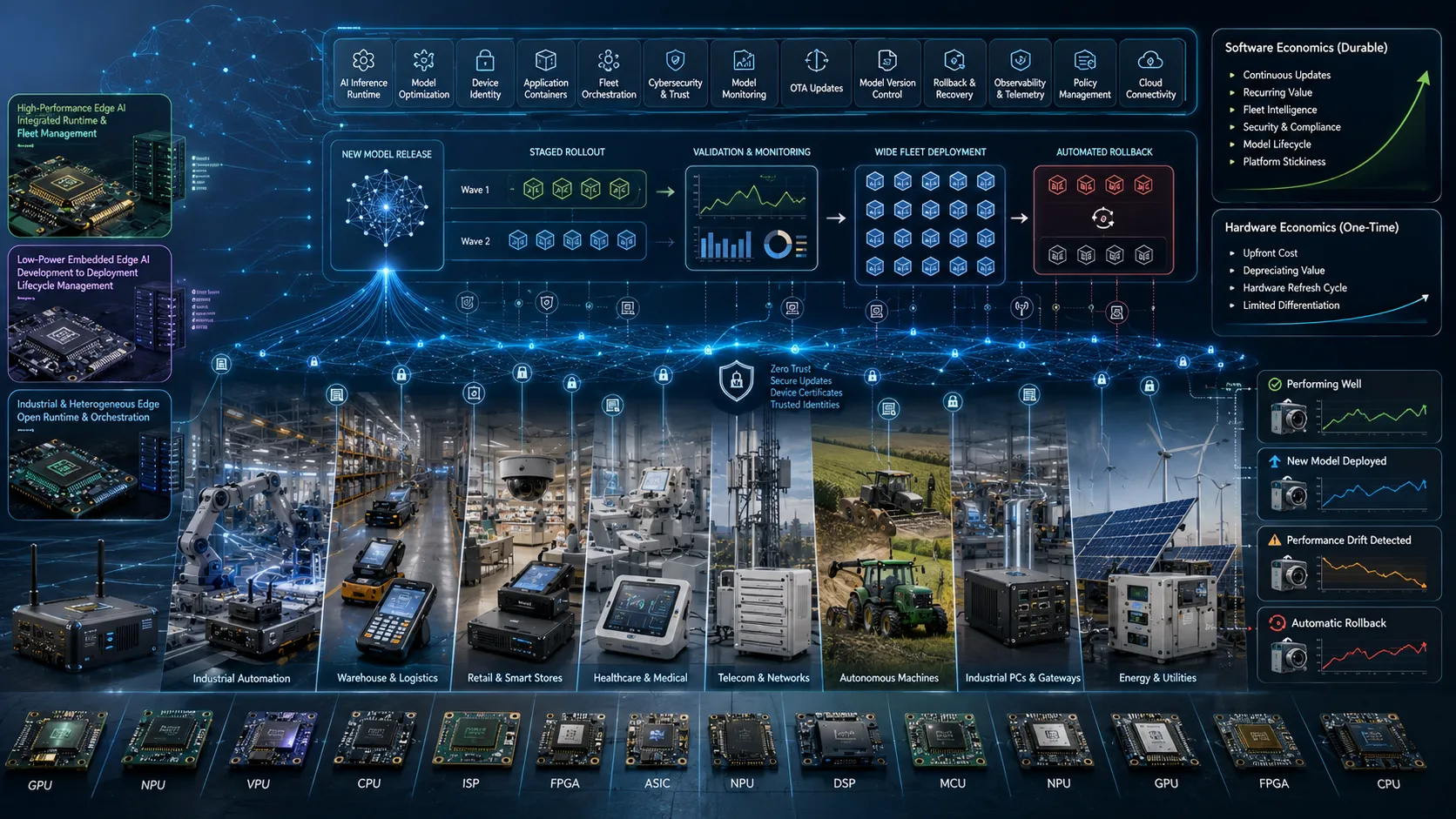
Someone has to deploy the models, monitor whether they still work, secure every device, replace failed software, distribute new model versions, roll back bad updates and keep thousands of remote systems running.
That is where the economics of edge AI are starting to change.
DataM Intelligence values the global Edge AI Market at US$24.90 billion in 2025 and projects it to reach US$177.46 billion by 2035, with a 21.7% CAGR during 2026-2035. More important than the headline growth rate is what customers are buying: the market is moving from isolated AI pilots toward repeatable deployment stacks combining hardware, inference software, orchestration and managed operations.
DataM Intelligence expects runtime and middleware to become one of the most durable commercial layers in edge AI because the operational relationship continues long after the accelerator has been installed.
The chip runs the model.
The software keeps the fleet alive.
Request For Exclusive Sample: https://www.datamintelligence.com/download-sample/edge-ai-market
Edge AI Has an Operations Problem
Running one AI model on one device is becoming easier.
Running the correct model on 20,000 devices across factories, stores, vehicles or hospitals is a different problem.
An enterprise needs to know:
Which model version is running?
Was the latest security update installed?
Did model accuracy change after an environmental shift?
Which devices failed an update?
Can the software roll back automatically?
Is a device still authorized to access company systems?
Can a new model run on older hardware?
Can one application be changed without taking the whole edge system offline?
Those questions are not mainly semiconductor questions.
They are runtime, middleware and fleet-management questions.
NIST's AI Risk Management Framework explicitly recommends monitoring AI systems and comparing pre- and post-deployment performance. That requirement becomes operationally difficult when models are distributed across thousands of physical locations rather than running inside one centralized cloud environment.
This is the hidden cost of edge AI.
Moving inference away from the cloud does not eliminate operational complexity. It distributes that complexity across the physical world.
Why Edge Hardware Revenue Can Be Uneven
Edge hardware remains essential.
AI accelerators, CPUs, NPUs, gateways, cameras and industrial computers determine latency, energy use, memory capacity and what models can run locally.
But hardware is generally purchased around installation and refresh cycles.
A factory may expect an industrial computer to remain in service for years. A camera fleet may not be replaced every time a better AI model becomes available.
Software changes much more frequently.
During the life of the same physical device, an operator might update the model several times, add another application, change a security policy, patch the operating system, adjust thresholds or move to a new cloud service.
That creates a different commercial relationship.
DataM Intelligence's current Edge AI research identifies runtime subscriptions, device orchestration and managed services as an increasingly important part of pricing. Software renewal and support can continue annually even when the underlying device remains in service.
That does not mean software automatically generates better economics than hardware.
It means the opportunity to charge for value can continue throughout the life of the deployed fleet.
NVIDIA Is Already Selling More Than the GPU
NVIDIA provides a useful example because its edge strategy no longer ends with Jetson or another accelerator.
NVIDIA Fleet Command is a cloud service designed to provision edge infrastructure, deploy AI applications, monitor systems and manage software across distributed locations. NVIDIA says the platform can manage AI deployments from relatively small installations to very large distributed fleets.
The commercial model is important.
Fleet Command is sold as a subscription and includes NVIDIA Enterprise Support.
NVIDIA AI Enterprise creates another recurring software layer. NVIDIA describes it as a software platform spanning cloud, data center and edge environments, including frameworks, NIM microservices, drivers, Kubernetes operators and management software. Its published licensing guide includes annual subscription pricing, including a listed one-year subscription price of $4,500 per GPU for one licensing configuration.
The lesson is broader than NVIDIA.
A hardware company can sell compute once and then remain involved through deployment software, orchestration, support and future applications.
That can make the software ecosystem strategically important even when the accelerator generates the initial customer relationship.
Qualcomm's Acquisition Strategy Shows Where the Value Is Moving
Qualcomm may provide an even clearer signal.
The company has spent the past 18 months assembling technologies around the edge AI lifecycle rather than relying only on processors.
By January 2026, Qualcomm said its industrial and embedded IoT expansion incorporated technologies from acquisitions including Edge Impulse, Foundries.io, Arduino, FocusAI and Augentix.
Those companies solve different problems.
Edge Impulse helps developers create, optimize, deploy and monitor edge AI models.
Foundries.io adds software lifecycle and security capabilities.
Arduino expands developer access and prototyping.
Together with Qualcomm AI Hub and Dragonwing processors, Qualcomm now describes a path stretching from model development through production deployment and long-term lifecycle management.
Then Qualcomm moved further up the software stack.
In July 2026, it completed its acquisition of Modular, whose AI-native software platform includes technology intended to support generative and agentic AI across edge, device and data-center environments. Qualcomm said the acquisition advances its move toward a developer-first AI solutions company rather than a silicon-only supplier.
That acquisition pattern is one of the strongest signals in the edge AI market.
Qualcomm is effectively trying to own more of the journey between:
AI model → optimization → runtime → application → device → fleet → lifecycle.
If hardware performance alone were enough to secure the customer relationship, this software expansion would be much less important.
Edge Impulse Shows Why Model Deployment Becomes Sticky
Edge Impulse also illustrates a practical problem with edge AI.
Models must often be rebuilt or optimized differently depending on available memory, compute, operating system and accelerator.
Its platform can package models for multiple edge deployment targets and estimates latency, flash and RAM requirements before deployment.
Once a company builds its data pipelines, model optimization, deployment process and monitoring procedures around one environment, replacing that environment becomes more difficult than replacing an individual accelerator benchmark.
The switching cost comes from workflow.
An engineering team may have:
validated the software,
built CI/CD pipelines,
trained operators,
passed cybersecurity reviews,
documented model versions,
connected the system to business applications,
and established rollback procedures.
Those investments can make middleware strategically sticky.
The winning runtime may therefore become the operating standard for future AI applications inside the account.
Request for Customized Sample: https://www.datamintelligence.com/customize/edge-ai-market
Intel's Strategy Shows Another Model: Use Software to Protect Hardware Choice
Intel has taken a more open route.
OpenVINO is its inference and deployment toolkit for optimizing AI applications across Intel CPUs, GPUs and NPUs. Intel's Open Edge Platform adds libraries, microservices, Edge AI Suites and orchestration capabilities designed for production edge environments.
The platform includes functionality for onboarding and managing edge systems while orchestrating AI applications across sites and geographies.
Intel's approach highlights an important nuance in the software-value argument.
Open source software does not necessarily create direct subscription revenue.
It can instead make hardware easier to deploy, reduce developer friction and make customers more likely to remain on a compatible architecture.
For Intel, runtime software can therefore be valuable because it protects and expands silicon demand, even where the runtime itself is not the primary item on the invoice.
That is another way software can control value.
Independent Software Vendors Have an Opening
Chip vendors do not automatically win the middleware layer.
Large companies often operate heterogeneous fleets.
One factory may use NVIDIA systems for computer vision, Intel industrial PCs for another process and Qualcomm-based devices in connected equipment.
That creates an opening for software vendors that can sit above the hardware.
Red Hat Edge Manager is designed to manage device fleets throughout their lifecycle, including operating-system and configuration updates, workload management and fleet-wide observability. It is available through Red Hat Device Edge and Red Hat Enterprise Linux configurations.
Canonical is following a similar route.
Ubuntu Core 26, released in May 2026, focuses on secure, remotely managed edge infrastructure. Canonical says the release cuts OTA update sizes by as much as 90% and adds capabilities for attested workloads and fleet observability.
ZEDEDA is targeting an even more hardware-neutral position. Its current Edge Intelligence Platform combines infrastructure orchestration, AI inference and autonomous agents while supporting lifecycle management across heterogeneous edge hardware.
These platforms do not need to design the accelerator.
Their value comes from ensuring that the accelerator remains usable, secure and manageable after deployment.
Security Could Make Middleware Mandatory Rather Than Optional
There is another reason the lifecycle layer is becoming important: regulation.
The European Union's Cyber Resilience Act applies cybersecurity obligations across products with digital elements, including both hardware and software. The European Commission says products must be designed, updated and maintained with cybersecurity in mind throughout their lifecycle.
A particularly important date is approaching.
From September 11, 2026, manufacturers covered by the CRA begin facing reporting obligations for actively exploited vulnerabilities and severe security incidents.
For a company selling thousands of AI-connected devices into Europe, this creates a practical requirement to know:
where every device is,
what software is installed,
which version is vulnerable,
whether a patch succeeded,
and what happened after the update.
That is exactly the problem fleet-management middleware is built to solve.
Cybersecurity therefore turns software maintenance from an engineering convenience into part of product compliance and operational risk management.
The Real Product Is Becoming the Update Path
This may be the biggest change in edge AI procurement.
Buyers are no longer purchasing only today's model.
They are buying the ability to run tomorrow's model on today's installed device.
Consider an intelligent camera installed in 2026.
The camera may initially detect safety equipment.
Six months later, the customer may add anomaly detection.
Later, the vision model may be upgraded.
A language interface might then be added so operators can question local events.
A security patch may need urgent deployment.
Eventually, a new model may require different quantization to fit within the same hardware.
The physical camera has not changed.
The commercial value has.
Runtime and middleware control that evolution.
This is why DataM Intelligence expects the update path to become as important as the original hardware specification.
Edge Generative AI Makes the Problem Harder
Traditional edge AI often involved relatively stable computer-vision or sensor models.
Generative and agentic AI introduce faster software cycles.
Local language models can be updated frequently.
An edge agent may need new tools, permissions or knowledge.
Multiple models may need to work together.
Cloud agents may coordinate with local inference.
Intel's 2026 Open Edge Platform already includes hybrid applications where cloud orchestration interacts with edge agents.
Qualcomm likewise describes its current architecture as spanning AI from the device and edge through the data center.
As edge systems become more dynamic, lifecycle software gains more responsibility.
The endpoint stops behaving like an appliance.
It begins behaving like a continuously updated computing platform.
DataM Intelligence View: Who Is Best Positioned?
NVIDIA has the strongest integrated high-performance edge stack.
Its advantage comes from combining accelerators with CUDA, inference optimization, AI Enterprise and Fleet Command. This gives NVIDIA a path from hardware deployment into recurring software management and support.
Qualcomm is making the most aggressive strategic move toward owning the complete embedded AI lifecycle.
Edge Impulse, Foundries.io, Arduino and Modular extend Qualcomm well beyond the processor. The acquisition strategy suggests Qualcomm wants developers to stay inside its ecosystem from first prototype through production and fleet management.
Intel has a strong open-platform position.
OpenVINO and Open Edge Platform are designed to reduce deployment friction across Intel's hardware portfolio. Its biggest software opportunity may be less about standalone license revenue and more about making Intel silicon easier to standardize across industrial and enterprise edge deployments.
Independent software vendors could become the neutral control layer.
Red Hat, Canonical, ZEDEDA and other lifecycle-management specialists have an opportunity where enterprises refuse to standardize on one accelerator vendor.
That may become especially important in industrial edge environments where hardware lasts much longer than AI models.
Hardware Wins the Design. Software Can Own the Relationship.
The edge AI market will continue to need faster processors.
But compute performance alone does not guarantee long-term account control.
Once devices leave the laboratory, customers care about uptime, security, model accuracy, remote updates, auditability and whether the next AI application can be deployed without sending an engineer to every physical site.
Those requirements do not disappear after installation.
They become more important.
That is why the most durable edge AI revenue may eventually sit in the layer that customers rarely photograph:
the runtime that executes the model, the middleware connecting it to the business and the management platform keeping every device current.
The hardware wins the first design decision.
The software can own every decision that follows.
For deeper analysis of hardware, software, services, deployment locations, applications and regional opportunities, this trend connects directly with DataM Intelligence's Edge AI Market research.
Frequently Asked Questions
What is edge AI runtime software?
An edge AI runtime is the software environment that executes an AI model on a local processor or accelerator. It can handle hardware acceleration, memory use, model execution and communication with other applications.
What is edge AI middleware?
Middleware sits between the AI model, device operating system, cloud services and business applications. It can manage deployment, messaging, security, device identity, orchestration, monitoring and software updates.
Why could edge AI software create more durable revenue than hardware?
A device is usually purchased around an installation or replacement cycle, while deployed software requires continuing maintenance, monitoring, security updates and model changes. Subscription, support and managed-service relationships can therefore continue throughout the device's operating life.
How is NVIDIA positioned in edge AI software?
NVIDIA combines accelerated edge hardware with AI Enterprise and Fleet Command. Fleet Command provides cloud-based deployment, management and monitoring of distributed AI infrastructure and is offered through a subscription model.
Why did Qualcomm acquire Edge Impulse?
Qualcomm said the Edge Impulse acquisition strengthens its AI developer and IoT capabilities. Edge Impulse helps developers build, deploy and monitor AI models across edge devices and had more than 170,000 developers when Qualcomm announced the transaction.
What is Intel OpenVINO used for?
OpenVINO is Intel's toolkit for optimizing and deploying AI inference across Intel hardware, including CPUs, GPUs and NPUs. It is also a core element of Intel's broader Open Edge Platform.
Why is fleet management important for edge AI?
Distributed devices require remote monitoring, security patches, model updates and failure recovery. Fleet-management software allows administrators to manage these processes without visiting each physical device.
How does cybersecurity affect the edge AI software market?
Connected edge devices need vulnerability management and secure update processes. The EU Cyber Resilience Act strengthens lifecycle cybersecurity requirements for hardware and software products, increasing the importance of fleet visibility and patch management.
Will chip companies control the edge AI software layer?
Not necessarily. Chip companies such as NVIDIA, Qualcomm and Intel are building large software ecosystems, but hardware-neutral platforms such as Red Hat, Canonical and ZEDEDA can be attractive to enterprises operating devices from several semiconductor vendors.
What should investors watch in the edge AI market?
Useful indicators include software subscription attach rates, managed devices, model deployments, customer renewal rates, OTA update activity, platform acquisitions, cross-hardware support and whether semiconductor vendors begin disclosing software or services revenue tied specifically to edge deployments.
Read Complete Research Report: https://www.datamintelligence.com/research-report/edge-ai-market