


The Next AI Infrastructure Battle Is Moving From the Cloud to the Device
Generative AI has largely been built around a cloud-first economic model. A user sends a prompt to a remote data center, powerful accelerators process the request, and the result returns over a network. This architecture works well for large models, complex reasoning, and workloads that require current external information.
It also creates recurring inference costs, network dependency, response-time variability, and privacy concerns. When millions of users repeatedly request summarization, translation, transcription, or document assistance, the cloud provider or application developer continues paying for compute, bandwidth, and storage.
On-device large language models challenge that model by turning smartphones, AI PCs, vehicles, cameras, robots and industrial equipment into inference platforms. Once a capable device has been sold, some AI requests can be processed locally without consuming remote GPU capacity for every interaction.
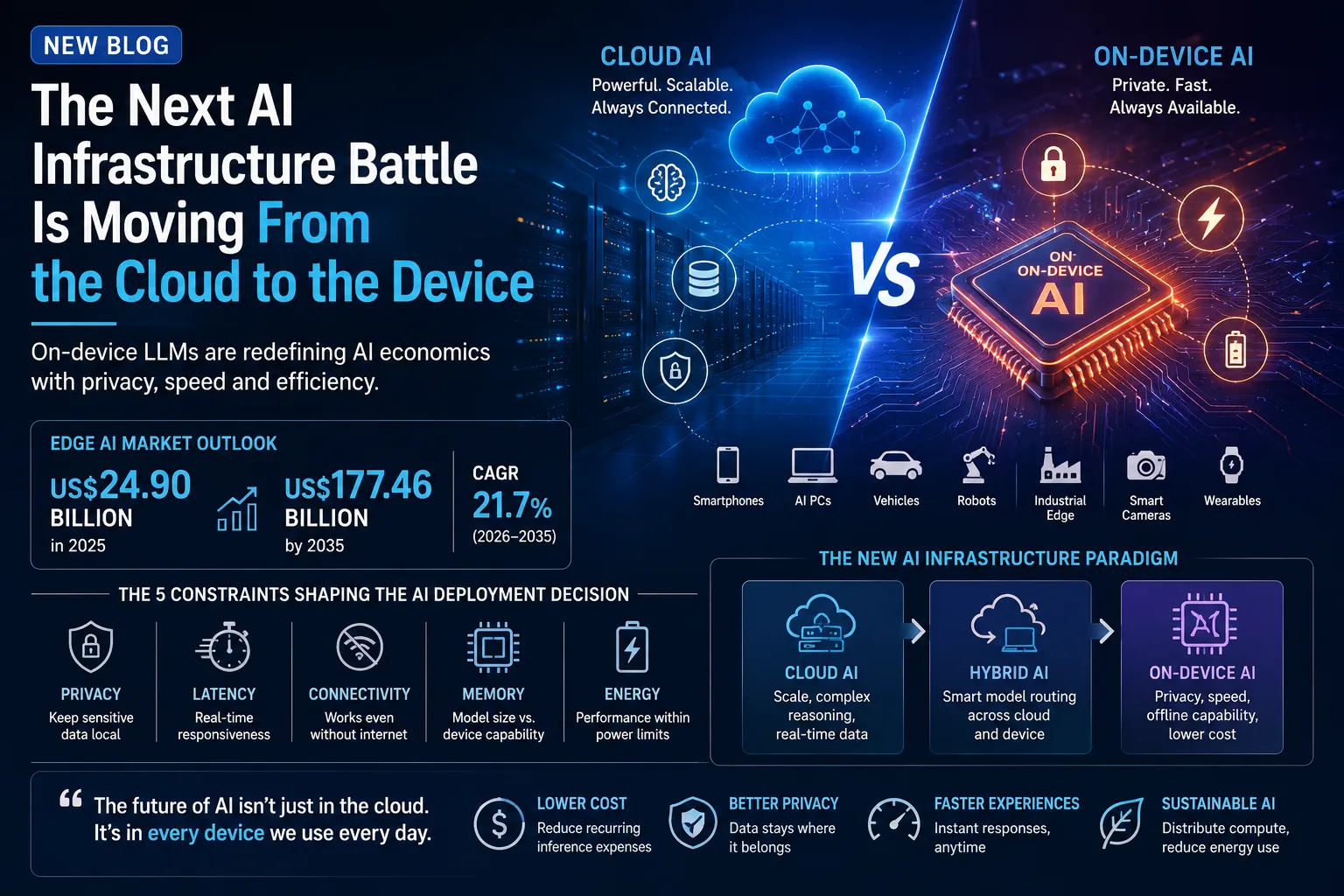
The shift will not eliminate cloud AI. It is creating a hybrid market in which each workload is placed according to five constraints:
Privacy + latency + connectivity + memory + energy
These constraints will determine which AI workloads move onto devices, which remain in data centers, and which operate across both environments.
DataM Intelligence estimates that the global edge AI market increased to US$24.90 billion in 2025 and could reach US$177.46 billion by 2035, expanding at a CAGR of 21.7% during 2026–2035. The forecast reflects demand across edge hardware, software, and services-not on-device LLMs alone.
Request for Exclusive Sample: https://www.datamintelligence.com/download-sample/edge-ai-market
What Is an On-Device LLM?
An on-device LLM is a language model that performs some or all inference directly on local hardware rather than sending every request to a remote cloud server.
The device may be a:
- Smartphone or tablet
- AI-enabled personal computer
- Vehicle infotainment or control platform
- Industrial computer
- Robot or autonomous machine
- Smart camera
- Medical device
- Wearable or augmented-reality system
On-device deployment does not necessarily mean the application never connects to the cloud. Many implementations use local models for immediate, private or routine tasks and invoke larger cloud models when the request exceeds local capabilities.
This produces three main deployment patterns.
| Architecture | Where inference occurs | Best suited to |
| Cloud-only AI | Remote data center | Large models, complex reasoning, live external data and compute-intensive generation |
| On-device AI | Local processor, GPU or NPU | Private, latency-sensitive, offline and repetitive tasks |
| Hybrid AI | Device and cloud | Applications requiring local responsiveness with optional access to larger models |
The commercial contest is therefore not “device versus cloud.” It is about which layer controls the user experience, model routing, developer tools and recurring revenue.
Why Cloud-Only AI Economics Are Being Challenged
Cloud inference converts every user interaction into an operating expense. The provider must allocate compute, memory, networking and power each time a model generates tokens.
That model is economically attractive when users pay subscriptions or when high-value tasks justify the cost. It becomes more difficult when AI is embedded into frequently used features that consumers expect to receive without a separate fee.
Examples include:
- Rewriting short messages
- Summarizing notifications
- Categorizing local documents
- Extracting information from receipts
- Generating suggested replies
- Providing offline transcription
- Translating conversations
- Searching files stored on a device
Sending every one of these requests to a data center can create substantial aggregate inference demand. On-device execution changes the cost structure because some compute is transferred to hardware already purchased and powered by the user or enterprise.
Cloud-only versus on-device economics
| Economic factor | Cloud-only inference | On-device inference |
| Compute cost | Recurs with every request | Primarily embedded in device cost |
| Bandwidth | Required for every interaction | Reduced for locally completed tasks |
| Capacity planning | Provider must provision infrastructure | Workload distributed across user devices |
| Response time | Influenced by network and server load | Influenced by local hardware |
| Data exposure | Information leaves the device | Sensitive data can remain local |
| Model size | Can support very large models | Constrained by memory and power |
| Updates | Centralized and immediate | Requires secure device deployment |
| Offline availability | Limited or unavailable | Possible for supported functions |
The cost advantage of local execution is not automatic. Device manufacturers must add capable NPUs, memory and software. Developers must compress, test and optimize models for multiple hardware platforms. Battery use and thermal limits can also reduce the frequency with which a model can run.
On-device AI is most economical when the workload is high-frequency, bounded, locally relevant and supported by hardware already present in the device.
Privacy Is a Strong Driver-but Not an Automatic Guarantee
Privacy-sensitive data is one of the clearest candidates for local processing. Personal messages, medical information, voice recordings, photographs, enterprise documents and location history can be processed without transmitting the raw content to an external server.
Apple’s foundation-model architecture demonstrates this direction. Its 2025 technical report describes an approximately 3-billion-parameter on-device model optimized for Apple silicon through techniques including KV-cache sharing and 2-bit quantization-aware training. Apple also maintains a larger server-side model, showing that its strategy is hybrid rather than device-only.
Local execution can reduce data movement, but it does not make an application inherently private. Privacy still depends on:
- What information the application stores
- Whether prompts or outputs are logged
- How model updates are delivered
- Whether third-party applications can access the model
- How permissions are enforced
- Whether telemetry leaves the device
- How local model data is protected from extraction
For regulated organizations, “runs locally” should be the beginning of a security assessment-not its conclusion.
Latency Makes Local AI Valuable in Real-Time Systems
A cloud model can respond quickly under favorable network conditions. It cannot guarantee that every request will complete within the same time window when connectivity, routing or server load changes.
For a user drafting an email, a short delay may be acceptable. For an industrial robot, vehicle or medical monitoring system, unpredictable delay can make a cloud-only design unsuitable.
Local inference is particularly valuable when an application must:
- Respond within milliseconds
- Interpret multiple sensor streams
- Control physical equipment
- Detect a safety condition
- Continue operating during network congestion
- Avoid uploading continuous video or audio
NVIDIA’s Jetson Thor illustrates the performance-oriented end of this market. The platform combines up to 128 GB of memory with a 40–130-watt power range and is designed to run generative and multimodal AI on robots and autonomous machines. NVIDIA states that Jetson Thor provides 7.5 times the AI compute and 3.5 times the energy efficiency of Jetson Orin. These are vendor-reported comparisons, but they demonstrate where the competitive target is moving: more model capability per watt at the point of action.
Connectivity Determines Whether Local AI Is Optional or Essential
Consistent cloud access cannot be assumed across factories, mines, farms, vehicles, ships, construction sites and remote energy infrastructure.
Even in connected environments, uploading continuous sensor or video data can be expensive and unnecessary. A local system can analyze raw inputs, discard irrelevant information, and transmit only an alert or structured result.
For example, a remote inspection camera does not need to send every video frame to the cloud if a local model can identify anomalies. A vehicle assistant can complete basic commands locally and contact the cloud only for current traffic, weather, or external knowledge.
Connectivity constraints make on-device AI valuable in four circumstances:
- The connection is unavailable.
- The connection is unreliable.
- The available bandwidth is expensive.
- Raw data should not leave the operating location.
The commercial result is increased demand for edge processors, embedded AI modules, optimization software and secure fleet-management platforms.
Memory Is the Defining Technical Constraint
LLMs require memory for model weights, activations and the key-value cache used during generation. The longer the context and larger the model, the more memory the device may need.
Smartphone s and embedded systems cannot allocate all available memory to one AI model. The operating system, applications, cameras, displays and communications functions must use the same device resources.
This makes model optimization commercially important. Common techniques include:
- Quantization: representing weights with fewer bits
- Pruning: removing parameters that contribute little
- Distillation: training a smaller model using a larger model
- Sparse activation: using only selected model components
- KV-cache optimization: reducing memory required for prior tokens
- Speculative decoding: generating and verifying multiple candidate tokens
A paper submitted in August 2026, EdgeXpert: An Edge Device for Memory-Efficient LLM Inference with Mixture-of-Experts and Speculative Decoding, addresses external memory access in feed-forward layers. Its proposed hardware-software design combines mixture-of-experts routing with speculative decoding. The authors report up to 56.3% lower latency and 44.1% lower energy use against prior works while maintaining near-baseline accuracy.
These are research results from a specific synthesized design, not measured performance across commercial consumer products. Their significance lies in the direction of innovation: future on-device LLM performance may depend as much on reducing memory movement as on increasing arithmetic throughput.
Energy Consumption Defines What Can Run Continuously
A model that runs once during a product demonstration may not be suitable for continuous deployment.
On a smartphone, heavy inference can drain the battery and create heat. In a vehicle, industrial camera or robot, additional power consumption affects system design, cooling, operating time, and total cost.
Energy efficiency must therefore be evaluated at the workload level.
Useful measures include:
- Energy consumed per generated token
- Tokens produced per second per watt
- Memory bandwidth required
- Device temperature under sustained use
- Battery impact per interaction
- Performance after thermal throttling
- Energy consumed while the model is idle
- Total system power, not only accelerator power
NPUs are becoming more important because they are designed to execute AI operations more efficiently than general-purpose processors for supported workloads. However, real applications may still distribute work across the CPU, GPU, and NPU. Software that schedules workloads efficiently can be as important as headline chip performance.
Which AI Workloads Are Most Likely to Move Onto Devices?
Not every AI workload requires a frontier model. Many high-volume tasks operate within a narrow context and can be handled by smaller, specialized models.
| Workload | Likely architecture | Reason |
| Message rewriting and suggested replies | On-device | Short context, high frequency and private content |
| Notification summarization | On-device | Personal data and bounded output |
| Offline transcription | On-device | Connectivity independence and privacy |
| Local document search | On-device or hybrid | Sensitive data with optional cloud reasoning |
| Real-time translation | On-device or hybrid | Low latency, with cloud escalation for difficult language |
| Voice commands | On-device | Immediate response and offline operation |
| Industrial anomaly detection | On-device/edge | Continuous sensor data and fast response |
| Robot perception and control | On-device/edge | Physical action cannot depend entirely on remote connectivity |
| Complex research synthesis | Cloud or hybrid | Large context, retrieval and stronger reasoning requirements |
| Large-scale code generation | Cloud or hybrid | Benefits from larger models and extensive context |
| Current news or market intelligence | Cloud or hybrid | Requires live external information |
| High-resolution media generation | Cloud or high-performance edge | Significant compute and memory requirements |
The first wave of migration will focus on bounded intelligence: tasks that do not require the model to know everything, but require it to respond quickly, privately, and repeatedly.
Request for Exclusive Sample: https://www.datamintelligence.com/download-sample/edge-ai-market
Qualcomm, Apple, NVIDIA and Intel Are Competing for Different Edge AI Positions
| Company | Strategic position | Primary advantage | Key constraint |
| Qualcomm | Smartphones, AI PCs, vehicles and embedded devices | Low-power heterogeneous compute and broad device reach | Fragmented OEM and software deployment |
| Apple | Integrated consumer-device ecosystem | Control of silicon, operating systems, models and user experience | Primarily limited to Apple platforms |
| NVIDIA | Robotics, physical AI and high-performance edge systems | Accelerated compute and mature developer stack | Higher power and cost than mobile-class devices |
| Intel | AI PCs, industrial computers and enterprise edge | CPU installed base, NPU integration and OpenVINO | Must maintain performance portability across hardware generations |
Qualcomm: taking on-device AI beyond flagship devices
Qualcomm is positioning Snapdragon and Dragonwing platforms across smartphones, PCs, vehicles and industrial equipment. The company’s Snapdragon 7 Gen 4 supports generative assistants and selected LLMs directly on the device, indicating that local generative AI is moving below the most expensive flagship tier.
Its competitive advantage comes from combining CPU, GPU, NPU, and connectivity. The challenge is providing developers with a consistent deployment path across many manufacturers and device configurations.
Apple: controlling the complete on-device stack
Apple controls the processor, operating system, model architecture, privacy framework, and application environment. This allows it to optimize a relatively compact model around defined device functions rather than competing solely on general benchmark rankings.
Apple’s use of both on-device and server models is also strategically important. It shows that an integrated device company does not need to choose one architecture. It can route tasks according to complexity, privacy, and resource availability.
NVIDIA: bringing generative AI into machines
NVIDIA’s strongest on-device position is not the smartphone. It is the high-performance edge: robots, autonomous machines, medical systems and industrial platforms.
Jetson links hardware with CUDA, TensorRT, Isaac, Metropolis and other development environments. This full-stack approach reduces the engineering work required to move from model development to a deployed machine.
Intel: making local AI portable across PCs and industrial systems
Intel’s OpenVINO platform is designed to optimize and deploy models across CPUs, GPUs, and NPUs. OpenVINO 2025.3 added NPU support for models including Qwen3 variants and expanded generative AI coverage.
Intel’s opportunity lies in the installed base of PCs and industrial computers. Its execution challenge is helping developers obtain predictable performance across multiple processor classes without extensive model rework.
On-Device LLMs Will Not Eliminate the Cloud
The cloud remains better suited to training, frontier-scale reasoning, large-context processing, centralized model governance, and workloads requiring current external information.
On-device AI is likely to change the cloud’s role rather than remove it.
The emerging hybrid model
- Cloud: training, complex reasoning, enterprise retrieval and large-scale generation
- Device: private context, immediate interaction and offline operation
- Edge gateway: site-level coordination across cameras, machines or sensors
- Cloud control plane: model distribution, monitoring, policy and fleet management
Cloud providers can continue capturing value through model training, developer services, orchestration and secure updates even when some inference occurs locally. Chip vendors may gain influence by controlling model optimization and runtime environments.
The most important competitive layer may ultimately be the routing system that decides whether each request runs locally, at an enterprise edge location or in a public cloud.
What Buyers Should Evaluate Before Deploying On-Device LLMs
Technology buyers should ask:
- What business or operational problem requires local inference?
- What response time must the application achieve?
- Which data cannot leave the device or site?
- Can the application continue operating without connectivity?
- How much memory is available after other device functions are considered?
- What is the energy cost under sustained use?
- How much accuracy is lost through quantization or compression?
- Can the model be updated, monitored and rolled back securely?
- Which CPU, GPU and NPU platforms are supported?
- When will the application escalate a request to the cloud?
- What happens when the device reaches thermal or memory limits?
- How will local model behavior be audited across a large fleet?
A successful edge AI deployment is not simply a model that runs on a device. It is a system that remains accurate, secure, supportable and economical throughout the device lifecycle.
Frequently Asked Questions About On-Device LLMs
Why are LLMs moving onto devices?
LLMs are moving onto devices to reduce latency, protect sensitive data, support offline operation and lower recurring cloud-inference demand. The shift is strongest for frequent, bounded tasks such as summarization, transcription, translation and local search.
Are on-device LLMs cheaper than cloud AI?
They can be cheaper for frequent workloads running on hardware that has already been deployed. Total cost must still include more capable chips, memory, software optimization, model maintenance, battery consumption and device management.
What limits the size of an on-device LLM?
Memory capacity, memory bandwidth, energy use and thermal limits constrain model size. Quantization, pruning, distillation, sparse activation and cache optimization allow models to operate within tighter device resources.
Are on-device LLMs more private?
On-device models can improve privacy by keeping raw data local, but privacy is not automatic. Applications must still control storage, permissions, telemetry, model access and security updates.
Can on-device LLMs work without the internet?
Yes, if the required model, data and software are stored locally. Tasks requiring current information, remote databases or large cloud models will still need connectivity.
Will on-device AI replace cloud computing?
No. On-device inference will complement cloud AI. The likely architecture is hybrid, with routine and sensitive requests handled locally and complex requests sent to larger remote models.
Which industries will adopt on-device LLMs first?
Consumer electronics, automotive, manufacturing, robotics, healthcare, retail, telecommunications, and public safety are strong candidates. Adoption will be fastest where privacy, response time, or network resilience creates measurable operational value.
What is the edge AI market size?
DataM Intelligence values the edge AI market at US$24.90 billion in 2025 and projects it to reach US$177.46 billion by 2035. The forecast represents a 21.7% CAGR during 2026–2035 and includes hardware, software, and services.
Outlook: Hybrid AI Will Become the Default Architecture
On-device LLMs are challenging the assumption that every useful AI request must become a metered cloud transaction. The strongest device-side opportunities are not unlimited general intelligence. They are private, repetitive, context-specific, and latency-sensitive workloads that can operate within predictable memory and energy limits.
The long-term winners will solve more than chip performance. They will combine:
Efficient models + capable accelerators + memory optimization + secure runtimes + device management + intelligent cloud routing
Qualcomm is positioned across mobile and embedded platforms. Apple benefits from controlling the device stack. NVIDIA leads high-performance physical AI, while Intel can use its PC and industrial footprint to expand local inference.
Cloud platforms will remain essential, but cloud-only architectures will lose their default status. The market is moving toward AI systems that decide dynamically where each task should run.
DataM Intelligence’s Edge AI Market report examines the hardware, software, deployment, application, regional, and competitive dynamics shaping this transition through 2035.