


Orthodontics is moving from physical molds and manually adjusted appliances toward connected digital workflows. A dentist can now scan a patient’s teeth, simulate how they should move and order customized aligners or braces using a digital treatment plan. As this process becomes faster and more accessible, the digital orthodontics market is creating opportunities across imaging, software, materials and manufacturing.
What Is Digital Orthodontics and How Does It Work?
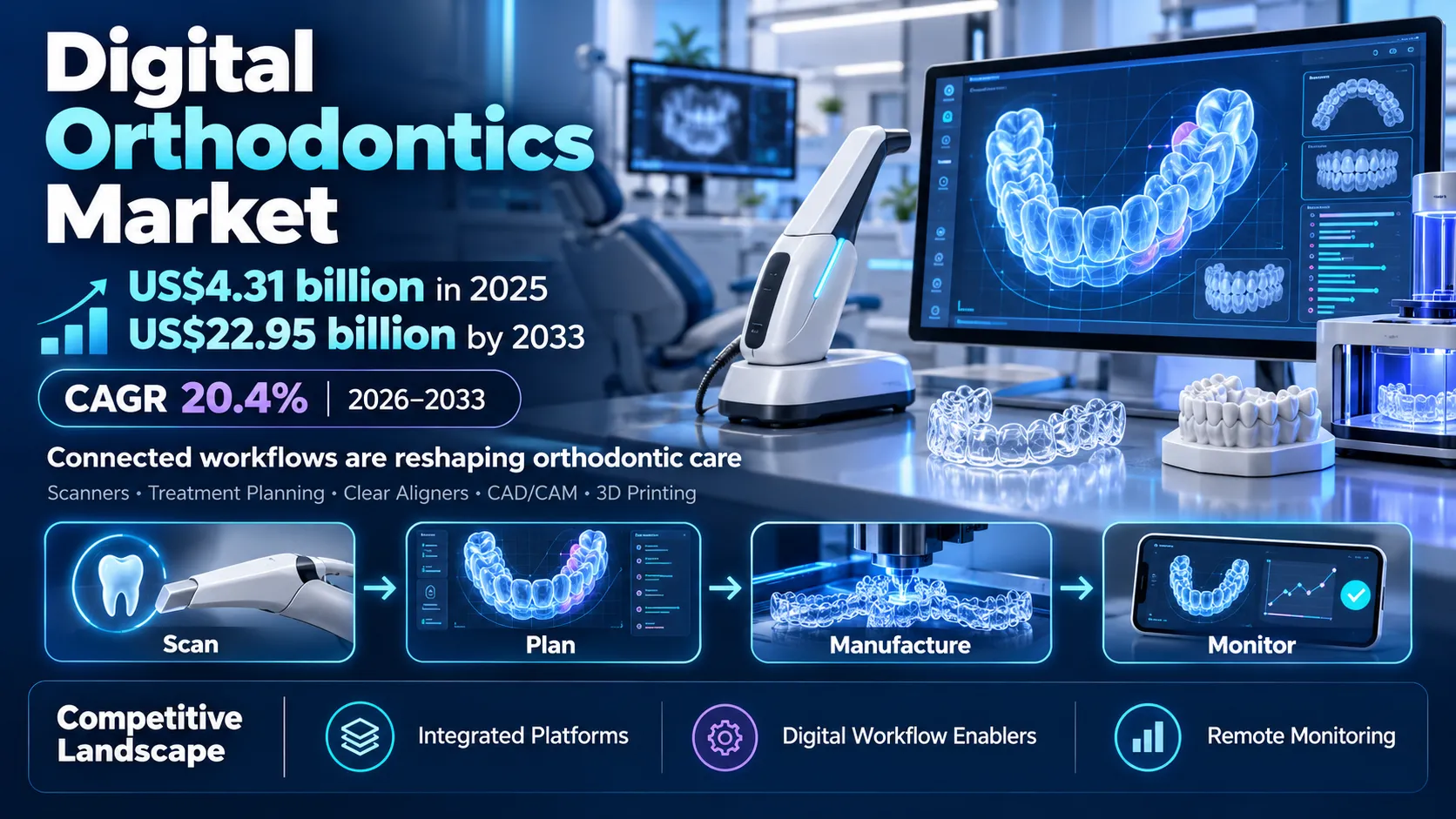
Digital orthodontics uses 3D scanning and computer software to plan, manufacture and monitor treatments that straighten teeth or correct bite alignment. Think of it as replacing a plaster model of someone’s teeth with a precise, editable digital model.
The process often starts with an intraoral scanner, a handheld camera that captures thousands of images inside the mouth to build a three-dimensional model. In some cases, X-rays or cone-beam CT add information about tooth roots and bone. Treatment-planning software then allows an orthodontist to map tooth movements, review the proposed result and make clinical adjustments. Computer-aided design and manufacturing (CAD/CAM) turns that plan into custom appliances.
For clear aligners, software creates a sequence of tooth positions. Manufacturing systems produce a series of transparent trays intended to move the teeth gradually. Digital workflows can also support customized brackets, retainers, and other orthodontic devices. Throughout treatment, scans and patient photographs can help clinicians check progress, although a digital simulation is never a guarantee of the final clinical outcome.
DataM Intelligence values the global digital orthodontics market at US$4.31 billion in 2025, forecasting US$22.95 billion by 2033 at a 20.4% CAGR.
Request Exclusive Sample: https://www.datamintelligence.com/download-sample/digital-orthodontics-market
Major Growth Opportunities in the Market
1. Clear aligners and broader patient access
Aesthetic preferences and demand for removable appliances support digital aligner adoption among adults and teenagers. Providers have opportunities to reach general dental practices, emerging markets and patients who previously postponed treatment. Clinician-led case selection remains important for more complex movements.
2. Intraoral scanners as the entry point
Scanners increasingly connect examination, patient communication, case submission and appliance production. Providers can compete through accuracy, speed, lower total ownership cost and compatibility with multiple treatment systems. Scanner installations also create recurring opportunities in software and service subscriptions.
3. Digital planning and remote monitoring
Software for tooth-movement staging, treatment visualization and case tracking can reduce administrative work and help orthodontists identify problems earlier. AI-assisted suggestions may improve workflow efficiency, but clinicians still need to approve treatment plans and assess patient safety.
4. In-office and laboratory 3D printing
Dental laboratories and larger practices are adopting 3D printing for dental models, retainers, indirect bonding trays and selected appliances. Growth depends on validated materials, printing consistency, post-processing and regulatory compliance. The commercial opportunity extends to printers, resins, design tools and outsourced production services.
5. Integrated solutions for growing clinic networks
Multi-location dental groups want repeatable workflows, predictable delivery and consistent clinical records. Connected scanners, practice software, treatment planning and manufacturing services could become more valuable than individual devices sold separately. Companies able to train clinicians and support implementation may gain an advantage.
Where Is the Market Headed Through 2035?
The next decade should bring three connected shifts. First, standalone scanning and aligner services will move toward integrated digital ecosystems. Second, orthodontic workflows will become more customized through better imaging, planning software and manufacturing. Third, providers will face increasing pressure to prove clinical outcomes, data security and cost effectiveness alongside convenience.
North America should remain an important established market while Asia-Pacific provides expansion opportunities as digital dentistry investments, private clinics and patient awareness increase. Adoption will nevertheless differ by reimbursement, household affordability, clinical training and regulatory requirements. DataM’s published forecast ends in 2033, so the 2035 outlook here is directional rather than an additional quantified market forecast.
10 Major Companies Shaping the Competitive Landscape
- Align Technology. Combines Invisalign clear aligners, iTero scanners and exocad design software in a connected orthodontic workflow.
- Straumann Group. Offers ClearCorrect aligners and digital dentistry solutions with distribution through dental professionals.
- Envista Holdings (Ormco). Provides Spark clear aligners, Damon orthodontic systems and digital treatment solutions.
- Dentsply Sirona. Supplies digital impressions, imaging and orthodontic products, including SureSmile treatment workflows.
- 3Shape. Specializes in TRIOS intraoral scanners and software connecting clinics with orthodontic laboratories.
- Angelalign Technology. Develops clear aligner systems, treatment-planning tools and clinical offerings across international markets.
- Planmeca. Provides intraoral scanning, imaging and digital dental software used in orthodontic diagnosis and planning.
- Medit. Supplies intraoral scanners and digital workflows that support orthodontic planning and laboratory collaboration.
- Carestream Dental. Offers imaging and intraoral scanning systems that supply diagnostic data for digital orthodontics.
- Stratasys. Provides additive-manufacturing technologies used by dental laboratories and aligner production operations.
- Other participants include FORESTADENT, Solventum (3M Oral Care), DentalMonitoring, uLab Systems, LightForce Orthodontics, Graphy, SHINING 3D and Henry Schein Orthodontics.
Competition increasingly centers on scanner-to-software interoperability, clinical evidence, AI-assisted planning, treatment predictability, manufacturing scale, clinician training and the lifetime cost of digital workflows. Companies with integrated platforms face specialist competitors offering open systems or focused technologies.
Request Exclusive Sample: https://www.datamintelligence.com/download-sample/digital-orthodontics-market
The Bigger Opportunity
Digital orthodontics is evolving from a better way to take impressions into a connected system for planning and delivering treatment. Over the next decade, the strongest opportunities will emerge where digital tools give clinicians greater control, reduce avoidable remakes and deliver measurable improvements in the patient experience. The market’s direction will depend as much on trusted clinical results as on faster software and more advanced manufacturing.