


| KEY TREND: U.S. copper inventory concentration and mine disruptions are tightening available metal outside North America |
| MARKET OUTLOOK: Copper demand from grids, AI data centers and electrification is rising faster than the pace of new mine development |
| RECOMMENDED FOR: Mining Strategy Teams, Electrical Equipment Buyers, Grid Developers, Data Center Procurement Teams |
DMI Analyst View
Copper is moving from a cyclical industrial metal into a strategic procurement problem. Record prices in 2026 have been amplified by a physical market distortion. Large volumes of refined copper have moved into U.S. warehouses as buyers hedge against possible tariff changes, leaving less immediately available metal in other regions. The Wall Street Journal reported that U.S. warehouses were holding about 2 million tonnes of copper as this trade accelerated.
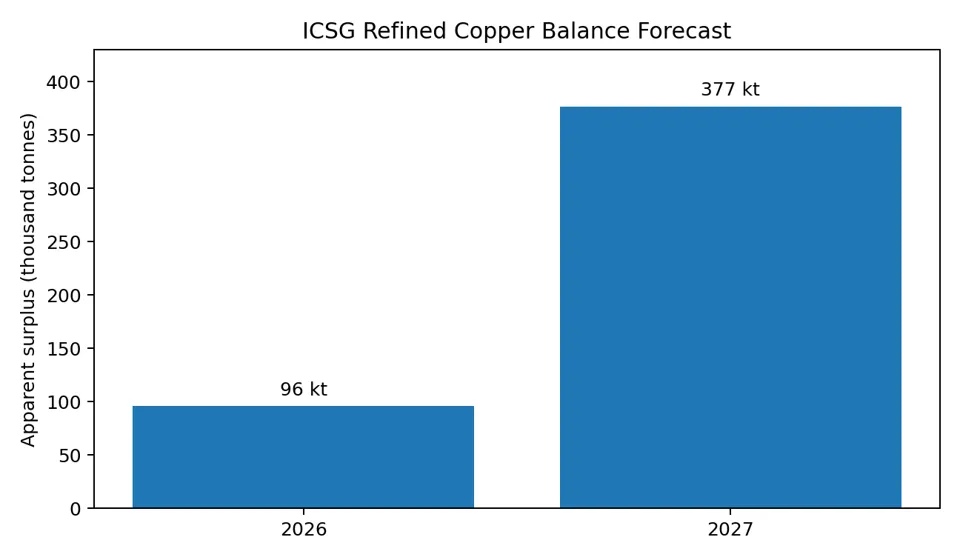
The short term picture is complicated because global balance forecasts do not all point in the same direction. The International Copper Study Group expects an apparent refined surplus of 96,000 tonnes in 2026 and 377,000 tonnes in 2027. BMI expects the market to move into deficit from 2027. The difference matters because headline balance numbers can hide regional inventory concentration, unreported Chinese stocks and severe tightness in copper concentrate.
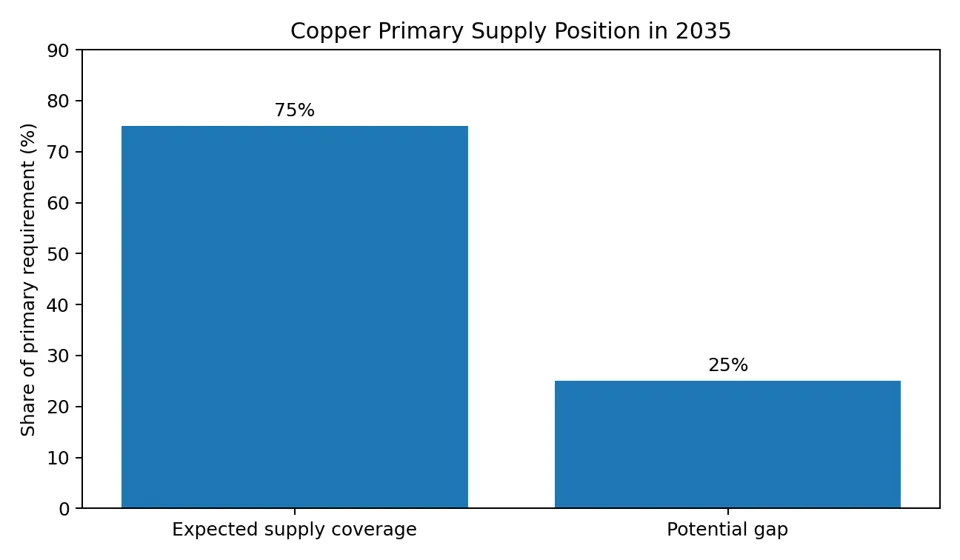
The strategic issue is clearer over the longer term. The International Energy Agency estimates that expected mine supply from existing and announced projects covers only about 75% of primary copper requirements in 2035 under its stated policy outlook. New copper mines frequently require 15 to 20 years from discovery to production. Buyers therefore cannot wait for a visible shortage before changing procurement strategy.
Source: Mining.com.au
The 2026 Copper Rally Is Being Driven by Both Structural Demand and a Physical Inventory Distortion
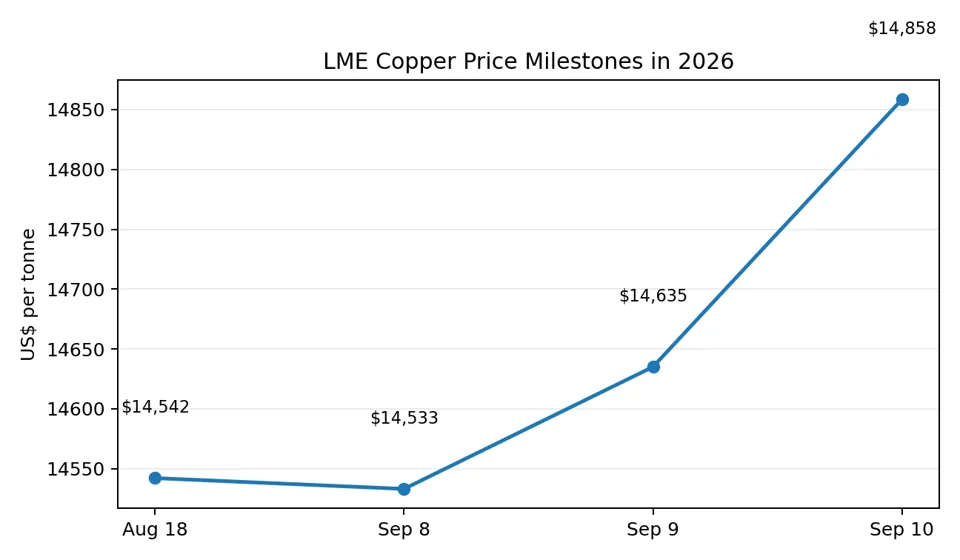
Copper reached repeated record levels during September 2026. Mining.com.au reported the LME benchmark at US$14,533 per tonne on September 8, US$14,635 per tonne on September 9 and US$14,858.50 per tonne on September 10. U.S. Comex copper also reached a record US$6.894 per pound.
The immediate market squeeze is partly logistical. Refined copper has been moving toward the United States because traders are positioning for possible tariff changes. Mining.com.au reported that LME inventories had fallen for 42 consecutive trading days by mid August. By August 18, LME stocks had fallen by almost half from mid May levels while the cash premium over three month copper reached as high as US$545 per tonne.
This creates a market where total global inventory can appear adequate while immediately deliverable copper becomes scarce in individual regions. Procurement teams exposed to transformers, motors, busbars, cable, data center electrical equipment and renewable power infrastructure should therefore monitor inventory location as closely as total supply.
Explore the DataM Intelligence Copper Market report
Mine Supply Is Growing Too Slowly to Absorb Repeated Operational Disruptions
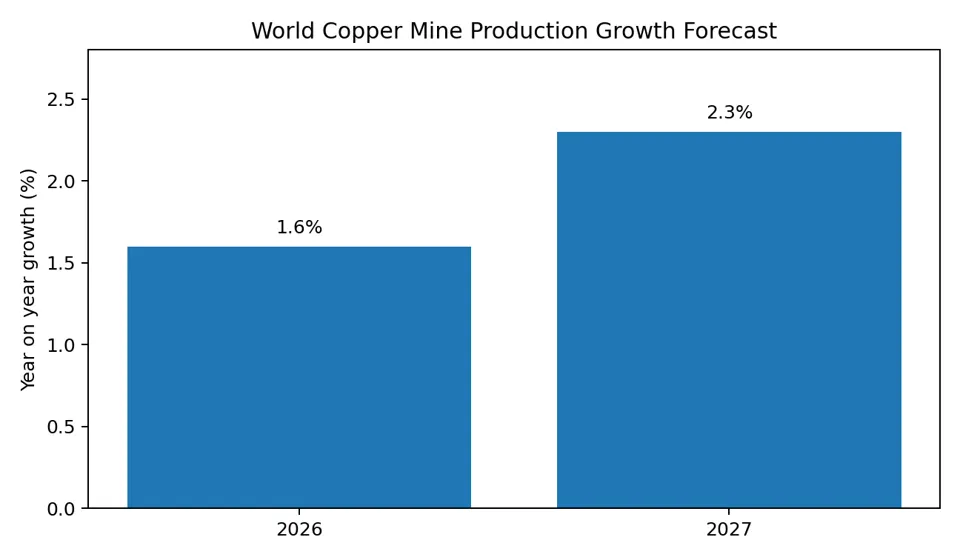
ICSG expects world copper mine production to grow only 1.6% in 2026 followed by 2.3% in 2027. The 2026 forecast was revised down from 2.3% because production expectations weakened in the Democratic Republic of Congo, Chile and Indonesia. Major incidents at Grasberg and Kamoa also constrained output.
The problem is that the demand base is broadening at the same time. Electricity grids require large quantities of copper for transmission and distribution. AI data centers are increasing demand for power cables, switchgear, transformers and cooling infrastructure. Electric mobility creates another layer through motors and charging equipment. These demand pools are difficult to defer because many are tied to infrastructure programs rather than discretionary consumer spending.
Source: ICSG Copper Market Forecast
A Near Term Surplus Does Not Remove the Procurement Risk
ICSG currently expects an apparent refined copper surplus of 96,000 tonnes in 2026 and 377,000 tonnes in 2027. That forecast deserves attention because it shows the market can loosen if secondary refined production rises and demand is weaker than expected. It also explains why buyers should avoid treating every shortage forecast as a certainty.
At the same time, ICSG explicitly notes that its China demand calculation excludes changes in unreported stocks. Regional inventory shifts can materially alter physical availability. The 2026 U.S. stock build is a direct example. A market can show a modest global surplus while fabricators in another region face high premiums and delayed access to cathode.
Source: ICSG Copper Market Forecast
The Deeper Bottleneck Is Copper Concentrate Rather Than Smelting Capacity
The most important signal is appearing upstream of refined metal. The IEA reported that the annual copper treatment and refining charge benchmark settled at US$0 per tonne in January 2026, the lowest annual benchmark on record. Spot treatment charges have been negative since 2024. These conditions indicate that smelters are competing aggressively for limited concentrate.
China now accounts for roughly half of global copper smelter output after contributing more than 90% of global smelter growth since 2005. Smelting capacity has therefore expanded faster than concentrate supply. The result is a mismatch where additional refining equipment cannot solve the problem if mines do not supply enough feedstock.
For buyers, this distinction is critical. New smelter announcements may improve regional refining capacity while doing little to remove upstream mine scarcity. The procurement question must therefore include mine development pipelines, ore grades, concentrate availability and ownership of strategic resources.
Explore the DataM Intelligence Critical Minerals Market report
The 2035 Supply Gap Changes How Copper Should Be Contracted
The IEA expects copper to record the largest absolute demand growth among major energy transition minerals through 2040, adding about 7 million tonnes. Yet expected mine supply from existing and announced projects covers only around 75% of 2035 primary requirements under the stated policy scenario.
This is the point where copper begins to resemble a security of supply market. Higher prices can improve project economics, although price alone cannot accelerate permitting, community agreements, power infrastructure and construction enough to close a multi year mine development gap. Buyers with large future requirements will increasingly need to secure access before the metal reaches the spot market.
Source: IEA Global Critical Minerals Outlook
How The Copper Industry Can Learn from Uranium: Secure Future Supply Before the Shortfall Becomes Visible
A useful mining comparison is uranium. Nuclear utilities spent years contracting below replacement levels while relying on inventories and legacy agreements. By 2026 the market had begun moving toward a new contracting cycle because utilities could see that future coverage would fall sharply even before reactors physically ran short of material.
Sprott estimates that maximum U.S. uranium coverage falls from about 98% of requirements in 2026 to 60% in 2030 and only 9% by 2033. In Europe, coverage falls from 100% in 2030 to 36% by 2034 even if utilities exercise all available contract flexibility. The response is long term contracting because uranium must pass through conversion, enrichment and fuel fabrication before use.
Copper is different because it has a larger recycling base and more substitution potential. The procurement lesson is similar. When project lead times are measured in more than a decade, buyers must respond to forward supply coverage rather than wait for an acute shortage.
Copper and Uranium Show the Same Procurement Problem Through Different Mining Markets
| Supply signal | Uranium precedent | Copper in 2026 | Buyer implication |
| Long project cycle | Fuel supply is contracted years before reactor use | New mines commonly need 15 to 20 years from discovery to production | Contract against future demand before spot tightness appears |
| Inventory dependence | Utilities relied on inventories plus legacy contracts | U.S. warehouses hold about 2 million tonnes while availability tightens elsewhere | Track location and accessibility of stocks |
| Forward coverage falls | U.S. maximum coverage drops to 9% by 2033 | IEA sees announced supply covering about 75% of 2035 primary needs | Use multi year offtake plus supplier qualification |
Secondary supply matters | Reprocessing and secondary sources can supplement primary uranium | Scrap copper can reduce primary mine dependence | Invest in closed loop scrap and recycled cathode qualification |
Recycling Becomes a Strategic Hedge, Although the Secondary Share Has Been Falling
Copper has one major advantage over many critical minerals because it can be recycled repeatedly without losing its core conductive properties. The IEA estimates that recycling could reduce the need for new copper mine development by around 40% by 2050 under its announced pledges scenario.
The challenge is that secondary supply has not kept pace with total consumption. Recycled copper including direct use scrap supplied 37% of demand in 2015 and only 33% in 2023 down to a further 30% in 2026. That decline means future recycling gains require better collection, sorting, processing and closed loop procurement rather than assuming scrap will automatically expand with demand.
Explore the DataM Metal Recycling Market report
What Copper Buyers Should Prepare for Before 2027
The most important change is to separate procurement strategy from spot price forecasts. Copper may experience periods of apparent surplus, especially if U.S. inventories return to global markets or demand slows. That does not remove the long term mine development problem.
Large buyers should build procurement around four actions. First, secure multi year contracts with refined copper suppliers that have visibility into concentrate sourcing. Second, qualify secondary copper for applications where recycled content can meet conductivity and quality specifications. Third, model regional inventory risk rather than relying only on global balance forecasts. Fourth, identify design areas where aluminum or other conductors can reduce copper exposure without compromising equipment performance.
The companies best positioned for the next cycle will therefore be those that treat copper as a strategic raw material. Miners with expandable resources, recyclers with high purity recovery capability, refiners with secure concentrate and electrical manufacturers capable of material optimization should all gain value as the market becomes more constrained.