


Will Alternatives Follow the Vanilla to Vanillin Playbook?
KEY TREND Cocoa has moved from a temporary price shock into a structural sourcing challenge shaped by climate, ageing farms, origin concentration and traceability requirements. |
MARKET OUTLOOK Premium chocolate will defend authentic cocoa, while mainstream coatings, bakery and compound applications are likely to accelerate cocoa optimization, alternative fats and cocoa-free ingredients. |
RECOMMENDED FOR Cocoa Processors, Chocolate Manufacturers, Confectionery Ingredient Suppliers, Procurement Teams and Alternative Cocoa Developers. |
DataM Analyst View
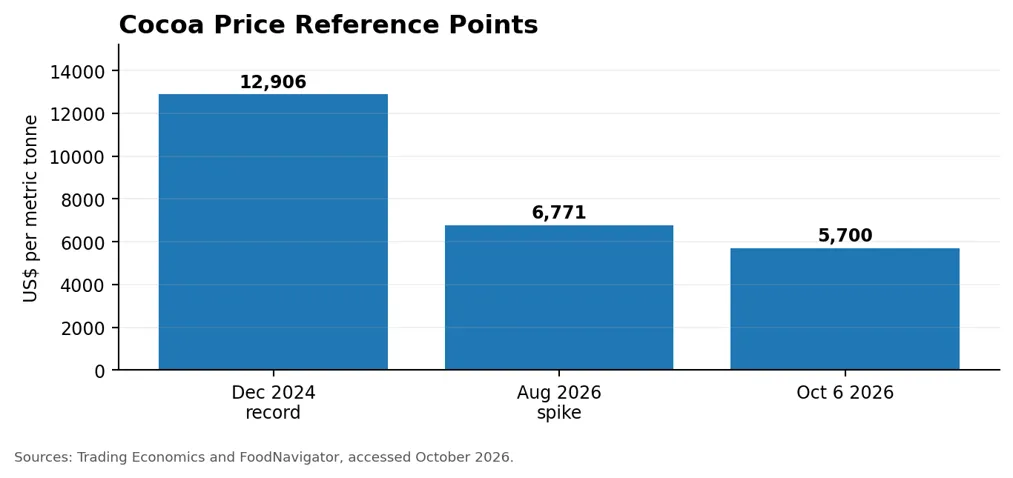
Cocoa prices have retreated sharply from the record levels of late 2024, yet the supply chain has not returned to its old equilibrium. Cocoa traded at US$5,700 per metric tonne on October 6, 2026 after an unexpected late August spike to US$6,771. The market is well below the US$12,906 historical high reached in December 2024, but manufacturers are still dealing with a cost base and volatility profile that can disrupt pricing, promotions and product architecture.
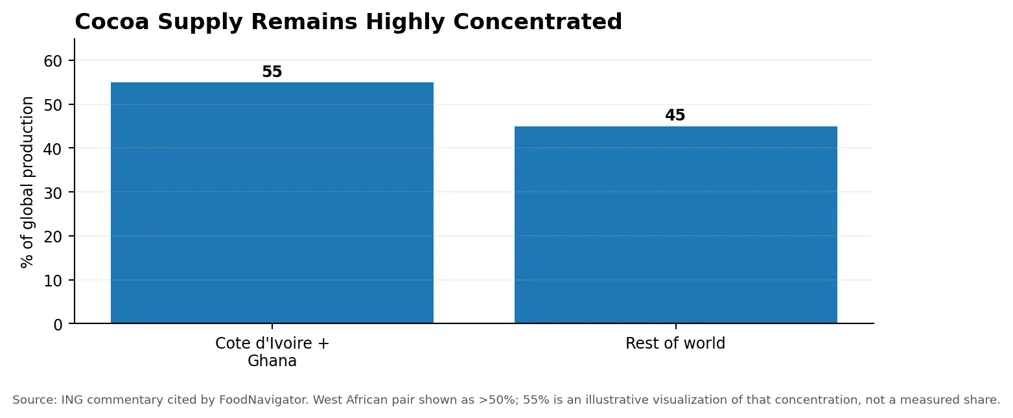
The deeper issue is structural. Climate volatility, ageing plantations and disease pressure are limiting the speed at which West African supply can recover. Ghana and Cote d’Ivoire still account for more than half of global production. At the same time, EU deforestation compliance is adding traceability and geolocation requirements to a supply chain built around millions of smallholders. Reuters reported that the EU buys about 60% of the world’s cocoa, which makes compliance a commercial access issue as well as a sustainability requirement.
The closest food ingredient precedent is natural vanilla. Repeated crop shocks and extreme price inflation pushed manufacturers toward synthetic and fermentation derived vanillin. Once formulations, labels and procurement systems were redesigned around substitutes, part of that demand became structurally less dependent on vanilla beans. Cocoa may now face the same strategic question: how much demand can be protected through farm investment, and how much will permanently migrate toward cocoa extenders, cocoa butter alternatives and cocoa-free ingredients?
Lower Prices Do Not Mean the Cocoa Crisis Is Over
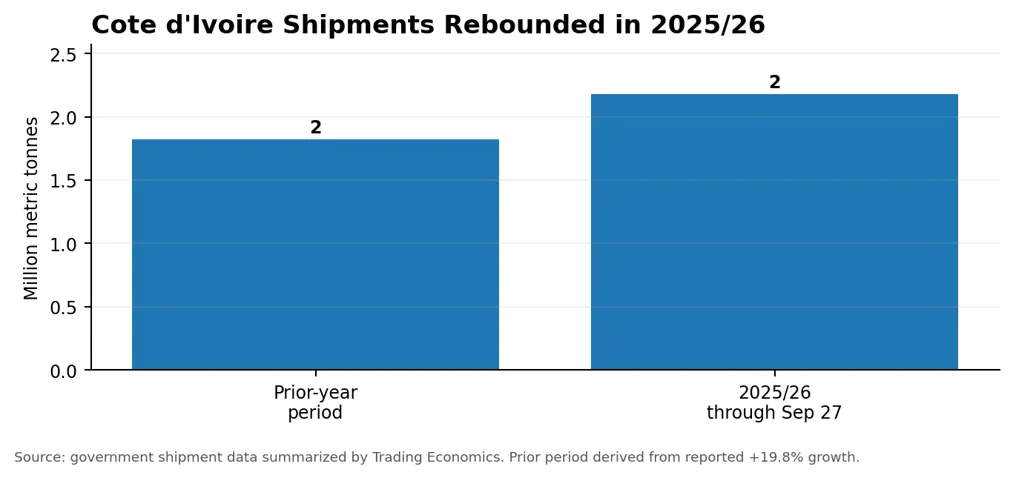
The 2025/26 season produced a better physical balance than the crisis years. Cote d’Ivoire shipments reached 2.18 million metric tonnes through September 27, 2026, up 19.8% from the comparable prior-year period. ICE inventories also rebuilt. Those improvements explain part of the decline from record prices.
However, the next cycle is already carrying weather risk. Trading Economics cited early estimates of roughly 1.8 million metric tonnes for Cote d’Ivoire in 2026/27 versus about 2.2 million tonnes in 2025/26. FoodNavigator’s ING commentary argues that excessive or insufficient rainfall, lower soil moisture and disease pressure are becoming structural threats to yield and farm investment. That changes the procurement problem from buying through a bad harvest to managing recurring volatility.
Track cocoa pricing, origin exposure and downstream demand shifts. Explore the DataM Intelligence Cocoa Market
Origin Concentration Is Now Colliding With Compliance Risk
Cocoa has a concentration problem that is difficult to diversify quickly. Ghana and Cote d’Ivoire remain the cornerstone of global supply, while Ecuador, Peru, Colombia, Brazil, Nigeria and Cameroon can add incremental production over time. New acreage, higher yielding varieties and export infrastructure can reduce concentration, but flavor profiles, farm economics and the time needed to establish productive trees limit rapid substitution between origins.
The EU Deforestation Regulation adds another layer. Reuters reported that farmers producing more than half of the beans in Nigeria, the world’s fourth largest cocoa producer, could fail to meet EU requirements when the rules take effect if traceability gaps are not resolved. For buyers, compliant cocoa can therefore become a distinct procurement pool with its own availability, verification cost and supplier concentration.
The Vanilla Lesson: Extreme Volatility Can Permanently Change Formulation
Natural vanilla provides a useful precedent because its supply chain shares several cocoa characteristics: tropical cultivation, geographic concentration, weather sensitivity, labor intensive production and a flavor profile that manufacturers value but can partially reproduce through alternatives. Madagascar historically supplied the majority of natural vanilla. Cyclones and poor harvests repeatedly created severe shortages.
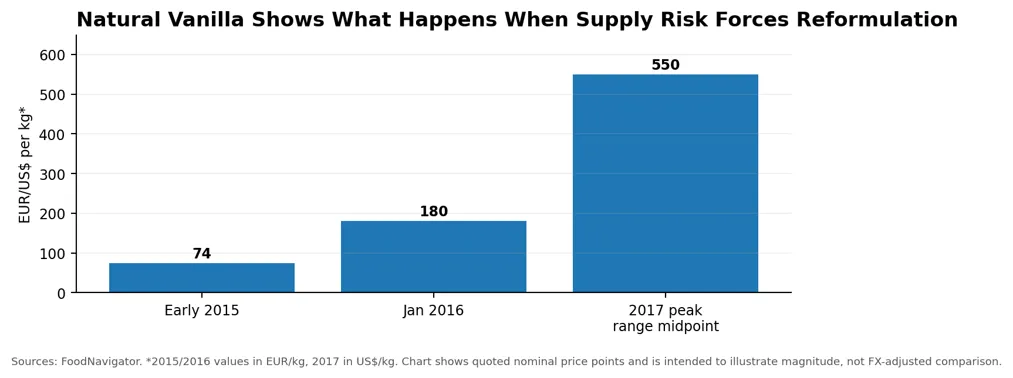
FoodNavigator reported that vanilla prices rose from about EUR74 per kilogram at the start of 2015 to EUR180 per kilogram in January 2016. By 2017, industry sources were discussing US$500 to US$600 per kilogram. Earlier shocks had already pushed manufacturers toward artificial vanilla flavors. Research on vanilla price bubbles notes that synthetic vanillin reduced demand for natural vanilla during prolonged high price periods, contributing to a subsequent bust in farmer returns.
| Supply-chain stage | Natural vanilla / vanillin precedent | Cocoa market today | Strategic implication |
| Concentration | Madagascar dominance amplified cyclone and crop risk. | West Africa still supplies more than half of global cocoa. | Diversification helps, but cannot quickly replace core origins. |
| Price shock | Natural vanilla moved from tens of dollars per kg to roughly US$500 to US$600/kg in the 2017 cycle. | Cocoa reached US$12,906/t in late 2024 and remains volatile in 2026. | Extreme pricing creates a budget for reformulation and alternative qualification. |
| Manufacturer response | Synthetic and bio based vanillin reduced dependence on vanilla beans. | Cocoa optimization, alternative fats, carob, grains, pulses and fermentation based ingredients are gaining attention. | Alternatives first win in applications where authentic origin is less visible to consumers. |
| After prices normalize | Some reformulated demand did not automatically return to natural vanilla. | Cocoa prices have fallen from record highs, but product redesign programs continue. | The long term risk is permanent demand destruction, not only temporary volume reduction. |
| Premium segment | Natural vanilla retained value where provenance and flavor complexity mattered. | Premium chocolate remains closely tied to authentic cocoa. | Cocoa is most defensible where origin, flavor and brand equity justify the premium. |
Cocoa Alternatives Do Not Need to Replace Chocolate to Reshape Demand
The strongest opportunity is likely to sit outside premium chocolate bars. Bakery coatings, inclusions, fillings, compound chocolate and mass market confectionery have more freedom to reduce cocoa intensity or use alternative fats and flavors. FoodNavigator notes that manufacturers are already exploring fermented grains, pulses, carob and precision fermentation approaches. DataM Intelligence also reported Döhler’s June 2026 acquisition of Nukoko, whose fava bean platform targets cocoa-free chocolate ingredients.
Economics are becoming difficult to ignore. DataM Intelligence cited cocoa butter at roughly US$8,000 to more than US$10,000 per metric tonne with a Q3 2026 projection near US$12,150, while cocoa butter equivalents and substitutes were quoted around US$1,200 to US$4,500 per metric tonne. That spread gives formulation teams room to invest in sensory work, processing changes and supplier qualification.
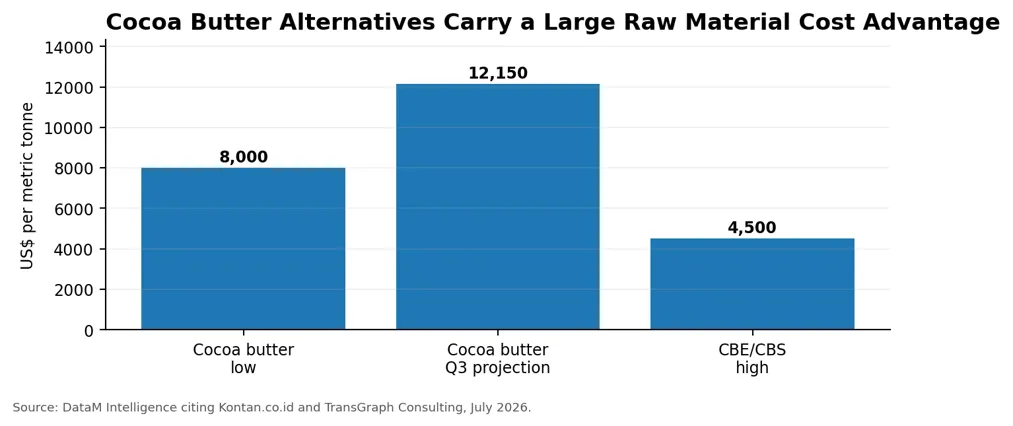
Assess the economics of CBE, CBS and other formulation routes as cocoa butter remains volatile. Explore the DataM Intelligence Cocoa Butter Alternatives Market
The Market Could Split Into Authentic Cocoa and Cocoa-Efficient Formulation
A two speed market is emerging. Premium chocolate, origin led products and high cocoa content formats will continue to compete on authenticity. Their strategic response will center on long term sourcing contracts, farmer productivity, climate resilience, traceability and selective geographic diversification. These companies need reliable cocoa more than they need a replacement.
Mainstream confectionery, bakery and coatings have a different economic equation. Here, the objective is consistent flavor, texture and consumer acceptance at a manageable cost. Cocoa extenders, compound chocolate, alternative fats and cocoa-free ingredients can therefore become permanent tools in the formulation portfolio. The vanilla precedent suggests that once those tools are qualified, lower cocoa prices alone may not reverse the shift.
Evaluate how ingredient reformulation is changing coatings, fillings and mass market confectionery. Explore the DataM Intelligence Confectionery Ingredients Market
What Buyers Should Watch Through 2027
| Indicator | Why it matters | Commercial signal |
| West African crop outlook | Determines whether 2025/26 recovery is durable | Renewed deficit risk would accelerate hedging and reformulation |
| EUDR compliant volumes | Separates physical cocoa availability from EU eligible supply | Traceable supply may command a structural premium |
| Cocoa butter versus CBE/CBS spread | Measures the financial incentive to reformulate | A wide spread improves payback on product redesign |
| Alternative ingredient scale | Shows whether cocoa-free systems can move beyond pilots | Acquisitions and commercial capacity are stronger signals than prototypes |
| Chocolate volume response | Tests the limit of consumer pricing power | Weak volumes increase pressure to lower cocoa intensity |
The Strategic Risk Is Demand That Does Not Come Back
Cocoa’s immediate problem is volatility. Its longer term problem is substitution learning. Every year of high prices gives food manufacturers more incentive to understand which parts of the cocoa experience can be reproduced with alternative fats, flavors, fermentation and process technology. Those investments accumulate even when the commodity price falls.
Vanilla shows why this matters. Natural vanilla survived its substitution cycles because it retained a premium role that synthetic vanillin could not fully replicate. Cocoa is likely to follow a similar path. Authentic cocoa will remain central to chocolate, but the amount of cocoa required per unit of confectionery revenue can still decline. The winners will be cocoa suppliers that make authentic supply more resilient and ingredient companies that help manufacturers use cocoa more selectively.