


Cocoa Butter Alternatives Market Size and Overview
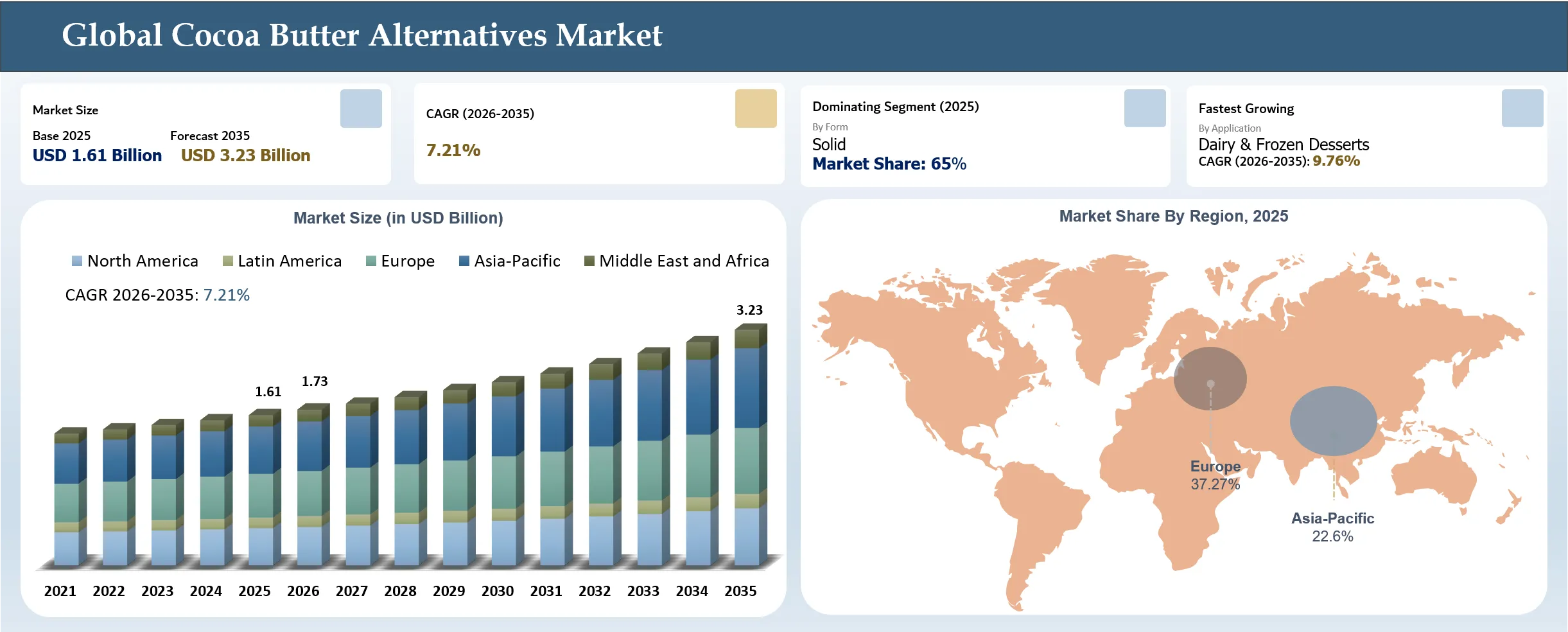
The global cocoa butter alternatives market reached USD 1.61 billion in 2025 and is expected to reach USD 3.23 billion by 2035, growing with a CAGR of 7.21% during the forecast period 2026-2035. The market is expanding as confectionery and food makers look for substitute ingredients that can help cut down their vulnerability to the risks associated with cocoa availability while at the same time retaining the necessary functional attributes that they need in their chocolate formulas. In September 2026, according to Green Queen, Japanese supermarket chain Aeon launched three more products without cocoa in its ingredient list by utilizing the cocoa-free formulation known as Anoza M, developed by Fuji Oil, in about 3,500 Aeon, Aeon Style, and MaxValu stores.
Technological advancements are the evolution of cocoa butter substitutes from regular vegetable fats to precision fermentation and bio-sourced lipids. In June 2026, according to Green Queen, UK-based Sun Bear Biofuture finished its first commercial-scale production batch of yeast-produced cocoa butter substitute on a €25,000 (USD 28,853) pilot scale that accounts for less than 10% of the typical investment for the entire industry installation, with dozens of kilograms of product output per month.
The company reached 78% lipid content in their yeast, and their fermenter cost less than £1,000 (USD 1,348.28) compared to £250,000 (USD 337,075) for a conventional one. In addition, Sun Bear stated that their product allows saving up to 95% of land resources and 90% of emissions in the production of tropical fats.
Cocoa Butter Alternatives Market Key Takeaways
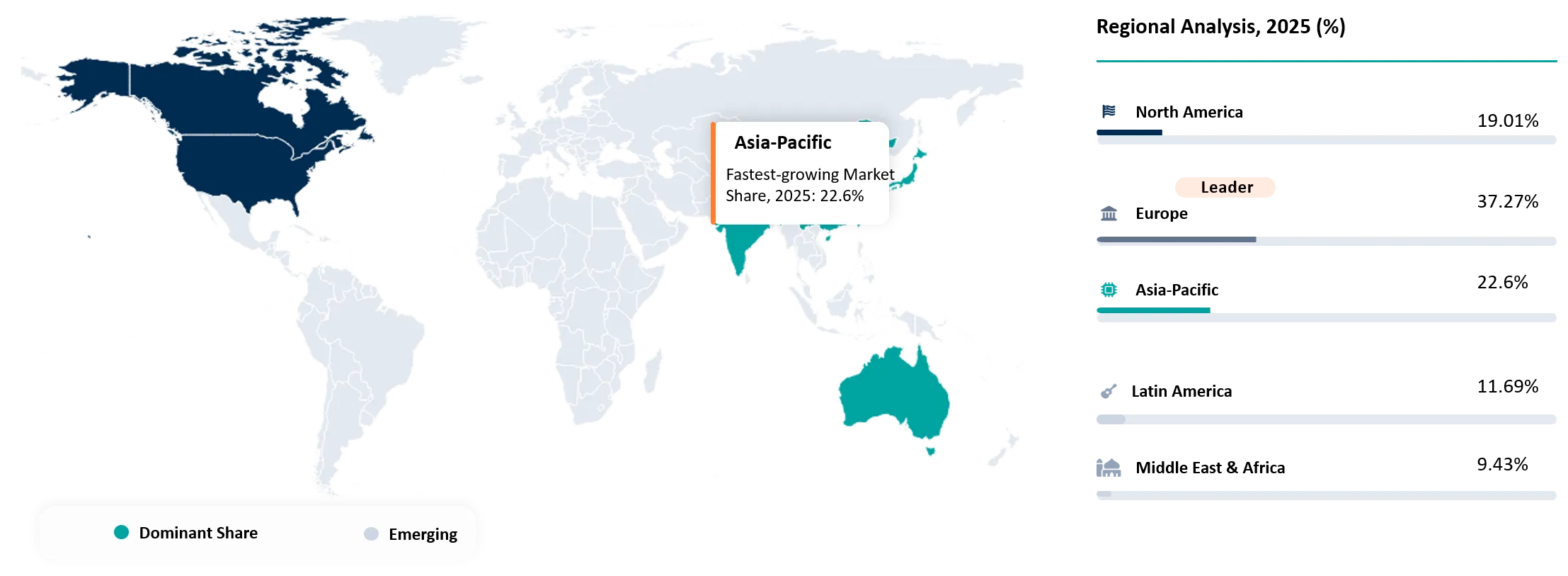
- Europe was the largest regional market for cocoa butter alternatives in 2025. It captured a leading global market share of 37.27%.
- Solid cocoa butter alternatives held the largest market share in 2025. The segment accounted for an estimated 65% of the global market.
- Cocoa butter prices range from USD 8,000 to over USD 10,000 per metric ton with projections reaching USD 12,150 in Q3 2026. Alternatives like CBE and CBS cost significantly less at USD 1,200 to USD 4,500 per metric ton.
- Cocoa butter typically accounts for close to 30% of standard chocolate formulations. Over 80% of its triglycerides consist of three symmetrical structures (POP, POS, SOS).
- Japanese supermarket chain Aeon integrated Fuji Oil's cocoa-free formulation into its product lineup. The launch rolled out cocoa-free items across approximately 3,500 retail stores.
Cocoa Butter Alternatives Market Scope
| Metrics | Details | |
| 2025 Market Size | USD 1.61 Billion | |
| 2035 Projected Market Size | USD 3.23 Billion | |
| CAGR (2026-2035) | 7.21% | |
| Largest Market | Europe | |
| Fastest Growing Market | Asia-Pacific | |
| By Type | Cocoa Butter Equivalents (CBE), Cocoa Butter Substitutes (CBS), Cocoa Butter Replacers (CBR), Cocoa Butter Improvers (CBI) | |
| By Form | Solid, Liquid | |
| By Source | Shea, Sal, Kokum & Mango Kernel, Illipe & Palm Kernel Stearin, Others | |
| By Application | Chocolate & Confectionery, Bakery, Cosmetics, Pharmaceutical, Others | |
| By Region | North America | U.S., Canada, Mexico |
| Europe | Germany, UK, France, Spain, Italy, Poland, Netherlands, Switzerland | |
| Asia-Pacific | China, India, Japan, Australia, South Korea, Indonesia, Malaysia | |
| Latin America | Brazil, Argentina | |
| Middle East and Africa | UAE, Saudi Arabia, South Africa, Israel, Türkiye | |
| Report Insights Covered | Competitive Landscape Analysis, Company Profile Analysis, Market Size, Share, Growth | |
Cocoa Butter Alternatives Market BCG Matrix: Company Evaluation

Stars include AAK AB, Cargill, Inc., and Fuji Oil Holdings Inc. because they have strong positions in specialty fats and cocoa butter alternative solutions, supported by broad product portfolios, formulation capabilities, and established relationships with chocolate and confectionery manufacturers. Companies such as Wilmar International Ltd., Bunge Limited, and IOI Loders Croklaan are placed in the Question Mark category because they possess substantial vegetable-oil and specialty-fat processing capabilities and are expanding their presence in higher-value confectionery fat applications.
The Potential category includes Archer Daniels Midland Company (ADM), Barry Callebaut AG, and Mewah International Inc., which benefit from established positions across food ingredients, cocoa, specialty fats, and confectionery supply chains. Manorama Industries Limited is categorized as a Tailender because its cocoa butter alternative opportunity is comparatively focused on specialty fats derived from non-traditional tropical and plant-based sources.
Cocoa Butter Alternatives Market Dynamics
Driver Impact Analysis
| Driver | Market Growth Impact (%) | Demand Concentration | Impacted Use Case | Strategic Impact |
Volatility in cocoa butter prices is driving manufacturers toward cost-effective cocoa butter alternatives to improve formulation economics. | 26% | High – Chocolate, confectionery and processed-food manufacturers | Chocolate coatings, compound chocolate, fillings, spreads, bakery coatings and confectionery products | Accelerates substitution of cocoa butter with CBE/CBS and encourages manufacturers to optimize formulation costs and reduce exposure to cocoa-price volatility. |
Growing demand for sustainable and responsibly sourced vegetable fats is accelerating the adoption of cocoa butter alternatives in chocolate and confectionery products. | 21% | High – Premium chocolate, confectionery and sustainability-focused brands | Sustainable chocolate, compound coatings, vegan products and responsibly sourced confectionery | Increases demand for traceable, certified and lower-impact vegetable fats while encouraging suppliers to develop sustainable CBA portfolios. |
Advances in fat fractionation and blending technologies are enabling alternatives to better replicate cocoa butter’s melting profile, texture, and mouthfeel. | 22% | Medium-High – Specialty chocolate and formulated-fat applications | CBE formulations, premium chocolate, fillings, coatings and temperature-sensitive confectionery | Improves functional equivalence and formulation flexibility, allowing CBAs to penetrate applications that previously required higher cocoa-butter content. |
Supply-chain risks associated with cocoa availability are encouraging food manufacturers to diversify away from exclusive dependence on cocoa butter. | 23% | High – Global chocolate and confectionery producers | Compound chocolate, cocoa-reduced formulations, coatings, bakery and industrial food applications | Strengthens supply-chain resilience by enabling manufacturers to diversify fat inputs and reduce dependence on cocoa-derived ingredients. |
Volatility in cocoa butter prices is driving manufacturers toward cost-effective cocoa butter alternatives to improve formulation economics
The sharp volatility in cocoa butter prices is increasingly pushing chocolate and food manufacturers toward cocoa butter alternatives to control formulation costs and reduce exposure to expensive cocoa-derived inputs. The consistently high cost of producing cocoa continues to make other fat sources more economical, especially when the manufacturer can achieve the same melting characteristics and functionalities as with cocoa butter at a lower raw material cost. As the price of cocoa butter remains high, CBEs and CBSes become more appealing options for formulation.
In parallel, in July 2026, Kontan.co.id noted that cocoa butter prices will stay within USD 8,000 to more than USD 10,000 per metric ton and are projected to grow up to around USD 12,150 per metric ton in Q3 2026, as stated by TransGraph Consulting. On the other hand, CBE and CBS are priced around USD 1,200-USD 4,500 per metric ton, providing a much lower price of raw material for food and chocolate producers. Kontan.co.id has also noted that Indonesian cocoa production is estimated at 200,000 tons per year versus annual processing industry needs of about 440,000-450,000 tons per year, which means that about half of the requirements for this raw material is imported.
Cocoa Butter Alternatives Market Segment Analysis
The globa cocoa butter alternatives market is segmented based on type, form, source, application, and region.
Solid Form Dominance Driven by Structural Stability and Crystallization Performance in Chocolate Applications
The solid form segment dominates the cocoa butter alternatives market, accounting for an estimated 65% market share in 2025, supported by its strong suitability for chocolate, confectionery, bakery coatings, fillings, and compound products. Solid cocoa butter alternatives provide manufacturers with the required hardness, melting behavior, crystallization stability, texture, and shelf-life performance needed in high-volume food formulations. The growing use of plant-based fats such as palm fractions, shea, palm-kernel, and other structured fats has further strengthened demand for solid alternatives, particularly as manufacturers seek to reduce dependence on volatile cocoa butter prices.
The growing demand for structurally stable and heat-responsive fats in chocolate and confectionery formulations is strengthening the preference for solid cocoa butter alternatives. In February 2026, according to Springer Nature’s European Food Research and Technology, cocoa butter accounts for close to 30% of chocolate, where its crystalline structure contributes to key characteristics including gloss, hardness, texture, and melting behavior. Also reports that more than 80% of cocoa-butter triglycerides have three symmetrical structures, POP, POS, and SOS, which strongly influence crystallization and functionality. It further notes that cocoa butter has a melting point of approximately 30 and 37°C, while stable Form V and VI structures formed during chocolate processing fall around 32 - 36°C.
Cocoa Butter Alternatives Market Geographical Penetration
Established Confectionery Industry and Sustainable Fat Adoption Strengthening Europe’s Market Leadership
The Europe region dominates the cocoa butter alternatives market, accounting for 37.27% of the global market in 2025, driven by its established chocolate and confectionery manufacturing base, strong specialty-fat industry, and increasing adoption of cocoa butter alternatives in chocolate, bakery, and other food applications. European manufacturers are increasingly using cocoa butter equivalents, substitutes, and replacers to improve formulation economics, maintain product texture and melting characteristics, and reduce exposure to cocoa supply and price volatility.
The development strengthens the availability of specialized cocoa butter equivalents for European food manufacturers seeking reliable and cost-efficient formulation solutions. In June 2026, AAK, a Sweden-based specialty fats and oils manufacturer, introduced Illexao EN 10, a cocoa butter equivalent (CBE) developed to help food manufacturers address cocoa price volatility, supply uncertainty, and rising production costs. The ingredient is designed for enrobed applications including chocolate bars, cookies, cakes, sandwich cookies, and wafers, providing formulation flexibility and performance at high levels of cocoa butter replacement.
Germany Cocoa Butter Alternatives Market Trends
Germany holds a dominant position in the European cocoa butter alternatives market, supported by its established chocolate and confectionery manufacturing ecosystem, strong food-processing industry, and increasing commercialization of cocoa-free formulations. The country has a particularly strong downstream demand base for cocoa butter alternatives because chocolate is deeply embedded in consumer consumption, while manufacturers are increasingly seeking plant-based fats and cocoa substitutes to address cocoa price volatility and supply-chain risks.
The deal demonstrates increasing investment in plant-based alternatives to conventional cocoa ingredients across Europe. In June 2026, Döhler, a Germany-based global food and beverage ingredients manufacturer, acquired Nukoko, a UK-based food-technology company, to strengthen its position in cocoa-free chocolate alternatives. Nukoko’s technology uses fava beans to create cocoa-free chocolate ingredients, addressing cocoa price volatility, supply insecurity, and cost pressures. The acquisition expands Döhler’s capabilities in alternative chocolate solutions and strengthens its position in the rapidly emerging cocoa-alternative market.
UK Cocoa Butter Alternatives Market Outlook
The UK is an important country in the European cocoa butter alternatives market, supported by its large confectionery industry, strong supermarket distribution network, and increasing reformulation activity in response to cocoa price volatility. The country has become an active market for cocoa-reduced and cocoa-free formulations as manufacturers seek to maintain affordable confectionery products while addressing raw-material cost pressures.
The development demonstrates how lower-cost biomanufacturing infrastructure can support the commercialization of sustainable cocoa butter substitutes. In May 2026, Sun Bear Biofuture, a UK-based biotechnology startup, completed its first production run of a yeast-fermentation-derived cocoa butter alternative using a custom-built automated pilot plant. The facility required an investment of £25,000 (USD 33,700) and has production capacity of dozens of kilograms per month, compared with the £350,000 (USD 471,905) - £1 million (USD 1.347 million) typically required for conventional precision-fermentation facilities.
U.S. Cocoa Butter Alternatives Market Trends
The U.S. holds a dominant position in the North American cocoa butter alternatives market owing to its large-scale chocolate and confectionery industry, strong food-technology ecosystem, and rapid adoption of alternative ingredients to improve supply-chain resilience. The presence of major food manufacturers, ingredient suppliers, and food-tech companies enables close collaboration across formulation, ingredient development, and commercial-scale production.
The innovation supports U.S. efforts to address cocoa supply variability while providing manufacturers with more consistent specialty-fat ingredients. In September 2026, C16 Biosciences, a U.S.-based biotechnology company, launched a fermented cocoa butter equivalent under its Palmless brand. Produced using aerobic precision fermentation, the ingredient uses a naturally oil-producing microorganism optimized to increase lipid output and provides a more predictable fat profile than conventional cocoa butter, whose characteristics can vary by growing region, season, and harvest conditions.
Japan Cocoa Butter Alternatives Market Trends
Japan is one of the major countries in the Asia-Pacific cocoa butter alternatives market due to its highly developed confectionery industry, strong consumer preference for premium chocolate products, and rapid adoption of innovative food ingredients. The country’s established food-processing ecosystem, sophisticated retail channels, and growing focus on sustainable and cocoa-free formulations provide a strong platform for cocoa butter alternatives.
Rising cocoa butter costs are accelerating demand for alternative fats as Japanese food manufacturers seek more economical and reliable formulation options. In January 2026, Fuji Oil, a Japan-based specialty fats and oils manufacturer, highlighted increasing demand for cocoa butter alternative fats as rising cocoa butter prices put pressure on food manufacturers. Fuji Oil President and CEO Tatsuji Omori noted that the company is responding through its specialty-fat solutions and a more agile management structure, reflecting growing Japanese demand for cost-effective alternatives to cocoa butter.
Cocoa Butter Alternatives Market Competitive Landscape
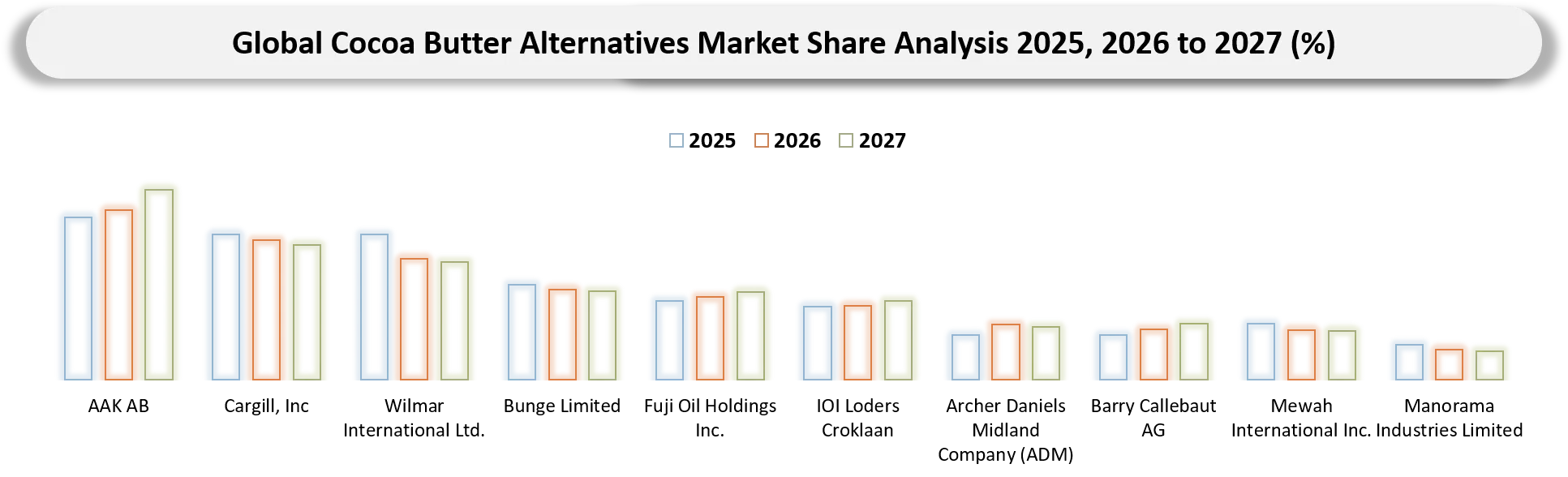
- The cocoa butter alternatives market is characterized by three key participant groups: specialty fats and oils manufacturers, integrated vegetable-oil companies, and confectionery and ingredient specialists. AAK AB, Cargill, Inc., Bunge Limited, Fuji Oil Holdings Inc., and IOI Loders Croklaan compete through broad portfolios of cocoa butter equivalents (CBEs), cocoa butter substitutes (CBS), cocoa butter replacers (CBRs), specialty fats, and customized fat blends. Wilmar International Ltd., Archer Daniels Midland Company (ADM), and Mewah International Inc. strengthen the competitive landscape through integrated oilseed processing, fractionation, and global ingredient supply, while Barry Callebaut AG and Manorama Industries Limited focus on confectionery ingredients, specialty fats, and application-specific cocoa butter alternative solutions. It is creating a highly competitive ecosystem where raw-material sourcing, fractionation technology, formulation expertise, sustainability, product functionality, and global distribution define competitiveness.
- Key players include AAK AB (Sweden), Cargill, Inc. (U.S.), Wilmar International Ltd. (Singapore), Bunge Limited (U.S.), Fuji Oil Holdings Inc. (Japan), IOI Loders Croklaan (Netherlands), Archer Daniels Midland Company (U.S.), Barry Callebaut AG (Switzerland), Mewah International Inc. (Singapore), and Manorama Industries Limited (India).
Key Developments
- March 2026: Cargill, a U.S.-based global food, agriculture, and specialty ingredients company, expanded its edible oil plant in Port Klang, Malaysia, with a new specialty fats production line through a multi-million-dollar investment.
- October 2025: AAK, a Sweden-based specialty oils and fats manufacturer, entered a joint venture with Kuala Lumpur Kepong Berhad (KLK), a Malaysia-based plantation and oleochemicals company, to establish Nura Specialty Oils and Fats and a specialty palm-fractions plant in Pasir Gudang, Malaysia.
- April 2025: NoPalm Ingredients, a Netherlands-based biotechnology company, launched REVÓLEO, a fermentation-based oils and fats brand for food and beauty applications.
- February 2026: LIPSA, a Spain-based specialty oils and fats manufacturer, introduced KAOLIP DUO, a 100% plant-based, non-GMO fat solution designed for chocolate and confectionery coatings.
- September 2025: NoPalm Ingredients, a Netherlands-based biotechnology company, partnered with NIZO Food Research, a Netherlands-based contract food research and development organization, to establish NoPalm’s first demonstration factory at the Food Innovation Campus in Ede.
- March 2025: Savor, a U.S.-based food-technology company, unveiled a novel butter alternative produced without cows, plants, or microbes using a thermochemical process that converts carbon dioxide, hydrogen, and oxygen into fats.
Key Procurement Priorities and Buyer Evaluation Criteria
- Organizations procuring cocoa butter alternatives increasingly select suppliers based on their ability to provide consistent-quality CBEs, CBS, CBRs, and CBIs that deliver reliable melting behavior, hardness, crystallization, texture, and shelf-life performance across chocolate, confectionery, bakery, and coating applications.
- The procurement decision-making process is increasingly influenced by cocoa price volatility, supply-chain uncertainty, sustainability requirements, clean-label preferences, and the need to reduce formulation costs, encouraging buyers to evaluate suppliers offering flexible vegetable-fat solutions and stable long-term raw-material availability.
- Buyers consider factors such as fat functionality, melting profile, compatibility with cocoa butter, crystallization behavior, sensory performance, oxidative stability, shelf life, and processing requirements when selecting cocoa butter alternative suppliers and formulation partners.
Why Choose DataM?
- Technological Innovations: Explores advancements in cocoa butter alternative technologies, including fat fractionation, blending, interesterification, specialty-fat structuring, and cocoa-free ingredient systems, enabling manufacturers to achieve improved melting behavior, crystallization, texture, stability, and functionality across chocolate and confectionery formulations.
- Product Performance & Market Positioning: Evaluates how different players deliver CBE, CBS, CBR, and CBI solutions based on melting profile, hardness, compatibility with cocoa butter, crystallization performance, sensory characteristics, shelf life, and processing efficiency, highlighting how leading suppliers differentiate through formulation expertise and customized specialty-fat solutions.
- Real-World Evidence: Highlights the commercialization and adoption of cocoa butter alternatives across chocolate, confectionery, bakery, coatings, fillings, cosmetics, and pharmaceutical applications, demonstrating their role in improving formulation economics, processing flexibility, product stability, and reducing dependence on conventional cocoa butter.
- Market Updates & Industry Changes: Tracks key developments such as specialty-fat capacity expansions, cocoa-free product launches, strategic partnerships, acquisitions, sustainable ingredient innovations, and alternative-fat commercialization across Europe, North America, and Asia-Pacific, supporting analysis of changing cocoa supply and formulation strategies.
- Competitive Strategies: Analyzes how leading companies expand through specialty-fat portfolio development, sustainable raw-material sourcing, technological innovation, strategic partnerships, acquisitions, and cocoa-free product development to address rising demand for cost-effective and functional cocoa butter alternatives.
- Pricing & Market Access: Examines pricing dynamics across CBEs, CBS, CBRs, CBIs, and specialty vegetable fats, including the influence of cocoa butter price volatility, raw-material availability, processing costs, and sourcing conditions, while assessing supplier distribution networks serving global chocolate and food manufacturers.
- Market Entry & Expansion: Identifies growth opportunities driven by cocoa price volatility, cocoa supply-chain risks, sustainability requirements, plant-based confectionery demand, and cocoa-free product innovation, while outlining strategies such as regional production expansion, formulation differentiation, sustainable sourcing, and partnerships with confectionery manufacturers.
Target Audience
- Cocoa Butter Alternative & Specialty Fat Manufacturers
- Chocolate & Confectionery Manufacturers
- Bakery & Food Product Manufacturers
- Ingredient Suppliers & Fat Processors
- Food & Beverage R&D and Product Development Teams
- Cosmetics & Pharmaceutical Manufacturers
- Procurement & Supply-Chain Decision Makers



























































