


Why Certified Reference Materials Matter More Than Ever
Testing laboratories are under more pressure than ever in 2026. Regulators want reliable results. Pharmaceutical companies need stronger analytical evidence. Food safety authorities are tightening contaminant limits. Environmental agencies are expanding monitoring programs for PFAS, heavy metals, microplastics, air pollutants, and water contaminants.
In this environment, accuracy is no longer just a technical goal. It is a business requirement, a compliance requirement, and a trust requirement.
This is why certified reference materials, also known as CRMs, are becoming one of the most important tools in modern laboratory testing. They help laboratories prove that their instruments, methods, analysts, and results are working correctly.
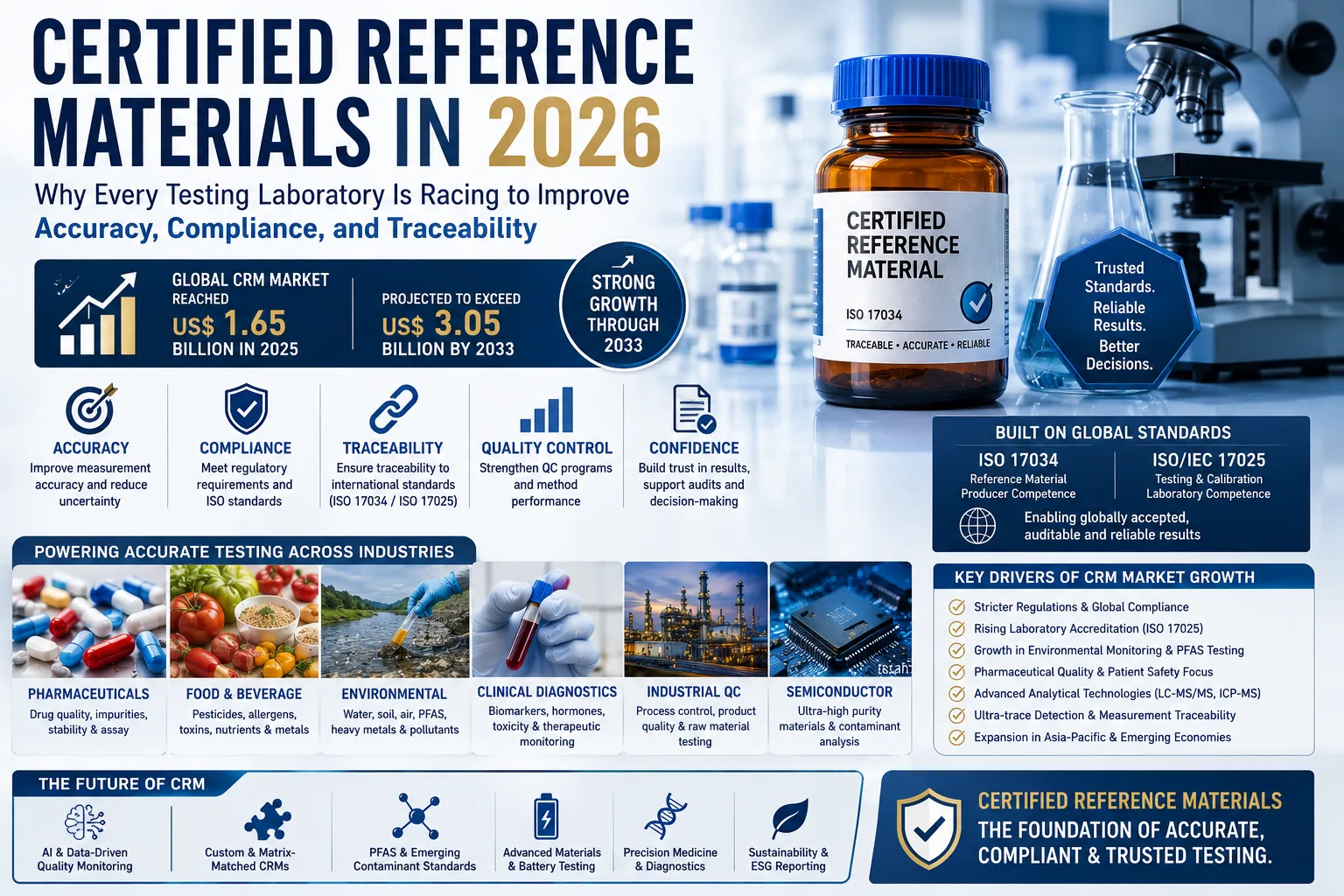
The global certified reference materials market reached approximately US$1.65 billion in 2025 and is projected to exceed US$3.05 billion by 2033. Growth is being driven by laboratory accreditation, pharmaceutical quality standards, environmental monitoring, food safety regulations, and the rise of advanced analytical technologies.
For laboratory managers, quality assurance teams, pharmaceutical companies, environmental testing firms, CROs, and regulators, CRMs are no longer optional. They are becoming central to credible, audit-ready, and traceable testing.
Request for Exclusive Sample on Certified Reference Materials Market
What Are Certified Reference Materials and Why Do They Matter?
Certified reference materials are specially prepared materials with one or more certified values. These values are assigned through scientifically valid measurement procedures and are supplied with a certificate that states the value, uncertainty, and traceability.
In simple terms, a CRM gives the laboratory a trusted benchmark.
If a lab is testing lead in drinking water, pesticide residues in food, impurities in a drug product, or trace metals in soil, it needs to know whether the test result is accurate. A certified reference material helps answer that question.
Calibration
Calibration ensures that an instrument gives the correct response. For example, an ICP-MS instrument used for heavy metal analysis may be calibrated using certified metal standards. Without reliable calibration, even the most advanced instrument can produce misleading results.
Method Validation
Before a laboratory uses a new test method, it must prove that the method works for its intended purpose. CRMs support method validation by helping analysts evaluate accuracy, precision, recovery, linearity, detection limits, and robustness.
Quality Assurance
CRMs are also used in routine quality control. A laboratory may test a CRM alongside real samples to check whether the method remains stable over time. If the CRM result falls outside the expected range, the lab knows something may be wrong with the instrument, reagent, method, or analyst technique.
Measurement Traceability
Traceability means a result can be linked back to recognized measurement standards through an unbroken chain of comparisons. This is especially important for accredited laboratories because customers, auditors, and regulators need confidence that results are internationally comparable.
Practical Examples
In food testing, CRMs are used to confirm results for pesticides, mycotoxins, allergens, nutrients, and heavy metals.
In pharmaceutical testing, CRMs support impurity profiling, assay testing, dissolution testing, stability studies, and identification of active ingredients.
In environmental analysis, CRMs help laboratories test drinking water, wastewater, soil, sediment, air filters, and biological samples for contaminants.
The Global Compliance Boom Driving CRM Demand
The certified reference materials market is growing because the world is becoming more regulated. Laboratories are not only expected to produce results; they are expected to prove that their results are technically valid.
Food Safety Regulations
Food supply chains are now global. A contaminated ingredient can travel across borders and affect thousands of consumers. As a result, food testing laboratories need accurate methods for detecting pesticide residues, heavy metals, toxins, pathogens, allergens, and nutritional components.
CRMs help these laboratories demonstrate that their testing methods are suitable for compliance with food safety limits.
Pharmaceutical Quality Standards
Pharmaceutical companies face strict requirements for identity, strength, purity, potency, and safety. Every analytical result used for batch release, stability testing, impurity analysis, or regulatory submission must be defensible.
This has increased demand for pharmaceutical reference standards, impurity standards, and matrix-specific CRMs.
Environmental Monitoring Programs
Environmental testing has expanded rapidly because governments are monitoring more contaminants at lower detection limits. Water quality, air pollution, soil contamination, industrial discharge, and emerging pollutants are all major testing areas.
CRMs help environmental laboratories produce comparable results across regions, methods, and time periods.
Laboratory Accreditation Requirements
ISO/IEC 17025 and ISO 17034 are two of the most important standards influencing CRM adoption.
ISO/IEC 17025 applies to testing and calibration laboratories. It requires laboratories to demonstrate competence, impartiality, reliable methods, valid results, and measurement traceability.
ISO 17034 applies to reference material producers. It sets requirements for the competence and consistent operation of producers that manufacture reference materials and certified reference materials.
As more laboratories seek accreditation, the demand for high-quality CRMs continues to rise.
Why Environmental Testing Has Become the Fastest-Growing CRM Application
Environmental testing is one of the strongest growth areas for certified reference materials. The reason is clear: contaminants are becoming more complex, detection limits are getting lower, and public pressure for clean water, clean air, and safe soil is increasing.
PFAS Monitoring
PFAS, often called “forever chemicals,” have become a major testing priority worldwide. These compounds are difficult to measure because they can appear at extremely low levels and require careful control of contamination during sampling and analysis.
PFAS testing often relies on LC-MS/MS methods, internal standards, isotope-labeled standards, and highly accurate calibration materials. This makes CRMs essential for reliable PFAS analysis.
Water Quality Testing
Drinking water and wastewater laboratories use CRMs to measure metals, nutrients, organic contaminants, disinfectant by-products, and emerging pollutants. As water regulations become stricter, laboratories need better reference materials to support defensible results.
Air Pollution Analysis
Air monitoring laboratories test particulate matter, volatile organic compounds, metals, and industrial emissions. Certified standards help ensure that air quality data can be trusted by regulators, industries, and public health agencies.
Soil Contamination Testing
Soil and sediment testing is important for agriculture, mining, construction, environmental remediation, and industrial site assessment. Matrix-matched CRMs are especially valuable because soil samples can be chemically complex.
Environmental testing now accounts for one of the largest shares of global CRM demand because every result may influence regulatory action, cleanup cost, public health decisions, or legal liability.
Pharmaceutical Companies Are Raising the Bar on Analytical Accuracy
The pharmaceutical industry is one of the most demanding users of certified reference materials. A small error in analytical testing can lead to batch rejection, regulatory warning letters, product recalls, or patient safety risks.
Biologics Testing
Biologics are complex products. They include monoclonal antibodies, vaccines, cell therapies, gene therapies, and recombinant proteins. Testing these products requires advanced methods and carefully controlled reference standards.
CRMs help laboratories evaluate identity, purity, potency, and stability.
Impurity Profiling
Impurities must be identified, measured, controlled, and justified. Pharmaceutical companies use reference standards to quantify known impurities and support method validation for unknown or degradation-related impurities.
Stability Testing
Stability studies show whether a drug remains safe and effective over its shelf life. Reliable reference standards are necessary to track degradation products, assay changes, and potency loss.
Clinical Diagnostics
Clinical laboratories rely on reference materials for accurate measurement of biomarkers, hormones, vitamins, drugs, toxicology markers, and trace elements. In healthcare, inaccurate results can directly affect diagnosis and treatment decisions.
This is why pharmaceutical and clinical laboratories increasingly rely on certified standards to reduce uncertainty and improve confidence.
The Rise of Ultra-Trace Analysis and Advanced Testing Technologies
Analytical instruments are becoming more powerful, but advanced instruments still need reliable standards. In fact, as detection limits become lower, the need for high-quality CRMs becomes even greater.
LC-MS/MS
LC-MS/MS is widely used for PFAS, pesticides, pharmaceuticals, toxins, hormones, and clinical biomarkers. It can detect compounds at very low levels, but results depend heavily on calibration quality, internal standards, and matrix control.
ICP-MS
ICP-MS is used for ultra-trace metals analysis in water, food, pharmaceuticals, environmental samples, and semiconductor materials. Certified metal standards are critical for calibration and quality control.
Chromatography Technologies
Gas chromatography and liquid chromatography are used across food, pharma, environmental, petrochemical, and forensic laboratories. Certified organic standards help laboratories identify and quantify target compounds accurately.
Ultra-trace analysis leaves little room for error. When laboratories are measuring parts per billion, parts per trillion, or lower, even minor contamination or calibration drift can change the final result. CRMs reduce that risk.
Why Asia-Pacific Is Emerging as the Global CRM Growth Hub
Asia-Pacific is becoming the largest and fastest-growing region in the certified reference materials market. China, India, Japan, and South Korea are expanding testing capacity across pharmaceuticals, food safety, environmental monitoring, electronics, chemicals, and advanced manufacturing.
China
China has invested heavily in laboratory infrastructure, pharmaceutical quality systems, food safety monitoring, environmental protection, and domestic metrology capabilities. This is creating strong demand for both imported and locally produced CRMs.
India
India is expanding pharmaceutical manufacturing, contract research, clinical diagnostics, food testing, water testing, and environmental monitoring. As more Indian laboratories pursue accreditation and global export compliance, CRM adoption is increasing.
Japan
Japan has a mature testing ecosystem with strong demand from pharmaceuticals, electronics, automotive materials, environmental analysis, and high-precision manufacturing.
South Korea
South Korea’s growth is linked to semiconductors, batteries, biotechnology, chemicals, environmental testing, and advanced materials. These industries require high-purity standards and traceable analytical results.
Government investment, domestic CRM production, laboratory accreditation, and export-driven quality requirements are all helping Asia-Pacific become the global growth hub for certified reference materials.
Key Challenges Facing the CRM Industry
Despite strong demand, the CRM industry faces several challenges.
High Production Costs
Producing a CRM is expensive. It requires high-purity raw materials, homogeneity testing, stability studies, characterization, uncertainty evaluation, documentation, and quality control.
ISO 17034 Compliance Complexity
Reference material producers must maintain strict technical and management systems. Smaller producers may struggle with documentation, validation, audits, and accreditation costs.
Limited Availability of Custom Reference Materials
Many laboratories need matrix-matched or custom CRMs for specific sample types. These can be difficult, expensive, and time-consuming to produce.
Supply Chain Risks
Raw material shortages, shipping delays, chemical restrictions, geopolitical issues, and supplier concentration can affect CRM availability. Laboratories that depend on a narrow supplier base may face delays or higher costs.
Future Outlook: What Will Shape the Certified Reference Materials Market Through 2033?
The CRM market will continue to grow through 2033 as testing becomes more data-driven, regulated, and technically advanced.
AI-enabled laboratories will use automation and data analytics to monitor quality control trends, detect instrument drift, and improve method performance. However, AI will not replace CRMs. It will make traceable standards even more important because automated systems still need trusted reference points.
Customized CRMs will become more common as laboratories test complex matrices such as biological fluids, environmental solids, battery materials, semiconductor chemicals, and advanced polymers.
PFAS-specific standards will remain a major growth area as governments expand monitoring requirements for drinking water, wastewater, soil, food packaging, and industrial discharge.
Semiconductor testing will create new demand for ultra-high-purity CRMs because chip manufacturing requires extremely low contamination levels.
Advanced materials testing will need reference materials for batteries, nanomaterials, rare earths, catalysts, polymers, and composites.
Precision medicine will increase demand for clinical and molecular reference materials used in diagnostics, genomics, biomarkers, and therapeutic monitoring.
Conclusion: CRMs Are Becoming the Backbone of Reliable Testing
Certified reference materials are becoming essential because modern laboratories cannot rely on instrument performance alone. They need proof. They need traceability. They need audit-ready evidence that their results are accurate and reliable.
In 2026, the CRM market is being shaped by stricter regulations, ISO accreditation, PFAS monitoring, pharmaceutical quality expectations, advanced analytical technologies, and rapid growth in Asia-Pacific.
For laboratories, CRMs are not just consumables. They are risk-control tools. They protect data quality, support compliance, reduce audit failures, and build customer confidence.
As testing becomes more complex through 2033, certified reference materials will remain at the center of laboratory quality control, analytical accuracy, and global measurement trust.
Read Complete Research Report: https://www.datamintelligence.com/research-report/certified-reference-materials-market
Frequently Asked Questions (FAQs)
What are Certified Reference Materials (CRMs) and why are they important?
Certified Reference Materials (CRMs) are materials with certified property values that are used to calibrate instruments, validate analytical methods, verify measurement accuracy, and ensure traceability. They help laboratories produce reliable, reproducible, and compliant test results.
How do Certified Reference Materials support ISO 17025 compliance?
ISO/IEC 17025 requires laboratories to demonstrate measurement traceability, method validation, and result reliability. CRMs provide documented evidence that analytical methods and instruments are performing accurately, helping laboratories meet accreditation requirements.
What is the difference between a Reference Material (RM) and a Certified Reference Material (CRM)?
A Reference Material (RM) contains known properties used for testing and calibration, while a Certified Reference Material (CRM) includes certified values, uncertainty estimates, and traceability documentation issued according to internationally recognized standards such as ISO 17034.
Which industries use Certified Reference Materials the most?
CRMs are widely used in pharmaceutical testing, food and beverage analysis, environmental monitoring, clinical diagnostics, petrochemical testing, mining and metals analysis, semiconductor manufacturing, and industrial quality control laboratories.
Why is environmental testing driving demand for Certified Reference Materials?
Growing concerns about PFAS, heavy metals, microplastics, air pollution, and water contamination have increased the need for accurate environmental testing. CRMs help laboratories validate methods and ensure reliable contaminant measurements at very low detection levels.
How are Certified Reference Materials used in pharmaceutical laboratories?
Pharmaceutical laboratories use CRMs for method validation, impurity profiling, assay testing, stability studies, dissolution testing, and quality control. They help ensure compliance with regulatory requirements and support product safety and efficacy.
What role do Certified Reference Materials play in laboratory quality control?
CRMs act as benchmark samples that allow laboratories to monitor instrument performance, detect analytical errors, verify method consistency, and maintain ongoing quality assurance programs.
Why are CRMs critical for advanced analytical technologies such as LC-MS/MS and ICP-MS?
Advanced analytical instruments can detect substances at extremely low concentrations. CRMs provide accurate calibration and validation standards that help laboratories achieve precise measurements and maintain confidence in ultra-trace analysis results.
What challenges are affecting the Certified Reference Materials market?
Major challenges include high production costs, ISO 17034 compliance requirements, limited availability of matrix-matched materials, supply chain disruptions, and increasing demand for specialized reference materials for emerging contaminants and advanced materials.
What trends will shape the Certified Reference Materials market through 2033?
Key trends include expanding environmental regulations, increased PFAS monitoring, growth in pharmaceutical and biotechnology testing, AI-enabled laboratories, precision medicine applications, semiconductor manufacturing quality requirements, and rising demand for customized CRMs.