


Why 40-60+ Layer AI Boards Are Rewriting the PCB Supply Chain
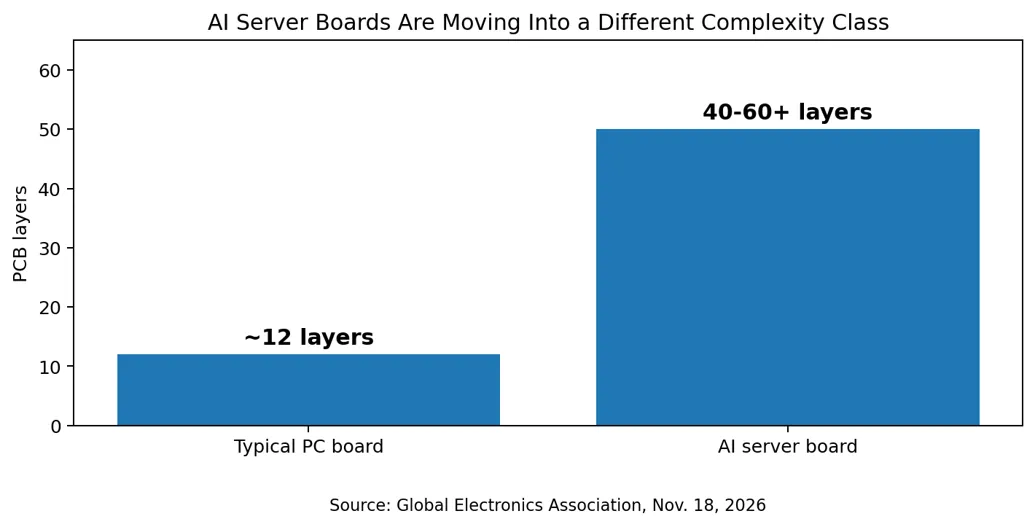
| 40-60+ | AI SERVER LAYER COUNTS A typical PC board is about 12 layers. AI-server boards are moving to 40-60+ layers, increasing demand for glass fabric, resin, copper foil and laminate. |
| 56.1% | BOOKINGS ARE OUTRUNNING SHIPMENTS North American PCB bookings increased 56.1% through September 2026, versus only 13.3% shipment growth. |
| 16-20 wks | HIGH-LAYER LEAD TIMES High-layer PCB lead times are now running 16-20 weeks or more, with meaningful supply-chain relief viewed as unlikely before mid-2028. |
The PCB shortage has moved from a component-level procurement issue to a capacity-allocation problem. AI infrastructure is consuming the most complex boards, the most constrained materials and a disproportionate share of premium fabrication capacity. The result is a two-speed market: hyperscalers are locking in high-layer, low-loss capacity while automotive, industrial, telecom, medical and defense buyers increasingly compete for the remaining slots.
1. AI Is Not Just Adding PCB Demand - It Is Multiplying Material Intensity
Request Sample: https://www.datamintelligence.com/download-sample/printed-circuit-board-pcb-market
The constraint is not simply the number of boards being ordered. AI server PCBs are structurally more material-intensive. Moving from roughly 12 layers to 40-60+ layers multiplies the number of copper, prepreg, glass-fabric and laminate interfaces that must be produced, aligned, laminated, drilled and tested. This makes a unit of AI demand much harder to absorb than a unit of conventional electronics demand.
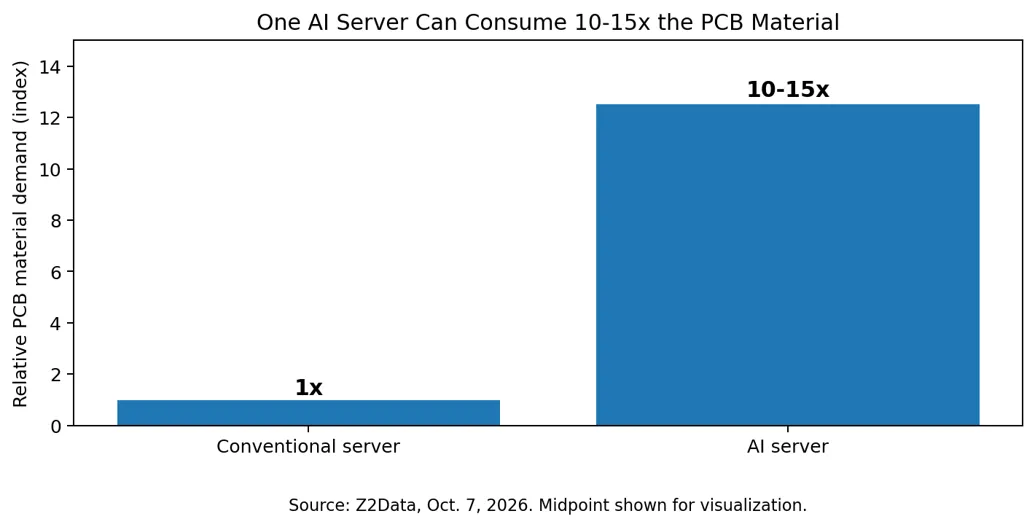
Z2Data cites estimates that a single AI server can require 10-15 times the PCB materials of a conventional server. This is broader than the layer-count ratio alone because AI systems also use larger, higher-performance boards and specialized low-loss materials. The commercial implication is that hyperscaler growth can consume upstream material capacity much faster than headline server-unit growth suggests.
2. The Real Shortage Signal Is the Booking-to-Shipment Gap
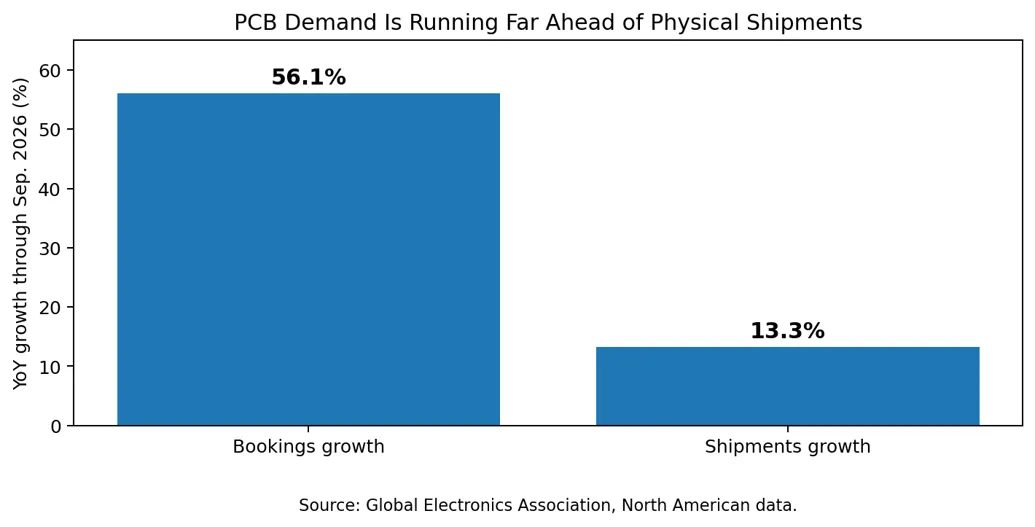
Bookings rising 56.1% while shipments increase only 13.3% is a classic allocation signal. Fabricators are receiving demand faster than they can physically convert it into shipped boards. For high-layer products, lead times have extended to 16-20 weeks or more, and the Global Electronics Association warns that the availability problem may rival the 2021 chip shortage.
3. AI Capacity Is Pulling the Market Toward High-Layer Boards
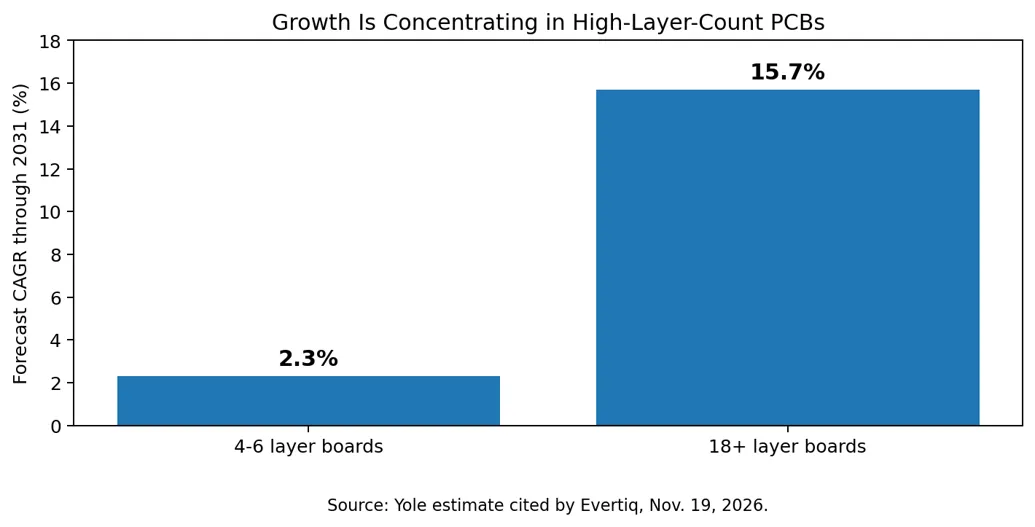
The market is splitting by complexity. Yole estimates cited by Evertiq put 18+ layer PCB growth at 15.7% annually through 2031, versus only 2.3% for 4-6 layer boards. AI-grade boards and materials are already estimated at roughly 30% of the PCB market and could exceed half by 2031. That changes where manufacturers allocate new equipment, engineering talent and raw-material contracts.
4. Why New Fabs Alone Do Not Solve the Problem
More than 90% of global PCB production is concentrated in Asia. The Global Electronics Association says at least US$10 Bn has been invested in new PCB plants in Southeast Asia over the last three years, with at least as much in China. Yet new board capacity still depends on constrained inputs including glass fabric, copper foil, resin and copper-clad laminate. Z2Data reports mainstream CCL prices up more than 270% year over year, prepreg costs up about 180% from August 2025 to August 2026, E-glass fabric up roughly 140% and epoxy-resin lead times extending from around three weeks to as much as 15 weeks for some producers.
Commercial Signals for PCB Buyers and Suppliers
| Signal | What is changing | Commercial implication |
| AI/hyperscaler allocation | Premium high-layer capacity is being locked early | Longer commitments, deposits and forecast visibility become procurement advantages |
| Material bottlenecks | Low-loss glass, CCL, copper foil and resin remain constrained | Qualifying alternate materials and second sources becomes strategic, not tactical |
| Cross-sector displacement | Automotive, defense, telecom and industrial buyers are pushed back | Non-AI programs need earlier sourcing decisions and critical-program prioritization |
| Capacity bifurcation | New investment favors high-layer and AI-grade products | Supplier economics shift toward complex boards and higher-value material systems |
5. What the PCB Market Report Needs to Track Now
A useful PCB market view can no longer stop at total demand by board type. Buyers now need visibility into high-layer capacity by supplier, AI versus non-AI allocation, lead-time movement, low-loss laminate and glass availability, regional capacity additions, material qualification timelines and customer-priority rules. The key question is not only how much PCB demand exists, but which demand gets access to constrained fabrication and materials first.
This is also why automotive, defense, telecom and industrial customers need a more granular supplier map. As AI absorbs premium capacity, procurement risk increasingly depends on layer count, material set, qualification status, supplier region and end-market priority. Companies that understand those constraints earlier can lock capacity, qualify alternates and avoid being pushed into the back of the queue.
Report Description Overview Addition
AI infrastructure is creating a structural shift in the printed circuit board supply chain. While a typical PC board uses about 12 layers, advanced AI-server boards are moving toward 40-60+ layers and consume substantially more glass fabric, resin, copper foil and laminate per system. In 2026, PCB bookings in North America increased 56.1% through September while shipments grew only 13.3%, with high-layer board lead times extending to 16-20 weeks or more. This imbalance is increasing the strategic importance of multilayer and high-speed PCBs, low-loss materials and suppliers with secured access to advanced fabrication capacity.
The AI-driven capacity squeeze is also reshaping procurement across automotive, telecommunications, industrial, medical and aerospace and defense applications. Hyperscalers are locking in premium high-layer capacity and upstream materials, while other sectors face longer qualification cycles, tighter allocations and higher sourcing risk. As a result, competitive advantage in the PCB market is increasingly linked to layer-count capability, material availability, regional manufacturing footprint, customer-priority allocation and the ability to qualify alternate laminate, prepreg and copper-foil sources as supply constraints persist into 2027 and potentially 2028.