


AI in drug discovery is moving from technology demonstrations toward a more practical test: can a platform help identify promising targets, design useful molecules, and advance candidates through development with a pharmaceutical partner?
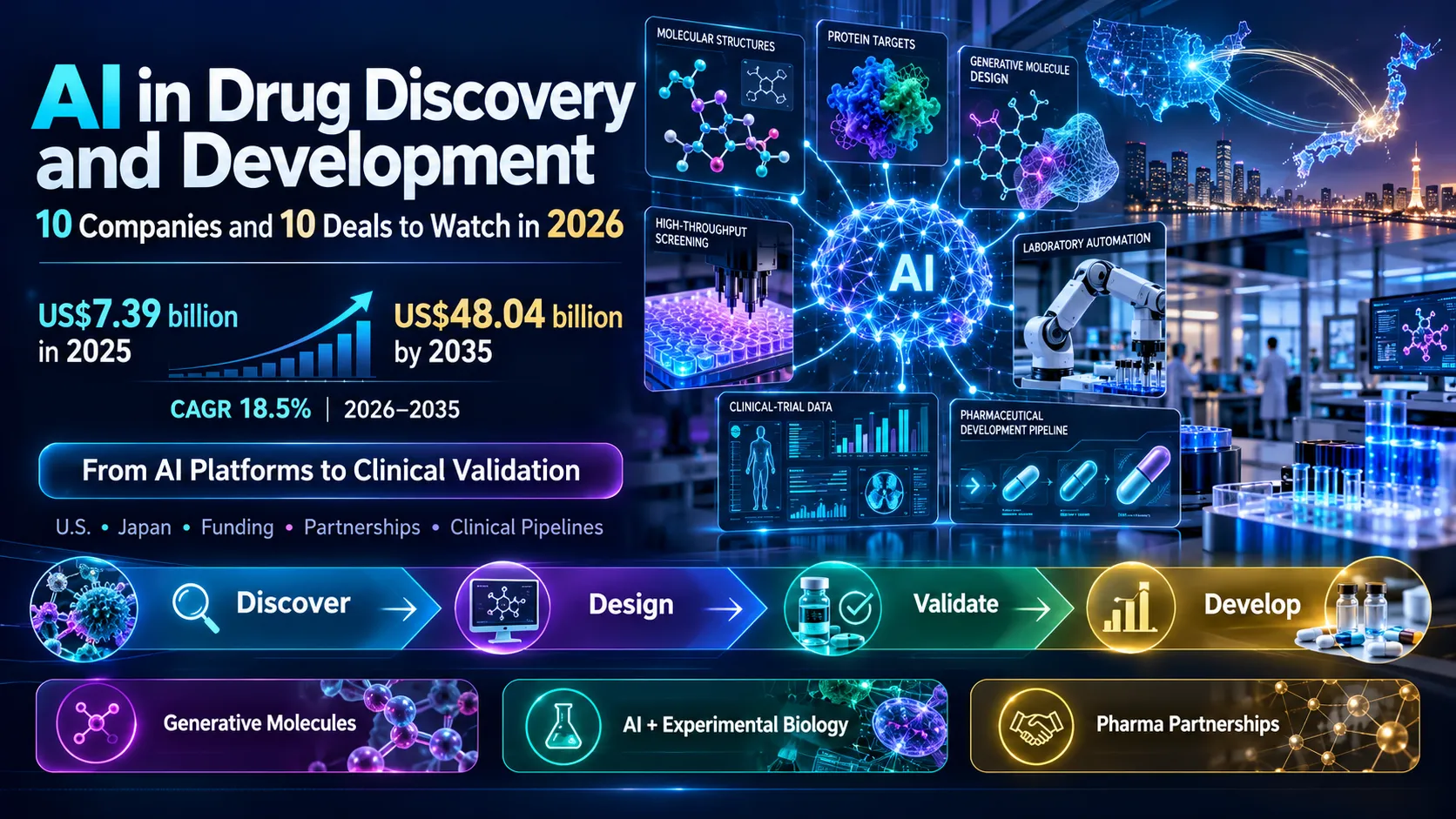
DataM Intelligence estimates that the global AI in drug discovery and development market reached US$7.39 billion in 2025 and could reach US$48.04 billion by 2035, at a projected CAGR of 18.5%. The companies and deals below show where investors and pharmaceutical partners are placing bets-and where those bets still need validation.
Request Sample: https://www.datamintelligence.com/download-sample/ai-in-drug-discovery-and-development-market
What Changed in the last six months?
Pipeline progress is becoming a stronger signal. Insilico Medicine reported that its AI-enabled candidate rentosertib entered Phase III development. Recursion announced that Sanofi optioned a candidate from their collaboration, triggering a milestone payment. Enveda’s September financing followed early clinical readouts for two medicines discovered using its AI platform. These milestones are worth tracking because they connect platform claims with drug-development progress, though none alone establishes clinical or commercial success.
Pharmaceutical partnerships are increasingly tied to programs and assets. Insitro and AstraZeneca signed a discovery and licensing collaboration for MASH and cardiomyopathies. AbbVie and Iambic announced a multi-year small-molecule discovery collaboration. Ono and Aitia are applying causal AI to neurological disease research. Across these agreements, partners combine AI capabilities with disease expertise, experimental work, clinical development, or commercialization.
Japan is developing a broader commercial ecosystem. ITOCHU’s capital alliance with MOLCURE is intended to connect AI-driven candidate creation with preclinical and clinical development support. Takeda’s collaboration with Insilico adds another Japan-U.S. example, while Ono’s partnership with U.S.-based Aitia targets neurological disease mechanisms. Together, these moves show different routes to adoption: strategic investment, joint research, and access to a partner’s discovery platform.
Top 10 companies to watch
This is a curated watchlist based on recent platform, pipeline, partnership, and funding activity. It is not a ranking by market share.
- Insilico Medicine - Combines generative AI with drug discovery programs and announced collaborations with Takeda and SK Biopharmaceuticals. Its pipeline progress makes it a key company to follow.
- Isomorphic Labs - Raised US$2.1 billion in Series B funding to scale its AI drug-design engine and progress its therapeutic pipeline.
- Recursion Pharmaceuticals - Combines AI-enabled discovery with a drug pipeline; its October financing and Sanofi milestone put clinical and partnership progress in focus.
- Enveda Biosciences - Uses AI to search natural chemistry for potential medicines. Its US$311 million Series E will support clinical programs and platform expansion.
- Schrödinger - Its computational discovery platform and Bunsen AI co-scientist are being applied in a strategic agreement with Bristol Myers Squibb.
- insitro - Applies AI to human and cellular data. Its AstraZeneca collaboration focuses on identifying causal disease biology and advancing programs toward development candidates.
- Iambic Therapeutics - Its AI-driven discovery and development platform is being used in a multi-year AbbVie collaboration across immunology, neuroscience, and oncology.
- XtalPi - Combines AI, physics-based modeling, and robotics; in September it announced a U.S. FDA IND submission for an internally developed candidate.
- Aitia - Uses causal AI and digital-twin models to identify disease targets. Ono selected its technology for a neurological disease partnership.
- MOLCURE - Japan-based AI drug discovery company focused on antibodies and peptides. Its capital alliance with ITOCHU is intended to connect discovery with development support.
10 major funding, partnership, and M&A developments
The amounts below are not directly comparable: some are cash raised, while others include potential milestones, royalties, or undisclosed terms.
| Announcement | Deal signal |
| Isomorphic Labs, May | Raised US$2.1 billion in Series B funding. |
| Insilico Medicine-SK Biopharmaceuticals, June | Potential deal value above US$2.5 billion; Insilico disclosed up to US$18 million in upfront and near-term milestones. The larger figure includes contingent milestones and royalties. |
| Insilico Medicine-Takeda, July | Insilico reported approximately US$600 million in total potential value, including project initiation fees, near-term payments, and milestones. |
| Dassault Systèmes-ArisGlobal, July | Announced an acquisition for about US$1.8 billion cash, plus up to US$200 million tied to AI-related revenue milestones. This is adjacent life-sciences AI: ArisGlobal focuses on regulated operations and patient-safety workflows. |
| Ono-Aitia, September | Partnership for neurological disease target discovery. |
| Schrödinger and Tectora, September | Tectora, co-founded with Schrödinger, closed a US$55 million Series A to advance immunology and inflammation programs. |
| Enveda, September | Raised US$311 million in Series E funding to advance clinical programs and scale its platform. |
| AbbVie-Iambic, September | Multi-year collaboration with upfront payment, milestones, and royalties; amounts were not disclosed. |
| ITOCHU-MOLCURE, October | Japan capital alliance; financial terms were not disclosed. The stated aim is to link AI-driven candidate creation with development support. |
| Recursion, October | Raised US$200 million in a follow-on offering and announced a Sanofi option milestone. |
Request Sample: https://www.datamintelligence.com/download-sample/ai-in-drug-discovery-and-development-market
U.S. and Japan: different routes to adoption
In the United States, recent activity highlights fundraising, clinical-stage pipelines, and pharmaceutical collaborations. Enveda and Recursion announced significant financing, while AbbVie-Iambic and AstraZeneca-insitro show how pharma companies are integrating AI platforms into disease-focused research programs.
In Japan, the recent story is the formation of partnerships that connect discovery with development. Takeda’s work with Insilico, Ono’s agreement with Aitia, and ITOCHU’s capital alliance with MOLCURE give the market three distinct models: co-discovery, licensing or option rights, and investment combined with development support. None of these announcements discloses every commercial term, so the value should be assessed from the stated scope and structure-not inferred from an unreported price.
What decision-makers should watch next
The next test for AI drug discovery is whether platforms can produce repeatable results across different targets, modalities, and disease areas. Relevant evidence will include candidate quality, reproducibility, development timelines, clinical progress, and partner decisions to continue or expand programs.
Data access and experimental validation will also matter. AI can prioritize hypotheses, but proposed targets and molecules must still withstand biological testing and development requirements. Companies that connect models with high-quality data, laboratory work, and experienced development partners may be better positioned to translate discovery into viable programs.
The recent funding and partnership announcements show that the sector is attracting capital and pharmaceutical interest. The more useful measure of progress will be how many programs advance-and what evidence they produce along the way.
Frequently Asked Questions
Which AI drug discovery companies announced notable activity in 2026?
Insilico Medicine, Isomorphic Labs, Recursion, Enveda, Schrödinger, Insitro, Iambic, XtalPi, Aitia, and MOLCURE are among the companies with relevant funding, partnership, or pipeline announcements during the review period.
What was the largest funding announcement in this review?
Isomorphic Labs announced a US$2.1 billion Series B in May 2026.
Which recent announcements involved Japanese companies?
Takeda-Insilico, Ono-Aitia, and ITOCHU-MOLCURE are prominent Japan-linked developments in the period.
Do large deal values mean the money has already been paid?
No. Some figures are potential milestone and royalty values. The blog should distinguish disclosed upfront payments from contingent future payments and undisclosed terms.