


United States Choline Supplements Market Size and Forecast 2035
As per DataM Intelligence analysis, the United States choline supplements market was US$ 210.11 Million in 2025 and is expected to reach up to US$ 424.34 Million in 2035, growing at a CAGR of 7.4% during the forecasting period (2026-2035).
The U.S. choline supplements market is shifting from basic nutrient inclusion to targeted supplementation. FDA sets choline’s daily value at 550 mg. NIH highlights that typical supplement doses range from 10 mg to 250 mg using choline bitartrate, phosphatidylcholine or lecithin.
Prenatal nutrition is the country’s strongest adoption platform. In 2025, CDC recorded 3,606,400 U.S. births, while NIH says 90% to 95% of pregnant women consume less choline than the adequate intake, and prenatal supplements often include little or no choline.
Consumer need is clear because many adults do not get enough choline. NIH reports average daily intake from foods and drinks is 402 mg for adult men and 278 mg for adult women while supplements add only a small share.
Ingredient suppliers are supporting choline with stronger investment rather than viewing it as a basic commodity. Balchem’s Human Nutrition and Health segment reported 2025 net sales of US$ 659.4 million, up 9.9%, with growth driven by nutrients and food ingredient solutions.
Premium cognition is becoming the next major growth area after prenatal nutrition. Kyowa Hakko USA promotes Cognizin citicoline for focus, attention and memory. The company says the ingredient is used in over 200 supplements and functional beverages, supporting premium nootropic products and active lifestyle positioning for consumers seeking mental performance.
Choline products are becoming more specific as brands use different forms such as choline bitartrate, choline chloride, phosphatidylcholine, lecithin, alpha GPC and citicoline. Official supplement references such as common choline amounts from 10 mg to 250 mg. USP 2025 sets choline bitartrate purity at 99% to 100.5% by specification.
Product strategy is moving from adding small amounts of choline in multivitamins to creating dedicated non-animal choline products. For instance, MegaFood’s vegan prenatal option with 400 mg plant-based DHA and 300 mg choline shows that brands can link fetal brain support with clean-label plant-based delivery for modern prenatal consumers in the market.
Premium brands are increasingly focusing on dosage. Nature Made’s prenatal product provides 265 mg choline with folic acid and DHA while public guidance recommends 450 mg daily during pregnancy. The gap supports higher dose capsules and repeat purchase maternal nutrition models built around clearer intake needs and stronger value communication
Key Takeaways
- Cognitive health applications dominate demand, with increasing use of choline supplements for memory, focus, and brain performance.
- Cognitive Enhancement & Nootropics captured 25.25% of total market revenue in 2025, making it the leading application segment for choline supplements.
- Prenatal nutrition is a major growth driver, as awareness of choline's role in fetal brain development continues to rise.
- Citicoline and Alpha-GPC are gaining popularity, particularly among nootropic and brain-health consumers seeking premium formulations.
- E-commerce channels are expanding rapidly, driven by consumer preference for online supplement research, reviews, and direct-to-consumer purchases.
- Clean-label and plant-based supplements are becoming key differentiators, with consumers increasingly demanding vegan, non-GMO, and transparent ingredient formulations.
U.S. Choline Supplements Market Scope
| Metric | Details |
| Market Size in 2025 | USD 210.11 million |
| Market Forecast 2035 | USD 424.34 million |
| U.S. Choline Supplements Market CAGR | 7.4% |
| Historic Years | 2023-2024 |
| Base Year | 2025 |
| Forecast Years | 2026-2035 |
| Country Covered | United States |
| Leading Demand Platform | Prenatal and Maternal Nutrition |
| Key Growth Application | Brain Health, Cognitive Wellness and Nootropics |
| by Ingredient Types | Alpha-GPC, CDP-Choline/Citicoline, Choline Bitartrate, Choline Chloride, Phosphatidylcholine, Lecithin-Based Choline and Others |
| by Sources | Natural and Synthetic |
| by Forms | Tablets and Capsules, Powder, Liquid, Softgels and Gummies |
| by Applications | Brain Health, Prenatal and Maternal Nutrition, Pediatric Nutrition and Infant Formula, Healthy Aging and Longevity, Sports Nutrition and Performance, Liver and Metabolic Health and Others |
| by End Users | Infants and Children, Adolescents, Adults, Geriatric Population, Pregnant and Lactating Women |
| Key Companies | Nestlé, NOW Foods, Jarrow Formulas, Thorne, Life Extension, Nutricost, Swanson Health Products, Nature’s Way, Doctor’s Best, Source Naturals, Transparent Labs and Nootropics Depot |
| Report Insights Covered | Market Size, Market Share, Growth Analysis, Demand Forecast, Competitive Landscape, Company Profiles, Ingredient Strategy, Formulation Trends, FDA Labeling, Dosage Positioning, DTC Channel Strategy and Recent Developments |
MARKET DYNAMICS
DRIVERS
Rising Prenatal Nutrition Awareness Boosts Choline Supplementation Among Pregnant Women
Rising clinical awareness around fetal brain development is significantly increasing prenatal choline supplementation adoption globally. According to the U.S. National Institutes of Health Office of Dietary Supplements, pregnant women require 450 mg/day of choline, yet only 7.7% of U.S. pregnant women achieve recommended intake levels. NIH further reports that approximately 90–95% of pregnant women consume insufficient choline, creating a substantial nutritional gap. This deficiency awareness is driving obstetricians, prenatal nutrition specialists, and supplement manufacturers to integrate higher-choline formulations into maternal health portfolios, particularly across North America and Europe where preventive prenatal nutrition programs continue expanding.
NIH data also highlights that low maternal choline intake is associated with a 36% higher risk of neural tube defects and a 33% higher risk of spina bifida in offspring. As healthcare systems increasingly emphasize early-life cognitive health interventions, supplement companies are investing in premium prenatal formulations combining choline with DHA, folate, and omega-3 nutrients. This trend is accelerating product innovation strategies aimed at supporting fetal cognitive development and reducing long-term developmental health risks.
Rapid Growth of E-commerce and Direct-to-consumer Supplement Brands
Nutritional shortfall is creating high-intent online demand. Pregnancy and lactation remain strong digital entry points, as recommended choline intake is 450 mg per day during pregnancy and 550 mg during lactation. Around 90% to 95% of pregnant women consume below adequate levels, creating a clear search-led need for prenatal choline products.
E-commerce is becoming a stronger supplement discovery channel. The retail e-commerce in the U.S. increased from 15.9% of total retail sales in the first quarter of 2024 to 16.9% in the first quarter of 2026. In Europe, 78% of internet users bought online in 2025, giving choline brands a wider route to educate and convert consumers.
Direct-to-consumer brands are building choline into pregnancy regimens. For instance, Ritual positions Natal Choline around a 550 mg dose and links it to a studied 930 mg daily intake during pregnancy. Online bundles priced from US$ 68 to US$ 101 place choline alongside prenatal multivitamins and omega three, making it part of a planned maternal routine.
Subscription models encourage regular buying and commitment. A specialized choline supplement provides 500 mg choline chloride per capsule, while prenatal formulations offer 400 mg, 150 mg, or 100 mg options for different maternal needs. Subscription plans with 10%, 15%, and 20% discounts encourage long-term purchases and improve customer retention.
Growing Adoption of Preventive Healthcare Enhances Demand for Vital Nutrient Supplements
Preventive healthcare is increasing awareness of choline as an essential nutrient for daily health rather than a niche supplement. Recommended intake levels of 550 mg for men and 425 mg for women provide clear guidance, helping supplement brands promote choline for supporting everyday nutritional needs and nutrient sufficiency.
Low choline intake among adults is creating steady demand for choline supplements. According to U.S. nutrition data, average daily intake is around 402 mg for men and 278 mg for women, which is below recommended adequate intake levels. This nutritional gap is encouraging health-conscious consumers to use choline supplements as part of their daily wellness and preventive health routines.
Companies are increasingly developing choline-based nutrition products focused on preventive health. In 2024, Balchem introduced three new human nutrition solutions, including VitaCholine Pro Flo for multivitamins and Optifolin Plus, a choline-enhanced folate ingredient. In November 2025, Balchem also reported that Optifolin Plus showed 2.6 times higher bioavailability and was absorbed 3.5 times faster than conventional folic acid.
RESTRAINTS
Premium-priced Specialty Formulations Constrain Penetration In Developing Economies
Many choline supplements contain only 10–250 mg per serving, which is below the U.S. FDA’s recommended daily value of 550 mg. To meet daily requirements, consumers often need multiple servings, increasing monthly expenses. This makes premium choline supplements less affordable, particularly in price-sensitive developing countries where purchasing power is limited.
Lower-cost choline supplements create strong competition for premium products. For example, NOW Foods offers Choline and Inositol at US$ 15.99 for 100 capsules. As a result, premium citicoline and phosphatidylcholine brands must demonstrate stronger clinical benefits. However, in developing markets, consumers often choose affordable products over advanced formulations and branded ingredient technologies.
Insufficient Clinical Standardization Across Supplement Formulations Creates Market Uncertainty
Different forms of choline are used in supplements, including choline bitartrate, phosphatidylcholine, lecithin, choline chloride, choline dihydrogen citrate, and choline orotate. According to the National Institutes of Health, there is limited human research comparing how well these forms are absorbed and used by the body. As a result, consumers may be unsure whether the same choline dosage provides the same health benefits across different supplement types.
Quality requirements in the supplement industry are becoming stricter. U.S. FDA current good manufacturing practice (cGMP) regulations require finished products to meet specifications for identity, purity, strength, composition, and contamination limits. In July 2025, an FDA warning letter highlighted inadequate product specifications, increasing retailer caution toward multi-ingredient choline supplement formulations.
Clinical guidance generally supports choline intake during pregnancy, but recommendations are not fully standardized. A 2024 review by the Canadian Agency for Drugs and Technologies in Health found that most guidelines were based on limited evidence or expert opinion. Recommended choline intake through diet or supplements ranged from 350 mg to 600 mg, creating challenges for consistent guidance.
OPPORTUNITIES
Expanding Prenatal Supplement Formulations Incorporating Clinically Validated Choline Dosages
Current intake levels highlight a clear opportunity. Only 7.7% of pregnant women in the U.S. aged 20–40 consume more than the recommended adequate intake of choline through food. Prenatal supplements with clearly stated choline content can help fill this nutritional gap while addressing a well-recognized need without making broad wellness claims.
Label transparency is becoming an important factor in the prenatal supplement market. May 2025 review by the University of Colorado Anschutz Medical Campus found that only 12 out of 47 prenatal vitamins listed choline, and just 5 products provided the amount stated on their labels. Accurate and verified choline labeling helps build confidence among healthcare professionals and expecting parents.
Leading brands are increasingly highlighting brain development nutrients in prenatal supplements. For example, Bayer’s one a day prenatal advanced contains 110 mg of choline, 200 mg of DHA, and 800 mcg of folic acid. In comparison, many other prenatal multivitamins provide only 0–55 mg of choline. Strong retail presence also helps consumers better understand the importance of choline during pregnancy.
Partnerships Between Nutraceutical Brands and Healthcare Professionals
Partnerships with clinicians are becoming an effective way to increase trust in choline supplements, as the category is closely linked to nutrition education, pregnancy health, and cognitive wellness. A key opportunity lies in clinician-backed guidance that helps consumers understand choline deficiencies, appropriate dosage levels, reliable product labeling, and easy access through healthcare professionals, pharmacists, and prenatal care providers.
Perelel (women's health and wellness company) is a strong example of medical co-creation. Its choline boost provides 550 mg of choline per daily serving, uses VitaCholine from Balchem, and is recommended by a board-certified maternal-fetal medicine specialist. Trimester-based, breastfeeding, and subscription options support a clinician-guided consumer journey.
Standard Process (nutritional supplement company) demonstrates that practitioner-guided access helps reduce patient confusion. Its Choline supplement provides 180 mg per serving and is available through healthcare professionals. Through patient direct, practitioners can share access codes, supervise patient purchases, and allow 24-hour ordering while keeping consultation and product selection connected.
Why Choline Supplements Are Gaining Demand in U.S. Preventive Nutrition
Choline is becoming a more visible nutrient because it connects with several high-intent health concerns: pregnancy nutrition, fetal brain development, focus, memory support, liver function, healthy aging and daily nutrient sufficiency. This gives the U.S. choline supplement industry outlook a stronger commercial foundation than a single-use wellness product.
The U.S. consumer base is also more educated about supplement formats. Buyers are not only asking whether a product contains choline. They are asking which choline form is used, how much is provided per serving, whether the product is vegan, whether the ingredient is third-party tested, and whether the label clearly explains the dose.
This creates a clear opportunity for brands that can make choline easier to understand. The category still suffers from low consumer awareness compared with folate, DHA, magnesium or vitamin D. However, the gap is becoming an advantage for companies that build education-led product pages, clinician-backed prenatal formulas, nootropic comparison content and subscription-based maternal nutrition bundles.
U.S. Prenatal Choline Supplements and Maternal Nutrition Gap
Prenatal nutrition is the strongest adoption platform for choline supplements in the United States. The reason is simple: pregnancy creates a clearer nutrient need, but many prenatal products still provide limited choline.
In 2025, CDC recorded 3,606,400 U.S. births, creating a large annual consumer base for pregnancy and postnatal nutrition products. Choline demand is particularly relevant because NIH-based data shows that 90% to 95% of pregnant women consume less choline than the adequate intake, and only 7.7% of U.S. pregnant women aged 20-40 consume more than the recommended adequate intake from food.
This creates a practical product gap. Many prenatal multivitamins focus heavily on folate, iron, iodine, vitamin D and DHA. Choline is increasingly being added, but often at levels that are below the daily intake requirement. A 2025 review found that only 12 out of 47 prenatal vitamins listed choline, and just 5 products provided the amount stated on their labels. For consumers and healthcare professionals, this raises two issues: whether prenatal products contain choline at all, and whether the label amount is accurate.
The strongest prenatal product strategy is not simply to add a token dose. Brands can differentiate through clearly stated choline content, pregnancy-specific dosage logic, choline and DHA prenatal supplements, trimester-based bundles, lactation products and clinician-backed education. Products such as MegaFood’s vegan prenatal formula with 400 mg plant-based DHA and 300 mg choline show how brands can connect fetal brain support with clean-label, non-animal delivery. Nature Made’s prenatal product with 265 mg choline, folic acid and DHA also reflects how mainstream brands are moving toward more visible choline inclusion.
Supply Chain / Value Chain Analysis
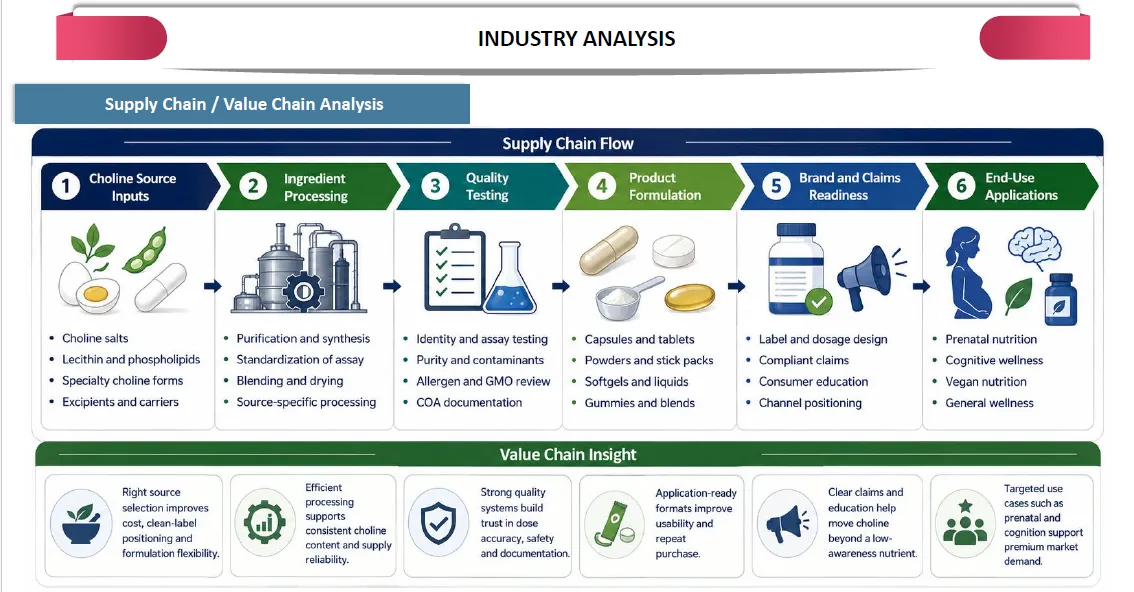
Analyst Opinion
- Ingredient demand is expected to move toward premium and science backed formats. Alpha GPC, CDP Choline and phosphatidylcholine are likely to gain stronger traction due to cognition, prenatal nutrition and healthy aging use cases. Choline bitartrate will remain important because of affordability while choline chloride and lecithin-based choline will support wider value driven adoption.
- Tablets and capsules are expected to remain the most preferred format due to convenience, dosage control and strong acceptance in pharmacies and online channels. Powders will gain momentum among sports nutrition and functional wellness users. Softgels will support premium lipid-based delivery while gummies and liquids will grow through easier use among children, adults seeking convenience and first-time supplement buyers.
- Brain health will remain a major demand driver as consumers link choline with memory, focus and cognitive performance. Nootropic positioning is expected to become more premium across developed markets. Brands can improve adoption by using clearer benefit communication, clean labels, clinical references and product education that explains how different choline forms support daily mental performance.
- Prenatal and maternal nutrition will be one of the most important growth areas during the forecast period. Pediatric nutrition, healthy aging, sports performance and liver support will also strengthen the market. DMI expects stronger opportunities for brands that connect choline with life stage nutrition, clinician education, pregnancy health, infant development and age-related cognitive wellness.
- Synthetic choline will continue to support mass market supply because of cost efficiency, stable availability and broad use across standard supplement formats. Natural sources will gain faster brand attention as consumers look for clean label and plant linked positioning. Companies can improve differentiation by offering transparent sourcing, better ingredient traceability and clear claims around natural choline benefits.
- Adults will remain the largest target group as choline aligns with cognition, productivity, liver health and general wellness. Pregnant and lactating women will become a stronger priority due to rising awareness of fetal brain development. Geriatric consumers will support healthy aging demand while infants, children and adolescents will need careful dosage communication and trusted professional recommendations.
- DMI believes the global choline supplements market will perform strongly from 2025 to 2035 as demand shifts from basic nutrient inclusion toward evidence-based health positioning. Best placed brands will combine premium ingredients, simple consumer education, clinician backed messaging and convenient formats. Growth will depend on trust, compliance, retail access and clear links to cognition, prenatal care and healthy aging.
United States Choline Supplements Market Segmentation
BY INGREDIENT TYPE
- Alpha-GPC
- CDP-Choline (Citicoline)
- Choline Bitartrate
- Choline Chloride
- Phosphatidylcholine (PC)
- Lecithin-Based Choline
- Others
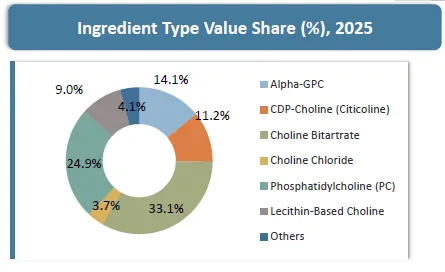
Alpha-GPC is gaining stronger relevance as a premium choline ingredient because it fits cognitive support, active lifestyle and functional beverage positioning. Unlike basic choline salts, it is positioned around acetylcholine support, mental performance and higher-value nootropic formulations, making it attractive for capsules, powders, gummies and fortified drinks.
This premium positioning is being reinforced by clinical evidence around short-term cognitive performance. A 2024 Nutrients study by Kerksick et al. tested 315 mg and 630 mg Alpha-GPC in healthy men and found significant improvement in Stroop cognitive performance, supporting its use in focus and productivity-oriented supplements.
As evidence strengthens, regulatory activity is also helping Alpha-GPC move beyond conventional capsules into broader delivery formats. FDA’s GRAS notice (2024) listed L-alpha-glycerophosphorylcholine as a choline source for use up to 600 mg/serving across sports drinks, energy drinks, powdered mixes, gummies, nutrition powders and bars, showing wider dosage-form flexibility.
Wider format expansion also increases formulation and compliance responsibility for brands. Health Canada’s 2024 safety assessment concluded AGPC can be considered a supplemental choline source, while reviewed human studies used oral doses up to 1,200 mg/day; therefore, brands must manage dosage clarity, safety positioning, label accuracy and premium pricing expectations.
BY FORM
- Tablets and Capsules
- Powder
- Liquid
- Softgels
- Gummies
Tablets and capsules are commercially relevant for choline supplements because they can deliver higher choline amounts in a compact serving while masking the natural taste and odor challenges of choline ingredients.
This dosage-form advantage is becoming especially important in prenatal nutrition, where higher choline requirements are difficult to deliver through gummies alone. In March 2026, SmartyPants launched Prenatal Plus Multivitamin Capsules with 480 mg of choline per daily serving, showing how capsule formats are being used to meet higher maternal nutrition expectations.
Beyond prenatal use, this category is also moving toward format engineering rather than simple encapsulation. Vantage Nutrition stated that the VitaCholine liquid capsule platform can deliver 275 mg to 550 mg of free choline in a single capsule serving, while capsule banding helps improve leak prevention, capsule strength, shelf life and formula potency.
As tablets and capsules scale across adult, prenatal and performance nutrition, brands need stronger control over dosage accuracy, ingredient stability and label consistency. FDA’s dietary supplement cGMP rules under 21 CFR Part 111 require manufacturers, packagers, labelers and holders of dietary supplements to follow quality controls, making tablets and capsules commercially important where choline products must deliver reliable potency, stable shelf life and clearly declared active choline content.
BY APPLICATION
Brain Health
Prenatal & Maternal Nutrition
Pediatric Nutrition & Infant Formula
Healthy Aging & Longevity
Sports Nutrition & Performance
Liver & Metabolic Health
Others
The application of choline is becoming commercially important because it connects memory support, focus and attention, cognitive performance, nootropics and mood wellness under one broad brain-health positioning. NIH states that choline is needed to produce acetylcholine, a neurotransmitter involved in memory, mood, muscle control and broader brain and nervous system functions.
Memory Support is the most established brain-health use case because it connects choline supplementation with acetylcholine activity, phospholipid metabolism and age-related cognitive maintenance. Brands are using multiple choline forms for this positioning: citicoline for brain bioavailability, Alpha-GPC for acetylcholine support, and phosphatidylcholine or lecithin-based choline for membrane-health and healthy-aging.
In April 2024, OLLY launched Focus Buddies Brainy L’OLLY Pops with Cognizin Citicoline, positioned for attention and mental clarity in an on-the-go format. This shows how choline-based cognitive support is being translated into accessible daily-use products for students, professionals and consumers seeking non-stimulant focus support.
Similarly, Doctor’s Best launched Citicoline CDP-Choline in October 2024, a vegan formula featuring Cognizin Citicoline and positioned for focus, attention, memory and overall cognitive health. This reflects how premium standalone choline products are becoming more specialized and evidence-led, with branded choline ingredients helping companies differentiate brain-health supplements from generic cognition products
BY SOURCE
Natural
Synthetic
Natural choline is moving from a “basic nutrient” positioning to a premium clean-label platform, especially in prenatal nutrition, liver health, cognitive wellness and functional foods. Natural sources such as egg-derived nutrients, soy or sunflower lecithin, phosphatidylcholine, nuts, seeds, whole grains and vegetables are gaining relevance as brands strengthen food-derived, plant-based formulations.
Within this shift, sunflower lecithin is becoming one of the most practical natural choline carriers, as it supports non-GMO, allergen-conscious and plant-based positioning while also fitting food and beverage formats. FDA’s 2026 review evaluated sunflower lecithin as an emulsifier and dietary source of choline and fatty acids, including use levels up to 55,000 mg/kg in selected food applications, showing its relevance beyond capsules and softgels.
Prenatal nutrition gives natural choline a strong commercial route, as the category depends heavily on trust, safety and food-based credibility. ACOG recommends 450 mg/day of choline during pregnancy, with eggs, chicken, beef, milk, soy products and peanuts listed as natural dietary sources.
A 2025 AJCN study of 47 prenatal multivitamin and mineral products found that only 12 listed choline, and just 5 were within 20% of the claimed amount, highlighting an opportunity for natural-source brands that can offer verified content, clean-label sourcing and third-party testing.
BY END-USER
Infants & Children (0-12 years)
Adolescents (13-19 years)
Adults (20-64 years)
Geriatric Population (65+ years)
Pregnant & Lactating Women
Adolescents are becoming a more defined choline consumer group as puberty, brain maturation and active growth increase nutritional requirements. NIH lists choline Adequate Intake at 550 mg/day for boys aged 14-18 and 400 mg/day for girls aged 14-18, creating a clear basis for teen-specific choline positioning.
These higher and sex-specific requirements make adolescent products different from both pediatric and adult supplements. Instead of using generic multivitamin claims, brands can build teen-focused gummies, powders and cognitive wellness blends around study performance, nervous system support, liver metabolism and active lifestyle nutrition.
The relevance of choline in adolescence is also widening beyond cognitive health into growth-linked outcomes such as bone health. A 2024 Frontiers in Nutrition study using NHANES data included 3,800 participants, with an average age of 15 years, and found dietary choline intake was positively associated with total bone density, with a stronger association observed in males.
This broader positioning still requires careful dosage discipline because adolescents sit between child and adult nutrition. NIH sets the tolerable upper intake level at 3,000 mg/day for ages 14-18, making controlled-dose formats, clear serving guidance and responsible claims important for teen-focused choline supplements.
United States Choline Supplements Top Companies and Vendor Landscape
The U.S. choline supplements market is moderately fragmented and highly brand-driven. The top five companies, Nestlé, NOW Foods, Jarrow Formulas, Thorne and Life Extension, collectively hold around 22.68% of the market. Other players, including Nutricost, Swanson Health Products, Nature’s Way, Doctor’s Best, Source Naturals, Transparent Labs, Nootropics Depot and related regional brands, account for the remaining 77.33%.
| Company | U.S. Strategy Position | Commercial Relevance |
| Nestlé | Nutrition scale and maternal/infant wellness relevance | Strong fit for broader nutrition and life-stage supplementation |
| NOW Foods | Affordable supplement access | Important for mass-market choline bitartrate and choline with inositol |
| Jarrow Formulas | Science-led supplements and brain health positioning | Relevant to cognitive wellness and ingredient-focused consumers |
| Thorne HealthTech | Practitioner-trusted, premium formulations | Strong in phosphatidylcholine, Alpha-GPC, clean labels and clinical positioning |
| Life Extension | Healthy aging and premium wellness | Relevant to cognitive support, longevity and advanced formulations |
| Nootropics Depot | E-commerce-first nootropic specialization | Strong fit for Alpha-GPC, citicoline and high-intent online buyers |
| Doctor’s Best | Science-positioned supplement brand | Relevant to citicoline, cognitive health and ingredient-led formulas |
| Swanson Health Products | Value-focused online supplement retail | Supports affordable access and repeat purchase |
| Nature’s Way | Retail and wellness channel strength | Relevant to mainstream supplement consumers |
| Transparent Labs | Sports nutrition and performance positioning | Strong fit for Alpha-GPC and performance-focused stacks |
Thorne is a strong example of premium strategy. Its product portfolio includes Phosphatidyl Choline, Creatine + Alpha GPC, Pre-Workout Elite, Advanced Pre-Workout, Kids Multi+, Men’s Multi 50+ and Children’s Basic Nutrients. This shows how one brand can use choline across liver health, cognitive support, sports performance, pediatric nutrition and healthy aging rather than treating it as a single supplement SKU.
COMPANY PROFILES
Thorne Healthtech
Overview
Thorne is one of the key companies operating in the Global Choline Supplements Market, supported by its premium, science-backed and practitioner-trusted supplement positioning. The company’s relevance in the choline category is driven by products such as Phosphatidyl Choline, which is positioned for liver health, cellular function, cognitive performance, nervous system support and healthy fat metabolism. Thorne benefits from strong credibility among healthcare professionals, athletes, wellness consumers and premium supplement users due to its focus on clean-label formulations, quality testing and targeted nutrition solutions.
In the choline supplements market, Thorne is well placed to serve demand across brain health, liver support, prenatal wellness, healthy aging and performance nutrition applications. Its clinical-grade brand perception and evidence-led formulation approach strengthen its competitiveness in premium choline-based supplements.
Product Portfolio
Phosphatidyl Choline
Thorne Phosphatidyl Choline is used for liver health, brain support, cellular health and fat metabolism. Its main ingredient is phosphatidylcholine, a phospholipid that supports healthy cell membranes, bile flow, cognitive function and normal lipid transport.
Creatine + Alpha GPC
Creatine + Alpha GPC is used for muscle performance, cognitive support, power output and exercise recovery. Its main ingredients are creatine and Alpha GPC, supporting cellular energy production, strength performance, focus and brain-muscle communication.
Pre-Workout Elite
Pre-Workout Elite is used for workout performance, energy, focus, endurance and power output. Its main ingredients include Alpha GPC, beta-alanine, caffeine and PeakATP®, supporting mental focus, muscle performance, training intensity and exercise capacity.
Advanced Pre-Workout
Advanced Pre-Workout is used for energy, focus, endurance, power output and workout performance. Its main ingredients include Alpha GPC, beta-alanine, caffeine and PeakATP, supporting mental sharpness, training intensity, muscle performance and exercise capacity
Kids Multi +
Kids Multi+ is used for children’s daily nutrition, brain support, growth, immune health and energy metabolism. Its main ingredients include choline citrate, DHA, folate, iodine and essential vitamins, supporting cognitive development, nutrient balance and overall wellness.
Men's Multi 50+
Men’s Multi 50+ is used for men’s daily nutrition, energy metabolism, brain support, immune health and healthy aging. Its main ingredients include choline citrate, B vitamins, minerals and antioxidants, supporting cognitive wellness, cellular energy, heart health and overall nutrient balance.
Children's Basic Nutrients
Children’s Basic Nutrients is used for children’s daily nutrition, growth, brain support, immune health and energy metabolism. Its main ingredients include choline citrate, essential vitamins and minerals, supporting nutrient balance, nervous system function and overall wellness.
Adoption Barriers: Awareness, Price, Dosage Confusion and Label Accuracy
The U.S. choline supplements market has strong demand signals, but adoption barriers remain.
Consumer awareness is still low. Many consumers understand folate, DHA and omega-3 better than choline, especially in prenatal nutrition. This creates a need for education-led marketing and clinician-backed communication.
Price is another barrier. Choline bitartrate is affordable, but premium citicoline, Alpha-GPC and phosphatidylcholine products cost more. In a crowded supplement market, brands need to justify premium pricing with clear ingredient benefits, testing and credible positioning.
Dosage confusion is a major issue. Products may provide anywhere from small multivitamin amounts to higher standalone doses. Consumers may not understand the difference between Daily Value, adequate intake, free choline amount and ingredient compound weight.
Label accuracy is a trust issue. When prenatal products list choline but fail to deliver the stated amount, the category loses credibility. Third-party testing, cGMP compliance and transparent Supplement Facts panels can help solve this.
Recent Developments in U.S. Choline Supplement Formulations
In April 2026, the nutraceutical industry continued to report stronger demand for cognitive health and prenatal wellness supplements, supporting choline-based formulation expansion.
In March 2026, SmartyPants launched Prenatal Plus Multivitamin Capsules with 480 mg of choline per daily serving, showing how capsule formats are being used to meet higher maternal nutrition expectations.
In 2026, Vantage Nutrition highlighted a VitaCholine liquid capsule platform capable of delivering 275 mg to 550 mg of free choline in a single capsule serving, supporting higher-dose and shelf-stable formats.
In February 2026, AI-enabled personalized nutrition platforms gained traction, including nutrient recommendations for choline-based cognitive and prenatal products.
In November 2025, Balchem reported that Optifolin Plus showed 2.6 times higher bioavailability and was absorbed 3.5 times faster than conventional folic acid, strengthening the company’s role in advanced prenatal and nutrient delivery.
In October 2025, investment activity increased around microencapsulation, advanced nutrient delivery and condition-specific cognitive wellness products.
In August 2025, AAK launched AkoVita OptiSyn, a DHA and phosphatidylcholine blend designed for immune and metabolic health applications in Asia’s nutrition market, showing wider global interest in phosphatidylcholine-based nutrition.
In April 2025, Balchem introduced VitaCholine Pro-Flo, a microencapsulated choline ingredient developed for multivitamin and sports nutrition formulations.
In October 2024, Doctor’s Best launched Citicoline CDP-Choline, a vegan formula featuring Cognizin Citicoline and positioned for focus, attention, memory and overall cognitive health.
In April 2024, OLLY launched Focus Buddies Brainy L’OLLY Pops with Cognizin Citicoline, positioned for attention and mental clarity in an on-the-go format.
Report Benefits
This report helps supplement brands understand where choline demand is becoming more specific across prenatal nutrition, brain health, liver support, sports performance and healthy aging.
For prenatal supplement brands, the report explains how the U.S. maternal nutrition gap supports higher-dose choline products, choline plus DHA bundles and trimester-specific subscription models.
For nootropic brands, the report clarifies how Alpha-GPC, citicoline and CDP choline products can be positioned for focus, attention, memory support and non-stimulant cognitive wellness.
For ingredient suppliers, the report identifies opportunities in high-bioavailability choline, microencapsulation, phosphatidylcholine, lecithin-based choline and clean-label B2B ingredients.
For e-commerce teams, the report supports content planning around choline dosage, FDA Daily Value, ingredient comparisons, subscription pricing, reviews and conversion-focused product education.
For investors, the report highlights opportunities in U.S. prenatal nutrition, nootropic supplements, clinician-backed brands, DTC subscription models, practitioner channels and plant-based choline formulations.
Target Audience
Choline supplement manufacturers
Prenatal supplement brands
Nootropic supplement companies
DTC women’s health brands
Cognitive health supplement companies
Ingredient suppliers
Phosphatidylcholine suppliers
Alpha-GPC suppliers
Citicoline suppliers
Plant-based supplement brands
Retail pharmacy chains
E-commerce supplement retailers
Amazon supplement sellers
Practitioner supplement brands
Functional nutrition companies
Contract supplement manufacturers
Regulatory and labeling teams
Nutraceutical investors
Market intelligence teams


























































