


Non-Cystic Fibrosis Bronchiectasis (NCFB) is entering its first targeted-treatment competitive wave, shifting from antibiotics, airway-clearance techniques and symptom management toward therapies that directly address neutrophilic inflammation, chronic infection and recurrent pulmonary exacerbations. Brinsupri became the first FDA-approved NCFB-specific treatment on 12 August 2025, establishing DPP1 inhibition as the first commercially validated targeted mechanism and raising the clinical benchmark for emerging competitors.
NCFB is no longer only an underpenetrated respiratory pipeline opportunity; it is becoming a commercially validated and evidence-driven market. Insmed’s first-mover position is reinforced by regulatory approvals, specialist engagement and rapid commercial adoption. BRINSUPRI generated US$172.7 million in 2025, followed by US$207.9 million in the first quarter of 2026 and US$309.2 million in the second quarter of 2026, demonstrating strong demand for disease-specific exacerbation prevention.
Competition is expected to intensify as Boehringer Ingelheim and Chiesi–Haisco advance late-stage DPP1 programmes, while other developers pursue PDE3/PDE4 inhibition, inhaled immunoglobulins, cytokine-targeted biologics, bacteriophage therapies and novel anti-infective platforms. Future market leadership will depend on demonstrating durable exacerbation reduction, lung-function preservation, infection control, acceptable long-term safety and lower treatment burden. Biomarker-supported patient selection and differentiation across frequent-exacerbator, neutrophilic-inflammation and chronic Pseudomonas aeruginosa phenotypes will become increasingly important.
Key Takeaways
- Brinsupri’s approval has shifted NCFB from predominantly supportive management into a commercially validated targeted-treatment market, establishing the first clinical, access and adoption benchmark.
- Late-stage DPP1 programmes represent the most immediate competitive challenge to Insmed, increasing the need for superior efficacy, safety, dosing convenience and phenotype-level differentiation.
- Pipeline competition is expanding beyond DPP1 inhibition into biologics, inhaled immunoglobulins, bacteriophage therapies and novel antimicrobials targeting distinct inflammatory and infection-driven patient populations.
- Commercial opportunity is concentrated among frequent exacerbators, patients with chronic Pseudomonas aeruginosa infection and neutrophilic phenotypes associated with greater hospitalization and treatment burdens.
- Sustainable market leadership will require durable exacerbation reduction, preservation of lung function, lower antibiotic dependence, payer-relevant evidence and seamless integration into specialist respiratory-care pathways.
Disease Overview
NCFB is a chronic and progressive respiratory disease characterized by irreversible widening and structural damage of the airways unrelated to cystic fibrosis. Recurrent infection and persistent inflammation impair mucus clearance, creating a self-reinforcing cycle of mucus retention, bacterial colonization, airway injury and pulmonary exacerbations. Patients commonly experience chronic productive cough, excessive sputum, breathlessness and recurrent respiratory infections, although clinical severity varies considerably. High-resolution computed tomography is the diagnostic gold standard because it enables confirmation of bronchial dilation and assessment of disease extent. NCFB represents a heterogeneous condition associated with previous respiratory infections, immune disorders, autoimmune diseases, aspiration and other underlying causes, while a substantial proportion of cases remain idiopathic.
Epidemiology Analysis
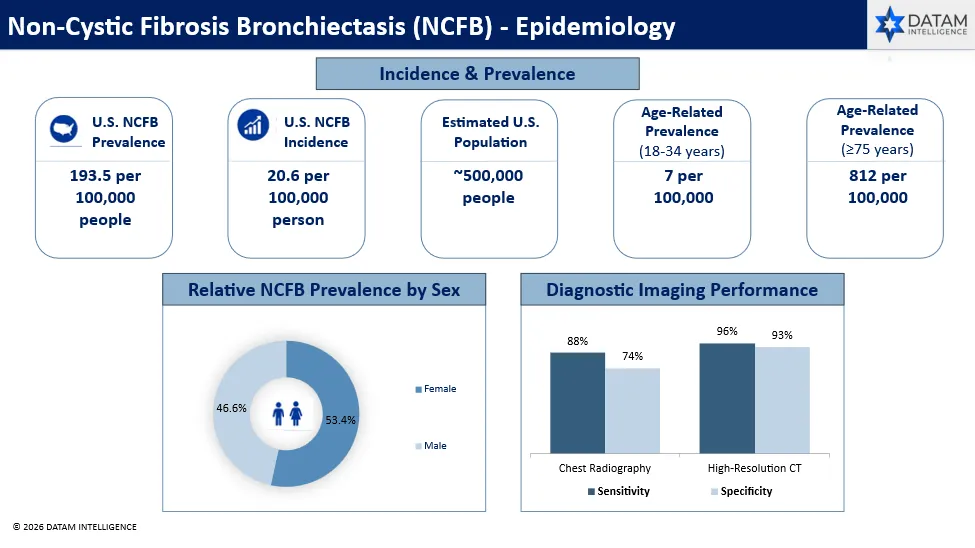
NCFB affects approximately 500,000 people in the United States, with an estimated prevalence of 193.5 per 100,000 and incidence of 20.6 per 100,000 person-years. Disease burden rises sharply with age and is higher among females. High-resolution CT remains the preferred confirmatory imaging modality due to its superior sensitivity and specificity compared with chest radiography.
Approved Drugs
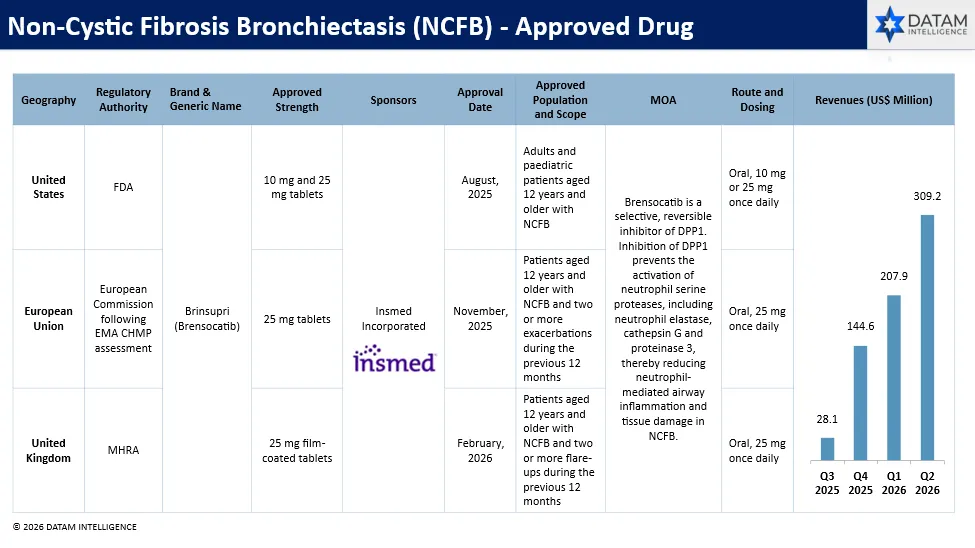
- Brinsupri (brensocatib), transformed the NCFB treatment landscape as the first targeted therapy approved specifically for the disease. FDA approval on 12 August 2025 established the initial commercial pathway, followed by European Commission authorisation on 18 November 2025 and MHRA approval on 20 February 2026, creating an expanding transatlantic regulatory footprint.
- Brensocatib selectively and reversibly inhibits DPP1, preventing the activation of neutrophil serine proteases including neutrophil elastase, cathepsin G and proteinase 3. Targeting an upstream inflammatory pathway differentiates Brinsupri from conventional antibiotics, airway-clearance interventions and symptom-directed therapies, positioning it as a mechanism-based treatment for neutrophil-mediated inflammation, airway injury and recurrent pulmonary exacerbations.
- The US indication covers adults and paediatric patients aged 12 years and older without a specified previous-exacerbation threshold and permits 10 mg or 25 mg oral once-daily dosing. European Union and UK approvals are narrower, covering patients aged 12 years and older with at least two exacerbations during the preceding 12 months and using 25 mg once daily.
- BRINSUPRI generated US$28.1 million in Q3 2025, increasing to US$144.6 million in Q4 2025, US$207.9 million in Q1 2026 and US$309.2 million in Q2 2026. Rapid sequential growth indicates substantial unmet demand, strong physician uptake, and effective identification of exacerbation-prone patients following the United States commercial launch.
- Brinsupri establishes DPP1 inhibition as the first commercially validated targeted mechanism in NCFB and raises the clinical-development benchmark for competing pipeline therapies. Future entrants will need to demonstrate superior exacerbation reduction, broader phenotype applicability, disease-modifying potential, improved safety, or differentiated administration. Regulatory leadership, growing prescriber familiarity, and accelerating revenue strengthen Insmed’s first-mover advantage.
Pipeline Analysis
As of July 2026, the therapeutic pipeline for Non-Cystic Fibrosis Bronchiectasis (NCFB) is robust, encompassing various modalities aimed at slowing disease progression and preserving vision. Here's an overview of key investigational therapies across different classes:
| Intervention | Sponsor | Current Status | MoA | RoA | Modality |
| Verducatib, BI 1291583 | Boehringer Ingelheim | Phase III | DPP1 and CatC inhibitor that reduces activation of neutrophil serine proteases | Oral | Small molecule |
| Itepekimab, SAR440340 | Sanofi and Regeneron | Phase II completed | Anti-IL-33 antibody designed to suppress upstream inflammatory signalling | Subcutaneous injection | Monoclonal antibody |
| HSK31858, CHF10196 | Haisco Pharmaceutical Group and Chiesi Farmaceutici | Phase III | Selective, reversible DPP1 inhibitor that reduces neutrophil serine-protease activation | Oral | Small molecule |
| AP-PA02 | Armata Pharmaceuticals | Phase II completed; Phase III planning | Bacteriophage cocktail that selectively infects and destroys Pseudomonas aeruginosa | Nebulized inhalation | Bacteriophage therapy |
| RSS0343 | Jiangsu Hengrui Medicine and Reistone Biopharma | Phase II | DPP1 inhibitor intended to reduce activation of neutrophil elastase, cathepsin G and proteinase 3 | Oral | Small molecule |
| XH-S004 | S-INFINITY Pharmaceuticals and Shanghai Fosun Pharmaceutical | Phase II | DPP1 inhibitor targeting neutrophil-mediated airway inflammation | Oral | Small molecule |
| ARINA-1 | Renovion | Phase II completed; further development planned | Improves mucus clearance while reducing airway inflammation and inhibiting bacterial growth | Nebulized inhalation | Multi-component inhaled formulation |
| Ensifentrine | Verona Pharma, a subsidiary of Merck & Co. | Phase II | Dual PDE3 and PDE4 inhibitor combining bronchodilator and non-steroidal anti-inflammatory activity | Nebulized inhalation | Small molecule |
| RESP302 and RESP303 | Thirty Respiratory Limited | Phase I and IIa | Nitric oxide-generating antimicrobial formulations designed to control chronic airway infection | Nebulized inhalation | Inhaled antimicrobial formulation |
| CSL787 | CSL Behring | Phase IIb | Polyclonal IgG with anti-infective, anti-inflammatory and immunomodulatory activity | Nebulized inhalation | Plasma-derived polyclonal immunoglobulin |
| Galvokimig | UCB Biopharma | Phase II | Multispecific inhibition of IL-13, IL-17A and IL-17F inflammatory pathways | Parenteral | Multispecific antibody |
Market Size & Forecasting
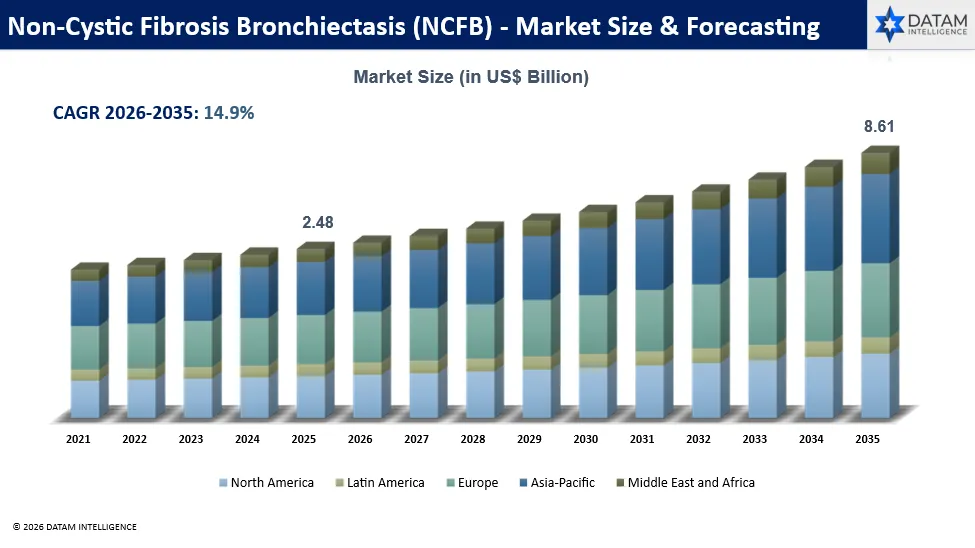
The global non-cystic fibrosis bronchiectasis (NCFB) treatment market stood at US$ 2.48 billion in 2025 and is expected to reach US$ 8.61 billion by 2035, growing with a CAGR of 14.9% during the forecast period 2026-2035.
Request For Exclusive Sample on NCFB Treatment Market
Competitive Landscape and Market Positioning
- The NCFB competitive landscape is transitioning from symptom-oriented management toward targeted therapies addressing neutrophilic inflammation, chronic infection, and impaired mucus clearance.
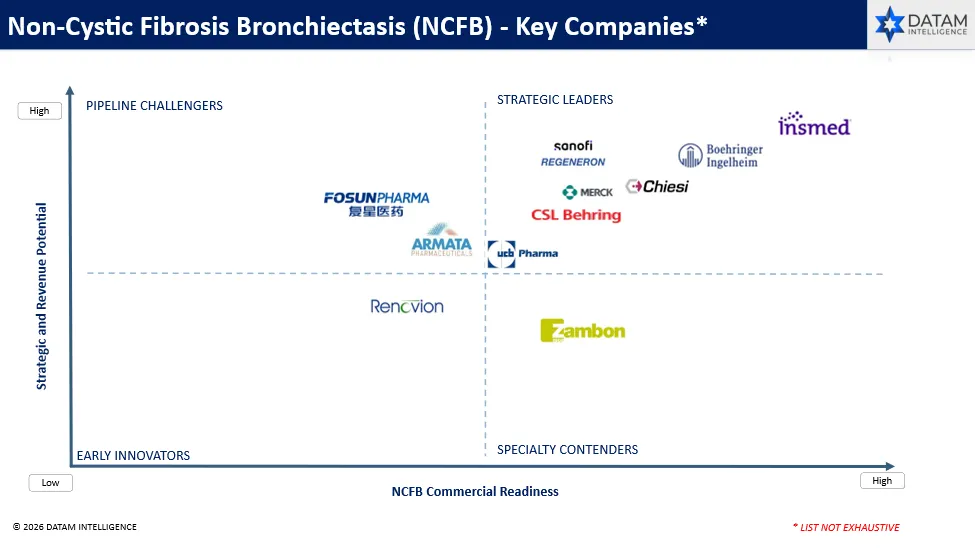
- Insmed holds the strongest market position following Brinsupri’s approval and commercialization, securing first-mover advantage while establishing the clinical-evidence, physician-engagement and market-access benchmark that emerging competitors must overcome.
- Boehringer Ingelheim and Chiesi represent the most credible late-stage challengers, supported by Phase III DPP1 programmes, established respiratory capabilities and global commercialization infrastructure that could intensify direct mechanism-level competition.
- Merck, CSL Behring and Sanofi-Regeneron bring substantial development resources and differentiated approaches spanning PDE3/PDE4 inhibition, inhaled immunoglobulin and IL-33 blockade, positioning them to compete through targeted patient segmentation.
- Fosun Pharma, Armata and UCB provide differentiated pipeline optionality through DPP1 inhibition, bacteriophage therapy and multispecific cytokine blockade; however, clinical maturity, partnering requirements and uncertain commercialization pathways constrain near-term influence.
- Zambon occupies a specialty position through inhaled colistin methate sodium for chronic Pseudomonas aeruginosa infection, while Renovion remains an early innovator. Future leadership will depend on clinical differentiation, phenotype-based targeting, regulatory execution, and the ability to demonstrate meaningful reductions in exacerbations and treatment burden.
Target Opportunity Profile (TOP)
To compete effectively with Brinsupri and established NCFB supportive treatments, emerging therapies must demonstrate a differentiated Target Opportunity Profile across clinical efficacy, safety, phenotype targeting, administration convenience and real-world usability.
Target Opportunity Profile (TOP) - Competitive Attributes
| Dimension | Desired Profile for Emerging NCFB Therapies | Strategic Rationale |
| Safety |
| NCFB requires chronic treatment, making long-term tolerability and safety essential for sustained adoption. |
| Efficacy |
| Exacerbation reduction remains the primary competitive benchmark, but patient-relevant outcomes will strengthen differentiation. |
Mechanism of Action |
| Novel mechanisms may address NCFB heterogeneity and provide alternatives for patients who respond inadequately to existing treatment. |
| Route of Administration |
| Convenient delivery can improve adherence and reduce disruption to existing airway-clearance routines. |
| Dosing Frequency |
| Lower dosing and monitoring burden can improve persistence and real-world treatment feasibility. |
| Modality |
| Multiple modalities enable intervention across inflammatory, infectious and mucus-related disease pathways. |
| Durability |
| Durable control is critical for managing a chronic disease characterized by recurrent exacerbations and infections. |
| Innovation Level |
| Mechanistic and biomarker differentiation can support premium positioning and targeted clinical adoption. |
| Clinical Impact |
| Clinicians and payers require benefits extending beyond statistical reductions in exacerbation frequency. |
| Patient-Population Targeting |
| Phenotype-specific positioning can concentrate clinical benefit and support clearer treatment-selection pathways. |
| Antimicrobial Stewardship |
| Lower antibiotic exposure may address antimicrobial resistance while improving long-term infection management. |
| Commercial Differentiation |
| Market uptake will depend on clinically meaningful differentiation, manageable treatment costs and integration into specialist practice. |
Unmet Needs & Market Dynamics
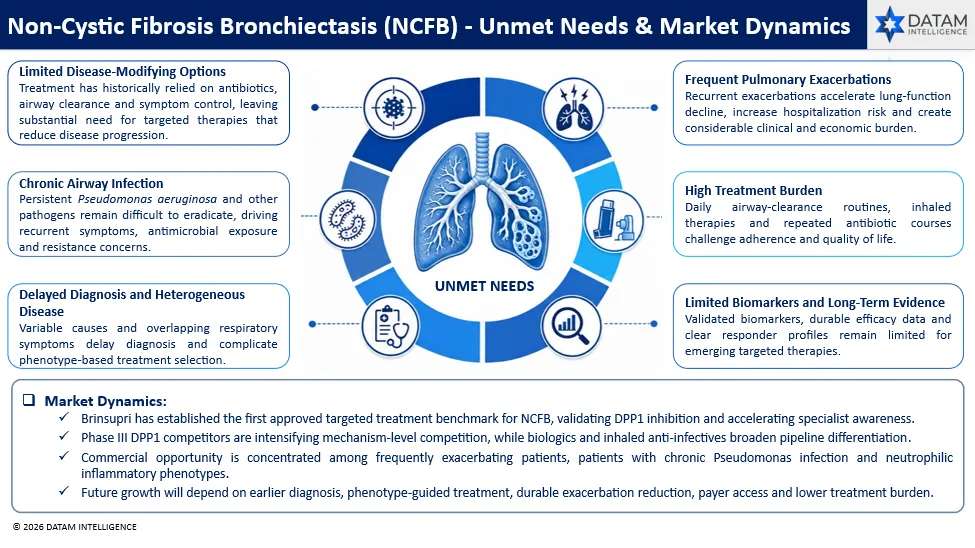
Non-Cystic fibrosis bronchiectasis presents substantial unmet need as existing treatments primarily manage chronic infection, mucus retention and symptoms but do not consistently prevent exacerbations or halt disease progression. The market is evolving around earlier diagnosis, phenotype-guided treatment, chronic infection control, lower treatment burden, and targeted therapies that deliver durable exacerbation reduction and preserve lung function.
Strategic Summary
Emerging therapies for NCFB will need to demonstrate clear advantages over Brinsupri and established supportive care to secure meaningful market share. Exacerbation reduction alone may not be sufficient. Future products must deliver durable clinical benefits, including preservation of lung function, improved respiratory symptoms, fewer hospitalizations and better quality of life.
Safety and tolerability will remain important adoption drivers, particularly given long-term treatment requirements, antimicrobial-resistance concerns and potential risks associated with immune-pathway modulation. Therapies offering convenient oral dosing, less frequent administration, effective inhaled delivery or reduced dependence on repeated antibiotic courses could achieve stronger real-world uptake.
Differentiated approaches such as DPP1 inhibition, cytokine-targeted biologics, inhaled immunoglobulins, bacteriophage therapies and novel anti-infective platforms may enable phenotype-specific treatment across heterogeneous NCFB populations. Overall, market success will depend on a balanced profile combining durable exacerbation reduction, lung-function preservation, infection control, safety, convenience, and clear clinical differentiation.
Why Buy Our Non-Cystic Fibrosis Bronchiectasis (NCFB) Competitive Intelligence Report?
The NCFB market is entering a targeted-treatment era, driven by the approval of the first disease-specific therapy, advancing late-stage pipelines and growing demand for interventions that reduce pulmonary exacerbations and preserve lung function. As treatment pathways become more complex, companies need clear intelligence on clinical differentiation, patient phenotypes, chronic infection status, regulatory progress, access dynamics, and future pipeline disruption. Our report converts the evolving NCFB landscape into actionable clinical and commercial strategies.
Identify Where Competition Is Intensifying
Understand how Brinsupri is shaping the emerging targeted-treatment market, which companies are advancing differentiated pipeline assets, and which mechanisms may define the next competitive wave.
Prioritize the Right Patient Segments
Assess commercially relevant populations, including frequently exacerbating patients, patients with chronic Pseudomonas aeruginosa infection, neutrophilic inflammation, mucus hypersecretion, and progressive lung-function decline.
Evaluate Asset Differentiation
Compare therapies based on exacerbation reduction, lung-function outcomes, infection control, safety, dosing frequency, route of administration, treatment durability, and fit within respiratory-care workflows.
Track Regulatory and Launch Readiness
Monitor clinical readouts, approval timelines, label-expansion opportunities, geographic access developments, and commercialization readiness across approved and investigational therapies.
Support Pricing and Access Planning
Understand payer expectations, reimbursement barriers, treatment eligibility, biomarker requirements, administration burden, and evidence thresholds influencing adoption across major markets.
Strengthen Business Development Decisions
Identify licensing, partnership, acquisition and investment opportunities across DPP1 inhibitors, anti-inflammatory biologics, inhaled antimicrobials, bacteriophage therapies, mucus-clearance solutions and other emerging NCFB platforms.
