


Generalized myasthenia gravis (gMG) is entering a new competitive phase as the treatment paradigm shifts from broad immunosuppression toward targeted, mechanism-driven therapies. The commercial landscape now spans FcRn blockade, complement C5 inhibition and B-cell depletion, with approved products including VYVGART, VYVGART HYTRULO, ULTOMIRIS, SOLIRIS, RYSTIGGO, ZILBRYSQ, IMAAVY and UPLIZNA. This expansion has raised the competitive benchmark beyond basic symptom control toward rapid MG-ADL improvement, deeper response, durability, steroid-sparing potential, broad serotype coverage and reduced treatment burden.
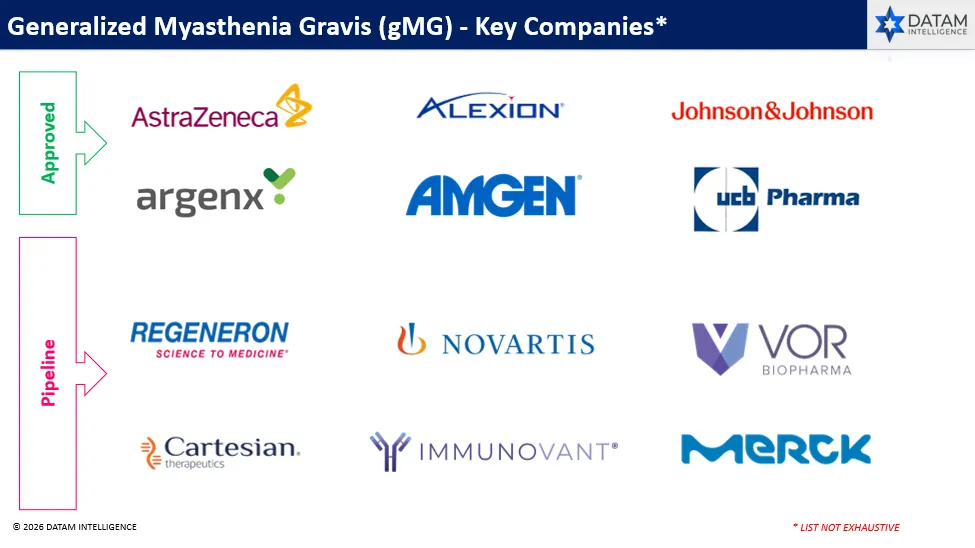
Competitive leadership is currently concentrated among argenx, AstraZeneca, UCB, Johnson & Johnson and Amgen. argenx is strongly positioned through its FcRn franchise, AstraZeneca maintains an established complement portfolio and UCB differentiates through participation in both FcRn and C5 inhibition. Johnson & Johnson and Amgen have further intensified competition through IMAAVY and UPLIZNA, respectively. The market was valued at approximately US$6.4 billion in 2025 and is projected to reach US$11.1 billion by 2035, reinforcing the commercial importance of treatment differentiation and lifecycle positioning.
The next competitive wave could be more disruptive. Cemdisiran is under FDA Priority Review, while gefurulimab, telitacicept, Descartes-08, IMVT-1402, iptacopan, remibrutinib and cladribine represent major late-stage programs. Emerging CAR-T, plasma-cell-targeted and immune-reset approaches could challenge the prevailing chronic-treatment model by pursuing deeper and potentially more durable suppression of pathogenic autoimmunity.
From a CI perspective, future winners are unlikely to succeed through mechanism novelty alone. The strongest opportunity lies in therapies combining rapid onset, sustained disease control, broader patient eligibility, favorable long-term safety, lower monitoring requirements and greater dosing convenience. Oral therapies, self-administered subcutaneous options and finite or immune-reset treatment strategies have the potential to materially reshape treatment sequencing, physician preference and commercial share over the next decade.
Key Takeways
- gMG accounts for approximately 85% of MG patients, with an estimated ~100,000 U.S. patients; AChR-positive disease represents roughly 80% of gMG, establishing the largest commercially addressable serological segment.
- The market has expanded to eight major targeted branded therapies, spanning FcRn inhibition, complement C5 inhibition, and CD19-directed B-cell depletion, with IMAAVY and UPLIZNA representing the latest 2025 approvals in the report.
- argenx, AstraZeneca, UCB, Johnson & Johnson and Amgen form the core competitive group. argenx leads through the VYVGART franchise, AstraZeneca maintains a strong complement position and UCB differentiates through both FcRn and C5-targeted products.
- Competitive pressure is accelerating through cemdisiran under FDA Priority Review and late-stage assets including gefurulimab, telitacicept, Descartes-08, IMVT-1402, iptacopan, remibrutinib and cladribine, while CAR-T programs introduce potential immune-reset competition.
- The report values the gMG market at US$6.4 billion in 2025, reaching US$11.1 billion by 2035 at a 5.8% CAGR, supported by targeted-therapy adoption and pipeline expansion. Company-level market-share percentages are not provided in the uploaded file, so they should not be stated as report-derived data without an additional market-share analysis.
Disease Overview
Generalized myasthenia gravis (gMG) is a chronic, antibody-mediated autoimmune disease of the neuromuscular junction characterized by fluctuating and fatigable weakness involving bulbar, limb, axial and respiratory musculature. Pathogenic autoantibodies target proteins on the postsynaptic membrane, predominantly the acetylcholine receptor (AChR), while clinically distinct subgroups are associated with antibodies against muscle-specific kinase (MuSK) and, less frequently, L4.
In AChR-positive disease, predominantly IgG1 and IgG3 autoantibodies impair neuromuscular transmission through receptor cross-linking, internalization and complement-mediated destruction of the postsynaptic membrane. By contrast, MuSK-associated disease is largely driven by IgG4 antibodies that disrupt the agrin–Lrp4–MuSK signaling pathway required for AChR clustering.
Clinical manifestations range from dysarthria, dysphagia and proximal limb weakness to severe respiratory involvement and myasthenic crisis. Increasing recognition of distinct immunopathological subtypes has shifted gMG management toward mechanism-directed therapy targeting pathogenic IgG, complement activation, B cells and plasma cells, supporting increasingly individualized treatment strategies.
Epidemiology Analysis
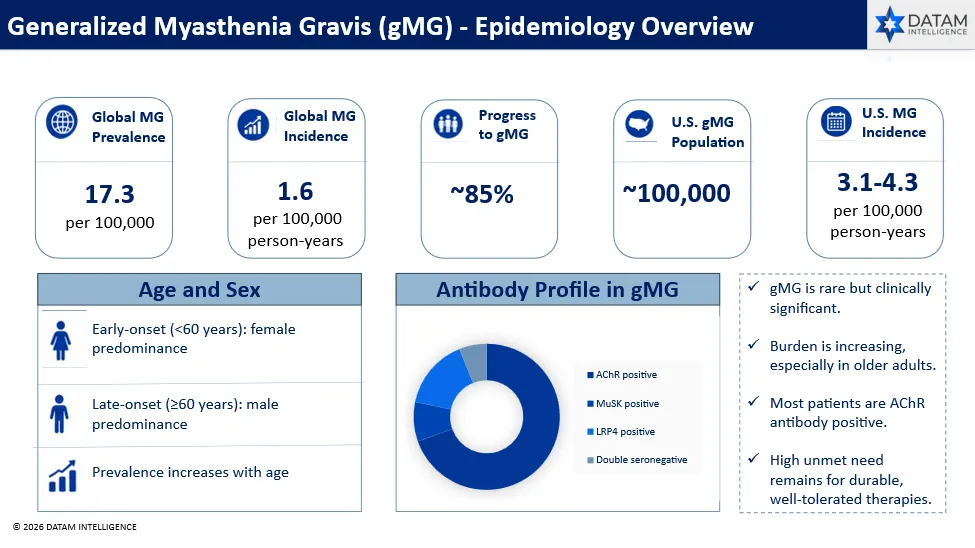
Generalized myasthenia gravis (gMG) represents the predominant clinical form of myasthenia gravis, accounting for approximately 85% of patients. Recent epidemiological evidence indicates a global MG prevalence of around 17.3 per 100,000 population and an incidence of approximately 1.6 per 100,000 person-years, although substantial geographic variation persists. In the United States, the gMG population is estimated at approximately 100,000 patients, with recent MG incidence estimates ranging from 3.1 to 4.3 per 100,000 person-years.
Disease distribution demonstrates a distinct age- and sex-related pattern, with greater female representation among younger-onset patients and increasing male predominance at older ages. Serologically, AChR antibodies are detected in approximately 80% of gMG patients, while MuSK-positive, LRP4-positive, and seronegative populations represent smaller but clinically important subgroups. Rising prevalence among older adults and persistent heterogeneity across antibody-defined populations continue to support demand for durable, well-tolerated, and broadly effective therapies.
Approved Drugs
The FDA-approved treatment landscape for generalized myasthenia gravis (gMG) has expanded significantly over the past decade, moving beyond conventional symptomatic and broad immunosuppressive therapies toward targeted, mechanism-based treatment strategies. Current approved therapies primarily act through complement C5 inhibition, FcRn blockade, and B-cell depletion, enabling more selective control of pathogenic autoantibody activity and neuromuscular junction injury. Recent approvals such as UPLIZNA and IMAAVY, together with established therapies including VYVGART, RYSTIGGO, ZILBRYSQ, ULTOMIRIS and SOLIRIS, have increased therapeutic choice across antibody-defined patient populations. This growing diversity is reshaping treatment sequencing, competitive positioning and long-term disease management in gMG.
| FDA Approval | Sponsor | Brand | Current Owner | Asset | MoA | RoA | Modality |
| December, 2025 | Horizon Therapeutics Ireland DAC | Uplizna | Amgen | Inebilizumab-cdon | CD19 targeting and depletion of CD19-expressing B-cell lineage populations | Intravenous | Humanized afucosylated IgG1 monoclonal antibody |
| April, 2025 | Janssen Biotech | Imaavy | Johnson & Johnson | Nipocalimab-aahu | FcRn blockade, reducing circulating IgG including pathogenic autoantibodies | Intravenous | Monoclonal antibody |
| October, 2023 | UCB | Zilbrysq | UCB | Zilucoplan | C5 inhibition, preventing C5 cleavage and terminal complement activation | Subcutaneous | Synthetic macrocyclic peptide |
| June, 2023 | UCB | Rystiggo | UCB | Rozanolixizumab-noli | FcRn blockade, reducing circulating pathogenic IgG | Subcutaneous infusion | Humanized IgG4 monoclonal antibody |
| June, 2023 | argenx BV | Vyvgart Hytrulo | argenx | Efgartigimod alfa and hyaluronidase-qvfc | FcRn blockade, increasing degradation of circulating IgG | Subcutaneous | Fc fragment plus recombinant hyaluronidase |
| April, 2022 | Alexion Pharmaceuticals | Ultomiris | AstraZeneca | Ravulizumab-cwvz | C5 inhibition, blocking terminal complement activation | Intravenous | Humanized IgG2 and IgG4 monoclonal antibody |
| December, 2021 | argenx BV | Vyvgart | argenx | Efgartigimod alfa-fcab | FcRn blockade, accelerating degradation of circulating IgG | Intravenous | Human IgG1 Fc fragment |
| October, 2017 | Alexion Pharmaceuticals | Soliris | AstraZeneca | Eculizumab | C5 inhibition, preventing terminal complement activation | Intravenous | Humanized monoclonal antibody |
Competitive Timeline: Approvals
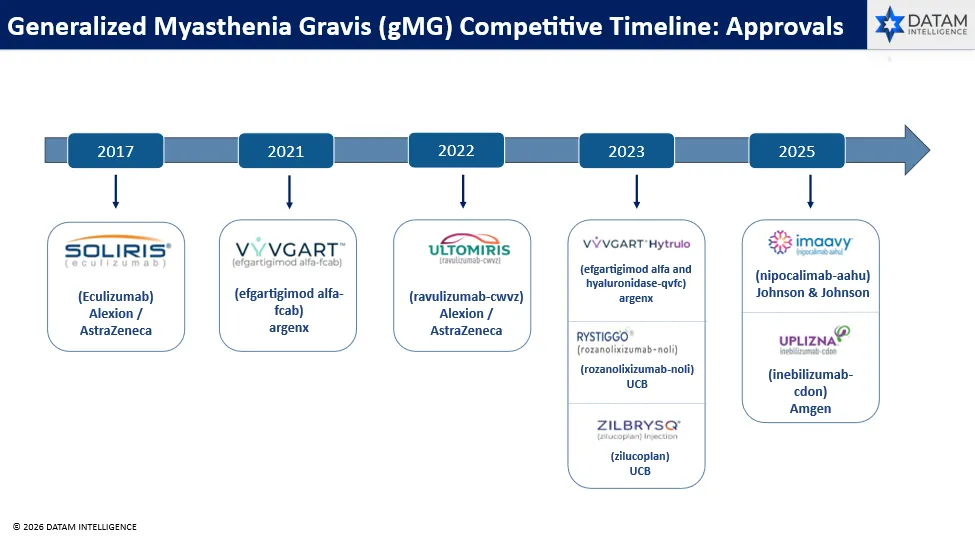
The gMG approval timeline highlights a rapid shift from complement inhibition toward broader targeted immunomodulation. SOLIRIS established the first targeted biologic benchmark in 2017, followed by VYVGART and ULTOMIRIS, while 2023 marked a major expansion with VYVGART HYTRULO, RYSTIGGO and ZILBRYSQ. The 2025 approvals of IMAAVY and UPLIZNA further diversified the market through FcRn blockade and CD19-directed B-cell depletion. Overall, the competitive landscape is becoming increasingly mechanism-diverse, with differentiation now centered on speed of response, serotype coverage, treatment convenience, durability and long-term disease control.
Pipeline Analysis
As of August 2026, the therapeutic pipeline for Generalized myasthenia gravis (gMG) remains highly active, with development focused on achieving faster disease control, deeper immune modulation and more durable clinical responses. Investigational programs span complement inhibitors, FcRn antagonists, B-cell and plasma-cell targeted therapies, BTK inhibitors, immune-reconstitution approaches and next-generation cell therapies, reflecting a shift beyond conventional immunosuppression toward mechanism-driven and potentially disease-modifying treatment strategies:
| Sponsor | Intervention | Current Status | MoA | RoA | Modality |
| Regeneron Pharmaceuticals | Cemdisiran | Regulatory Review, FDA Priority Review | C5-targeting siRNA reduces hepatic production of complement C5, suppressing terminal complement activation | Subcutaneous | siRNA therapeutics |
| AstraZeneca / Alexion | Gefurulimab (ALXN1720) | Phase III, positive pivotal results | C5 inhibition blocks terminal complement activation and prevents complement-mediated injury at the neuromuscular junction | Subcutaneous | Dual-binding nanobody |
| Vor Bio / RemeGen | Telitacicept (RC18) | Phase III global, approved in China | Dual BAFF and APRIL inhibition suppresses B-cell and plasma-cell survival and pathogenic autoantibody production | Subcutaneous | TACI-Fc fusion protein |
| Cartesian Therapeutics | Descartes-08 | Phase III | BCMA-directed CAR-T-mediated depletion of antibody-producing plasma cells | Intravenous | Autologous mRNA CAR-T cell therapy |
| Immunovant | IMVT-1402 | Phase III, registrational | FcRn inhibition accelerates degradation of circulating IgG including pathogenic autoantibodies | Subcutaneous | Monoclonal antibody |
| Novartis | Iptacopan | Phase III, recruiting | Factor B inhibition selectively suppresses the alternative complement pathway | Oral | Small molecule |
| Novartis | Remibrutinib | Phase III, recruiting | BTK inhibition modulates B-cell receptor signaling and Fc receptor-mediated immune activation | Oral | Small molecule |
Merck KGaA / EMD Serono | Cladribine Capsules | Phase III | Selectively reduces B and T lymphocytes involved in pathogenic autoantibody generation | Oral | Purine nucleoside analogue, small molecule |
| argenx | Empasiprubart (ARGX-117) | Phase II gMG combination study | C2 inhibition suppresses classical and lectin complement pathway activation | Intravenous | Humanized monoclonal antibody |
| UCB | Cizutamig | Phase I, Phase II planned by end-2026 | BCMA × CD3 engagement redirects T cells to eliminate BCMA-expressing plasma cells and B cells | gMG Phase II route not yet confirmed | Bispecific T-cell-engaging antibody |
| Cabaletta Bio | Resecabtagene autoleucel, rese-cel (CABA-201) | Phase I/II | CD19-directed CAR-T depletion of pathogenic B cells designed to induce immune-system reset | Intravenous | Autologous CD19 CAR-T cell therapy |
| Novartis | Rapcabtagene autoleucel (YTB323) | Phase I/II, recruiting | CD19-directed CAR-T-mediated B-cell depletion designed to reset pathogenic B-cell immunity | Intravenous | Autologous CD19 CAR-T cell therapy |
Bristol Myers Squibb / Juno Therapeutics | BMS-986353 (CC-97540) | Phase I, ongoing | CD19-directed CAR-T-mediated depletion of B cells to enable immune reset in refractory autoimmune disease | Intravenous | Autologous CD19 NEX-T CAR-T cell therapy |
Gilead Sciences / Arcellx | Anitocabtagene autoleucel (Anito-cel) | Phase I, recruiting | BCMA-directed CAR-T eliminates BCMA-expressing plasma cells responsible for pathogenic autoantibody production | Intravenous | Autologous BCMA CAR-T cell therapy |
AstraZeneca / Gracell | GC012F (AZD0120) | Early Phase I / Phase I investigator-led gMG studies | Dual CD19 and BCMA targeting depletes pathogenic B cells and antibody-producing plasma cells | Intravenous | Autologous dual-target BCMA × CD19 FasTCAR-T cell therapy |
Market Size & Forecasting
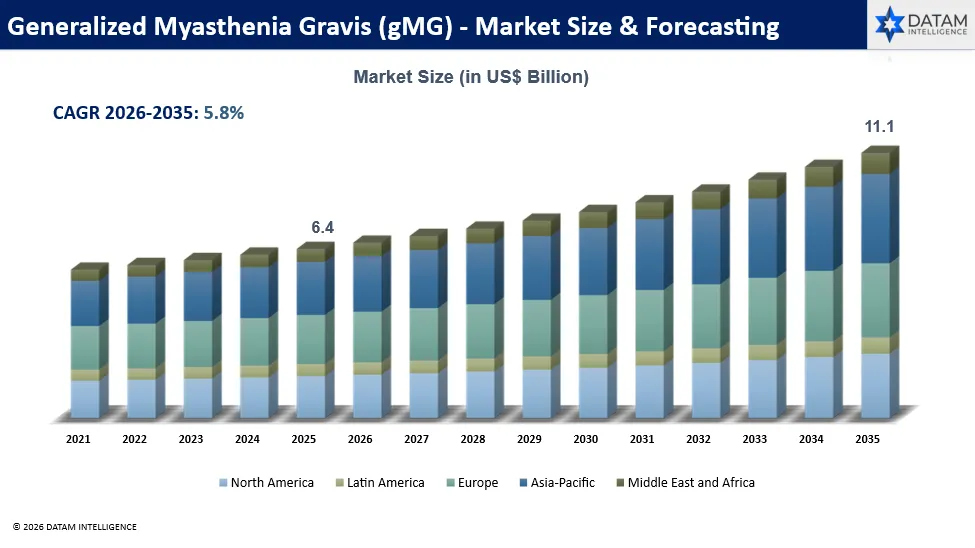
The global generalized myasthenia gravis (Gmg) market stood at US$6.4 billion in 2025 and is expected to reach US$11.1 billion by 2035, growing with a CAGR of 5.8% during the forecast period 2026-2035.
Request for Exclusive Sample on Generalized Masthenia Gravis Treatment Market
Competitive Landscape and Market Positioning
The generalized myasthenia gravis (gMG) market is becoming increasingly competitive as treatment shifts from broad immunosuppression toward targeted, mechanism-driven therapies. Established players such as AstraZeneca, argenx, UCB, Johnson & Johnson and Amgen currently shape the commercial landscape through approved complement inhibitors, FcRn-targeted therapies and B-cell-directed treatments. Competitive positioning is increasingly influenced by speed of symptom control, durability of response, serotype coverage, route of administration, dosing frequency and the ability to reduce corticosteroid dependence.
argenx maintains a strong position through VYVGART and VYVGART HYTRULO, supported by FcRn leadership and flexible IV and subcutaneous administration. AstraZeneca remains a major complement-focused competitor through SOLIRIS and ULTOMIRIS, while UCB has established a differentiated dual-mechanism presence with RYSTIGGO and ZILBRYSQ. Johnson & Johnson and Amgen have strengthened competition through IMAAVY and UPLIZNA, respectively, broadening the range of targeted immune approaches available to physicians.
Future competitive intensity will increasingly be shaped by late-stage assets including gefurulimab, telitacicept, Descartes-08, IMVT-1402, iptacopan, remibrutinib and cladribine. Emerging CAR-T, plasma-cell-targeted and immune-reset strategies may further disrupt current chronic-treatment models.
Overall, market leadership will depend less on mechanism novelty alone and more on delivering rapid, deep and durable disease control with lower treatment burden, broad patient eligibility and favorable long-term safety. Companies that can combine biologic-level efficacy with greater convenience and sustained remission potential are likely to secure the strongest future positioning.
Key Companies
Target Opportunity Profile (TOP)
To compete effectively against established targeted therapies such as Vyvgart, Vyvgart Hytrulo, Ultomiris, Rystiggo, Zilbrysq, Imaavy and Uplizna in the generalized myasthenia gravis (gMG) market, emerging therapies must demonstrate a superior Target Opportunity Profile (TOP) across several critical dimensions. Competitive differentiation will increasingly depend on achieving rapid and clinically meaningful symptom improvement, durable disease control, broad serotype coverage, reduced corticosteroid dependence, favorable long-term safety and lower treatment burden, while offering greater convenience through oral, self-administered or less frequent dosing approaches.
Target Opportunity Profile (TOP) - Competitive Attributes
| Dimension | Desired Profile for Emerging Therapies | Rationale |
| Safety |
| Safety remains a major differentiator as targeted gMG therapies move into broader patient populations. Complement inhibition can increase susceptibility to serious meningococcal infection, creating vaccination, monitoring and risk-management requirements. |
| Efficacy |
| Approved targeted therapies provide meaningful symptomatic improvement, but residual disease burden remains in a proportion of patients. MG-ADL and QMG remain key measures of functional and objective clinical benefit. |
| Onset of Action |
| gMG is characterized by fluctuating weakness and potential acute deterioration; faster onset can reduce the period of uncontrolled symptoms and strengthen differentiation from slower-acting conventional immunosuppressants. |
| Durability of Response |
| Current targeted therapies often require repeated or chronic administration. Longer-lasting control could reduce treatment burden while improving persistence and long-term disease stability. FDA review documents note, for example, chronic daily use for zilucoplan. |
| Patient Coverage |
| Existing targeted therapies have historically differed in antibody-defined eligibility. Broader serotype coverage can increase the addressable population; VYVGART's U.S. indication was expanded in May 2026 to adults with gMG without an AChR-positive qualifier. |
| Route of Administration |
| Existing gMG therapies span IV, SC infusion and SC injection, leaving meaningful opportunity for less resource-intensive administration and greater patient autonomy. |
| Dosing Convenience |
| Lower dosing frequency and simplified treatment schedules may improve adherence, reduce healthcare-resource utilization and provide competitive differentiation as efficacy across targeted mechanisms becomes stronger. |
| Steroid-Sparing Effect |
| Long-term corticosteroid and immunosuppressant exposure contributes materially to treatment burden. A therapy capable of maintaining control while reducing background immunosuppression would deliver meaningful clinical value. Thymectomy data have also demonstrated the clinical value of reducing immunosuppressive requirements in MG. |
| Treatment Monitoring |
| Monitoring and risk-mitigation requirements can create barriers to adoption. Complement-targeted therapies, for example, require specific precautions because of serious meningococcal infection risk. |
| Quality of Life |
| Functional disability is central to gMG disease burden; therefore, improvements should extend beyond laboratory or strength measures toward meaningful gains in activities of daily living and patient independence. MG-ADL was specifically developed to assess the impact of gMG on daily function. |
Unmet Needs & Market Dynamics
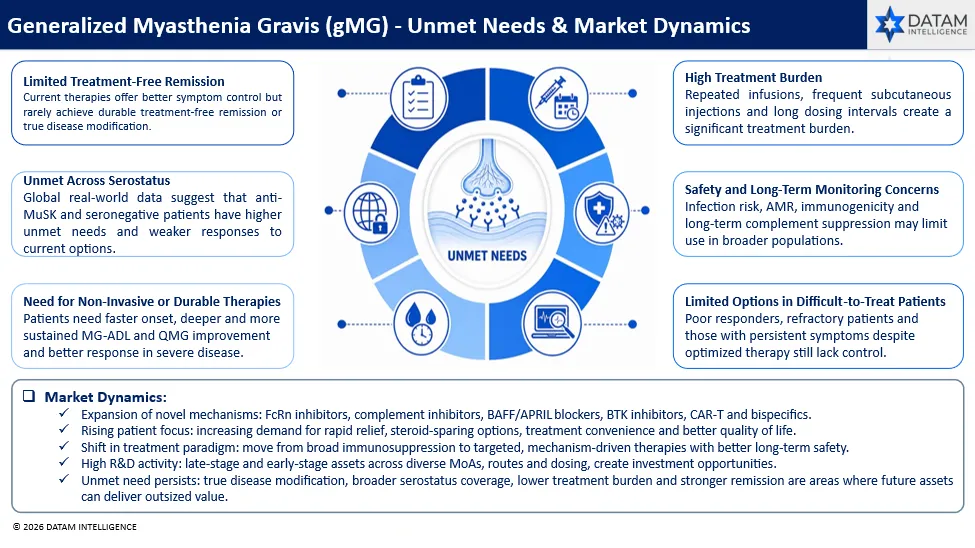
Generalized myasthenia gravis presents a significant unmet need as current therapies can improve symptom control but do not consistently achieve durable remission, broad serotype coverage or freedom from chronic treatment. The market is evolving around faster and deeper clinical response, reduced corticosteroid dependence, lower treatment burden, improved long-term safety and the development of therapies that provide sustained disease control across AChR-positive, MuSK-positive and difficult-to-treat patient populations.
Strategic Summary
The generalized myasthenia gravis (gMG) treatment landscape is moving rapidly from broad immunosuppression toward targeted, mechanism-driven and increasingly differentiated therapies. Approved FcRn inhibitors, complement inhibitors and B-cell-directed therapies have raised the treatment benchmark, making incremental efficacy alone insufficient for future market leadership.
The strongest commercial opportunity lies in therapies that combine rapid onset of action, deep MG-ADL improvement, durable disease control and meaningful steroid-sparing potential with a lower treatment burden. Broad applicability across AChR-positive, MuSK-positive and potentially seronegative populations will further strengthen competitive positioning by expanding the addressable patient pool.
Convenience is emerging as a major strategic battleground. Oral administration, self-administered subcutaneous delivery, longer dosing intervals and reduced monitoring requirements could materially improve adoption versus infusion-intensive regimens. At the same time, next-generation approaches targeting B cells, plasma cells and immune reset may redefine expectations by shifting treatment from chronic suppression toward prolonged remission or finite therapy.
Overall, future winners in gMG are likely to be therapies that deliver biologic-level efficacy with greater durability, broader patient coverage and substantially improved convenience, while maintaining a favorable long-term safety profile.
Why Buy Our Generalized myasthenia gravis (gMG) Competitive Intelligence Report?
The generalized myasthenia gravis market is entering a more competitive and clinically differentiated phase, driven by the rapid adoption of FcRn inhibitors, complement-targeted therapies and B-cell-directed approaches alongside an increasingly diverse late-stage pipeline. As treatment choices expand, companies require clear intelligence on efficacy differentiation, serotype coverage, safety, route of administration, treatment burden, sequencing and the potential impact of emerging immune-reset strategies. Our report helps clients translate this evolving neuromuscular landscape into actionable clinical, portfolio and commercial strategies.
Identify where competition is intensifying
Understand how approved therapies such as Vyvgart, Vyvgart Hytrulo, Ultomiris, Rystiggo, Zilbrysq, Imaavy and Uplizna are shaping treatment patterns, while tracking late-stage assets across FcRn, complement, B-cell, plasma-cell and CAR-T approaches.
Prioritize the right patient segments
Assess commercially relevant patient populations across AChR-positive, MuSK-positive and seronegative disease, treatment-naïve and previously treated patients, refractory gMG, highly active disease and patients with persistent symptoms despite standard therapy.
Evaluate asset differentiation
Compare therapies based on MG-ADL and QMG improvement, onset of response, durability, minimal symptom expression, steroid-sparing potential, serotype breadth, route of administration, dosing frequency, safety and monitoring burden.
Benchmark emerging mechanisms
Assess how next-generation approaches including BAFF and APRIL inhibition, Factor B inhibition, BTK inhibition, C2 blockade, FcRn inhibition, CD19 CAR-T and BCMA-directed therapies could reshape the future treatment algorithm.
Understand treatment sequencing and positioning
Evaluate where targeted therapies are likely to be used across earlier-line, refractory and rescue settings and how physicians may sequence FcRn blockers, complement inhibitors, B-cell therapies and emerging immune-reset approaches.
Identify pipeline disruption risk
Track pivotal and emerging assets such as gefurulimab, telitacicept, Descartes-08, IMVT-1402, iptacopan, remibrutinib, cladribine and empasiprubart to identify potential competitive threats before market entry.
Assess convenience as a competitive lever
Compare IV, subcutaneous and oral treatment strategies, administration frequency, home-treatment potential and monitoring requirements to understand where patient and physician preference may drive switching or uptake.
Support portfolio and partnering decisions
Identify whitespace across mechanisms, patient populations and treatment settings, helping biopharma companies prioritize licensing, partnership, acquisition and internal development opportunities with the strongest strategic fit.
Strengthen launch and market-access strategy
Understand how efficacy, safety, treatment burden and differentiation may influence payer positioning, physician adoption, patient access and value communication in an increasingly crowded specialty neurology market.
Anticipate the next treatment paradigm
Evaluate whether emerging B-cell, plasma-cell and CAR-T strategies can move gMG management beyond chronic suppression toward deeper immune control, prolonged remission and potentially finite treatment.
