


Tobacco Products Market Size and Forecast
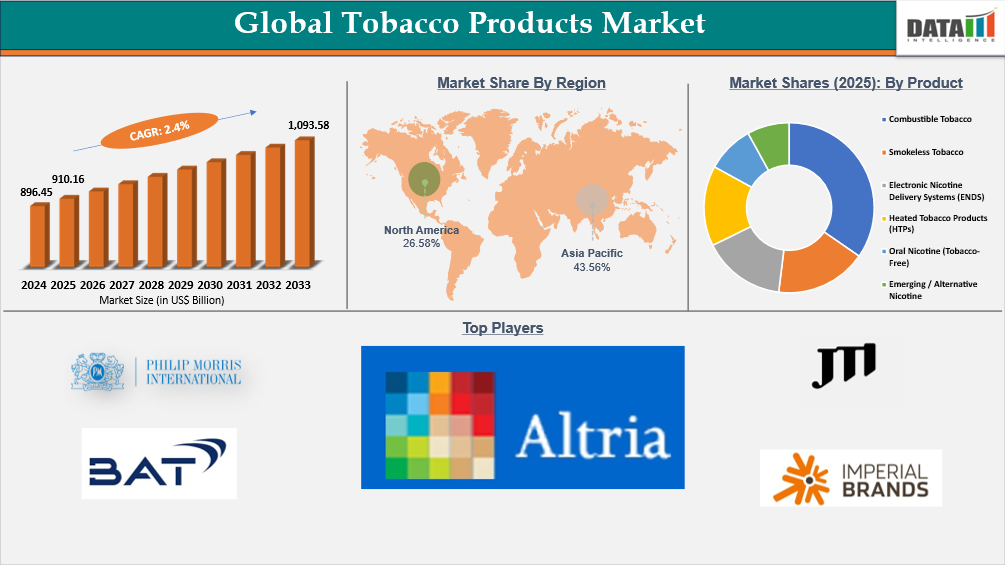
The Tobacco Products Market is estimated to reach USD 931.96 Billion in 2026 and is projected to grow to USD 1,146.71 Billion by 2035, registering steady growth at a CAGR of 2.4% during the forecast period from 2026 to 2035.
The global tobacco products market is also influenced by the increase in the smoking population, especially in low- and middle-income countries, where nearly 80% of the total 1.3 billion people using tobacco reside, according to the World Health Organization. The willingness of people across the globe towards alternative smoking products like e-cigarettes is gradually changing market trends. Finally, innovation regarding flavors and ways in which these goods may be delivered is also an influencing factor in the expansion of market growth.
For example, British American Tobacco (BAT) launched a synthetic nicotine product, Velo Plus, in U.S. market in October 2025. The synthetic form has an advantage over FDA review because its chemical composition is similar to natural tobacco-derived nicotine, which inspires a prediction of steady growth in other segments of the market for nicotine pouches and other forms of alternative tobacco.
Tobacco Products Industry Trends and Strategic Insights
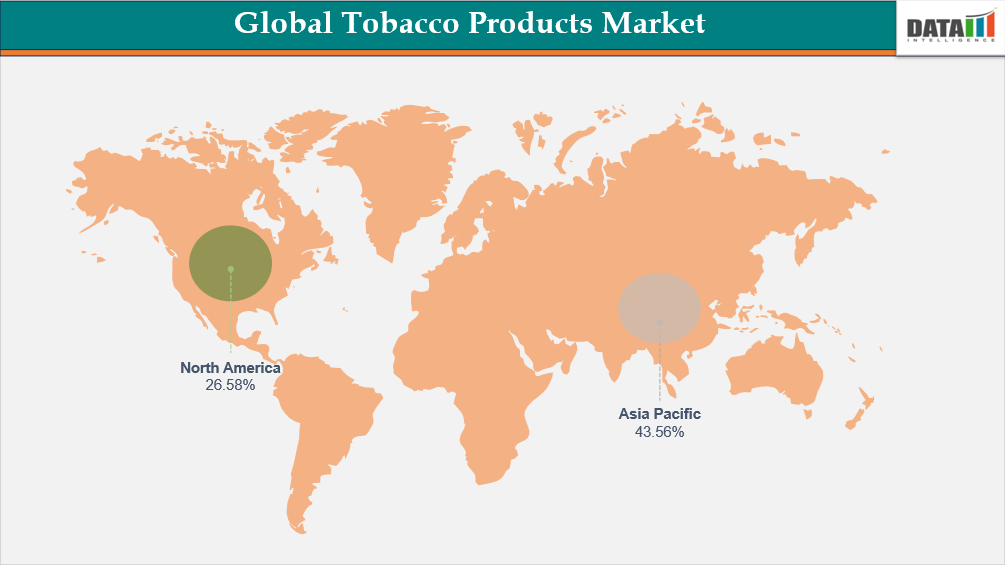
- Asia-Pacific led the global tobacco products market with 41.56% in 2025, driven by a large population base, rising disposable incomes, rapid urbanization, increasing awareness of premium products and strong distribution networks supporting high market penetration.
- By product, combustible tobacco dominated the tobacco products market driven by high demand, widespread availability, strong consumer preference and well-established distribution networks, along with continued investments in production efficiency and product innovation.
Tobacco Products Market Scope
| Metrics | Details | |
| By Product | Combustible Tobacco, Smokeless Tobacco, Electronic Nicotine Delivery Systems (ENDS), Heated Tobacco Products (HTPs) oral Nicotine (Tobacco-Free), Emerging / Alternative Nicotine | |
| By Tobacco Type | Virginia, Burley oriental, Dark Air-Cured, Mixed Blends, Others | |
| By Flavor Profile | Tobacco / Classic, Menthol, Fruit, Mint / Cooling, Dessert / Sweet, Other | |
| By Product Strength | For Cigarettes: Ultra Low Tar, Low Tar, Regular; For E-Cigs / Pouches: ≤3 mg, 3-6 mg, 6-12 mg, >12 mg | |
| By Price Tier | Economy, Mid-Price, Premium, Super Premium / Luxury | |
| By Distribution Channel | Convenience Stores, Supermarkets / Hypermarkets, Specialty Tobacconists, Vape Shops, Duty-Free / Travel Retail, Online / E-Commerce, Illicit / Informal Trade | |
| By Pack Size | <10 sticks, 10-19 sticks, 20 sticks, >20 sticks | |
| By Device Ecosystem | Device Revenue, Consumables Revenue | |
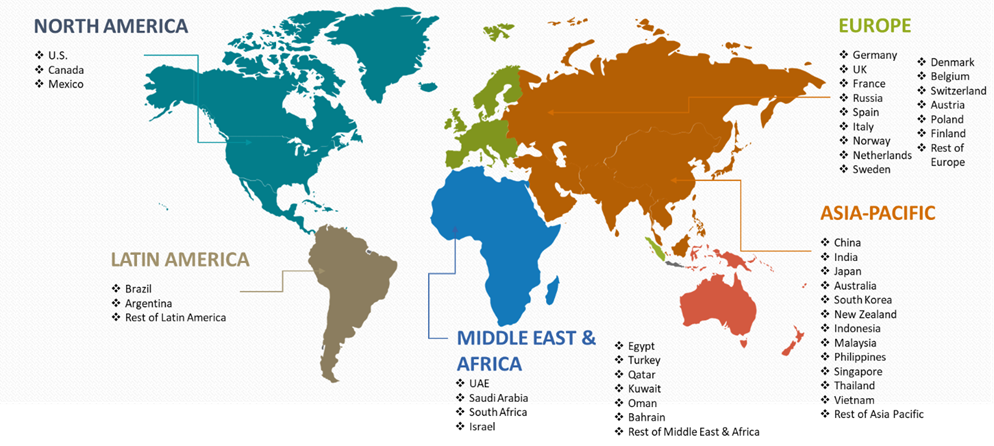
| By Region | North America | U.S., Canada, Mexico |
| Europe | Germany, UK, France, Spain, Italy, Norway, Netherlands, Sweden, Denmark, Belgium, Switzerland, Austria, Poland, Finland | |
| Asia-Pacific | China, India, Japan, Australia, South Korea, New Zealand, Indonesia, Malaysia, Philippines, Singapore, Thailand, Vietnam | |
| Latin America | Brazil, Argentina | |
| Middle East and Africa | UAE, Saudi Arabia, South Africa, Israel, Egypt, Turkey, Qatar, Kuwait, Oman, Bahrain | |
| Report Insights Covered | Competitive Landscape Analysis, Company Profile Analysis, Market Size, Market Share, Market Growth | |
For More Detailed information Request for Sample
Tobacco Products Market Key Takeaways
- The market is expected to generate more than US$ 183 billion in new revenue opportunities between 2025 and 2033, highlighting its long-term commercial attractiveness for manufacturers, distributors, and investors.
- Asia-Pacific accounted for 41.56% of global market revenue in 2025, maintaining its position as the largest regional market due to its large consumer base, expanding middle class, and strong retail penetration.
- Combustible tobacco products continue to dominate industry revenue; however, the fastest growth is being observed in smoke-free and reduced-risk nicotine categories, reflecting a gradual shift in consumer preferences.
- Premium tobacco products are outperforming value segments in several markets as consumers increasingly prioritize product quality, brand reputation, and differentiated experiences.
- Alternative nicotine products are evolving from niche offerings into mainstream revenue generators, creating new growth avenues for leading manufacturers.
- Digital technologies are transforming consumer engagement, with manufacturers increasingly leveraging data analytics, digital marketing, and e-commerce channels to strengthen customer relationships.
- Product innovation is becoming a critical competitive advantage as companies invest in advanced nicotine delivery systems, flavor development, and next-generation reduced-risk products.
Tobacco Products Market Analyst Viewpoint
The tobacco products industry is undergoing a significant transformation from a traditional cigarette-focused market to a diversified nicotine ecosystem. While combustible tobacco products continue to generate the majority of industry revenue, manufacturers are increasingly investing in next-generation products that align with evolving consumer preferences and regulatory requirements.
The industry's future growth will be influenced by the balance between declining smoking rates in developed markets and increasing adoption of alternative nicotine products worldwide. Companies that successfully diversify their portfolios while maintaining strong brand equity are expected to outperform competitors in the coming years.
Furthermore, premium tobacco products, reduced-risk nicotine alternatives, and digital retail expansion are emerging as critical factors shaping future market competitiveness. As regulatory frameworks continue to evolve globally, innovation and portfolio diversification will remain essential for sustainable growth.
Tobacco Products Market Latest Industry Intelligence & Future Growth Catalysts (2026)
Premiumization Is Driving Revenue Growth
Consumers are increasingly purchasing premium cigarettes, cigars, nicotine pouches, and specialty tobacco products, allowing manufacturers to improve margins despite relatively modest volume growth.
Reduced-Risk Products Are Reshaping the Industry
Heated tobacco products, nicotine pouches, and other smoke-free alternatives are becoming strategic growth engines as companies expand beyond traditional tobacco categories.
Synthetic Nicotine Is Gaining Commercial Interest
Manufacturers are investing in synthetic nicotine technologies to diversify product portfolios and capitalize on emerging regulatory opportunities.
Alternative Nicotine Adoption Continues to Accelerate
Growing consumer awareness and changing lifestyle preferences are encouraging adoption of reduced-combustion and smoke-free nicotine products.
Digital Commerce Is Expanding Distribution Reach
Online retail channels are becoming increasingly important for premium and alternative nicotine products, helping brands strengthen consumer engagement.
Emerging Markets Continue to Support Volume Demand
Population growth, urbanization, and rising disposable incomes in developing economies continue to support long-term market demand.
Product Innovation Is Becoming a Key Competitive Differentiator
Manufacturers are focusing on flavor innovation, product formats, nicotine delivery technologies, and premium positioning strategies to capture market share.
Tobacco Products Market Dynamics
Persistent Nicotine Addiction and Cultural Acceptance
Nicotine is so addictive that it is very hard for users to quit. It keeps demand for tobacco products always high. The addictive power of nicotine has caused millions to fall prey to its chains. An astonishing number of 23.6 million Americans are afflicted with nicotine addiction; 8.5% of those over age 12 prove that its addictive power has dug deep into the market. Despite the stringent rules and regulations imposed on buyers, consumers still manage to consume tobacco products. Therefore, chemical played an integral role in the market.
Cultural acceptance also enhances the drive for the development of tobacco products across the globe. Tobacco smoking can be a widely accepted tradition or culture among individuals globally. The prevailing culture prevents any negative perceptions that are seemingly meant to deter the young users from engaging in tobacco products. The robust culture that has been upheld for some time ensures that the customer base is concrete. The two factors remain the driving force for continuous development of tobacco products.
Tobacco Products Market Segmentation Analysis
The global tobacco products market is segmented based on product, tobacco type, flavor profile, product strength, price tier, distribution channel, pack size, device ecosystem and region.
Combustible Tobacco Dominates Tobacco Products Market Due to High Demand, Wide Availability and Consumer Preference
Combustible tobacco goods such as cigarettes and cigars lead in the market share of the global tobacco business. It can be explained by their popularity and their consumption patterns. Despite the availability of other tobacco-related goods such as e-cigarettes, the tobacco business concerning combustible tobacco goods leads in terms of revenue generated.
Following this trend, Cigar Ambassador from the Dominican Republic plans to launch its first cigars in 2024 under the name Tobacco Queen. Four varieties have already been introduced under this new product line: Robusto, Lancero, Salomon and Super A. The products will be distributed through City of Palms Cigar Distribution Services. The high-priced and exclusive product will continue to do well in the market. The launch again reflects the popularity of tobacco products worldwide.
Tobacco Products Market Geographical Penetration
Tobacco Products DOMINATING MARKET:
Asia-Pacific Leads Global Tobacco Market Due to Large Population, Rising Income and Rapid Urbanization
Asia-Pacific has the maximum market share for tobacco products due to the high population and cultural acceptability of using tobacco products in this region. In the research done by the researchers at the Vanderbilt University, it has been stated that in the Asian countries, the average percentage of males who used tobacco was 65.4%, the average percentage of females using tobacco was 7.8% and the average age at which they started using tobacco was 22.8 years. All the factors resulted in the region leading the tobacco market globally.
India Tobacco Products Market Outlook
India boasts one of the biggest tobacco product industries in the world, with a huge market share attributed to its widespread use, particularly both smoked and smokeless varieties. However, with increasing awareness around health and regulatory power exercised by the Indian Government, a gradual shift is taking place with regard to how Indian consumers respond to and engage with tobacco products. Within this context, South Korea-based KT&G has finally entered India in May 2025 through a partnership with Kedara Trading LLP and has now launched four premium superslim varieties of cigarettes on June 2, 2025, out of a total of eight varieties. The move is observed to target the emerging middle-class population.
China Tobacco Products Market Trends
China tops global rankings in tobacco production and consumption and represents more than 300 million of the world’s total population of smokers. In fact, half of China’s adult males are active smokers and one out of every three cigarettes consumed internationally is smoked by a citizen of China. In addition to active smoking, the country has over 700 million people exposed to second-hand smoke, including 180 million daily non-smoking children. In conclusion, it needs to be said that the outlook on tobacco products in China revolves around high levels of consumption and an epidemic of smoking in Chinese citizens.
Tobacco Products Market Regulatory Analysis
The trade of tobacco has a very rigid public health-oriented regulation system under the WHO FCTC, which essentially covers all marketing, packaging, flavors and age restriction requirements. There are many examples of strict implementation of plain packaging, advertisement bans and point-of-sale restriction regulations aiming at control of youth engagement in the use of tobacco products. The EU Tobacco Products Directive gives the necessary regulation for the uniform regulation of the product. Other countries, such as Canada, are regulating vaping products under traditional tobacco control laws.
In countries like India, there are laws like COTPA governing advertisements, packages and sales. Tax rates are high and e-cigarettes and heated tobacco are still banned in those countries due to health hazards. Taxation laws might have some implications if illicit trade increases due to non-observance of laws. With new issues emerging in the form of online herbal tobacco, tax and other regulatory issues need to be addressed frequently.
Tobacco Products Market Competitive Landscape
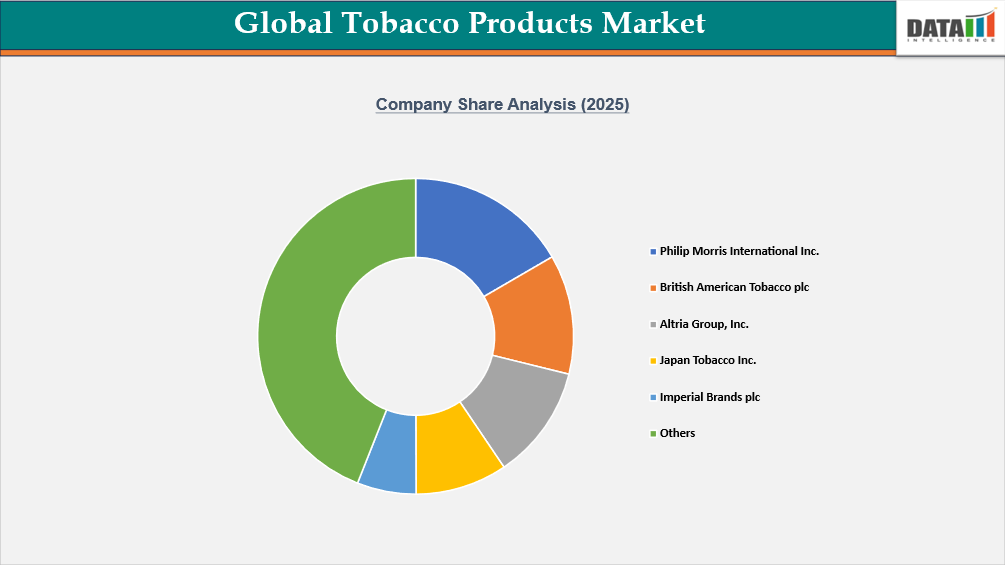
- The competitive nature of the tobacco products market is highly regulated, with manufacturers constantly engaging in innovation, product variety and flavors to capture their respective markets.
- Market share is held by a few players such as Bertrandt AG, Capgemini SE, L&T Technology Services Limited, IAV GmbH, Tech Mahindra Limited, Harman International Industries, Inc. and Continental AG.
- Price sensitivity and brand loyalty are important factors in consumer choice and distribution channels may include traditional retail or online platforms.
Tobacco Products Market Key Players:
Philip Morris International Inc.
British American Tobacco plc
Altria Group, Inc.
Japan Tobacco Inc.
Imperial Brands plc
ITC Limited
KT&G Corporation
Scandinavian Tobacco Group A/S
Swedish Match AB
PT Hanjaya Mandala Sampoerna Tbk
Gudang Garam Tbk PT
Eastern Company S.A.E.
Vector Group Ltd
Reynolds American Inc.
Universal Corporation
Alliance One International, Inc.
Godfrey Phillips India Ltd.
Donskoy Tabak
JTI-Macdonald Corp.
Panafrican Tobacco Group Holding Ltd.
China National Tobacco Corporation
Key Developments in the Tobacco Products Market
- August 2026: Philip Morris International Inc. continued accelerating its shift toward smoke-free products, with nicotine pouches and heated-tobacco products becoming increasingly important growth areas as cigarette consumption declines.
- August 2026: Altria Group, Inc. and Philip Morris International Inc. entered into contract-manufacturing agreements designed to expand cigarette import and export opportunities and benefit from U.S. duty-drawback provisions.
- August 2026: Philip Morris International Inc., British American Tobacco plc and Altria Group, Inc. intensified competition in the U.S. nicotine-pouch market, with manufacturers introducing higher-strength products as demand for oral nicotine products expands.
- August 2026: Japan Tobacco Inc. continued strengthening its next-generation nicotine portfolio as nicotine pouches, heated-tobacco products and other smoke-free formats gain importance within the global tobacco industry.
- August 2026: British American Tobacco plc continued its transition toward a multi-category nicotine business, with smoke-free products increasingly central to its long-term growth strategy.
- August 2026: Swedish Match AB continued benefiting from the expansion of nicotine pouches and other oral nicotine products, as consumers increasingly shift toward smoke-free nicotine formats.
- July 2026: Philip Morris International Inc. continued expanding its smoke-free portfolio, with heated-tobacco products, nicotine pouches and e-cigarettes increasingly complementing its traditional cigarette business.
- June 2026: China National Tobacco Corporation continued maintaining its dominant position in China's tobacco sector while the global industry increasingly focused on product innovation, alternative nicotine formats and regulatory compliance.
- May 2026: Imperial Brands plc continued strengthening its next-generation product portfolio, focusing on nicotine pouches, vaping and other modern nicotine formats alongside its traditional tobacco business.
- In December 2025, Philip Morris Japan launched Sentia Icy Red, a new heated tobacco product that has been launched with the company’s IQOS ILUMA I device, which is now available at various stores, electronic shops and convenience shops from December 1, while online shopping is from December 4. Sentia Icy Red offers a strong menthol sensation with red berry and floral notes, expanding the Sentia lineup to 17 flavors.
- In October 2025, 22nd Century Group, Inc. launched its VLN reduced nicotine cigarettes at about 140 locations of Circle K in Illinois, taking the brand to 45 authorized states. VLN reduced nicotine cigarettes are made of special tobacco with 95% less nicotine content than regular tobacco, designed to help consumers cut down on the volume of nicotine they use and meet the FDA's proposed nicotine standards.
- In June 2025, Firstunion Group launched the PTH MASTER, the world’s first puff-to-heat (PTH) heated tobacco device. With this product, there will be no more ‘waiting to heat,’ and there will be no compromise in flavor from the first to last puff. It will have instant ON and pause options with three ‘first-to-market’ technologies: a six-module ‘AI-driven thermal control,’ ‘HOP honeycomb-engineered tobacco sheets,’ and ‘Lingxi airflow sensor.’
Why Choose DataM
- Latest Data & Forecasts - Comprehensive, up-to-date insights and projections through 2033. Coverage includes global value by product, tobacco type, flavor profile, product strength, price tier, distribution channel, pack size, device ecosystem and region. Scenario forecasts with region-level splits (North America, Europe, Asia-Pacific, Latin America, Middle East and Africa) and sensitivity to factors such as regulatory reclassification and raw-material costs.
- Regulatory Intelligence - Actionable analysis of regulatory frameworks that materially affect Tobacco Products commercialization, revenue by country, allowable label claims, permitted doses, import/export controls and advertising restrictions.
- Competitive Benchmarking - Standardized profiling and benchmarking of leading pharma and nutraceutical players, contract manufacturers and e-commerce specialists active in the market.
- Geographic & Emerging Market Coverage - Region-by-region market sizing, growth drivers, reimbursement dynamics, cultural/consumer behavior and market access considerations. Focus on high-growth or regulatory-uncertain markets.
- Actionable Strategies - Identify opportunities for launching innovative products, while leveraging strategic partnerships and supply chain integration for maximum ROI.
- Pricing & Cost Analysis - In-depth assessment of price trends, raw material costs and sustainability-driven cost efficiencies across regional markets.
- Expert Analysis - Insights from industry experts such as product specialists, regulatory affairs professionals and key manufacturing companies.
Why Buy This Tobacco Products Market Report?
This report provides comprehensive insights into one of the world's largest consumer goods industries. It helps stakeholders understand evolving market dynamics, identify high-growth product categories, evaluate investment opportunities, and anticipate future regulatory and consumer trends.
The study supports strategic planning, market entry assessments, competitive benchmarking, portfolio diversification decisions, and long-term investment planning by delivering actionable intelligence across the global tobacco products value chain.
Target Audience
- Tobacco Manufacturers - Large and medium-sized companies producing cigarettes, cigars, heated tobacco products (HTPs) and smokeless tobacco. They require support in product development, regulatory compliance, flavor innovation and sustainable sourcing.
- Tobacco Ingredient & Additive Suppliers - Providers of raw materials, flavorings, nicotine, filters and packaging components who partner with manufacturers to optimize formulations, comply with regulations and improve product consistency.
- Alternative Nicotine & Next-Gen Product Companies - Firms developing e-cigarettes, nicotine pouches oral nicotine products, heated tobacco devices and other reduced-risk products targeting adult smokers and new consumer segments.
- Retailers & Distribution Channels - Convenience stores, supermarkets, specialty tobacconists and online platforms responsible for selling tobacco products. They need insights on consumer preferences, regulatory labeling and merchandising strategies.
- Regulatory & Compliance Agencies - Organizations ensuring adherence to laws and guidelines, including health warnings, packaging restrictions, marketing limits and product testing for safety and chemical compliance.
- Investors & Financial Institutions - Venture capital firms, private equity investors and strategic investors funding tobacco innovation, alternative nicotine products or sustainable tobacco ventures.
- Testing, Laboratory & Certification Providers - Labs and agencies conducting chemical analysis, emissions testing, toxicology studies and product certifications to meet national and international safety standards.
- Research & Innovation Centers - Academic institutions, industry R&D labs and technology centers focusing on tobacco alternatives, nicotine delivery systems, plant-based materials and sustainability in tobacco farming and processing.





























































