


Market Size
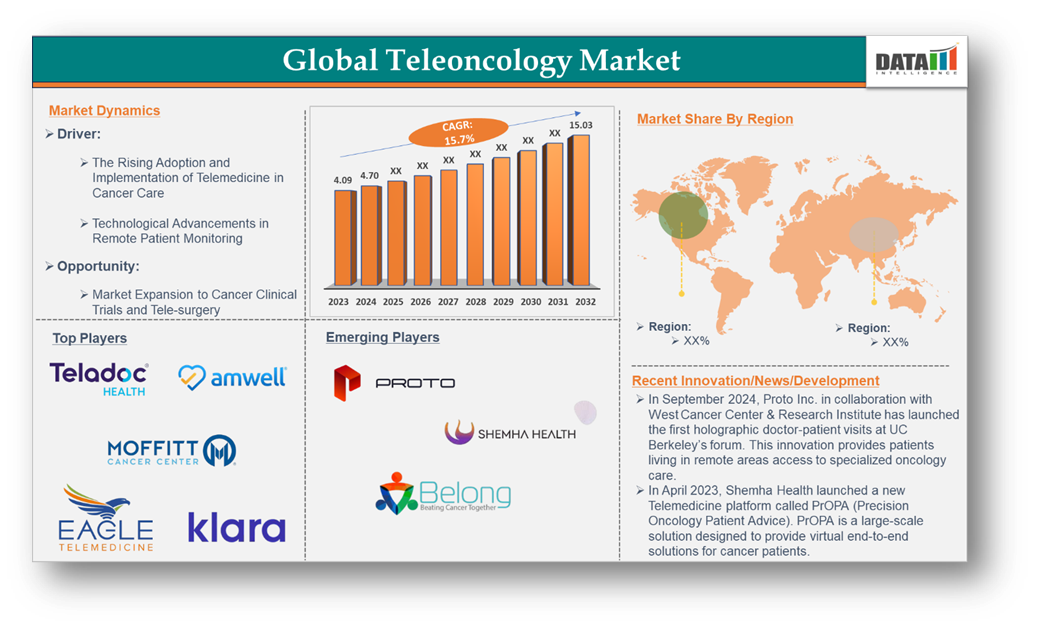
The global teleoncology market reached US$5.44 billion in 2025 and is expected to reach US$ 17.39 billion by 2033, growing at a CAGR of 15.7% during the forecast period 2026-2033.
Teleoncology refers to the application of telemedicine to oncology, which involves delivering oncology services such as diagnosis, treatment, and monitoring via virtual platforms. Teleoncology enables patients living in remote areas to get accurate diagnoses, make clinical decisions, and get precise care at lower costs. Teleoncology reduces the economic burden on remote patients, eliminating the need for frequent hospital visits.
The rising adoption and implementation of telemedicine in cancer care and technological advancements in modern healthcare services by major market players are expected to play a crucial role in driving market growth in the forecast period.
Executive Summary
Market Dynamics: Drivers & Restraints
The Rising Adoption and Implementation of Telemedicine in Cancer Care
The rising adoption and implementation of telemedicine in cancer care is a major factor contributing to the market growth in the forecast period. The COVID-19 pandemic has clearly affected the way healthcare is delivered to patients. Remote monitoring, telemedicine, and online consultations have gained traction, and their importance is ever-growing post-pandemic. Post-pandemic many reputed cancer clinics across the U.S. have started virtual consultations, remote monitoring, and care.
Telemedicine has brought physicians and patients closer virtually, and it has become a major medium for care delivery to patients living in remote or rural areas.
According to USA Facts, the adoption of telehealth has risen drastically in the United States. Telehealth visits have increased from about 5 million to more than 53 million among Medicare recipients and the majority of physicians plan to implement telemedicine practices going further.
Several cancer care delivery centers in the U.S. have also initiated delivering their services virtually, and among these services, online consultations have a major share for oncology patients living in rural areas.
The implementation of telehealth has also reduced the financial burden imposed on rural patients by eliminating the cost of travel. For instance, a research study published in the JAMA network in 2023, which has evaluated the cost reductions associated with the implementation of telehealth has reported an average saving between US$147 to US$186 per visit.
In the forecast period, the demand is expected to continuously rise, fuelling the market growth.
Lack of Awareness and Technological Gaps
The need for Teleoncology is higher in rural areas and the patient population living in these parts is the major target for teleoncology services. The implementation of Teleoncology is linked with the use of software and modern electronic devices with high-speed internet connectivity. This may pose a challenge to the elderly population and patients with technological gaps. Patients may feel this process to be cumbersome and may hesitate to adopt this novel method of care, and rather prefer the traditional way of care through physician visits.
Hence the adoption of teleoncology becomes questionable in certain parts of the world, despite the growing demand in the other well-developed regions. Moreover, virtual care has limited options for cancer patients. Cancer patients must undergo frequent screening tests to assess the clinical stage of cancer and to check the prognosis of the treatment.
The only way this can be done virtually is if the patient visits the nearest diagnostic center, the radiology images generated will be sent to the corresponding physician who is addressing the patient virtually.
This process again is limited by the lack of proper diagnostic facilities in rural areas. Some patients may feel ambiguity in this entire process. Moreover, the regulatory policies vary from state to state, and the adoption may vary according to the state. The reimbursement policies and extent of coverage for Teleoncology services may also vary. This may passively impact the adoption of teleoncology services.
All these factors may restrain the market growth in the forecast period.
Segment Analysis
The global teleoncology market is segmented based on component, cancer type, application, and region.
Breast cancer is the cancer type segment that is expected to dominate the market.
Among different cancers that are affecting patients, breast cancer is one of the most prevalent cancers.
For instance, As per the recent statistics published by the Global Cancer Observatory, in 2022, there are approximately 2.3 million new breast cancer cases reported across the world. Ranking among the top most incident cancer cases. It is estimated that in 2025, the number of breast cancer cases incidence will rise to 2.5 million, and in 2030, the incidence will reach 2.7 million cases. This alarming rise in breast cancer is a major contributing factor to its dominance in the teleoncology market.
As the number of patients with breast cancer is higher among other cancers, the patient population opting for teleoncology services is also expected to be higher. For instance, according to a study published in Nature Journal in 2023, the implementation of telemedicine is majorly recorded for breast cancer followed by lung cancer, head, and neck cancers, brain cancer, and others, and among the telemedicineapplications, teleconsultation was the most commonly deployed application with a share of 60%.
Moreover, due to care disparities among urban and rural populations, breast cancer patients in rural areas have higher mortality as compared to urban breast cancer patients. The disparities arise from a lack of care physicians, advanced diagnostic facilities, and a lower rate of early cancer diagnosis. For instance, a recent study published in the National Center for Biotechnology Information in 2021, has stated that the 10-year risk of breast cancer mortality is higher among rural population i.e., 17.1%, which is higher than that of mortality of breast cancer patients living in metropolitan areas which is 14.6%.
The implementation of teleoncology services and the launch of remote digitalized diagnostic equipment in rural areas will provide an opportunity to increase the survival rate, and also reduce the financial burden imposed due to frequent physician visits for breast cancer patients.
Geographical Analysis
North America is expected to hold a significant share of the teleoncology market.
North America currently holds a significant market share in the teleoncology market due to various factors including, the advanced healthcare infrastructure, technologically advanced states, high awareness of telemedicine, and the rising prevalence of cancer. For instance, as per the International Agency for Research on Cancer projections, nearly 2.60 million new cancer cases were reported in North America, and by 2040, the incidence is expected to reach 3.60 million. This rising prevalence combined with the advanced healthcare landscape positions North America as the market leader in the global teleoncology market.
The region has higher investments in telehealth platforms to significantly improve patient access to medical care. Moreover, governments in North America are proactively supporting the integration of telemedicine, encompassing teleoncology, through diverse policies and initiatives. One significant example is the Centers for Medicare & Medicaid Services (CMS) in the U.S., which has broadened its reimbursement policies for telehealth services. This expansion includes teleoncology, thereby enhancing patient accessibility to these advanced healthcare services.
Competitive Landscape
The major global players in the teleoncology market are Teladoc Health, Inc., American Well, Moffitt Cancer Center, Eagle Telemedicine, Intermountain Health, Klara Technologies, Inc., DocPanel Technologies, Inc., OurExpertDoc, Cancerdocs and OncoHealth. among others.
Emerging Players
The emerging players in the teleoncology market include Proto Inc., Shemha Health, Belong. Life, among others
Key Developments
April 2026: Teladoc Health expanded virtual oncology consultation and remote cancer care platforms across North America and Europe, strengthening its position in the global teleoncology market and digital cancer care sector.
February 2026: Siemens Healthineers launched AI-enabled remote oncology imaging and cloud-based cancer management solutions across Asia-Pacific and the Middle East, supporting rising demand for virtual oncology care and connected healthcare technologies.
December 2025: The United States accelerated adoption of telehealth oncology services, remote chemotherapy monitoring, and digital cancer diagnostics, reinforcing growth in the regional cancer telemedicine and healthcare digitization industry.
October 2025: GE HealthCare expanded integrated teleoncology imaging and AI-assisted diagnostic platforms across Europe and North America, strengthening innovation in the remote diagnostics and oncology information systems market.
September 2025: India increased investments in digital healthcare infrastructure, rural oncology access, and virtual cancer consultation networks across major healthcare institutions, supporting growth in the telehealth services and oncology care sector.
July 2025: Philips introduced cloud-based oncology collaboration platforms and remote patient monitoring technologies across global markets, accelerating expansion of the digital oncology and connected care industry.
May 2025: Europe increased funding and regulatory support for telemedicine oncology programs and interoperable healthcare platforms across Germany, France, and the United Kingdom, strengthening regional adoption of remote patient management and smart healthcare technologies.
March 2025: Oracle Health expanded cloud oncology data systems and AI-powered clinical workflow solutions across Asia-Pacific and North America, supporting innovation in the oncology informatics and healthcare IT market.
February 2025: China witnessed rising demand for AI-assisted cancer diagnosis, online oncology consultations, and remote treatment planning systems, driving expansion of the domestic digital healthcare and smart hospital industry.
January 2025: Varian Medical Systems strengthened remote radiation therapy planning and virtual oncology management capabilities across North America and Europe, expanding innovation in the cancer treatment and telemedicine market.
| Metrics | Details | |
| CAGR | 15.7% | |
| Market Size Available for Years | 2023-2033 | |
| Estimation Forecast Period | 2026-2033 | |
| Revenue Units | Value (US$ Mn) | |
| Segments Covered | Component | Software, Hardware, and Services |
| Cancer Type | Breast Cancer, Lung Cancer, Colorectal Cancer, Prostate Cancer, Bladder Cancer, Liver Cancer, and Others | |
| Application | Remote Patient Monitoring, Medical Second Opinions, Patient Consultations, and Others | |
| Regions Covered | North America, Europe, Asia-Pacific, South America, and Middle East & Africa | |
Why Purchase the Report?
- Pipeline & Innovations: Reviews ongoing clinical trials, and product pipelines, and forecasts upcoming pharmaceutical advancements.
- Type Performance & Market Positioning: Analyzes product performance, market positioning, and growth potential to optimize strategies.
- Real-World Evidence: Integrates patient feedback and data into product development for improved outcomes.
- Physician Preferences & Health System Impact: Examines healthcare provider behaviors and the impact of health system mergers on adoption strategies.
- Market Updates & Industry Changes: Covers recent regulatory changes, new policies, and emerging technologies.
- Competitive Strategies: Analyzes competitor strategies, market share, and emerging players.
- Pricing & Market Access: Reviews pricing models, reimbursement trends, and market access strategies.
- Market Entry & Expansion: Identifies optimal strategies for entering new markets and partnerships.
- Regional Growth & Investment: Highlights high-growth regions and investment opportunities.
- Supply Chain Optimization: Assesses supply chain risks and distribution strategies for efficient Type delivery.
- Sustainability & Regulatory Impact: Focuses on eco-friendly practices and evolving regulations in healthcare.
- Post-market Surveillance: Uses post-market data to enhance product safety and access.
- Pharmacoeconomics & Value-Based Pricing: Analyzes the shift to value-based pricing and data-driven decision-making in R&D.
The global teleoncology market report would provide approximately 62 tables, 57 figures, and 195 pages.
Target Audience
- Manufacturers: Pharmaceutical, Biotech Companies, Contract Manufacturers, Distributors, Hospitals.
- Regulatory & Policy: Compliance Officers, Government, Health Economists, Market Access Specialists.
- Technology & Innovation: R&D Professionals, Clinical Trial Managers, Pharmacovigilance Experts.
- Investors: Healthcare Investors, Venture Fund Investors, Pharma Marketing & Sales.
- Consulting & Advisory: Healthcare Consultants, Industry Associations, Analysts.
- Supply Chain: Distribution and Supply Chain Managers.
- Consumers & Advocacy: Patients, Advocacy Groups, Insurance Companies.
- Academic & Research: Academic Institutions.




























































