


Tactical Data Links Market Size and Overview
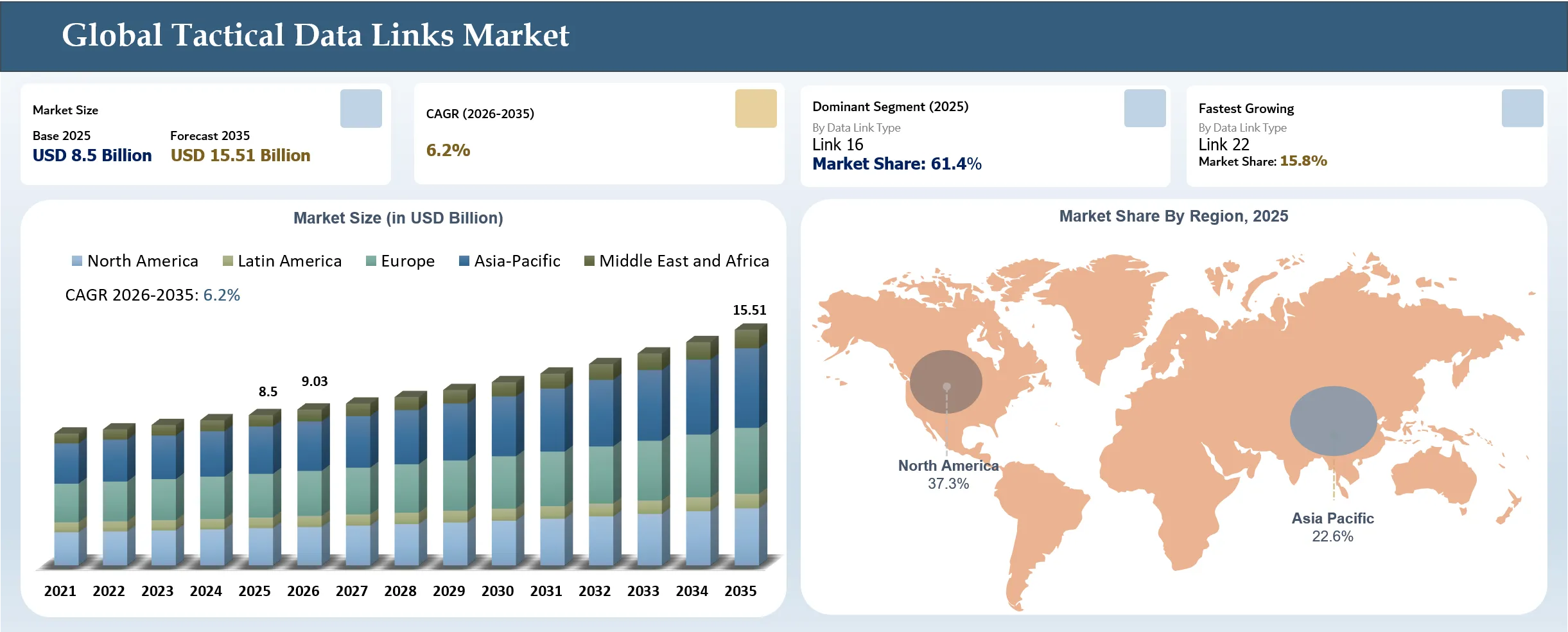
The global tactical data links market reached USD 8.5 billion in 2025 and is expected to reach USD 15.51 billion by 2035, growing with a CAGR of 6.2% during the forecast period 2026-2035. The market is being shaped by continued modernization of secure, interoperable military communication networks. In February 2025, BAE Systems highlighted its Link 16 portfolio, with Data Link Solutions supporting Link 16 terminals across 40 platforms in 30 allied countries, demonstrating the broad installed base of tactical data-link systems. The U.S. Navy's FY2026 procurement program also includes Advanced Tactical Data Link Systems and Link 16 antenna deliveries, indicating continued investment in tactical networking capabilities. In parallel, Leonardo DRS reports more than 250 Link 22 units delivered or under contract, reflecting ongoing modernization from legacy Link 11 toward secure BLOS communications. The market is further moving toward software-defined and smaller-form-factor systems, with BAE Systems' 2025 SAFF Modular Data Link Set combining a Link 16 radio and data-link processor for UAVs, ground vehicles, maritime and airborne platforms. The developments indicate increasing demand for Link 16 and Link 22 modernization, software-defined terminals, interoperability, BLOS connectivity, and tactical networking across diverse military platforms.
White-Space Opportunities for Software-Defined Tactical Data Links and Multi-Platform Interoperability
The US Navy's $248 million January 2026 contract awarded to Data Link Solutions for hundreds of MIDS JTRS terminals demonstrates continued government investment in software-defined Link 16 capabilities for U.S. and coalition forces. The terminals are intended for more than 45 platform types, including aircraft, unmanned aerial vehicles, maritime assets, and armored command vehicles, highlighting demand for interoperable tactical connectivity across heterogeneous platforms. This creates white space for suppliers offering compact, software-defined, multi-protocol TDL terminals that can be integrated into newer unmanned and legacy platforms without extensive hardware redesign.
NATO's commitment to 5% of GDP annually for defense and security by 2035, including at least 3.5% for core military requirements, is further expanding the funding base for interoperable and networked military capabilities. NATO's 2026 industry strategy also identifies interoperability and standardization as priority areas, creating opportunities for TDL gateways, interoperability software, Link 22 modernization, and coalition-ready network-management solutions. Suppliers capable of bridging legacy and next-generation tactical networks across multinational forces are therefore positioned to address an underserved modernization requirement.
Tactical Data Links Market Key Takeaways
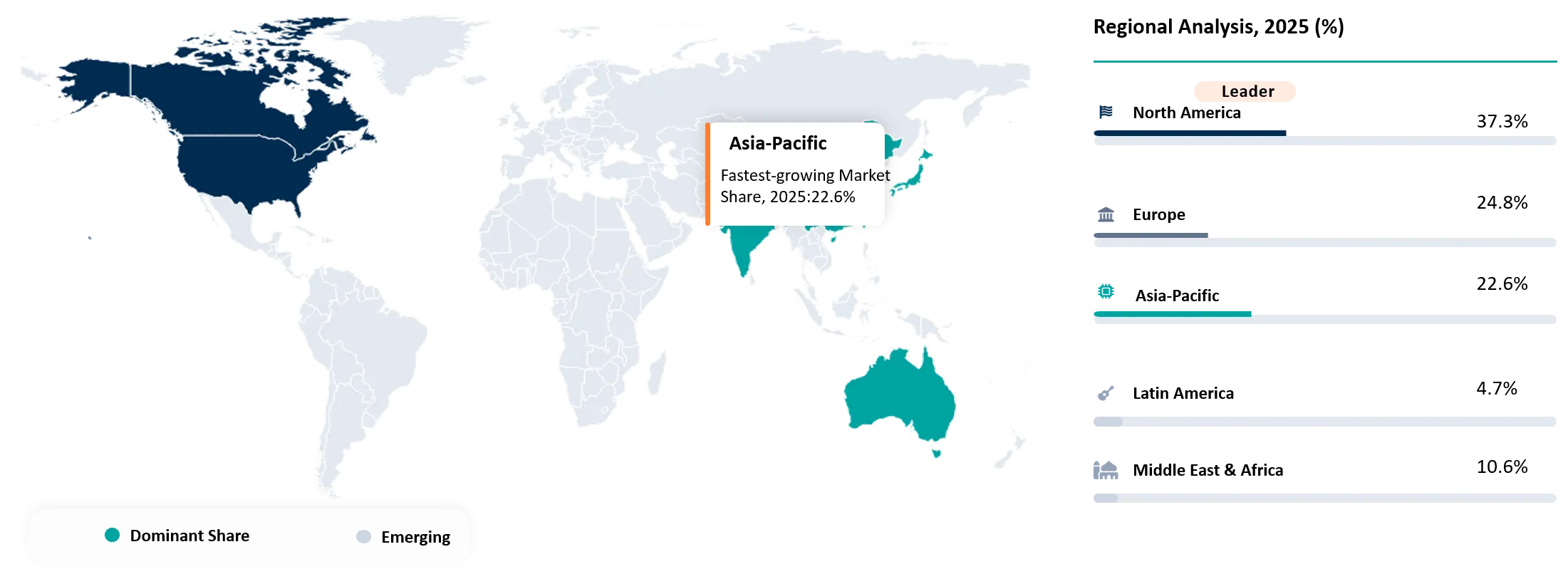
- North America captured the largest regional market share at 37.30% in 2025, supported by extensive deployment of Link 16 across U.S. military platforms and continued modernization of tactical communications infrastructure. Asia-Pacific is projected to be the fastest-growing regional market with 22% share, driven by defense modernization, expansion of network-centric warfare capabilities, and increasing interoperability requirements among regional armed forces.
- Link 16 dominated the market by data-link type, accounting for approximately 61.40% of the total market share in 2025, reflecting its extensive deployment across airborne, maritime, ground, and joint-force platforms. Link 22 accounted for 15.80%, supported by modernization of legacy Link 11 networks and requirements for beyond-line-of-sight tactical communications.
- The U.S. and its allies have begun to increase their tactical data link capabilities across multi-domain systems, where Link 16 has been increasingly deployed on aircraft, UAVs, naval systems, ground systems, and command posts. Increased deployment has resulted in growing demand for software-defined terminals, gateway systems, network management systems, and tactical communications infrastructure.
- Modernization programs in the military sector have increasingly become oriented towards interoperable tactical networks, where NATO and individual countries have increased their information sharing through air, land, maritime, space, and unmanned systems.
Tactical Data Links Market Industry Trends and Strategic Insight
- The shift toward multi-domain operations is accelerating demand for interoperable tactical data links, as defense forces increasingly connect air, land, maritime, space, cyber, and unmanned assets within integrated operational networks.
- Defense organizations are increasing investment in software-defined tactical communication systems, enabling Link 16 and other data-link capabilities to support multiple waveforms, faster upgrades, and integration across diverse military platforms.
- The growing deployment of unmanned aerial and maritime systems is expanding demand for compact, low-SWaP tactical data-link solutions, particularly for platforms requiring secure real-time exchange of command, surveillance, targeting, and sensor data.
- Modernization of legacy tactical networks is creating sustained demand for Link 22, gateways, and interoperability solutions, enabling defense forces to transition from legacy Link 11 networks while maintaining connectivity with existing Link 16 and national systems.
- Increasing electronic warfare and contested-spectrum risks are driving investment in resilient tactical networking technologies, including anti-jamming communications, secure waveforms, adaptive networking, and beyond-line-of-sight connectivity.
Tactical Data Links Market Scope
| Metrics | Details | |
| 2025 Market Size | USD 8.5 Billion | |
| 2035 Projected Market Size | USD 15.51 Billion | |
| CAGR (2026-2035) | 6.2% | |
| Largest Market | North America | |
| Fastest Growing Market | Asia-Pacific | |
| By Data Link Type | Link 16, Link 22, Link 11, Others | |
| By Solution | Hardware, Software, Services | |
| By Platform | Aircraft, Naval Vessels, Ground Vehicles and Command Posts, Unmanned Aerial Vehicles, Unmanned Maritime Systems | |
| By Application | Command and Control, Intelligence, Surveillance and Reconnaissance, Electronic Warfare, Battlefield Situational Awareness, Others | |
| By Communication Mode | Line-of-Sight Communication, Beyond-Line-of-Sight Communication | |
| By End User | Military Forces, Special Operations Forces, Defense Agencies, Joint Military Commands, Others | |
| By Region | North America | U.S., Canada, Mexico |
| Europe | Germany, United Kingdom, France, Italy, Spain, Netherlands, Switzerland, Sweden, Norway, Denmark, Belgium, Poland, Austria, Ireland, Portugal, Greece, Finland, Rest of Europe | |
| Asia-Pacific | China, Japan, India, South Korea, Australia, New Zealand, Singapore, Malaysia, Thailand, Indonesia, Vietnam, Philippines, Taiwan, Rest of Asia Pacific | |
| Latin America | Brazil, Argentina, Chile, Colombia, Peru, Rest of Latin America | |
| Middle East and Africa | Saudi Arabia, United Arab Emirates, Qatar, Kuwait, Oman, Bahrain, South Africa, Egypt, Nigeria, Morocco, Rest of Middle East & Africa | |
| Report Insights Covered | Competitive Landscape Analysis, Company Profile Analysis, Market Size, Share, Growth | |
Tactical Data Links Market Disruption Analysis
Shift Toward Software-Defined Multi-Domain Tactical Networking
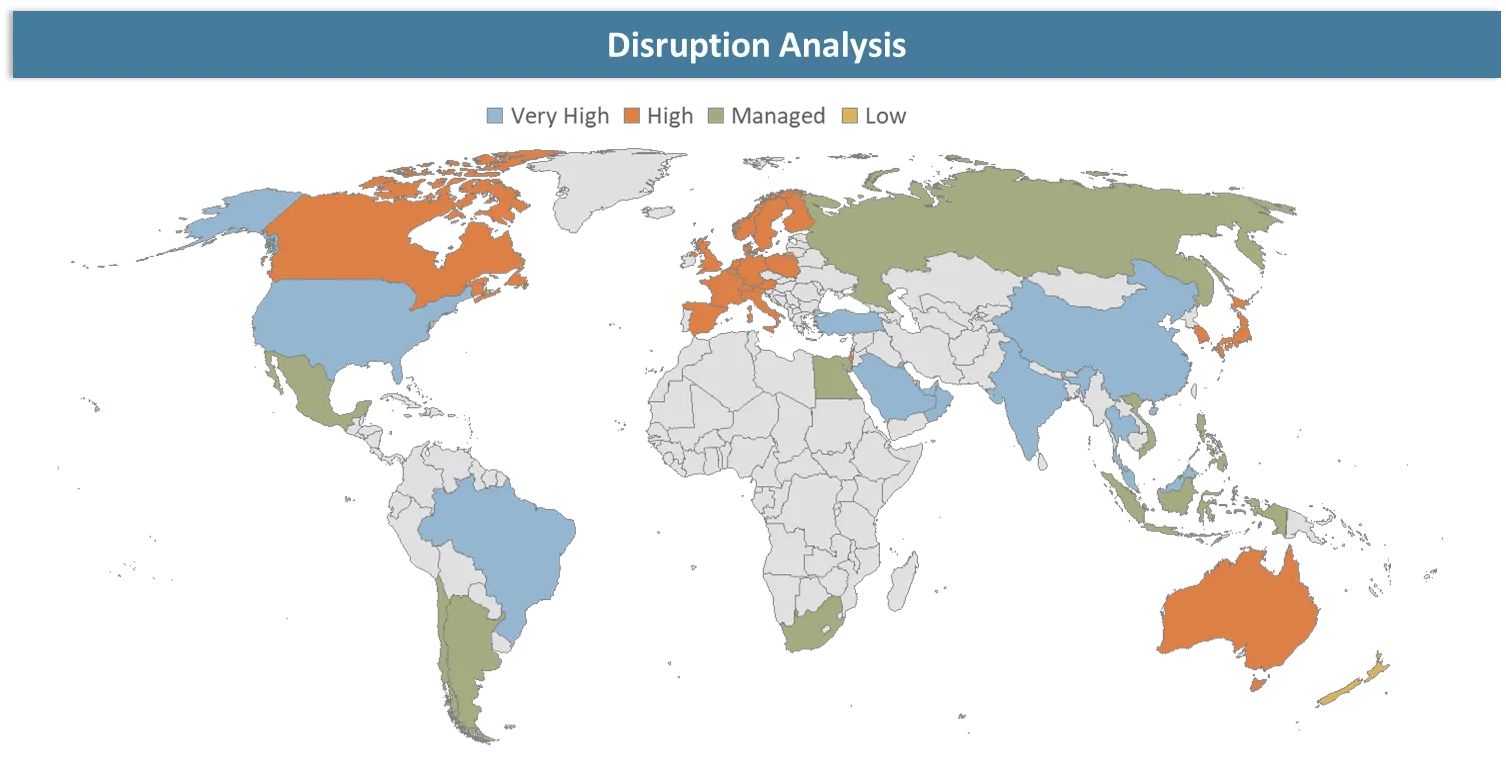
Tactical Data Links Market is shifting from standalone platform-based communications to networking land, maritime, airborne, cyber, and space systems together. Saab in April 2026 identified real-time data sharing, secure communication, cloud computing, and data fusion as key components of upcoming multi-domain operations. This transition is affecting the requirements of TDL from standalone connectivity of links to networking and information exchange between domains as well as real-time data distribution.
The transition is also increasing the role of software-based networking alongside conventional tactical radios and terminals. Saab's 2026 SPNP portfolio combines tactical routing, secure information-exchange gateways, tactical radios, satellite communications, and 5G within a software-based architecture supporting NATO Federated Mission Networking. This indicates a market shift toward flexible networking architectures capable of integrating multiple communication channels, security domains, and tactical platforms rather than relying on dedicated data-link equipment alone.
Tactical Data Links Market BCG Matrix: Company Evaluation

The Stars position is led by L3Harris Technologies, BAE Systems, Northrop Grumman, and Thales, supported by established Link 16/22 capabilities, extensive platform integration, and strong defense-program participation. The Potential Companies category includes Collins Aerospace, Leonardo DRS, and Lockheed Martin, which possess strong tactical networking and platform capabilities with scope for broader TDL expansion. Their positioning is supported by established relationships with defense forces and integration across aircraft, naval, ground, and C4ISR platforms.
The Question Marks category comprises Saab AB, General Dynamics UK, and Elbit Systems Deutschland, where tactical networking capabilities are supported by broader defense-electronics and C4ISR portfolios but TDL exposure remains more selective. These companies have opportunities to strengthen their position through multi-domain networking, platform modernization, and coalition interoperability programs.
Tactical Data Links Market Dynamics
Driver Impact Analysis
| Driver | Market Growth Impact (%) | Demand Concentration | Impacted Use Case | Strategic Impact |
Multi-domain warfare driving interoperable tactical data networks | 25% | High demand across NATO members and advanced defense forces integrating land, air, maritime, space, cyber, and unmanned assets. | Multi-domain command and control, joint operations, battlefield situational awareness, sensor-to-shooter networks. | Accelerates adoption of interoperable TDLs, gateways, network-management systems, and cross-domain data exchange solutions. |
NATO coalition interoperability requirements expanding Link 16 adoption | 22% | Concentrated across NATO members and coalition forces requiring standardized communications and interoperability across allied platforms. | Coalition operations, joint C2, ISR coordination, multinational air and maritime operations. | Strengthens demand for Link 16 terminals, interoperability gateways, secure radios, and NATO-compliant tactical networking solutions. |
Space-enabled Link 16 extending beyond-line-of- sight connectivity | 18% | Concentrated among defense forces investing in resilient satellite-enabled tactical communications and distributed operations. | BLOS command and control, long-range ISR, distributed targeting, contested-environment communications. | Expands TDL deployment beyond conventional radio coverage and increases demand for satellite-enabled terminals and network gateways. |
Unmanned warfare increasing machine-to-machine tactical connectivity | 18% | Strong demand among air, naval, and ground forces deploying UAVs, unmanned maritime systems, and autonomous platforms. | Unmanned ISR, autonomous operations, remote targeting, collaborative combat platforms. | Drives demand for compact, low-SWaP terminals, automated data exchange, tactical gateways, and machine-to-machine communications. |
Legacy tactical networks requiring Link 22 modernization | 17% | Concentrated among naval forces and defense organizations replacing aging Link 11 infrastructure while maintaining interoperability with existing networks. | Maritime C2, fleet coordination, BLOS communications, joint tactical networking. | Accelerates Link 22 deployment, modernization programs, protocol gateways, and solutions supporting Link 11-to-Link 22 transition. |
Multi-Domain Warfare Driving Interoperable Tactical Data Networks
The expansion of multi-domain warfare is increasing the requirement for tactical networks that connect forces and sensors across land, air, maritime, space, and cyber domains. In May 2026, NATO's Digital Transformation Implementation Strategy 2.0 reaffirmed interoperable digital capabilities as a priority for multi-domain operations. NATO is also conducting Digital Backbone Experimentation (DiBaX) 2026 to test secure, interoperable, open, resilient and low-latency networks across operational environments. These initiatives are moving tactical communications toward integrated network architectures rather than isolated platform-level connectivity.
The requirement is also becoming operationally visible through multinational experimentation and deployment. In July 2026, NATO's Task Force X-Central Mediterranean demonstrated multi-domain awareness by connecting crewed and uncrewed systems through a digital backbone, interoperable C2 and data-sharing arrangements. The development demonstrates the need to exchange information rapidly between heterogeneous platforms and command elements during joint missions. Consequently, demand is shifting toward interoperable TDL terminals, gateways, network-management systems and cross-domain communication solutions capable of supporting distributed military operations.
Restraint Impact Analysis
| Restraint | Drag on Market Growth (%) | Primary Impact Area | Impacted Use Case | Strategic Impact |
Legacy platforms complicating modern tactical data-link integration | 22% | Platform modernization, system integration, and interoperability | Fighter aircraft, naval vessels, armored vehicles, and legacy command systems | Increases integration costs and upgrade complexity, slowing deployment of modern TDL capabilities across aging platforms. |
Electronic warfare increasing anti-jamming technology requirements | 21% | Spectrum resilience, cybersecurity, and communications reliability | Contested battlefield communications, ISR, C2, and precision targeting | Raises technology and certification requirements for jam-resistant waveforms, adaptive networking, and resilient tactical communications. |
Complex multinational interoperability extending qualification timelines | 18% | Standards compliance, testing, certification, and coalition integration | NATO operations, multinational exercises, joint missions, and coalition C2 | Extends procurement and qualification cycles while increasing engineering requirements for standards-compliant interoperability. |
Proprietary architectures limiting cross-system interoperability | 20% | System integration, protocol compatibility, and network interoperability | Mixed-fleet operations, joint C4ISR networks, and coalition tactical communications | Restricts seamless data exchange between heterogeneous systems and increases dependence on gateways, middleware, and protocol translation. |
Legacy Platforms Complicating Modern Tactical Data-Link Integration
The legacy military systems have older communication infrastructures, interfaces, and processing capabilities which were never intended to be integrated with the contemporary tactical data links. There are added needs for the modification of hardware, integration of software, testing, certification, and platform engineering for this purpose. It becomes especially important in case of long-term aircrafts and naval systems wherein the replacement of systems cannot be done due to economic and operational reasons.
The U.S. Air Force's B-52 Tactical Data Link modernization program illustrates this constraint, with GAO reporting that the program's first modernization kit was installed in January 2025, while delays in receiving contractor proposals affected subsequent production lots and resulted in a two-year production gap. Such integration dependencies can extend deployment schedules and increase lifecycle costs, making phased upgrades, modular architectures, and interoperability gateways increasingly important for modernizing legacy fleets without requiring complete platform replacement.
Tactical Data Links Market Segmentation Analysis
The global tactical data links market is segmented by data link type, solution, platform, application, communication mode, end-user, and region.
Link 16 Adoption Is Accelerating Through Expanded Platform Integration and Next-Generation Network Performance
Link 16 continues to be the most dominant tactical data-link segment owing to its high levels of interoperability among different platforms in the United States, NATO, and coalitions. In 2025, L3Harris launched a new generation of TDL terminals that would allow smaller air, land, and maritime platforms that could not use Link 16 earlier, due to constraints of size, weight, power, and cooling (SWaP-C), access the technology for secure situation-awareness communication.
The current technological trends tend to ensure increased Link 16 performance, portability, and versatility of its integration. The 2025 MIDS-LVT Block Upgrade 2 by L3Harris is an example of the use of Enhanced Throughput technology, which allows for an increase in network-coded data throughput from up to 115.2 Kbps to more than 1,100 Kbps along with cryptographic and frequency remapping updates. In August 2026, the company demonstrated the integration of Link 16 onto UH-60 Black Hawks as part of Project Convergence-Capstone 6.
Tactical Data Links Market Geographical Penetration
North America strengthening by U.S. Army Aviation Tactical Data Link Adoption Through Link 16 Integration Into Multi-Domain Helicopter Operations
North America dominates the Tactical Data Links market due to the wide use of the U.S. Link 16 network and ongoing tactical networking in the U.S. Army, aircraft, naval, and joint forces platforms. In August 2026, L3Harris integrated Link 16 on UH-60 Black Hawk helicopters as part of the U.S. Army’s Project Convergence-Capstone 6 exercise held at Fort Irwin, California.
The integration helps Link 16-integrated Black Hawks to facilitate long-range networked fires and other multi-domain operations and expand the scope of tactical data transfer beyond traditional Link 16 systems. This will result in a need for more airborne tactical data-link terminals, secure networking, interoperable interfaces, and software defined communication solutions in the U.S. Army aviation. This is indicative of the transition from embedding TDL capability into other operational platforms instead of relying only on fighter and naval fleets.
U.S. Tactical Data Links Market Trends
USA leads the tactical data link market due to growth in the usage of Link 16 technology in military and civil aviation platforms. In August 2026, the United States Coast Guard released a request for information for Small Tactical Terminal Link 16 integration and support in the MH-65 helicopters, showing the need to add tactical data link capability in its rotary wing fleet.
The requirement has expanded the addressable user base in USA for TDL in terms of platforms from conventional combat aircraft, naval and Army platforms to Coast Guard aviation, thus, increasing demand for small-size Link 16 terminals, integration in aircraft, software setup, and sustaining services.
Canada Tactical Data Links Market Outlook
Canadian market opportunities for TDL are growing as the Canadian Armed Forces invest in distributed Link 16 infrastructure within the TIC3 program. Ultra Intelligence & Communications recently received a $7 million contract from the Canadian Armed Forces in October 2024 to supply Remote Tactical Data Link Management Systems at 16 or more sites in Canada to facilitate Link 16 Recognized Air Picture and air-defense capabilities.
The development is shifting the TDL needs from platform terminals to management system at remote sites, secure rekeying, distributed site connections, and tactical-data infrastructure. It will, thus, create additional opportunities for TDL management systems, interoperability tools, cryptographic facilities, and lifecycle services at Canadian defense sites. The Canadian Department of National Defense also considers Link 16, Link 22, and Link 11 as major TDLs and insists that CAF operational platforms should be interoperable with J-series messages
Expanding Tactical Data Exchange and Cross-National Network Interoperability Strengthening Asia-Pacific Tactical Data Links Market Growth
Asia-Pacific is expanding its tactical data links capability as Australia introduces the AH-64E Apache with integrated Link 16, advanced sensors, video transmission, and unmanned-system teaming. In August 2025, Australia’s Department of Defence highlighted the Apache’s Link 16 capability as part of its transition into Australian Army service, with associated training, airworthiness, and operational procedures being developed for Australian requirements.
The integration extends tactical data-link connectivity into Australian rotary-wing aviation and strengthens interoperability between Australian and allied forces operating within shared tactical networks. Link 16-enabled helicopters increase requirements for airborne terminals, secure communications, network integration, and interoperability with existing air and joint-force assets. The development also positions TDL connectivity as an integral element of Australia’s manned-unmanned teaming and multi-domain aviation architecture, rather than a standalone communication capability.
Australia Tactical Data Links Market Trends
Australia is advancing tactical data exchange through 2026 airborne interoperability operations with Japan, where a Royal Australian Air Force P-8A Poseidon and Japan Air Self-Defense Force RC-2 aircraft exchanged information through a tactical battlefield network. Australia's Defence Department reported in June 2026 that the activity was designed to connect Australian, Japanese, and U.S. ISR crews and enable data exchange across their operational networks.
It demonstrates an operational requirement for interoperable tactical networks capable of distributing ISR information between allied aircraft and other battlefield units. Australia's Defence Department also noted that the information shared through the tactical network can be distributed to aircraft, ships, and units, while the experience will inform future applications across other RAAF aircraft. This strengthens demand for TDL interoperability, secure network interfaces, tactical data processing, and network-management capabilities within Australia's defense architecture.
Japan Tactical Data Links Market Trends
Japan's FY2025 defense program allocates ¥9.8 billion specifically for development of a tactical datalink to maintain and enhance tactical information sharing among vessels, aircraft, and radar sites. The same program allocates ¥11.9 billion to field the next-generation JADGE, Japan's core integrated air and missile defense command-and-control system, with mobile terminals intended to strengthen operational resilience.
The dedicated datalink program directly expands Japan's requirements for tactical communications equipment, network interfaces, data-processing capabilities, and interoperability infrastructure across maritime and airborne assets. Its linkage with JADGE modernization also indicates that Japan is developing TDL capability as part of a broader integrated command architecture, rather than as isolated platform connectivity. This makes Japan's FY2025 investment a direct indicator of TDL infrastructure expansion and modernization demand.
Tactical Data Links Market Competitive Landscape
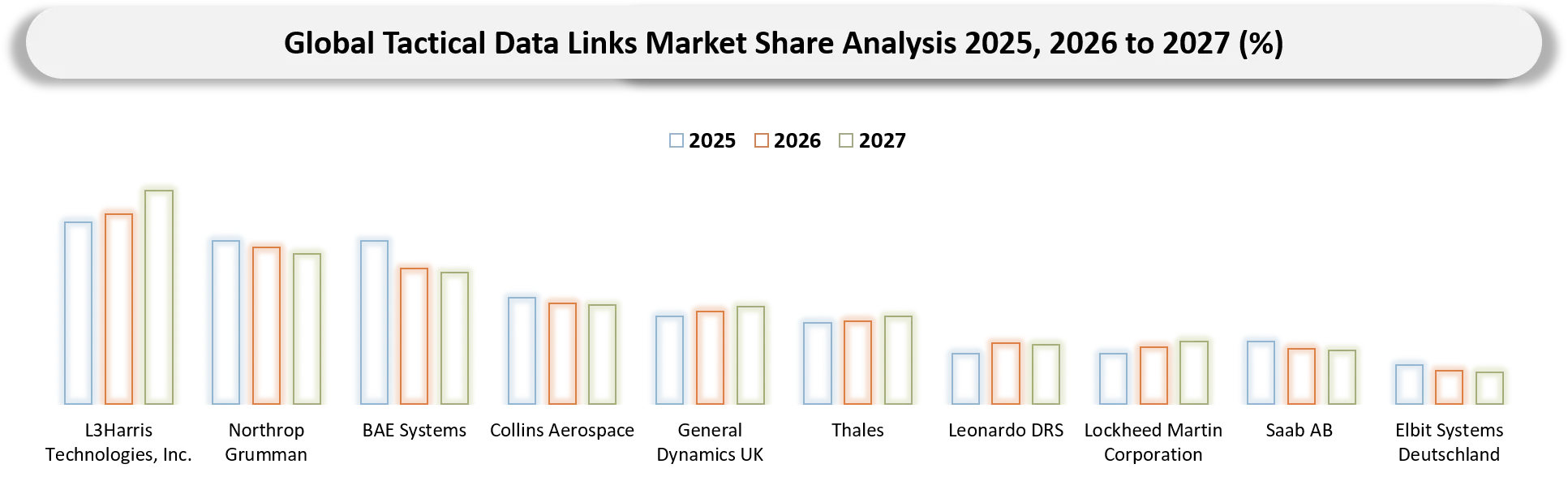
- Key players include L3Harris Technologies, Inc., Northrop Grumman, BAE Systems, Collins Aerospace, General Dynamics UK, Thales, Leonardo DRS, Lockheed Martin Corporation, Saab AB, Elbit Systems Deutschland.
Key Developments
- January 2025: BAE Systems, a U.S.-based defense technology company, received an $85 million U.S. Navy contract for Network Tactical Common Data Link (NTCDL) systems. NTCDL provides real-time exchange of voice, data, imagery, and full-motion video across air, surface, subsurface, and man-portable platforms.
- February 2025: BAE Systems, a UK-based defense technology company, expanded its Link 16 portfolio with MIDS JTRS, FireNet Link 16, Multi-Link Manager, and SAFF Modular Data Link Set. The solutions support software-defined, multi-protocol tactical networking across airborne, maritime, ground, and unmanned platforms.
- September 2025: Lockheed Martin, a U.S.-based aerospace and defense company, highlighted Link 16 connectivity through the Space Development Agency’s Transport Layer satellite network. The capability extends tactical data exchange into space and supports resilient, low-latency connectivity across distributed military forces.
- September 2025: L3Harris Technologies and Collins Aerospace, U.S.-based defense technology companies, received U.S. Navy contracts valued at up to $940 million each for MIDS radio production and sustainment. The awards support continued deployment and lifecycle modernization of Link 16 tactical data-link terminals.
- January 2026: Data Link Solutions, a U.S.-based BAE Systems and Collins Aerospace joint venture, received a $248 million U.S. Navy contract for hundreds of MIDS JTRS terminals. The software-defined terminals provide Link 16 connectivity across more than 45 platform types, including aircraft, UAVs, maritime vessels, and armored command-and-control vehicles.
- June 2026: Thales, a France-based defense technology company, demonstrated Link 16 and Link 22 interoperability capabilities supporting NATO tactical networks. The company's solutions enable tactical data exchange across air, land, naval, and joint command environments and strengthen interoperability between different data-link systems.
- August 2026: L3Harris Technologies, a U.S.-based defense technology company, demonstrated Link 16 integration on UH-60 Black Hawk helicopters during U.S. Army Project Convergence-Capstone 6. The integration connected Army aviation with multi-domain sensors and effectors, extending tactical data-link connectivity into rotary-wing operations.
Key Procurement Priorities and Buyer Evaluation Criteria
- Organizations procuring Tactical Data Link systems increasingly prioritize secure, interoperable, and resilient communication solutions capable of supporting real-time information exchange across aircraft, naval vessels, ground forces, and unmanned platforms.
- Procurement decisions are increasingly influenced by multi-domain operations, coalition interoperability, electronic warfare threats, and the need to connect legacy and next-generation platforms through standardized tactical data-link architectures.
- Buyers evaluate suppliers based on interoperability, anti-jamming resilience, communication range, data throughput, latency, cybersecurity, platform compatibility, certification requirements, network scalability, lifecycle support, and integration capabilities when selecting tactical data-link technology partners.
Why Choose DataM?
- Technological Innovations: Explores advancements in tactical data-link technologies, including Link 16 and Link 22 terminals, software-defined radios, tactical gateways, network-management systems, secure communications, anti-jamming capabilities, and interoperability solutions supporting multi-domain military operations.
- Product Performance & Market Positioning: Evaluates tactical data-link solutions based on interoperability, secure data exchange, communication range, anti-jamming resilience, throughput, latency, platform compatibility, network scalability, and multi-domain connectivity, highlighting how leading players differentiate through advanced terminals, gateways, and software-defined architectures.
- Real-World Evidence: Highlights deployment of tactical data-link systems across fighter aircraft, naval vessels, ground platforms, command posts, UAVs, and unmanned maritime systems, demonstrating their role in real-time situational awareness, command and control, ISR, electronic warfare, and coordinated military operations.
- Market Updates & Industry Changes: Tracks developments in Link 16 modernization, Link 22 adoption, space-enabled tactical connectivity, multi-domain command-and-control architectures, unmanned warfare, NATO interoperability initiatives, and defense communication modernization programs across North America, Europe, and Asia-Pacific.
- Competitive Strategies: Analyzes how leading companies strengthen market positions through next-generation terminal development, software-defined architectures, strategic defense contracts, platform integration, interoperability solutions, acquisitions, partnerships, and expansion into emerging multi-domain tactical networking requirements.
- Pricing & Market Access: Explains pricing variations based on terminal type, platform integration complexity, communication capabilities, software requirements, encryption, certification, customization, and lifecycle support, alongside procurement through defense ministries, military organizations, prime contractors, platform OEMs, and system integrators.
- Market Entry & Expansion: Identifies opportunities arising from military communications modernization, Link 11-to-Link 22 migration, NATO-standard interoperability, unmanned platform deployment, space-based tactical networking, and Eastern European defense investment, while assessing localization, strategic partnerships, platform integration, and government procurement strategies.
Target Audience
- Defense Forces and Military Organizations
- Special Operations Forces and Tactical Units
- Defense Agencies and Government Procurement Organizations
- Joint Military Commands and Multinational Defense Organizations
- Tactical Data Link Manufacturers and Communication System Providers
- Defense Electronics and Secure Communication Equipment Manufacturers
- Command, Control, Communications, Computers, Intelligence, Surveillance and Reconnaissance (C4ISR) System Providers


























































