


Supercapacitors Market Size & Forecast 2035
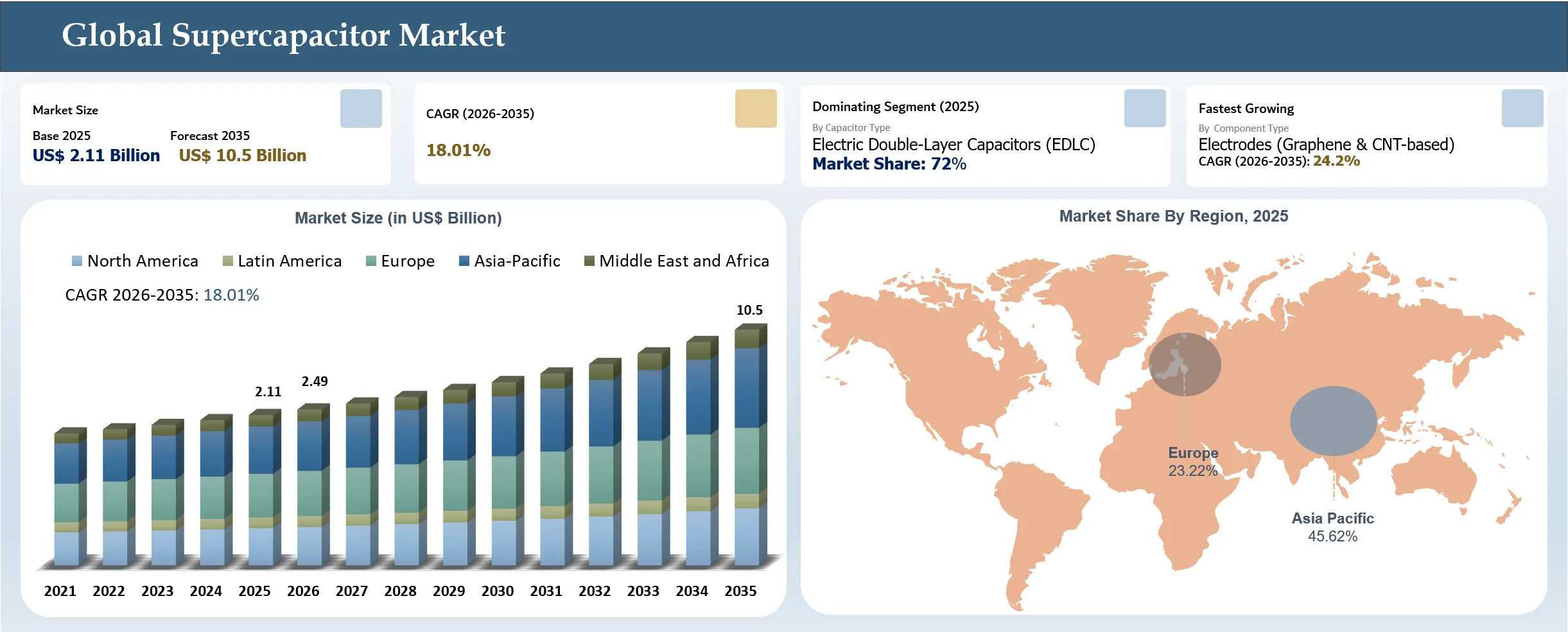
The global Supercapacitors market reached USD 2.11 billion in 2025 and is expected to reach USD 10.5 billion by 2035, growing with a CAGR of 18.01% during the forecast period 2026-2035. The market is witnessing a structural transition from conventional backup power applications to high-power energy management applications in AI data centers, modern power grids, transportation systems, and industrial equipment. The increasing need for power stabilization within milliseconds, fast charge-discharge ability, and high cycle energy storage is driving the adoption of supercapacitors in mission-critical infrastructures. Modernization of grids, regenerative brake systems, 48V automotive designs, and electrification of industrial machinery are expanding the supercapacitor application area by incorporating supercapacitors into energy recovery systems and power electronics. Companies are concentrating more on certification of their products for applications including balancing, diagnostics, thermal management, and power electronics in a bidirectional fashion.
The development of an UL 1973-certified energy storage system by Musashi, namely ESS400, is just one of those examples. Commercialization of hybrid battery-supercapacitor systems, LICs, higher voltage electrolytes, and carbon electrodes is improving future opportunities for growth, despite lower energy density and self-discharge rates restricting their use in long-duration energy storage.
This perspective underscores the increasing importance of supercapacitors for next-generation high-performance computing systems, where the need for fast-response, high-cycle energy storage systems is on the rise along with that of AI computing capability. In July 2026, according to an Investing.com report by Everbright Securities, the rapid expansion of AI Data Centers (AIDC) is expected to significantly increase the demand for supercapacitors.
The market for supercapacitors for AIDC is estimated to have revenue of RMB 10 billion in 2026–2027. In addition, it notes that the deployment of NVIDIA's GB300 NVL72 for 2026 will be at 50,000 to 60,000 racks, with each rack requiring 300 supercapacitors per rack, which means there will be 15 to 18 million supercapacitors in demand. Musashi plans to produce about 6.5 million units per year by Q3 2026.
White-Space Opportunities for Indigenous Supercapacitor Manufacturing and High-Power Energy Storage Systems
In October 2025, the Technology Development Board (TDB) under the Department of Science and Technology (DST), Government of India, sanctioned financial support to Westech Power Management Pvt. Ltd. for the commercialization of an Indigenous Mobile High-Power Containerized Supercapacitor Energy Storage System, creating significant investment opportunities across India's advanced energy storage ecosystem. The funding is primarily directed toward supercapacitor-based energy storage system development, indigenous technology commercialization, power electronics integration, system engineering, and domestic manufacturing, rather than conventional battery technologies. The project targets high-power applications across electric mobility, renewable energy integration, industrial backup power, defence, railways, mining, ports, and grid support infrastructure, where rapid charging, high cycle life, and reliable power delivery are critical. The initiative is expected to accelerate investments in advanced electrode materials, supercapacitor modules, power conversion systems, battery-supercapacitor hybrid architectures, energy management software, and localized manufacturing capabilities, supporting India's objective of strengthening domestic advanced energy storage production and reducing dependence on imported technologies.
The government-backed investment is expected to benefit companies across the supercapacitor value chain. Westech Power Management Pvt. Ltd. will directly benefit through technology commercialization and manufacturing expansion, while Exide Industries, Amara Raja Energy & Mobility, Siemens India, ABB India, Hitachi Energy India, Schneider Electric India, Delta Electronics India, and Tata AutoComp Systems are well positioned to benefit from increasing opportunities in power electronics, industrial energy storage, grid modernization, and energy management systems. In the electric mobility and transportation segment, companies such as Tata Motors, Ashok Leyland, JBM Auto, Olectra Greentech, and Bharat Electronics Limited (BEL) could leverage high-power supercapacitor systems for regenerative braking, auxiliary power, and hybrid energy storage applications. Additionally, NTPC Green Energy, Tata Power, Adani Energy Solutions, Larsen & Toubro (L&T), and BHEL are expected to benefit through the deployment of supercapacitor-based solutions for renewable energy integration, utility-scale grid stabilization, industrial automation, and critical infrastructure projects, expanding India's domestic supercapacitor manufacturing and deployment ecosystem.
Supercapacitor Market Strategic Takeaways
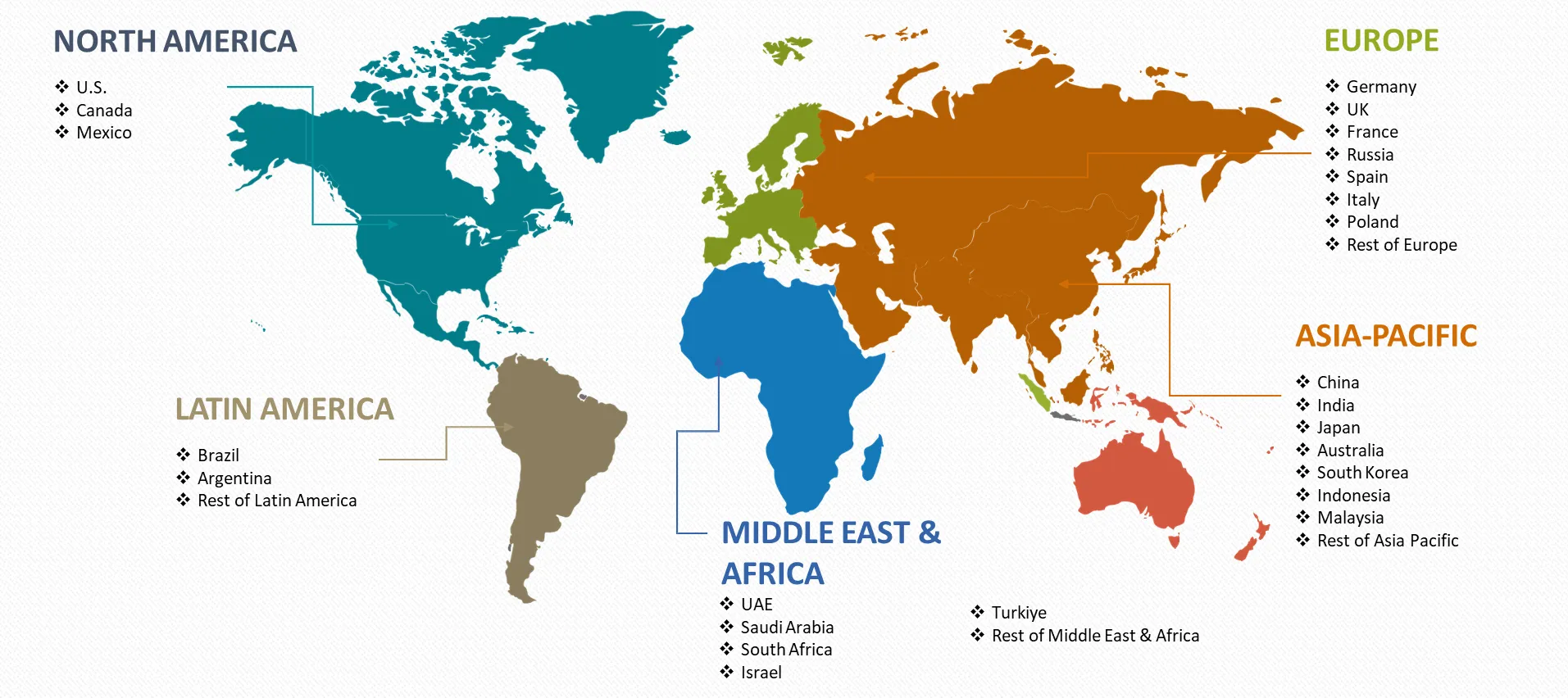
- Asia-Pacific held the largest market share in 2025 at 45.62% ($962.63 Million), followed by North America at 24.55% ($518.03 Million) and Europe at 23.22% ($489.99 Million). By 2035, Asia-Pacific revenue is forecast to reach $6,359.44 Million, with North America expanding to $2,135.20 Million and Europe reaching $854.77 Million.
- Electric Double-Layer Capacitors (EDLC) accounted for 63.4% of total market value in 2025, but are projected to drop to 52.0% by 2035. In contrast, Hybrid Supercapacitors are expected to increase their market share from 24.9% in 2025 to 34.8% by 2035.
- Automotive & Transportation led all application segments with a 32.7% share ($689.81 Million) in 2025, reaching 34.6% ($3,634.16 Million) by 2035. Industrial Equipment held 23.1% in 2025, while Renewable Energy is projected to expand its share from 16.1% in 2025 to 25.6% by 2035.
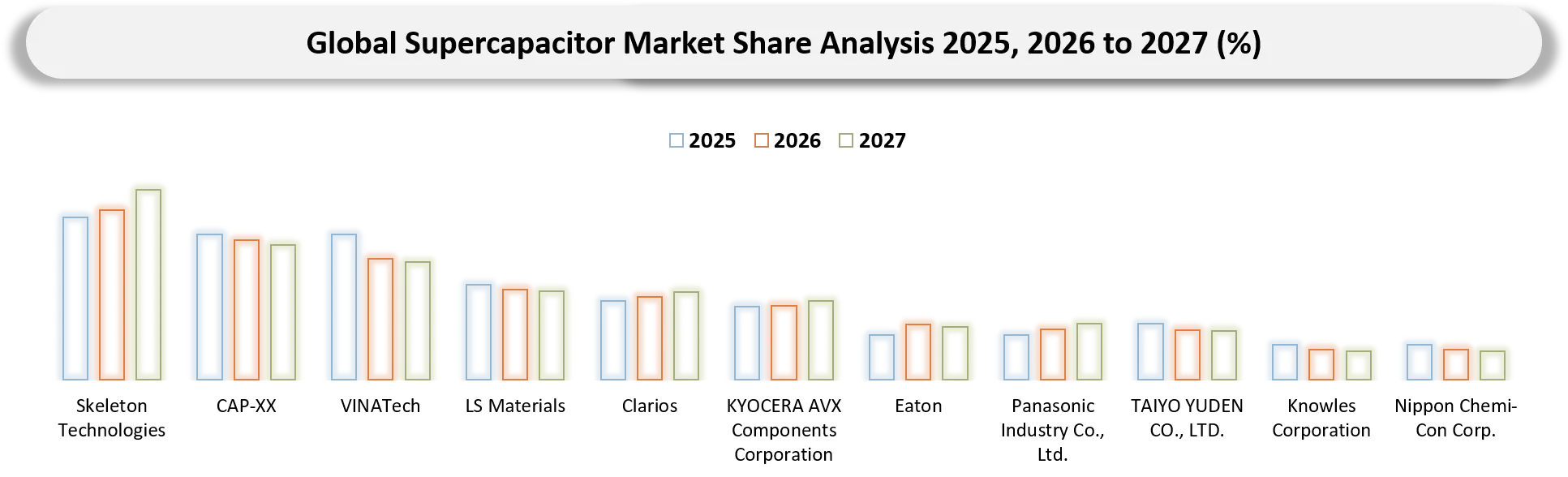
- Panasonic Industry Co., Ltd. led vendor market share in 2025 at 7.20%, followed by Clarios at 6.50% and Eaton at 5.80%. Nippon Chemi-Con Corp. held 5.20% and KYOCERA AVX held 4.80%, while remaining market players made up 70.50%.
Supercapacitor Market Industry Trends and Strategic Insight
- Lithium-ion capacitors (LICs) are redefining product development, as manufacturers transition from conventional electric double-layer capacitors (EDLCs) toward asymmetric architectures that combine higher energy density with rapid charge-discharge capability.
- AI data center infrastructure is emerging as a high-value deployment segment, with supercapacitors being integrated into UPS systems, DC-bus stabilization, and rack-level power architectures to manage millisecond-scale power fluctuations.
- Hybrid battery-supercapacitor architectures are strengthening commercial adoption, as end users increasingly deploy supercapacitors for peak-power delivery, regenerative braking, and battery protection while lithium-ion batteries provide sustained energy.
- Commercial competition is shifting toward application-ready integrated systems rather than discrete capacitor cells, with manufacturers differentiating through balancing electronics, bidirectional converters, intelligent diagnostics, thermal management, and software-enabled energy management.
- Regional supply chain localization is becoming a strategic priority, supported by government-backed investments in advanced carbon materials, energy storage manufacturing, and domestic production capabilities.
Supercapacitor Market Scope
| Metrics | Details | |
| 2025 Market Size | USD 2.11 Billion | |
| 2035 Projected Market Size | USD 10.5 Billion | |
| CAGR (2026-2035) | 18.01% | |
| Largest Market | Asia-Pacific | |
| Fastest Growing Market | Europe | |
| By Capacitor Type | Electric Double-Layer Capacitors (EDLC), Pseudocapacitors, Hybrid Supercapacitors | |
| By Capacity Range | Below 10 F, 10 F – 100 F, 100 F – 500 F, 500 F – 3,000 F, above 3,000 F | |
| By Voltage Range | Below 2.7V, 2.7V – 3.0V, above 3.0V | |
| By Component Type | Electrodes, Separators, Electrolytes, Current Collectors | |
| By Application | Automotive & Transportation, Consumer Electronics, Energy Storage Systems, Industrial Equipment, Renewable Energy, Aerospace & Defense, Others | |
| By Region | North America | U.S., Canada, Mexico |
| Europe | Germany, UK, France, Spain, Italy, Poland | |
| Asia-Pacific | China, India, Japan, Australia, South Korea, Indonesia, Malaysia | |
| Latin America | Brazil, Argentina | |
| Middle East and Africa | UAE, Saudi Arabia, South Africa, Israel, Türkiye | |
| Report Insights Covered | Competitive Landscape Analysis, Company Profile Analysis, Market Size, Share, Growth | |
Supercapacitor Market Disruption Analysis
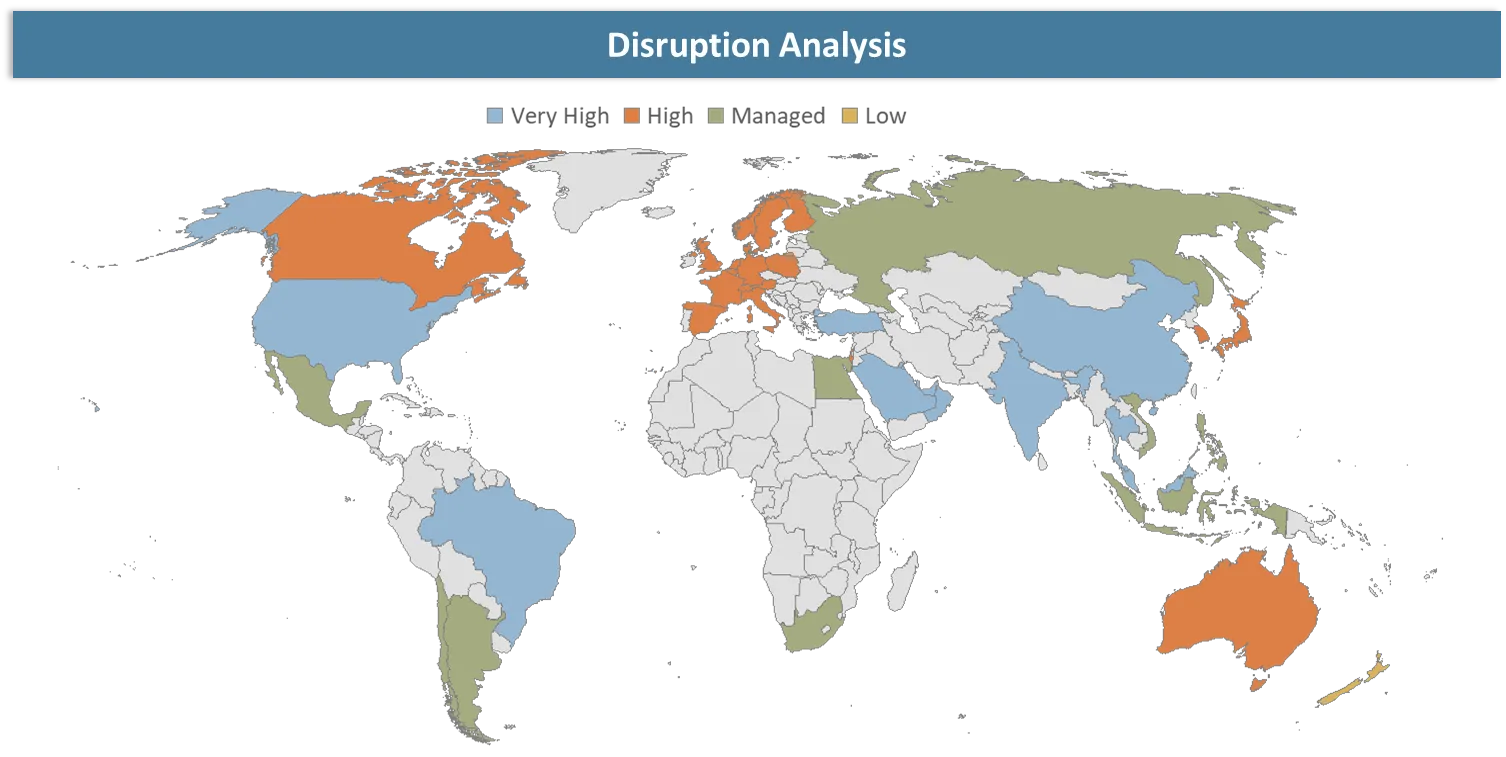
Hybrid battery-supercapacitor systems are emerging as preferred solutions for grid balancing and renewable energy integration
The disruption begins with a shift from technology selection to intelligent workload allocation. Supercapacitors manage second-to-second renewable fluctuations, ramp- rate events, and frequency deviations, while batteries provide sustained energy delivery. This division reduces high-current stress on batteries and preserves usable capacity. As this architecture matures, the strongest opportunity will emerge in short-duration grid services rather than bulk energy shifting. Hybrid systems are particularly suited to frequency response, voltage stabilization, renewable smoothing, black-start support, and DC-bus stabilization, complementing rather than replacing multi-hour battery storage. This operating model shifts competitive value from storage hardware toward system orchestration.
Bidirectional converters, predictive controls and energy-management software must continuously determine which asset should charge or discharge. Consequently, standalone component suppliers risk losing influence to integrated solution providers capable of delivering system-level performance guarantees. Current product capabilities support this transition. Skeleton’s SuperBattery offers charging in under 90 seconds, up to 50,000 cycles, and operating durations of up to 30 minutes, positioning hybrid architectures between conventional supercapacitors and lithium-ion batteries for grid and mission-critical applications.
Supercapacitor Market BCG Matrix: Company Evaluation
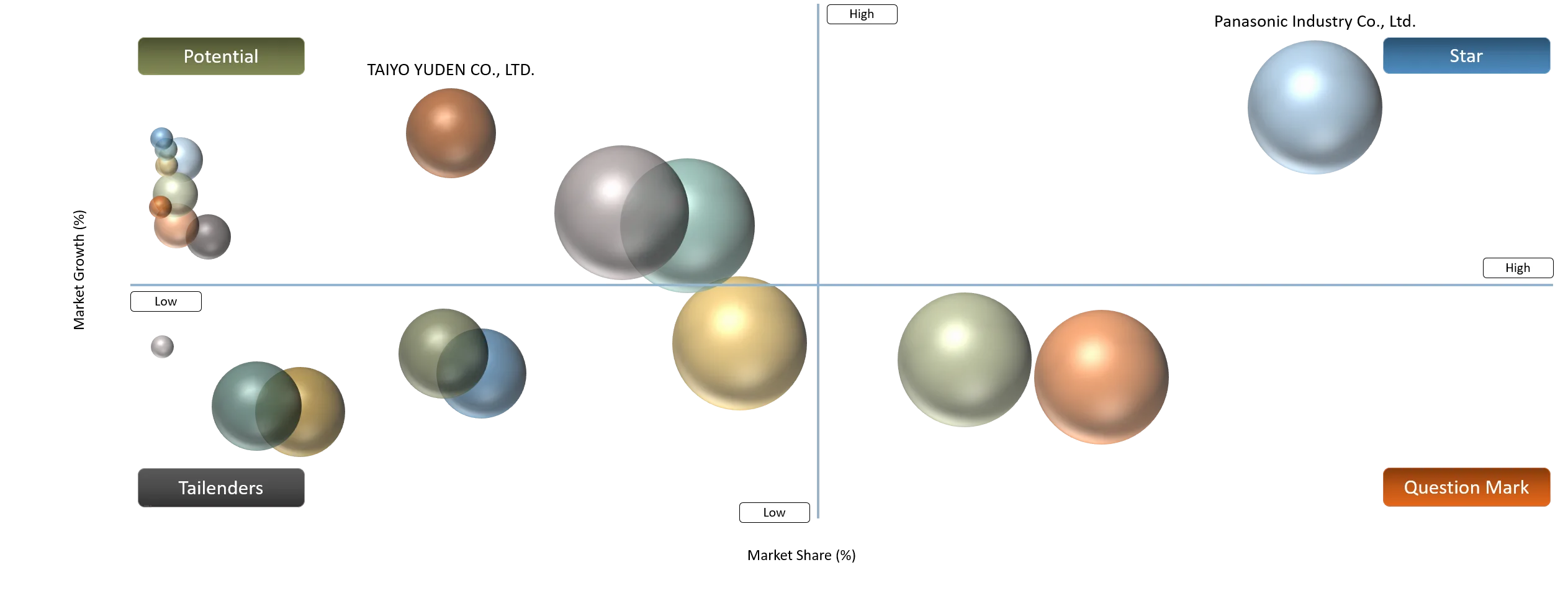
Stars include Panasonic Industry Co., Ltd., Eaton, Clarios, and KYOCERA AVX Components Corporation because they possess strong commercial presence, broad product portfolios, and active participation in high-growth applications such as AI data centers, transportation electrification, industrial power systems, and grid infrastructure. The PDF highlights their continuous product innovation, certified solutions, power electronics integration, and large-scale commercialization, positioning them as leading beneficiaries of the rapidly expanding supercapacitor market. Question Marks include Skeleton Technologies, LS Materials, VINATech, and Nippon Chemi-Con Corp. because these companies are aggressively expanding manufacturing capacity, advanced materials, and next-generation supercapacitor technologies to address AI infrastructure, industrial electrification, and automotive applications.
Potential includes TAIYO YUDEN CO., LTD. and Knowles Corporation, as both companies possess strong expertise in electronic components and high-reliability applications, providing opportunities to expand their participation in advanced supercapacitor solutions. Their existing capabilities support future growth in automotive electronics, industrial equipment, and energy storage applications, although their current market presence in supercapacitors remains more limited than the leading manufacturers discussed in the report. Tailenders include CAP-XX, which maintains a specialized position in compact and ultra-thin supercapacitor technologies for niche electronics and IoT applications.
Supercapacitor Market Dynamics
Driver Impact Analysis
| Driver | Market Growth Impact (%) | Demand Concentration | Impacted Use Case | Strategic Impact |
Grid Modernization and Fast-Frequency Response Requirements | 28% | Utilities, Smart Grids, Renewable Energy Storage, Grid Infrastructure | Grid frequency regulation, voltage stabilization, power quality management, renewable energy integration | Accelerates deployment of high-power energy storage systems for grid resilience, improves renewable energy integration, and increases demand for long-life supercapacitor modules. |
Growth of 48V Vehicle Architectures and Regenerative Power Applications | 32% | Automotive OEMs, Commercial Vehicles, Mild Hybrid Vehicles (MHEVs), Rail Transportation | Regenerative braking, start-stop systems, torque assist, peak power delivery | Expands supercapacitor adoption in electrified transportation, reduces battery stress, improves fuel efficiency, and strengthens demand for hybrid energy storage solutions. |
Escalating AI Data Center Pulse Loads and Short-Duration UPS Requirements | 22% | AI Data Centers, Cloud Service Providers, Telecom Infrastructure, Edge Computing | Short-duration UPS, peak power buffering, server power stabilization, emergency backup power | Drives adoption of supercapacitors for ultra-fast power response, enhances AI server reliability, and creates new opportunities in next-generation data center infrastructure. |
Growing adoption of transportation electrification and regenerative braking systems | 35% | Electric Buses, Metro & Rail Systems, Electric Trucks, Industrial Mobility Equipment | Regenerative braking, traction power recovery, auxiliary power systems, energy recovery | Strengthens market demand across electric mobility, increases system efficiency through energy recovery, and supports wider commercialization of high-cycle-life supercapacitor technologies. |
Grid Modernization and Fast-Frequency Response Requirements
Grid modernization is shifting utility procurement from energy-only capacity toward response speed, controllability, and high-cycle ancillary services. Supporting this transition, the IEA reported global grid investment of approximately USD 400 billion in 2024 and indicated that annual investment needs to increase by around 50% by 2030, creating a larger addressable requirement for fast- response storage technologies.
This investment requirement is becoming more urgent as inverter-based wind and solar generation replaces synchronous machines and reduces the rotating inertia traditionally used to contain frequency disturbances. Accordingly, ENTSO-E’s 2024 grid-forming framework emphasizes synthetic inertia, rapid current injection and transient-frequency containment, functions that align closely with the millisecond response and high-cycle capability of supercapacitors.
Building on these technical requirements, supercapacitor systems are progressing from demonstration projects to transmission-scale deployment. In 2025, Siemens Energy and TenneT deployed the Mehrum E-STATCOM, integrating supercapacitors with a 300 MVA converter capable of delivering up to ±200 MW of active-power response for simultaneous frequency and voltage stabilization. Consequently, ancillary-service opportunities are expanding through grid-forming regulations and distributed flexibility aggregation. Suppliers offering integrated supercapacitor cells, thermal management, bidirectional converters and control software can increasingly compete on response speed, cycling endurance and system availability, while complementing batteries designed for longer-duration energy delivery.
Restraint Impact Analysis
| Restraint | Market Growth (%) | Primary Impact Area | Impacted Use Case | Strategic Impact |
Lower Energy Density Compared with Lithium-Ion Batteries | 30% | Long-duration energy storage, Electric Vehicles, Consumer Electronics
| Battery replacement applications, long-duration backup power, portable energy storage | Restricts supercapacitors to high-power, short-duration applications and limits adoption where higher energy density is the primary requirement. |
High Self-Discharge and Cell-Balancing Complexity in Multi-Cell Systems | 22% | Energy Storage Systems, Industrial Power Modules, Transportation Electrification | Grid storage modules, UPS systems, hybrid energy storage, rail traction systems | Increases system integration complexity, raises maintenance requirements, and adds costs for balancing circuitry and power management. |
High manufacturing costs associated with advanced carbon electrode materials | 26% | Electrode Manufacturing, Material Processing, Commercial Deployment | Automotive supercapacitors, industrial automation, renewable energy storage | Elevates production costs, slows price competitiveness against batteries, and delays large-scale commercialization in cost-sensitive applications. |
Dependence on high-purity activated carbon and advanced material supply chains | 20% | Raw Material Procurement, Advanced Carbon Materials, Global Supply Chain | Supercapacitor cell manufacturing, module production, energy storage systems | Increases exposure to raw material price fluctuations and supply chain disruptions, affecting manufacturing scalability and long-term cost stability. |
Lower Energy Density Compared with Lithium-Ion Batteries
Conventional EDLC supercapacitors remain disadvantaged in energy-led applications because electrostatic surface storage holds less energy than battery electrochemistry. The U.S. Department of Energy’s 2024 assessment places EDLC energy density below 8 Wh/kg, while the IEA’s 2025 benchmarks show lithium-ion cells reaching 205 Wh/kg for LFP and 255 Wh/kg for NMC.
This gap translates into heavier modules for equivalent stored energy. Longer backup duration or vehicle-range requirements therefore increase cell count, enclosure volume, balancing circuitry and power-electronics cost, limiting supercapacitors’ competitiveness as standalone storage. Consequently, suppliers are redirecting commercialization toward hybrid architectures in which supercapacitors handle regenerative braking, pulse loads and ride-through, while lithium-ion batteries supply sustained energy.
This preserves supercapacitor value but confines adoption to power-dominant duty cycles. Technology development is reducing, rather than eliminating, the constraint. Eaton’s 2025 XTH and HVH high-density EDLC series delivered 20% higher energy density, with XTH cells rated up to 3.0 V and 400 F. Future adoption therefore depends on advanced carbons, higher-voltage electrolytes, and hybrid capacitors closing the gap without sacrificing cycle life.
Supercapacitor Market Segment Analysis
The global Supercapacitor market is segmented based on capacitor type, capacity range, voltage range, component type, application, and region.
Electric Double-Layer Capacitors (EDLC) Maintain Leadership Through High-Cycle Performance and Broad Commercial Deployment
The Electric Double-Layer Capacitors (EDLC) segment accounted for around 72% market share in 2025, making it the dominant capacitor type due to its proven reliability, extremely long cycling life, and fast charge/discharge properties. In terms of performance, EDLCs continue to act as the yardstick for all those applications where quick power supply, energy harvesting, voltage balancing, and emergency backup power are required owing to their well-established production process and reduced risks of commercialization.
Additionally, the increasing deployment of AI data centers, advanced power grid technology, and electrification of transportation is also seen as contributing further to the leadership position in this segment, since buffering and bus stabilization at a millisecond scale is becoming more important.
The report also indicates that manufacturers are making use of EDLC modules with advanced balancing systems, diagnostic features, thermal management, and bidirectional power electronics systems to offer energy storage products. Even though hybrid supercapacitors and lithium-ion capacitors have been gaining market presence in higher energy markets, EDLCs continue to lead the market due to proven performance and long life.
Supercapacitor Market Geographical Penetration
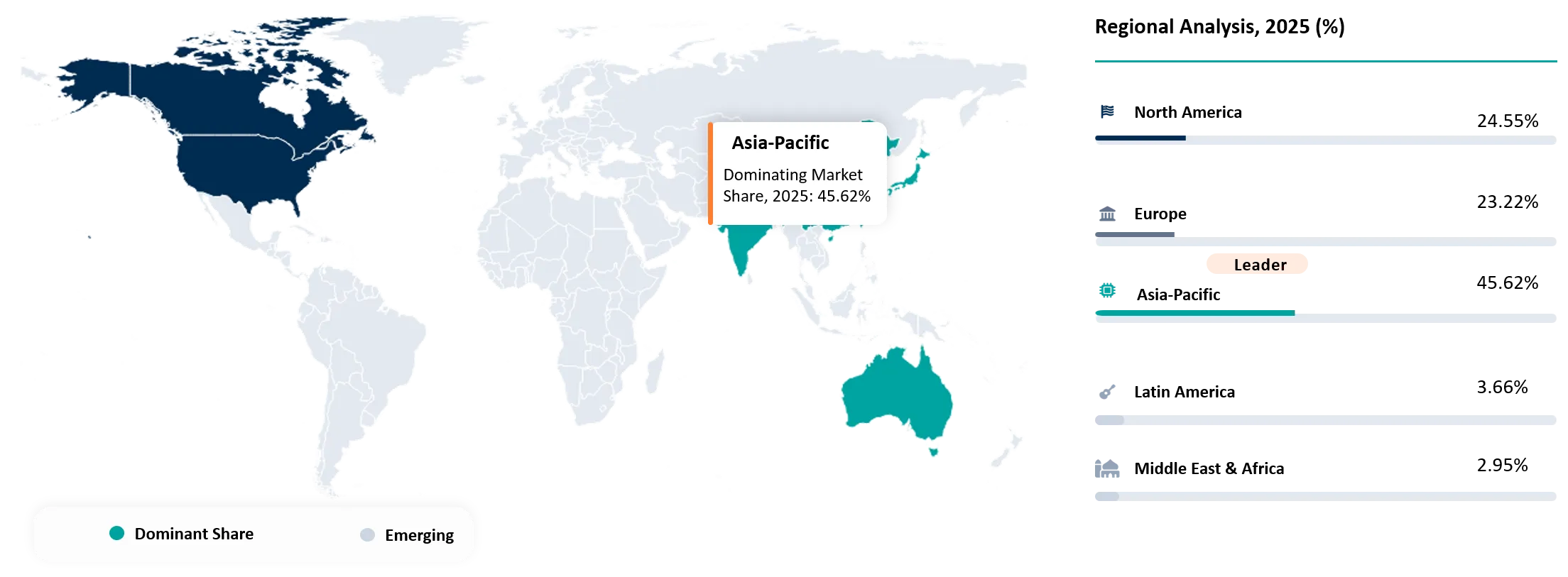
Asia-Pacific Dominates the Supercapacitor Market Through Manufacturing Leadership and Rapid Energy Storage Deployment
The Asia-Pacific dominates the supercapacitor market with 45.62% market share in 2025, due to its extensive manufacturing landscape, sophisticated electronics industry, and growing implementation of electrified transport systems, industrial automation, and renewable energy systems. Their favorable conditions include the availability of some major supercapacitor producers, reliable supply chains of high-end carbon products, and significant demand from the automotive, consumer electronics, and energy storage sectors. Growing focus on AI data centers and up-to-date power infrastructure is set to drive demand for supercapacitors that can support voltage stabilization, energy recovery, and power backup.
The increasingly popular use of supercapacitors to stabilize the power grid in the Asia-Pacific region. In January 2026, Hyosung Heavy Industries, a South Korea-based power equipment and grid infrastructure manufacturer, signed a strategic partnership with Skeleton Technologies, an Estonia-based supercapacitor and advanced energy storage technology developer, and Marubeni Corporation, a Japan-based general trading and industrial investment company, to jointly develop e-STATCOM, a next-generation grid stabilization solution integrating STATCOM technology with supercapacitor-based high-voltage energy storage.
The partners are targeting commercialization by 2027, with Marubeni responsible for supplying supercapacitors across the Asia-Pacific market. The solution builds on Hyosung's proven STATCOM portfolio, including the commercialization of a 150 Mvar STATCOM in 2015 and deployment of a 400 Mvar STATCOM-the world's largest single-unit installation at the time-in 2018, strengthening power grid resilience for renewable energy integration and AI-driven data center demand.
China Supercapacitor Market Trends
China’s supercapacitor sector is progressing from pilot-scale research toward localized manufacturing. In September 2024, Gansu Zhongchaorong commissioned an intelligent line with an annual capacity of 3 million supercapacitor cells, targeting grid-frequency regulation, rail-energy recovery, and hybrid storage systems. This production expansion is being reinforced by higher-performance R&D. In May 2025, Tsinghua University reported a micro-supercapacitor chip with a characteristic frequency above 1 MHz-six orders of magnitude above commercial devices-supporting compact power-management and high-frequency filtering applications.
The policy is now connecting these technical gains with deployment. In September 2025, China’s National Energy Administration called for high- specific-energy, long-life supercapacitors for short-duration, high-frequency storage and engineering validation, directly supporting grid stabilization and rapid-response power applications.
The ecosystem continued broadening in 2026; CRRC formed a decarbonization alliance involving 100 organizations to jointly develop low-carbon technologies including supercapacitors, while CAS researchers advanced filtering-supercapacitor electrodes for better high-load frequency response, strengthening China’s path from materials innovation to transport, electronics, grid commercialization and scalable domestic supply- chain development.
India Supercapacitor Market Outlook
India’s supercapacitor industry entered commercial manufacturing in October 2024 when Keltron inaugurated the country’s first production facility. Its automated line can manufacture 6,000 high-CV and 30,000 low-CV supercapacitors daily, establishing a domestic supply base for customized supercapacitor cells. Supporting this manufacturing foundation, IIT Guwahati advanced MXene–cellulose-nanofiber supercapacitor electrodes in 2024.
The electrodes retained 96% capacitance after 20,000 charge-discharge cycles, addressing durability, ion-transport, and electrode-loading requirements that influence commercially viable supercapacitor performance. Building on cell and electrode capabilities, India progressed toward complete supercapacitor systems in 2025.
The Technology Development Board funded Westech Power Management’s mobile, containerized supercapacitor platform for pulse power, grid stabilization, industrial automation and defence deployment; Westech holds two granted patents and five pending patents. This commercialization pathway was strengthened further in 2026 when DST-supported ARCI researchers developed a 3.4-V porous-graphene supercapacitor delivering up to 17,000 W/kg, storing 33% more energy and retaining 96% performance after 15,000 cycles, improving prospects for compact domestic supercapacitor modules.
Supercapacitor Market Competitive Landscape
- The global supercapacitor market is characterized by three major participant groups: advanced supercapacitor technology developers, diversified electronic component manufacturers, and integrated power management & energy storage solution providers. Companies such as Skeleton Technologies, Panasonic Industry Co., Ltd., KYOCERA AVX Components Corporation, Eaton, Clarios, Nippon Chemi-Con Corp., LS Materials, and VINATech are strengthening their competitive positions through advanced carbon electrode technologies, hybrid energy storage systems, transportation electrification, industrial automation, and AI-driven power infrastructure. The competitive environment is increasingly shaped by product reliability, certified system integration, manufacturing scale, and application-specific power electronics rather than standalone capacitance performance.
- Key market participants include Skeleton Technologies, CAP-XX, VINATech, LS Materials, Clarios, KYOCERA AVX Components Corporation, Eaton, Panasonic Industry Co., Ltd., TAIYO YUDEN CO., LTD., Knowles Corporation, and Nippon Chemi-Con Corp.
Key Developments in the Supercapacitors Market
- June 2026: Skeleton Technologies announced that one of its supercapacitor systems achieved a 3,500-ampere peak-current rating during UL 810A safety certification. The compact 0.39-liter unit is designed for high-power applications, particularly AI data-center infrastructure, where cabinet-level power demand is rapidly increasing. The development highlights the growing role of supercapacitors in short-duration, high-current power buffering.
- May 2026: Skeleton Technologies announced the SB-VARKAUS project in Finland to scale production of its SuperBattery technology to 10 million cells annually by Q3 2029, equivalent to approximately 580 MWh of annual cell production at full operation. The hybrid technology combines battery and supercapacitor characteristics, targeting high-power applications including high-frequency grid balancing.
- May 2026: Skeleton Technologies secured an initial €33 million in a pre-IPO funding round, bringing its total venture capital funding to €392 million. The company plans to use the capital to expand high-power energy-storage production, including supercapacitor manufacturing in Germany and SuperBattery production in Finland, while preparing for U.S. expansion.
- January 2026: Researchers at India's International Advanced Research Centre for Powder Metallurgy and New Materials (ARCI) developed a high-voltage supercapacitor using a dual-functional porous graphene carbon nanocomposite electrode. The technology achieved an operating voltage of 3.4 V, exceeding the conventional 2.5–3.0 V range of many commercial supercapacitors and targeting applications including EVs and solar-energy systems.
- June 2026: Research published in Nature Communications demonstrated an all-water supercapacitor using 1-nanometer clay channels, offering a potential pathway toward energy-storage systems that avoid scarce materials and use water as the electrolyte. The development is relevant to the industry's push toward safer and more sustainable supercapacitor chemistries.
- April 2026: Researchers reported advances in highly disordered nanoporous carbon electrodes for supercapacitors. The work showed that controlling structural disorder can improve ion adsorption and capacitance, reinforcing the importance of advanced carbon architectures in next-generation electrode development.
- February,2026: Haycarb PLC commissioned a new high-capacity energy-carbon manufacturing facility in Badalgama, Sri Lanka, materially expanding its ability to produce battery-grade and supercapacitor-grade activated carbon at commercial scale. The facility extends the company’s energy-storage material platform beyond its established EDLC carbon portfolio and is designed to improve production consistency, customer-specific material development and supply support for global cell manufacturers.
- November,2025: Skeleton Technologies officially opened its US$258.78 million (€220 million) Leipzig SuperFactory in Markranstädt, Saxony, establishing a highly automated European manufacturing base designed for annual output of up to 12 million supercapacitor cells. The facility is expected to create approximately 420 jobs in Saxony and supports large-scale deliveries for grid stabilization, AI data-centre infrastructure, transportation and industrial power applications, strengthening regional manufacturing resilience and customer-proximate supply.
- February,2026: Clarios selected its Meadowbrook facility in Holland, Michigan, as the assembly site for supercapacitor systems supporting significant automotive OEM programmes. The localization initiative advances the industrialization of Clarios’ supercapacitor platform, establishes U.S.-based system assembly and reduces supply-chain exposure for safety-critical and high-power vehicle applications.
- March,2026: OCSiAl introduced an expanded TUBALL BATT portfolio of single-wall carbon-nanotube dispersions for high-loading energy-storage electrodes. The formulations are designed to create durable three-dimensional conductive networks at very low nanotube concentrations, supporting lower resistance, thicker electrodes, and improved mechanical stability.
- August,2025: Cabot Corporation launched LITX 95F conductive carbon, a new material engineered to improve conductivity, cycle performance and electrode processability in stationary energy-storage systems. The product was introduced primarily for lithium-ion battery applications rather than specifically for supercapacitors. However, its conductive-network engineering, dispersion performance and lower-resistance characteristics are relevant to next-generation supercapacitor electrodes where efficient electron transport and reduced inactive-material loading are critical.
Key Procurement Priorities and Buyer Evaluation Criteria
- Organizations investing in the supercapacitor market will be choosing to work with manufacturers who can provide them with certified and application-specific energy storage solutions with high-power density, fast charge/discharge capability, and advanced balancing, diagnostics, cooling, and bi-directional power electronics capabilities.
- Procurement decisions are now being affected by the increased adoption of AI data centers, grid modernization programs, electrification of transport, and industrial automation systems, leading to an increased need for supercapacitors that can stabilize power in milliseconds.
- Consumers tend to give preference to supercapacitors that have features like high cycle life, high power density, low ESR (electrostatic resistance), fast charging capability, reliability, UL 1973 certification, and easy integration with battery energy storage systems.
Why Choose DataM?
- Technological Innovations: Explores advancements in electric double-layer capacitors (EDLCs), hybrid supercapacitors, lithium-ion capacitors (LICs), advanced carbon electrodes, higher-voltage electrolytes, and hybrid battery-supercapacitor architectures, highlighting how these innovations improve power density, rapid charge-discharge performance, and high-cycle energy storage for AI data centers, transportation, and grid applications.
- Product Performance & Market Positioning: Evaluates how manufacturers differentiate through high power density, long cycle life, low equivalent series resistance (ESR), rapid energy buffering, certified system integration, and advanced thermal management, enabling reliable deployment across industrial equipment, renewable energy, automotive, and mission-critical power infrastructure.
- Real-World Evidence: Highlights commercial deployment of supercapacitors in AI data centers, modern power grids, regenerative braking systems, 48V vehicle architectures, cranes, robotics, automated machinery, and short-duration backup power, demonstrating their role in millisecond-scale power stabilization, energy recovery, and battery life extension.
- Market Updates & Industry Changes: Tracks key industry developments including UL 1973-certified energy storage systems, commercialization of integrated supercapacitor platforms, grid modernization initiatives, transportation electrification, and investments in advanced energy storage technologies, supporting the transition toward high-power energy management systems.
- Competitive Strategies: Analyzes how leading companies strengthen market positions through advanced carbon material innovation, certified energy storage solutions, hybrid battery-supercapacitor integration, strategic product commercialization, and application-focused power electronics development to address growing demand from AI infrastructure, industrial automation, and electrified transportation.
- Pricing & Market Access: Explains pricing differences based on capacitor technology, capacitance rating, voltage class, advanced electrode materials, certification requirements, and integrated power electronics, while assessing market access through automotive OEMs, industrial equipment manufacturers, grid infrastructure providers, and energy storage system integrators.
- Market Entry & Expansion: Identifies growth opportunities driven by AI data center expansion, grid modernization, renewable energy integration, transportation electrification, and industrial automation, while outlining strategies including regional manufacturing expansion, certified system development, advanced materials innovation, and hybrid energy storage commercialization for long-term market growth.
Target Audience
- Supercapacitor Manufacturers
- Electric Double-Layer Capacitor (EDLC) Manufacturers
- Hybrid Supercapacitor and Lithium-Ion Capacitor (LIC) Developers
- Advanced Carbon Material Suppliers
- Electrode, Electrolyte, Separator, and Current Collector Manufacturers
- Automotive OEMs and Tier-1 Suppliers
- Electric Vehicle (EV) and Hybrid Vehicle Manufacturers



























































