


Space Battery Market Size and Overview
The global space battery market reached an estimated US$ 0.89 billion in 2025 and is expected to reach approximately US$ 1.42 billion by 2035, growing at a CAGR of about 4.8% during 2026-2035. Lithium-based systems account for the dominant share because they provide high specific energy, proven mission heritage and scalable pack architectures across LEO, GEO and deep-space missions. Growth is being driven by satellite constellation deployment, defense and Earth-observation demand, lunar exploration, higher onboard computing loads and expansion of commercially procured spacecraft.
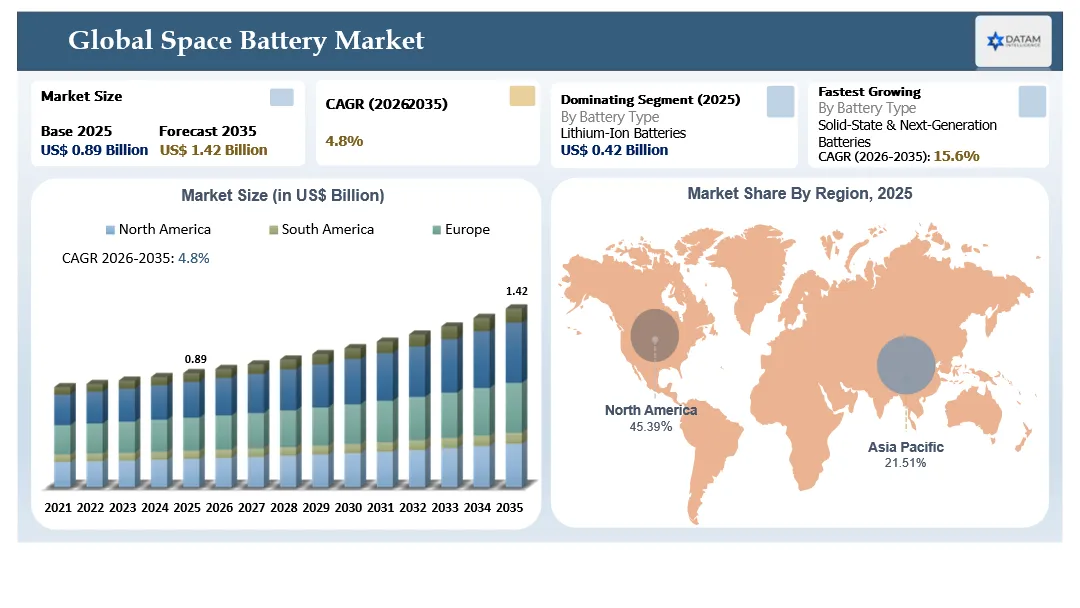
The market remains qualification-intensive. Battery suppliers compete on mission heritage, cell screening, fault containment, thermal design, radiation tolerance, cycle life and long-term supply assurance rather than commodity cell price. LEO constellations create high-cycle requirements because satellites repeatedly enter eclipse, while GEO and deep-space platforms prioritize long calendar life, redundancy and resilience under extreme thermal conditions.
| Metrics | Details |
| 2025 Market Size | US$ 0.89 Billion |
| 2035 Projected Market Size | US$ 1.42 Billion |
| CAGR (2026-2035) | ~4.8% |
| Largest Market | North America |
| Fastest Growing Market | Asia-Pacific |
| Largest Battery Type | Lithium-Ion Batteries |
| Fastest Growing Technology | Solid-State & Next-Generation Batteries |
| Dominant Platform | Satellites |
| Key Growth Theme | LEO constellations, lunar missions, high-cycle batteries and standardized space-qualified packs |
Space Battery Market Key Takeaways
- Lithium-ion remains the commercial standard because of its combination of specific energy, cycle life and extensive in-orbit heritage.
- LEO constellations are expanding demand for batteries capable of tens of thousands of eclipse cycles with tightly controlled depth of discharge.
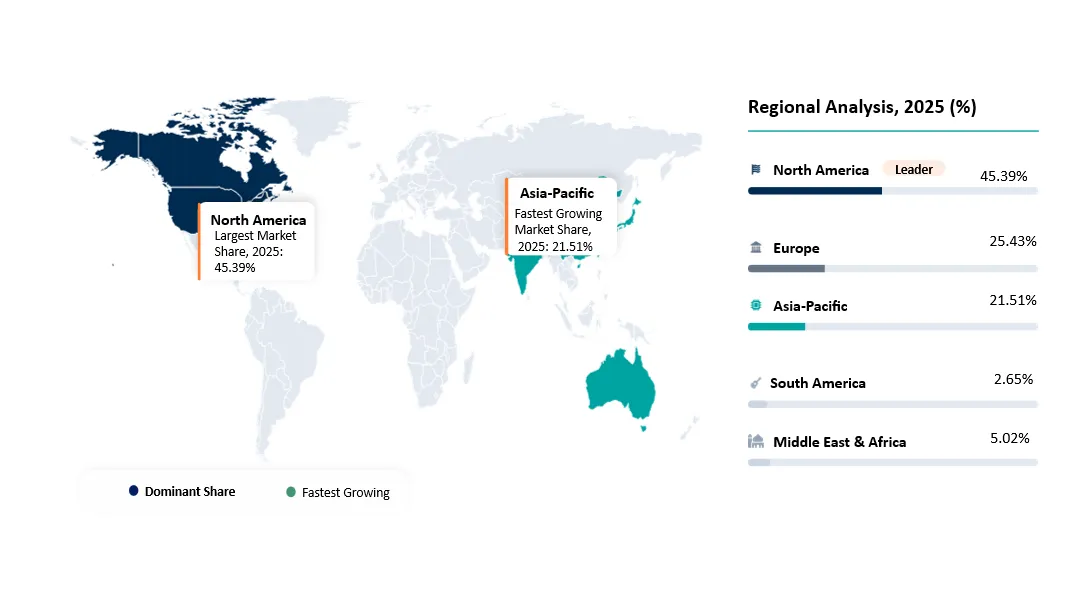
- North America leads through NASA, U.S. defense programs, commercial constellation operators and a deep spacecraft supply chain.
- Asia-Pacific is gaining share through China, India, Japan and South Korea as domestic satellite and launch programs expand.
- Standardized, modular space batteries are creating an important NewSpace segment between highly customized heritage systems and unqualified commercial packs.
- Radiation-tolerant BMS, thermal-runaway propagation resistance and digital state-of-health estimation are becoming key differentiators.
Space Battery Industry Trends and Strategic Insights
- The market is moving toward modular battery platforms with configurable series-parallel architectures that reduce non-recurring engineering for repeat satellite buses.
- High-cycle LEO applications are increasing interest in LTO and other chemistries that trade some energy density for power, safety and cycle life.
- Deep-space and lunar missions are increasing demand for low-temperature performance, long dormant storage life and robust thermal control.
- Space-qualified cell availability and long-term sourcing are strategic issues because automotive and consumer cell roadmaps can change faster than spacecraft qualification cycles.
- Battery-management electronics are becoming more autonomous, with improved fault isolation, state-of-health analytics and digital twins.
Why does this report matter in 2026?
The year 2026 is a key transition point because launch cadence, LEO constellation deployment and lunar mission planning are all increasing the number and diversity of spacecraft entering development. At the same time, space OEMs are under pressure to shorten design cycles and reduce recurring cost. This makes standardized, space-qualified battery platforms strategically important. EnerSys has refreshed ABSL space product documentation in 2026, Saft is marking six decades of space-battery heritage, and emerging suppliers such as KULR are positioning commercially scalable NASA-informed battery architectures for NewSpace missions.
The report matters because the battery requirement changes substantially by orbit and mission. LEO constellations prioritize cycle life and manufacturing repeatability, GEO platforms prioritize long-duration reliability, launch vehicles require high-power and often short-duration systems, while lunar and deep-space vehicles require low-temperature resilience and fault tolerance. Segmenting these missions prevents a single average battery assumption from overstating addressable demand.
Space Battery Market White Space & Investment Opportunities
- Commercial off-the-shelf space-qualified packs for CubeSats, microsatellites and responsive-space missions.
- High-cycle LEO battery platforms optimized for frequent eclipse duty and onboard compute loads.
- Radiation-tolerant BMS and autonomous fault-management electronics.
- Solid-state and lithium-sulfur technologies that can reduce mass while improving safety if qualification hurdles are overcome.
- Low-temperature batteries for lunar night, shadowed regions and deep-space missions.
- Regional manufacturing and testing capacity in India, Japan, Europe and the Middle East to reduce dependence on imported space-grade components.
Space Battery Future Market Transformation
By 2035, the market is expected to shift from largely bespoke battery engineering toward a two-tier structure: heritage custom systems for high-value government and deep-space missions, and configurable standardized packs for constellations and commercial spacecraft. Digital engineering, model-based qualification and common satellite-bus architectures will support reuse of validated designs across fleets.
Advanced chemistries will enter selectively rather than displace lithium-ion uniformly. Solid-state, lithium-sulfur and high-silicon systems must prove vacuum compatibility, thermal stability, radiation tolerance and long-duration cycle life before broad adoption. Near-term gains are therefore likely to come from improved cells, smarter BMS, better thermal containment and pack architecture rather than chemistry alone.
Space Battery Market Buyer Decision-Making Criteria
Spacecraft buyers prioritize mission reliability, qualification pedigree and predictable performance under the exact orbit duty cycle. Selection criteria include specific energy, specific power, cycle life, calendar life, depth of discharge, cell-to-cell consistency, thermal behavior, radiation tolerance, fault containment, redundancy, mass, volume, interface design and the supplier’s ability to support environmental testing and traceability.
Mission heritage has significant commercial value because failure can result in loss of an entire spacecraft. New suppliers therefore need incremental qualification paths, flight demonstrations and credible cell-screening processes. Buyers also evaluate long-term cell availability because redesigning a battery around a new commercial cell can trigger additional qualification cost and schedule risk.
Space Battery Market Economic & Investment Analysis
Space batteries represent a small share of overall spacecraft cost but have disproportionate mission risk. This supports premium pricing for qualified systems and creates strong barriers to entry. Suppliers with proven designs can spread non-recurring engineering over multiple missions, while constellation programs create opportunities for volume learning and standardized production. Investment is flowing toward pack automation, screening, environmental testing, radiation-tolerant electronics and advanced thermal-runaway containment.
The strongest investment case is in technologies that reduce spacecraft mass or shorten integration schedules without compromising reliability. Lower launch cost makes more missions economically feasible, but it does not remove the value of battery reliability. Instead, commercial operators increasingly seek a balance between heritage and scalable production economics.
Space Battery Investment Trends in the Market
- Expansion of space-qualified lithium-ion pack capacity and screening infrastructure.
- Investment in standardized battery platforms for small satellites and responsive-space programs.
- R&D in LTO, solid-state, lithium-sulfur, silicon-rich anodes and low-temperature chemistries.
- Development of radiation-tolerant BMS, high-voltage architectures and autonomous state-of-health analytics.
- Strategic sourcing and inventory programs for long-life cell availability.
- Regional localization of space-grade components in India, Japan and Europe.
Strategic Indicators For Space Battery Market
High Regulation Impact
Space batteries must comply with mission-specific qualification, transportation, safety and export-control requirements. NASA/JAXA/ESA standards, launch-provider rules and defense procurement requirements strongly influence design and testing.
High Investment Activity
Commercial constellations, defense space, lunar programs and Earth observation are increasing capital allocation to spacecraft power systems and qualified components.
Supply Chain Disruption
The market depends on qualified cells, specialty separators, radiation-tolerant electronics and long-lead testing. Commercial cell discontinuation can force costly redesign.
Pricing Volatility
Pricing is driven more by qualification, screening, engineering and program volume than by commodity lithium prices alone.
Procurement Pressure
Buyers demand mission heritage, traceability, lot control, long-term supply commitments and qualification support.
New Technology Adoption
Advanced BMS, LTO, solid-state and lithium-sulfur are gaining attention, but adoption is gated by flight heritage and reliability evidence.
Regional Expansion Opportunity
India, Japan, China and Europe are expanding sovereign space programs and domestic component ecosystems.
Government Policy Support
Civil-space budgets, defense-space procurement and national space-industrial policies support demand for domestic energy-storage capability.
Pricing Intelligence
Standardized small-satellite packs are reducing engineering cost, while high-voltage crewed and deep-space systems remain highly customized and premium-priced.
Disruption Analysis of Space Battery Market
The first major disruption is the shift from one-off spacecraft to fleets. Constellations require repeatable manufacturing, stable cell sourcing and faster acceptance testing, pushing suppliers toward productized battery families rather than unique designs. The second disruption is higher onboard computing and payload power, which increases both peak power and cycling stress. Battery degradation is becoming a system-level constraint for emerging in-orbit computing concepts, making energy-aware software and predictive battery management commercially relevant.
Space Battery Market BCG Matrix: Company Evaluation
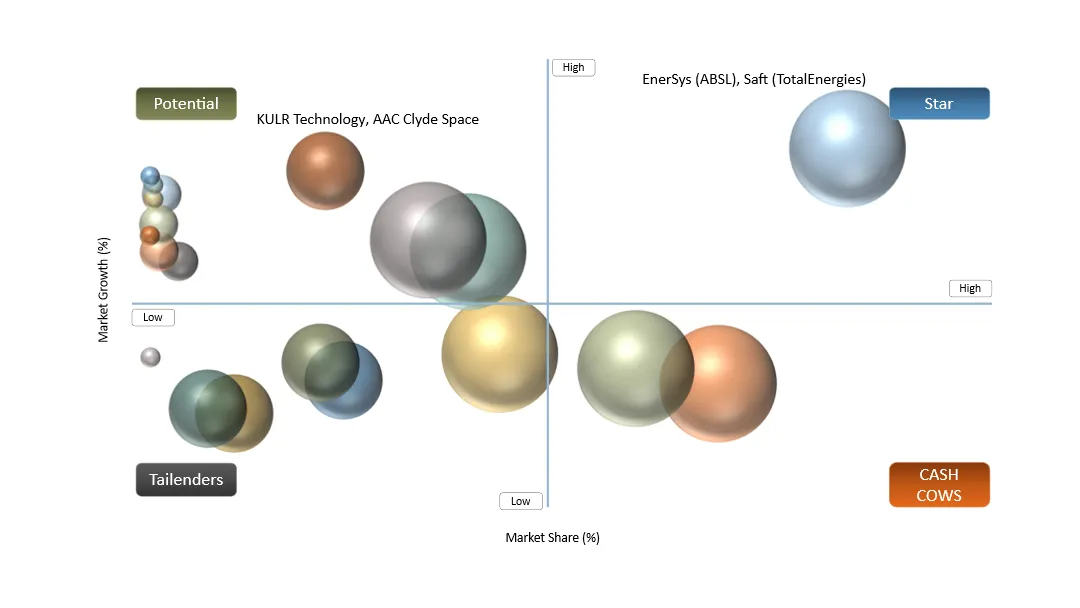
STAR: EnerSys (ABSL), Saft (TotalEnergies) and GS Yuasa combine long mission heritage, qualified products and relationships with major spacecraft programs.
POTENTIAL: KULR Technology, AAC Clyde Space, GomSpace, NanoAvionics ecosystem suppliers and regional NewSpace battery specialists are positioned to benefit from standardized packs and faster commercial mission cycles.
Space Battery Market Dynamics
Driver Impact Analysis
| Driver | Market Growth Impact | Demand Concentration | Impacted Use Case | Strategic Impact |
| LEO constellation expansion | High | North America, Europe, China | Communications and Earth observation | Creates recurring demand for high-cycle, standardized packs. |
| Lunar and deep-space missions | Medium-High | U.S., Europe, Japan, India | Landers, rovers, probes | Supports premium low-temperature and long-life systems. |
| Defense-space investment | High | U.S., Europe, Asia | Surveillance, missile warning, resilient LEO | Raises demand for secure, domestic and radiation-tolerant supply. |
| Higher onboard compute and payload power | Medium-High | Global commercial space | Data processing, radar, optical payloads | Increases peak-power and thermal-management requirements. |
Driver: Rapid Expansion of LEO Satellite Constellations
LEO satellites experience frequent eclipse cycles, so battery cycle life directly affects mission economics. Large constellations also change procurement from low-volume custom programs to repeat production. Suppliers that can combine qualified cells, standardized mechanical designs, automated testing and long-term cell availability are positioned to capture a larger share of constellation demand.
Restraint Impact Analysis
| Restraint | Drag on Market Growth | Primary Impact Area | Impacted Use Case | Strategic Impact |
| Long qualification cycles | High | New product introduction | All mission classes | Slows chemistry transitions and favors heritage suppliers. |
| High testing and NRE cost | Medium-High | Small programs and startups | Custom spacecraft | Encourages standardized platforms and shared qualification. |
| Qualified cell availability | High | Supply chain | Long-life satellite programs | Requires inventory, second-source planning and redesign readiness. |
| Thermal runaway and safety risk | Medium-High | Crewed and high-energy systems | Human spaceflight, large satellites | Drives propagation-resistant designs and conservative operating windows. |
Restraint: Qualification Cost and Cell-Supply Continuity
Space battery qualification can extend across vibration, shock, vacuum, radiation, thermal cycling and abuse tests. If a commercial cell is discontinued or materially changed, pack suppliers may need to repeat portions of qualification. This creates a strategic advantage for suppliers that manage cell inventories, maintain long supplier relationships or manufacture proprietary cells.
Space Battery Market Segmentation Analysis
The global Space Battery market is segmented based on Battery Type, Platform, Orbit, power/energy class, Function, Application, End User, distribution model, and region.
By Battery Type
Lithium-Ion Batteries Will Remain the Largest Chemistry
Lithium-ion dominates because it offers the strongest combination of specific energy, power, calendar life and in-orbit heritage. Nickel-hydrogen remains relevant in legacy and highly conservative applications, while thermal and primary lithium batteries serve launch or single-use functions. Solid-state and lithium-sulfur technologies are strategically important but remain qualification-limited.
By Platform
Satellites Will Continue to Lead Demand
Satellites represent the largest platform because every orbital spacecraft requires energy storage for eclipse and transient loads. Launch vehicles use batteries for guidance, actuation and safety systems, while lunar landers, rovers and crewed systems represent smaller but higher-value niches.
By Orbit
LEO Will Record the Fastest Growth
LEO benefits from communications, Earth observation and defense constellations. The challenge is high cycle count, with battery life determined by repeated eclipse exposure. GEO remains a high-value market with longer mission-life requirements and large battery systems.
By Power / Energy Class
500 Wh-5 kWh Will Benefit From Small-Satellite Scaling
Small and medium spacecraft increasingly use standardized battery modules in this range. Above-20-kWh systems remain critical for large GEO, crewed and exploration platforms but are lower-volume and more customized.
By Function
Rechargeable Batteries Will Dominate
Secondary batteries are required for repeated eclipse cycling in most satellites and crewed platforms. Primary and thermal batteries remain important for launch, deployment, emergency and short-duration functions.
By Application
Communication and Earth Observation Will Anchor Commercial Demand
Broadband constellations, IoT connectivity, weather, climate, agriculture and imaging platforms drive volume. Defense surveillance and science missions generate high-value requirements with stringent reliability.
By End User
Commercial Satellite Operators Will Gain Share
Government and defense remain major buyers, but commercial constellation operators and satellite manufacturers are increasing procurement volumes and encouraging standardized battery architectures.
By Distribution Model
Direct Program Contracts Will Remain Dominant
Space batteries are usually procured through direct qualification-driven relationships between battery suppliers, spacecraft OEMs and agencies. Specialized distribution is more relevant for standardized small-satellite products and qualified cells.
Space Battery Market Geographical Penetration
U.S. Space Battery Market Landscape
The U.S. is the largest national market through NASA, Space Force, commercial launch providers, satellite constellations and spacecraft primes. Demand spans standardized small-satellite batteries, high-voltage crewed systems and long-duration exploration missions. The U.S. also has a dense testing and qualification ecosystem.
Germany Space Battery Market Outlook
Germany benefits from ESA programs, Airbus Defence and Space activity, OHB, research institutions and a broad aerospace supplier base. Opportunity is strongest in European sovereign programs, Earth observation and advanced battery qualification.
Japan Space Battery Market Trends
Japan has deep heritage in space-grade lithium-ion batteries through GS Yuasa and major spacecraft programs led by JAXA and Mitsubishi Electric. The market emphasizes high reliability, long mission life and domestic supply assurance.
China Space Battery Market Outlook
China has a large state-supported satellite, navigation, launch and lunar-exploration program. Domestic battery industrial scale provides materials and cell capability, while space qualification and strategic autonomy support localized sourcing.
India Space Battery Market Outlook
India is one of the fastest-developing markets as ISRO and private launch/satellite companies expand. The emergence of off-the-shelf satellite battery products and local flight heritage is reducing dependence on imported components.
Middle East and Africa Space Battery Market Outlook
The region remains smaller but Gulf countries are investing in Earth observation, communications and national space programs. Demand is mainly imported through satellite primes and integrators, creating partnership opportunities for qualified suppliers.
Space Battery Market Competitive Landscape
- Competition is concentrated among suppliers with flight heritage, qualified cells, dedicated aerospace engineering and long-term program relationships.
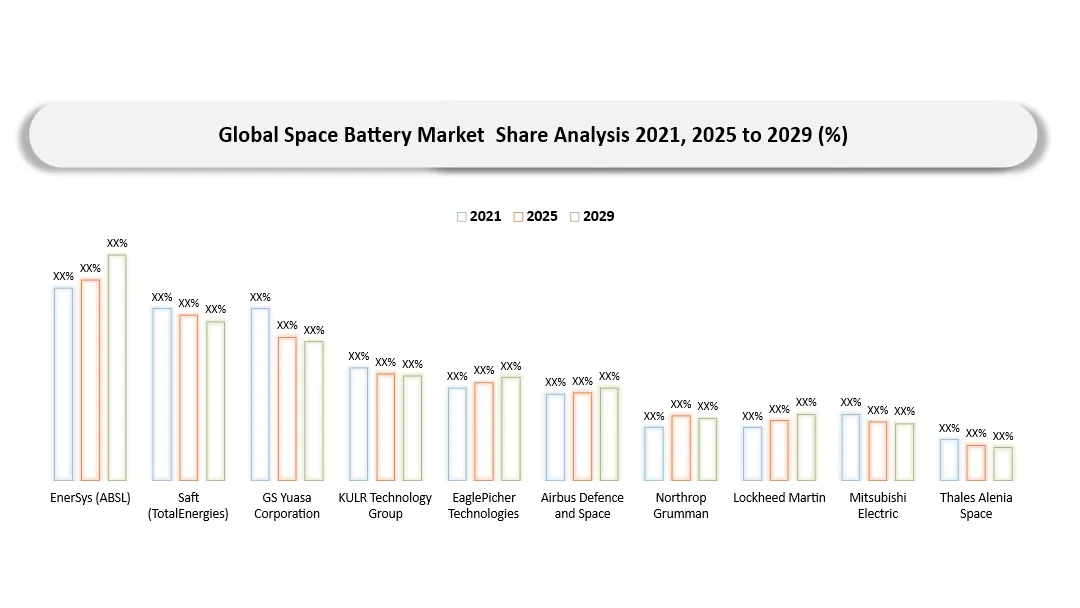
- EnerSys/ABSL, Saft and GS Yuasa hold strong positions in heritage space lithium-ion systems, while KULR is targeting standardized NewSpace packs built around NASA-informed screening and safety practices.
- Differentiation is shifting toward modularity, high-cycle performance, thermal-runaway containment, radiation-tolerant BMS and assured cell supply.
- Regional localization is becoming a competitive factor as governments seek sovereign space-component supply chains.
Public Company Q1-Q2 2026 Performance Comparison
| Public Company | Q1-Q2 2026 Performance Snapshot | Space Battery Exposure | Factors Driving Growth |
| EnerSys (NYSE: ENS) | FY2026 ended May 2026 with record net sales of about US$3.75B, up 4%; Q4 FY2026 sales were about US$988M. | Direct through ABSL space lithium-ion batteries, with extensive satellite and exploration heritage. | Aerospace/defense demand, high-reliability lithium products, defense-focused cell manufacturing plans and broader stored-energy recovery. |
| TotalEnergies (NYSE/Euronext: TTE) | Q2 2026 adjusted net income was about US$6.0B; H1 results reflected strong integrated energy cash generation. | Direct through wholly owned Saft, a major supplier of aerospace and space battery systems. | Saft advanced-battery innovation, aerospace/defense programs, long heritage in space and broader electrification investment. |
| GS Yuasa (TSE: 6674) | FY ended March 2026 results were released in May 2026; the group entered FY2026/27 under its Vision 2035 and new mid-term plan. | Direct through GS Yuasa Technology lithium-ion batteries used in satellites, launch vehicles and spacecraft. | Japanese space programs, JAXA/Mitsubishi Electric relationships, more than 250 spacecraft applications and specialty-battery demand. |
| KULR Technology Group (NYSE American: KULR) | 2026 remains an investment and commercialization year focused on battery systems and thermal management; quarterly scale is substantially smaller than legacy peers. | Direct through KULR ONE Space battery systems and NASA-compliant cell screening. | NewSpace demand, standardized battery packs, NASA safety heritage, thermal-runaway mitigation and responsive-space programs. |
| Mitsubishi Electric (TSE: 6503) | FY2026/27 began with continued aerospace, defense and infrastructure investment across the group. | Strategic downstream integrator: major satellite manufacturer and long-time adopter of GS Yuasa space batteries. | Japan satellite programs, navigation, Earth observation, defense-space and vertically integrated spacecraft demand. |
Market Ecosystem Table
| Value-Chain Sector | Representative Companies / Organizations | Role in Space Battery Ecosystem |
| Battery Materials & Cells | Saft, GS Yuasa Technology, Molicel, Panasonic Energy, specialty cathode/anode suppliers | Provide qualified or screened cells, electrode materials, separators and specialty chemistries. |
| Space Battery OEMs / Integrators | EnerSys ABSL, Saft, GS Yuasa Technology, KULR Technology, AAC Clyde Space, GomSpace | Design cells/modules/packs, BMS, mechanical housings, thermal containment and qualification packages. |
| BMS / Electronics & Components | Microchip, Texas Instruments, Analog Devices, Infineon, radiation-tolerant electronics suppliers | Provide control ICs, monitoring, switching, balancing and radiation-tolerant electronics. |
| Thermal & Safety Components | KULR, Boyd, Parker, specialty thermal-interface and flame-arrestor suppliers | Support thermal management, heat spreading and propagation resistance. |
| Spacecraft OEMs / Primes | Airbus Defence and Space, Thales Alenia Space, Lockheed Martin, Northrop Grumman, Boeing, Maxar, Mitsubishi Electric | Integrate batteries into satellite buses, payload platforms and exploration spacecraft. |
| Launch & NewSpace Companies | SpaceX, Rocket Lab, Firefly Aerospace, Blue Origin, Arianespace, Skyroot Aerospace | Drive launch cadence and create demand for launch-vehicle and spacecraft batteries. |
| Space Agencies / Defense Buyers | NASA, ESA, JAXA, ISRO, U.S. Space Force, national defense organizations | Set mission requirements, qualification standards and procurement demand. |
| Testing & Qualification | NASA/JSC/GSFC facilities, ESA/ESTEC, JAXA labs, TÜV/UL aerospace labs, independent vibration/thermal-vacuum labs | Provide screening, vibration, thermal vacuum, radiation, abuse and acceptance testing. |
| Distributors / Small-Satellite Channels | Aerospace specialty distributors, CubeSat component marketplaces, authorized electronics channels | Enable lower-volume procurement of standardized packs and qualified cells. |
Key Companies
- EnerSys (ABSL)
- Saft (TotalEnergies)
- GS Yuasa Corporation
- KULR Technology Group
- EaglePicher Technologies
- AAC Clyde Space
- GomSpace
- Bren-Tronics
- Ultralife Corporation
- ArianeGroup / space power suppliers
- Mitsubishi Electric
- Airbus Defence and Space
- Thales Alenia Space
- Northrop Grumman
- Lockheed Martin
Company Profiles
EnerSys (ABSL)
EnerSys is a major industrial stored-energy company with direct space exposure through its ABSL product family. ABSL lithium-ion batteries have accumulated billions of cell-hours in space and are used across Earth-orbiting, planetary and solar missions. Its competitive advantage is mission heritage, modular pack configurations and aerospace-grade engineering.
Competitive priorities include qualification efficiency, long-term cell supply, pack modularity, thermal safety, radiation-tolerant control and support for faster spacecraft production cycles.
Saft (TotalEnergies)
Saft has supplied batteries to space programs for decades and remains a leading European provider of advanced aerospace batteries. The company combines proprietary cell development with experience across satellites and other demanding aerospace/defense platforms. Its strategy emphasizes high-reliability lithium-ion and next-generation chemistries.
Competitive priorities include qualification efficiency, long-term cell supply, pack modularity, thermal safety, radiation-tolerant control and support for faster spacecraft production cycles.
GS Yuasa Corporation
GS Yuasa Technology develops high-performance lithium-ion batteries for satellites, launch vehicles and other special applications. Its batteries have been adopted in more than 250 spacecraft worldwide, supported by long relationships with JAXA and Japanese spacecraft manufacturers.
Competitive priorities include qualification efficiency, long-term cell supply, pack modularity, thermal safety, radiation-tolerant control and support for faster spacecraft production cycles.
KULR Technology Group
KULR targets the NewSpace segment with KULR ONE Space battery platforms using NASA-informed cell screening, propagation-resistant construction and integrated BMS options. Its opportunity is to reduce engineering time for small spacecraft while maintaining a higher safety and qualification standard than conventional commercial packs.
Competitive priorities include qualification efficiency, long-term cell supply, pack modularity, thermal safety, radiation-tolerant control and support for faster spacecraft production cycles.
EaglePicher Technologies
EaglePicher is a long-established U.S. supplier of mission-critical batteries for defense, aerospace and space. Its portfolio includes lithium-ion, silver-zinc, thermal and other specialized chemistries for high-reliability applications.
Competitive priorities include qualification efficiency, long-term cell supply, pack modularity, thermal safety, radiation-tolerant control and support for faster spacecraft production cycles.
AAC Clyde Space
AAC Clyde Space supplies small-satellite subsystems and platforms, including electrical power-system components and battery solutions. Its position is strongest in standardized CubeSat and small-satellite architectures.
Competitive priorities include qualification efficiency, long-term cell supply, pack modularity, thermal safety, radiation-tolerant control and support for faster spacecraft production cycles.
Space Battery Market Major Pain Points
- Long qualification timelines for new cells and chemistries.
- Risk of commercial cell discontinuation before spacecraft program completion.
- Thermal-runaway containment and propagation resistance in high-energy packs.
- High cost of radiation-tolerant electronics and environmental testing.
- Balancing specific energy with cycle life, safety and low-temperature performance.
- Limited flight heritage for solid-state and lithium-sulfur systems.
- Export controls and sovereign-supply requirements for defense and strategic missions.
- Need for reliable state-of-health prediction across long missions.
Space Battery Market Recent Developments
- July 2026: India-based TakeMe2Space reported flight heritage for its PowerBank-50 satellite battery aboard Skyroot Aerospace’s Vikram-1 mission, highlighting the emergence of indigenous commercial off-the-shelf space batteries.
- April 2026: EnerSys published refreshed ABSL space battery product documentation covering multiple 28 V and 100 V configurations, reinforcing its modular high-reliability space portfolio.
- April 2026: Saft highlighted sixty years of space-battery heritage and continued development of advanced lithium technologies for satellite missions.
- 2026: KULR continued commercialization of its KULR ONE Space battery family, including standardized packs using NASA-compliant cell screening and propagation-resistant construction.
- 2025: GS Yuasa lithium-ion batteries were installed in Japan’s Quasi-Zenith Satellite No. 6 and in H-IIA/spacecraft programs, extending a space-flight track record spanning more than 250 vehicles.
Analyst View / Opinion on Space Battery Market
- Space batteries are becoming a larger strategic bottleneck as spacecraft production scales faster than heritage component qualification cycles.
- Lithium-ion will remain the dominant chemistry through most of the forecast period because flight heritage outweighs theoretical performance gains from unproven chemistries.
- LEO constellations will favor standardized packs, automated acceptance testing and long-term cell sourcing, while deep-space programs will remain highly customized.
- The strongest competitive moat is not cell chemistry alone but an integrated combination of screening, thermal design, BMS, qualification data and mission heritage.
- New entrants can gain share by filling the gap between expensive one-off custom batteries and insufficiently qualified commercial packs.
- Regional space-industrial policies will increasingly reward suppliers that can localize manufacturing, testing and long-term support.
Space Battery Market Target Audience
| INDUSTRY | WHO SHOULD BUY THIS REPORT? | REASON TO BUY THIS REPORT |
| Spacecraft & Satellite OEMs | Power-system engineers, sourcing teams, program managers | Benchmark battery technologies, suppliers, qualification risk and sourcing strategies. |
| Battery & Cell Manufacturers | Aerospace business units, R&D and product teams | Identify chemistry, power-class and regional white spaces. |
| Launch Providers | Vehicle designers and procurement teams | Assess high-power, thermal and single-use battery requirements. |
| Space Agencies & Defense | Program offices, procurement and technology planners | Understand sovereign supply, qualification and mission-readiness issues. |
| Investors & Consulting | VC, PE, public-market investors and strategy teams | Evaluate market growth, supplier positioning, technology risk and NewSpace opportunities. |
| Testing & Components | Labs, BMS vendors, thermal suppliers and electronics companies | Identify demand for screening, radiation-tolerant electronics and safety systems. |
Why Choose DATAM?
- Data-driven insights combining spacecraft demand, battery architecture, qualification economics and supplier benchmarking.
- Post-purchase analyst consultations for supplier selection, market entry, partnership screening and custom forecasting.
- Annual updates covering mission awards, qualification milestones, launches and technology transitions.
- Specialized focus on emerging markets and NewSpace supply chains rather than generalized aerospace coverage.
- Actionable analysis linking chemistry performance with orbit duty cycles, spacecraft architecture and procurement decisions.
What DATAM Uniquely Provides
- Ten-year forecasts across eight segmentation categories and five regions.
- Mission-specific analysis separating LEO, GEO, launch, lunar and deep-space battery requirements.
- Competitive benchmarking of heritage suppliers and standardized NewSpace battery platforms.
- Market ecosystem mapping from cells and BMS through spacecraft primes, launch providers and agencies.
- Public-company performance comparison linked to specific space-battery growth drivers.


























































