


Smart Transformer Market Size and Overview
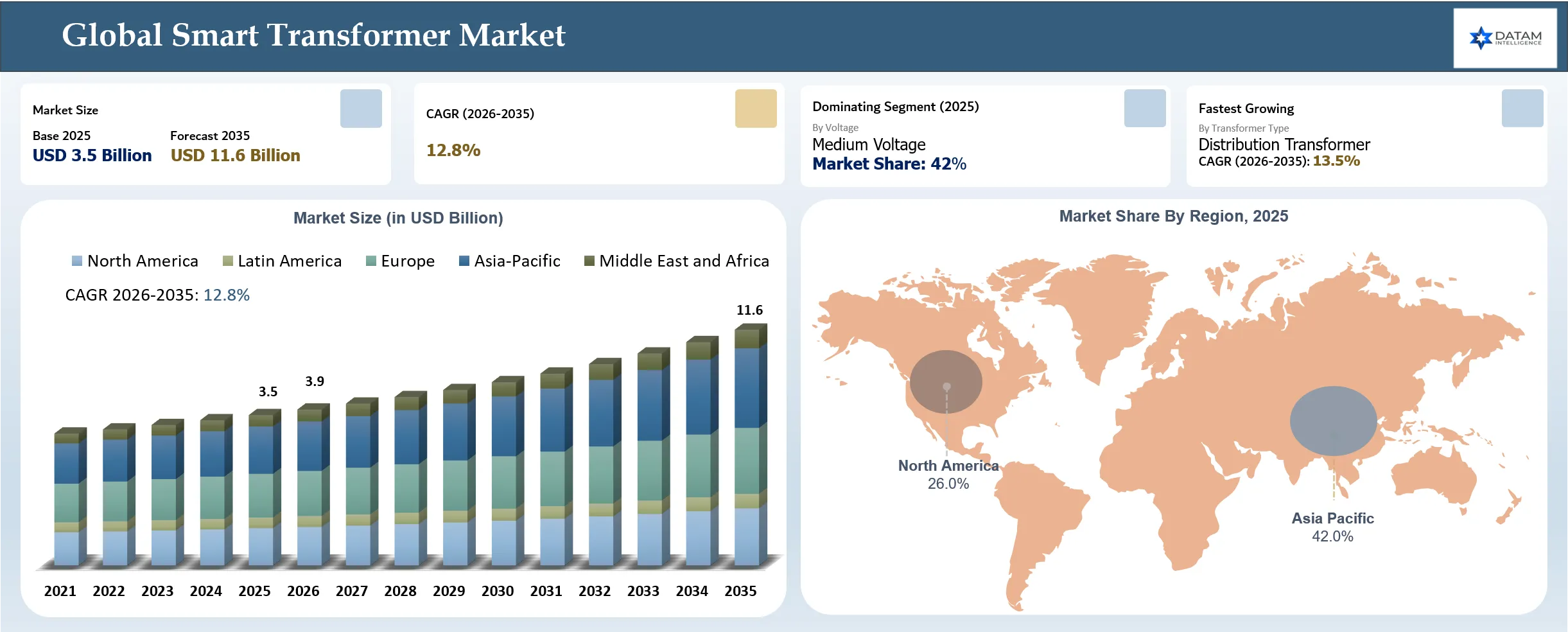
The global smart transformer market was valued at US$3.5 billion in 2025 and is projected to reach US$11.6 billion by 2035, growing at a CAGR of 12.8% during 2026–2035. The global smart transformers market is driven by the expansion and modernization of electricity transmission and distribution networks, rising global electricity demand and electrification, increasing integration of renewable energy and distributed energy resources, replacement and modernization of aging transformer infrastructure, and growing deployment of electric vehicles and data centers.
According to U.S. Department of Energy study, in 2024, the U.S has approximately 60–80 million distribution transformers, with around 55% of in-service units more than 33 years old and approaching the end of their expected life. The aging fleet of transformers has created the need to replace and upgrade the transformers, providing room for smart transformers with condition monitoring, sensors, and communication features.
Smart Transformer Market Key Takeaways
- Asia Pacific held the largest regional market share, accounting for approximately 42% of the global smart transformers market in 2025, supported by rapid expansion of transmission and distribution networks, rising electricity demand, renewable-energy integration, grid modernization, and increasing deployment of digitally monitored transformer systems.
- Medium-voltage transformers accounted for approximately 42% of the global smart transformers market in 2025, supported by their extensive deployment across electricity distribution networks, industrial facilities, renewable-energy interconnections, and grid-edge infrastructure. Increasing distribution-grid automation, real-time condition monitoring, voltage management, and integration of distributed energy resources are supporting the adoption of smart transformers in the medium-voltage range.
- Distribution transformers are projected to be the fastest-growing transformer type in the global smart transformers market, registering an estimated CAGR of 13.5% during 2026–2035. Growth is supported by distribution-grid modernization, increasing deployment of distributed renewable energy, EV charging infrastructure, feeder automation, and the integration of sensors, remote monitoring, predictive maintenance, and automated voltage regulation into distribution transformer systems.
Smart Transformer Market Industry Trends and Strategic Insights
- Adoption of digital monitoring and predictive maintenance capabilities is increasing as utilities and industrial users place greater emphasis on real-time transformer condition monitoring, asset health assessment, power quality, and operational reliability. Transformer manufacturers are integrating IIoT-enabled sensors, communication systems, analytics, and remote monitoring capabilities into smart transformers to support predictive maintenance and reduce unplanned outages.
- Expansion of smart transformer deployment across renewable energy, EV charging, data centers, and industrial applications is increasing as electricity demand and electrification create more complex and variable load requirements. Transformer manufacturers are developing digitally connected solutions and expanding application capabilities to support real-time monitoring, remote diagnostics, load management, and asset optimization across these high-demand installations.
- Integration of smart transformers with digital grid and utility management platforms is increasing as utilities move toward connected and automated electricity networks. Manufacturers are improving communication and interoperability capabilities to allow transformer data to be integrated with SCADA, energy management, distribution management, and asset-management systems. This supports centralized monitoring, faster identification of abnormal conditions, and data-driven maintenance and grid-management decisions.
Smart Transformer Market Scope
| Metrics | Details | |
| 2025 Market Size | USD 3.5 Billion | |
| 2035 Projected Market Size | USD 3.9 Billion | |
| CAGR (2026-2035) | 12.8% | |
| Largest Market | Asia-Pacific | |
| Fastest Growing Market | Asia-Pacific | |
| By Component | Hardware, Software, Services | |
| By Transformer Type | Power Transformers, Distribution Transformers, Specialty Transformers | |
| By Voltage | Low Voltage, Medium Voltage, High Voltage, Extra-High Voltage | |
| By End Use | Utilities, Industrial, Renewable Energy, Railways & Transportation, Commercial & Infrastructure | |
| By Region | North America | U.S., Canada, Mexico |
| Europe | Germany, United Kingdom, France, Italy, Spain, Netherlands, Switzerland, Sweden, Norway, Denmark, Belgium, Poland, Austria, Ireland, Portugal, Greece, Finland, and Rest of Europe. | |
| Asia-Pacific | China, Japan, India, South Korea, Australia, New Zealand, Singapore, Malaysia, Thailand, Indonesia, Vietnam, Philippines, Taiwan, and Rest of Asia Pacific. | |
| Latin America | Brazil, Argentina, Rest of Latin America | |
| Middle East and Africa | UAE, Saudi Arabia, South Africa, Israel, Türkiye, Rest of Middle East and Africa | |
| Report Insights Covered | Competitive Landscape Analysis, Company Profile Analysis, Market Size, Share, Growth | |
Smart Transformer Market Disruption Analysis
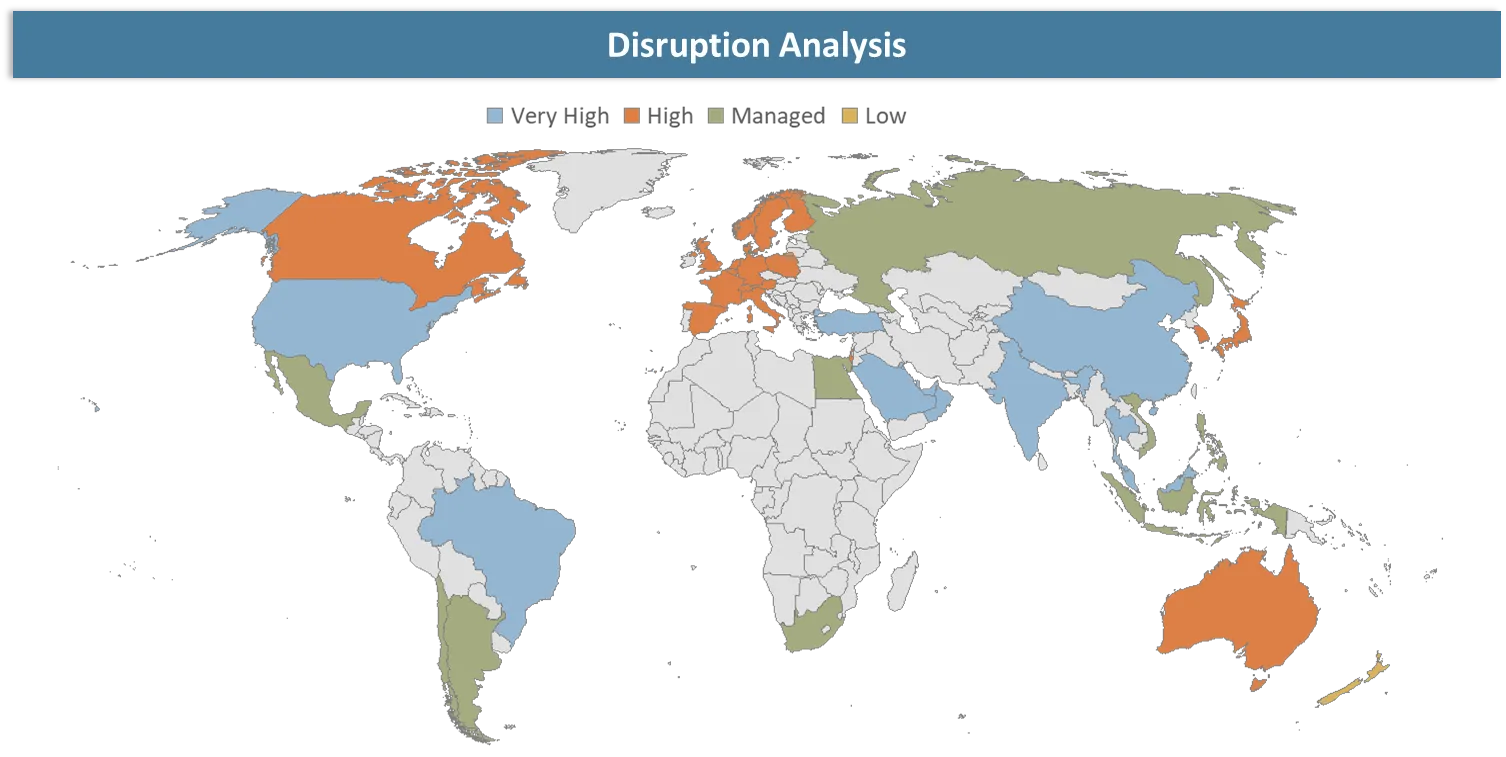
Integration of AI, Edge Analytics, and Autonomous Grid Control
The smart transformers market is experiencing changes as transformer systems evolve from digitally monitored equipment toward more automated and data-driven grid assets. Transformer manufacturers are integrating advanced sensors, edge computing, AI, digital twins, and automated control functions to enable continuous condition assessment, predictive maintenance, dynamic voltage regulation, and faster response to changing grid conditions.
The market is also affected by efforts of transformer manufacturers and technology providers to connect transformer assets with utility control platforms, substation automation systems, cloud-based asset-management platforms, and digital grid infrastructure. The competitive landscape continues to be affected by the integration of AI and analytics software with transformer hardware, interoperability requirements, cybersecurity considerations, communication standards, sensor capabilities, and the cost of upgrading conventional transformer installations with advanced digital functions.
Smart Transformer Market BCG Matrix: Company Evaluation
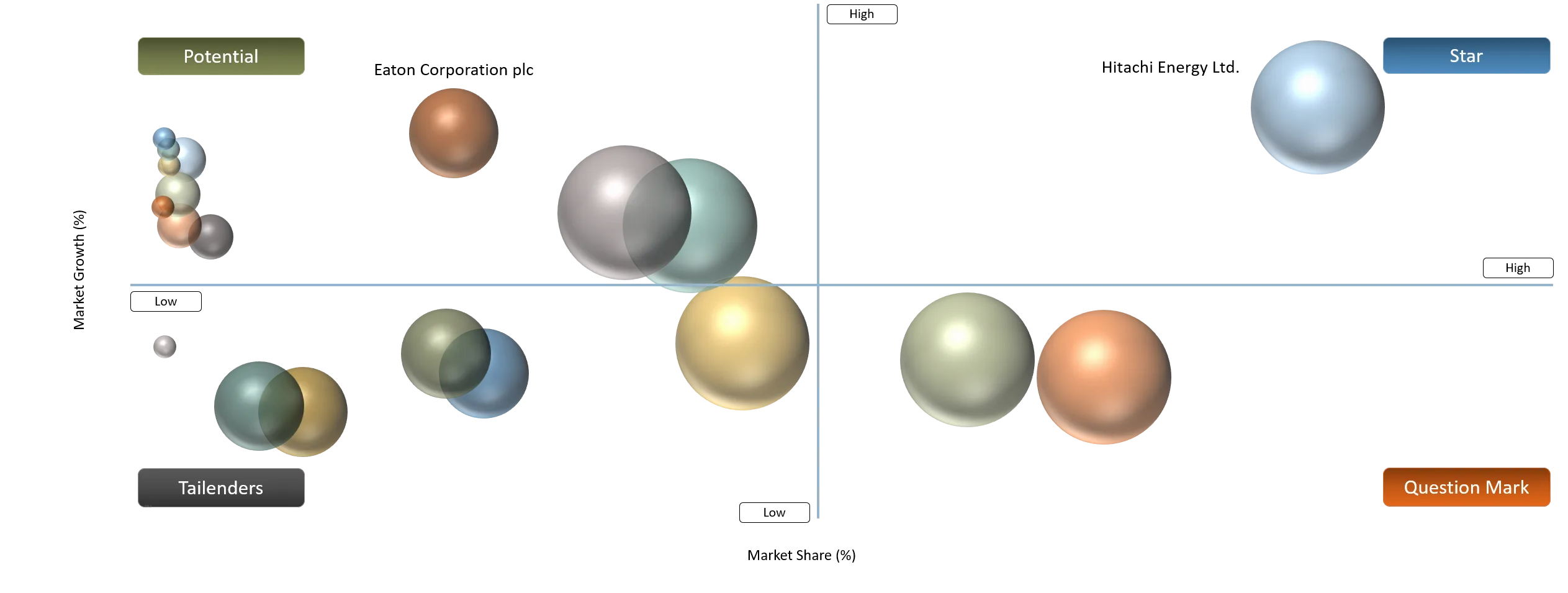
Hitachi Energy Ltd., Siemens AG, GE Vernova, Schneider Electric SE, and ABB Ltd. are positioned as Stars, supported by broad smart-transformer portfolios, advanced digital monitoring and asset-management capabilities, extensive geographic presence, and strong exposure to utility, transmission and distribution, renewable-energy, and industrial applications. Eaton Corporation plc, Hyosung Heavy Industries Corporation, and TBEA Co., Ltd. are positioned as Potential Stars, reflecting established transformer manufacturing capabilities, smart and digitally enabled transformer offerings, and growing exposure to grid modernization and intelligent power infrastructure.
Eaglerise Renewable Energy Inc. is positioned as a Question Mark, supported by its dedicated smart-transformer manufacturing capacity and expanding presence in the North American market, while its overall geographic and product-market reach remains narrower than that of the major global electrical-equipment manufacturers. OLT POWER INC. is positioned as a Tailender, reflecting its specialized smart transformer portfolio centered on Linear OLTC technology and a comparatively focused geographic and product presence.
Smart Transformer Market Dynamics
Driver Impact Analysis
| Driver | Market Growth Impact (%) | Demand Concentration | Impacted Areas | Strategic Impact |
Expansion and Modernization of Power Transmission and Distribution Infrastructure | 30% | Strong demand across North America, Asia-Pacific, Europe, and the Middle East, particularly in the U.S., China, India, Japan, and South Korea. | Smart power transformers, smart distribution transformers, digital substations, transformer monitoring systems, grid automation | Expands demand for digitally enabled transformers as utilities modernize transmission and distribution networks with real-time monitoring, communication, remote diagnostics, and automated control capabilities. |
Rising Electricity Demand and Electrification | 25% | Broad demand across Asia-Pacific, North America, and Europe, supported by industrial electrification, urbanization, electric vehicles, data centers, and increasing electricity consumption. | Smart distribution transformers, smart power transformers, load monitoring, voltage regulation, grid management systems | Increases transformer deployment and creates demand for intelligent equipment capable of monitoring load conditions, managing capacity utilization, and supporting reliable electricity delivery. |
Replacement and Modernization of Aging Transformer Infrastructure | 20% | Strong demand in North America and Europe, with increasing requirements across China, Japan, India, and other markets with aging electricity infrastructure. | Smart distribution transformers, smart power transformers, condition-monitoring systems, transformer asset-management platforms | Encourages utilities to replace aging conventional transformers with digitally enabled units that provide real-time condition monitoring, predictive maintenance, and remote diagnostics. |
Increasing Integration of Renewable Energy and Distributed Energy Resources | 15% | Increasing demand across China, India, the U.S., Europe, Australia, and other markets expanding solar, wind, distributed generation, and energy-storage capacity. | Smart transformers, renewable-energy transformers, grid-interconnection transformers, voltage regulation systems, monitoring and control systems | Supports adoption of smart transformers capable of providing greater visibility into variable power flows, voltage fluctuations, transformer loading, and grid-interconnection conditions. |
Growing Adoption of Digital Monitoring and Predictive Maintenance Technologies | 10% | Strong demand across North America, Europe, and Asia-Pacific, particularly in the U.S., Canada, Germany, Japan, South Korea, China, and India. | Smart power transformers, smart distribution transformers, IIoT monitoring, predictive maintenance, remote monitoring, power quality analysis | Accelerates adoption of digitally enabled transformers by providing real-time operating data, remote diagnostics, predictive maintenance, and transformer asset-health monitoring. |
Increasing Adoption of IoT-Enabled Monitoring and Predictive Maintenance
The adoption of IoT-enabled monitoring and predictive maintenance is driving the Smart Transformers Market as utilities and industrial users require real-time transformer condition monitoring and early fault detection. Manufacturers are integrating sensors, connectivity, and analytics to reduce equipment failures, downtime, and maintenance costs while improving grid reliability. For instance, in August 2026, Telawne Power Equipment showcased its IoT-enabled smart transformers at its Consultant Meet in India. The transformers feature real-time monitoring and predictive maintenance capabilities designed to reduce equipment failures and downtime while supporting renewable energy integration and intelligent power distribution.
Smart Transformer Market Segment Analysis
The global smart transformer market is segmented based on transformer type, component, voltage, end user and region.
Extensive Distribution Network Deployment and Grid Digitalization Drive Medium Voltage Smart Transformers Demand
Medium voltage is the dominant voltage segment in the global smart transformers market, primarily because of its extensive deployment across electricity distribution networks, large installed base of distribution transformers, increasing grid modernization activities, and growing integration of renewable energy and distributed energy resources.
Medium voltage smart transformers are gaining adoption as utilities and industrial users require greater visibility, monitoring, and control across distribution and electrical infrastructure. For instance, in October 2024, Hammond Power Solutions (HPS) launched HPS Smart Transformers for medium- and low-voltage applications, integrating IIoT-enabled power monitors for real-time data, analytics, predictive maintenance, and remote monitoring.
Smart Transformer Market Geographical Penetration
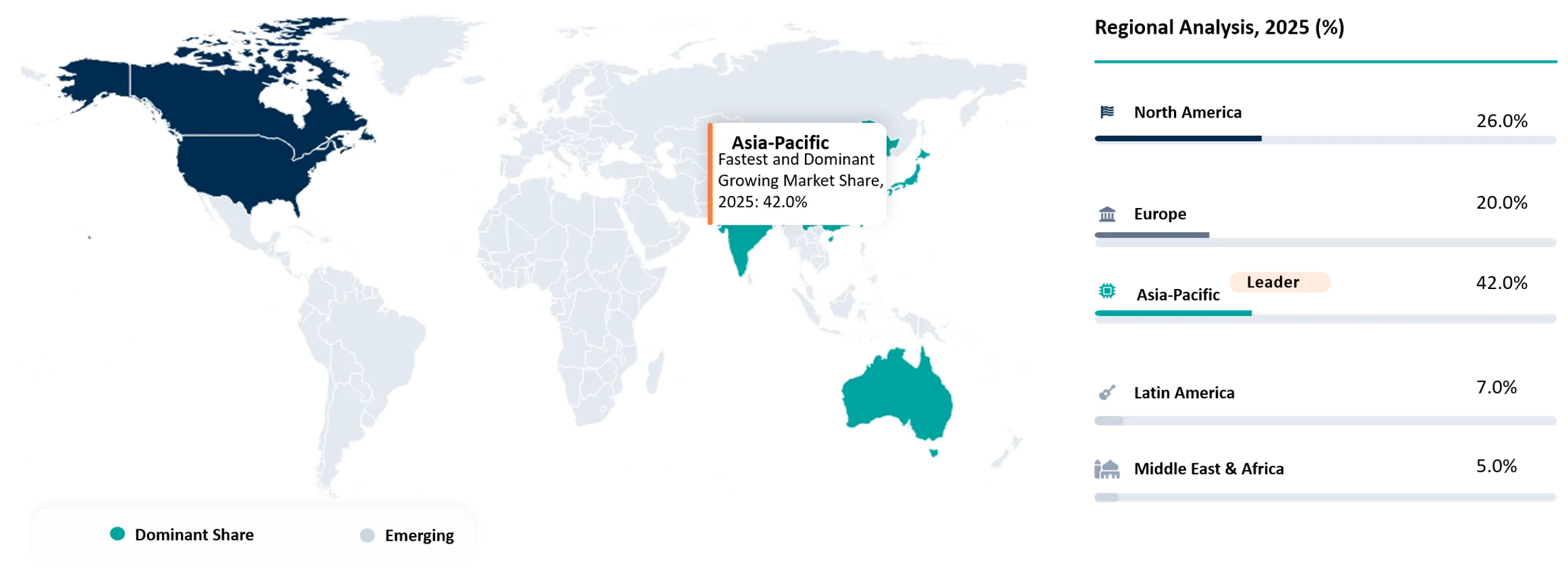
Grid Modernization and Electrification Drive the North American Smart Transformer Market
The North American region is making significant investments in the upgrade and expansion of electrical power transmission and distribution systems, which supports the demand for digitally-enabled transformer systems. In 2024, The Canada government raised the funding envelope of its Smart Renewables and Electrification Pathways Program (SREPs) by approximately C$4.5 billion for the upgrade of electricity transmission and distribution systems. These investments create opportunities for transformers equipped with digital monitoring, communication, and asset-management capabilities.
U.S. Smart Transformer Market Trends
The U.S. Smart Transformers Market is supported by aging grid infrastructure, rising electricity demand, grid modernization investments, renewable-energy integration, and increasing loads from data centers, EVs, and industrial electrification. Grid modernization and reliability investments are supporting demand for smart transformers in the U.S. In October 2024, the U.S. Department of Energy announced approximately US$4.2 billion in federal investments through the second round of the Grid Resilience and Innovation Partnerships (GRIP) program, supporting 46 projects across 47 states and the District of Columbia.
Smart transformers are gaining application across industrial facilities and power networks through integrated monitoring and intelligent control capabilities. For instance, in July 2026, IONATE deployed its Hybrid Intelligent Transformer at General Motors’ manufacturing plant in Michigan, providing real-time power monitoring and control with sub-millisecond visibility into power quality and energy consumption. The technology is designed to improve energy resilience and power quality while enabling up to 33% more distributed energy resources on existing networks.
Renewable Integration and Grid Expansion Drive the Asia Pacific Smart Transformer Market
The Asia Pacific smart transformers market is supported by rapid electricity demand growth, expansion of transmission and distribution networks, renewable-energy integration, grid modernization, industrial electrification, urbanization, and increasing deployment of digital substation technologies. China, India, Japan, South Korea, and Australia are investing in grid infrastructure to accommodate rising electricity consumption and variable renewable generation, increasing requirements for transformers with real-time monitoring, automated control, remote diagnostics, and power-quality management.
China’s Smart Transformer Market Trends
China’s Smart Transformers Market is supported by rapid electricity demand growth, expansion of ultra-high-voltage (UHV) transmission networks, renewable-energy integration, distribution-grid modernization, industrial electrification, and increasing adoption of AI-based grid management and condition monitoring. New developments are increasingly incorporating real-time monitoring, flexible power conversion, and advanced thermal-management capabilities to improve grid flexibility and reliability. For instance, in September 2026, Changzhou Xidian Transformer, part of China XD Group, developed a large-capacity flexible DC transformer for China’s ultra-high-voltage DC transmission network. The transformer incorporates real-time fiber-optic temperature monitoring, and rapid AC/DC response to accommodate variable wind and solar generation, and will support the 2,370-km Gansu–Zhejiang transmission project.
Japan Smart Transformer Market Trends
Japan’s smart transformers market is supported by the replacement of aging transformer infrastructure, increasing electricity demand from data centers and semiconductor facilities, renewable-energy integration, grid modernization, energy-efficiency requirements, and digitalization of substations. Japan’s aging transformer fleet is creating a replacement and modernization requirement. In May 2025, Hitachi Industrial Equipment Systems reported that approximately 56% of transformers currently operating in Japan had been installed more than 20 years earlier, with many having higher energy losses than newer equipment.
Japan’s utilities are accelerating grid modernization through aging infrastructure replacement, digital monitoring, and transmission-network upgrades. For instance, in April 2026, Kansai Electric Power announced plans to replace and modernize aging grid infrastructure, including the deployment of grid-congestion management systems and next-generation equipment with sensors and remote-monitoring functions. These initiatives support demand for digitally monitored transformers capable of providing real-time asset-condition data and improving grid reliability.
Smart Transformer Market Competitive Landscape
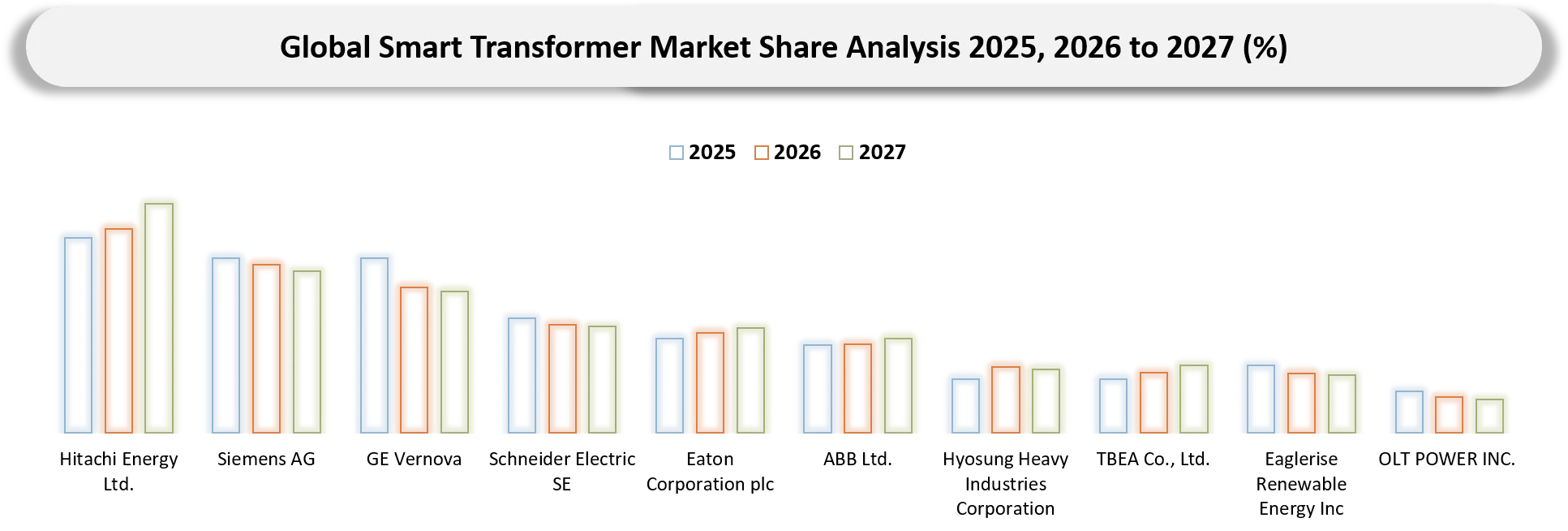
- Hitachi Energy Ltd. (Switzerland), Siemens AG (Germany), GE Vernova (United States), Schneider Electric SE (France), Eaton Corporation plc (Ireland), ABB Ltd. (Switzerland), Hyosung Heavy Industries Corporation (South Korea), TBEA Co., Ltd. (China), Eaglerise Renewable Energy Inc. (United States), and OLT POWER INC. (South Korea) are among the key companies operating in the global Smart Transformers Market.
- Hitachi Energy Ltd. (Switzerland), Siemens AG (Germany), GE Vernova (United States), Schneider Electric SE (France), Eaton Corporation plc (Ireland), ABB Ltd. (Switzerland), Hyosung Heavy Industries Corporation (South Korea), TBEA Co., Ltd. (China), Eaglerise Renewable Energy Inc. (United States), and OLT POWER INC. (South Korea) represent key participants across the global Smart Transformers Market.
Key Developments
- August 2026: Telawne Power Equipments showcased its IoT-enabled smart transformers at its Consultant Meet in Bengaluru, India. The transformers feature real-time monitoring and predictive maintenance capabilities designed to reduce equipment failures and downtime while supporting renewable energy integration and intelligent power distribution.
- September 2026: Changzhou Xidian Transformer, part of China XD Group, developed a large-capacity flexible DC transformer for China’s ultra-high-voltage DC transmission network. The transformer incorporates real-time fiber-optic temperature monitoring, magnetic-field management, and rapid AC/DC response to accommodate variable wind and solar generation, and will support the 2,370-km Gansu–Zhejiang transmission project.
- July 2026: IONATE deployed its Hybrid Intelligent Transformer at General Motors’ manufacturing plant in Michigan, providing real-time power monitoring and control with sub-millisecond visibility into power quality and energy consumption. The technology is designed to improve energy resilience and power quality while enabling up to 33% more distributed energy resources on existing networks.
- October 2024: Hammond Power Solutions (HPS) launched HPS Smart Transformers for medium- and low-voltage applications, integrating IIoT-enabled power monitors for real-time data, analytics, predictive maintenance, and remote monitoring.
Key Procurement Priorities and Buyer Evaluation Criteria
- Smart transformer buyers prioritize systems that provide reliable real-time monitoring, accurate condition assessment, predictive maintenance, automated voltage regulation, power-quality management, remote diagnostics, and secure communication to support reliable operation of transmission, distribution, industrial, renewable-energy, and other electrical infrastructure.
- Evaluation is based on criteria such as monitoring accuracy, sensor capabilities, condition-monitoring functions, predictive analytics, voltage-regulation performance, power-quality monitoring, communication protocols, interoperability, data availability, cybersecurity, remote-control capabilities, transformer efficiency, and compatibility with existing grid and asset-management systems.
- Utilities, transformer operators, and industrial users consider factors including equipment cost, installation requirements, digital infrastructure requirements, maintenance costs, software and subscription costs, communication connectivity, cybersecurity requirements, data-management capabilities, service availability, delivery timelines, and total cost of ownership. Reliability, scalability, ease of integration, and compliance with applicable transformer and communication standards are also considered when selecting suppliers.
- Preference is given to manufacturers with proven smart-transformer performance, broad transformer portfolios, integrated sensing and monitoring technologies, advanced analytics capabilities, strong digital platforms, reliable manufacturing capacity, and the ability to provide digitally enabled power, distribution, and specialized transformers for different applications.
- Power utilities, grid operators, industrial facilities, renewable-energy operators, data centers, commercial infrastructure providers, electric vehicle charging networks, and other large electricity users particularly prioritize suppliers that can provide accurate real-time data, reliable condition monitoring, predictive maintenance, remote diagnostics, long service life, secure connectivity, and technologies that improve transformer reliability while reducing unplanned downtime and maintenance requirements.
Why Choose DataM?
- Technological Innovations: Technological Innovations: Examines advancements in smart transformer technologies, including IoT-enabled sensors, real-time condition monitoring, predictive analytics, digital twins, automated voltage regulation, remote diagnostics, power-quality monitoring, edge computing, and AI-based transformer asset management. The analysis evaluates how these technologies improve transformer reliability, operational efficiency, fault detection, maintenance planning, and grid management.
- Real-World Evidence: Highlights the deployment of smart transformers across transmission and distribution networks, renewable-energy projects, substations, data centers, industrial facilities, electric vehicle charging infrastructure, and other high-load applications, providing evidence of actual requirements for real-time monitoring, automated control, predictive maintenance, and digital asset management.
- Market Updates & Industry Changes: Tracks key developments such as new smart-transformer manufacturing facilities, production capacity expansions, new product launches, digital transformer platforms, IoT and AI integrations, strategic partnerships, technology collaborations, acquisitions, and investments aimed at expanding intelligent transformer deployment across North America, Europe, Asia-Pacific, Latin America, and the Middle East & Africa.
- Competitive Strategies: Analyzes how leading smart transformer manufacturers expand through new product development, digital technology integration, manufacturing capacity additions, geographic expansion, partnerships with utilities and technology providers, acquisitions, digital platform development, and investments in monitoring, analytics, automation, and predictive-maintenance capabilities.
- Pricing & Market Access: Explains variations in smart transformer pricing based on transformer type, voltage rating, capacity, monitoring and sensing technologies, communication systems, automation functions, analytics capabilities, cybersecurity features, installation requirements, software integration, and service agreements. The analysis also evaluates market access through direct sales, distributors, electrical-equipment suppliers, system integrators, utilities, transformer manufacturers, and long-term contracts with industrial and infrastructure customers.
- Market Entry & Expansion: Identifies growth opportunities driven by transmission and distribution-grid modernization, replacement of aging transformers, renewable-energy integration, rising electricity demand, data-center expansion, industrial electrification, electric vehicle infrastructure, distributed energy resources, and increasing digitalization of substations and electricity networks.
Target Audience
- Smart Transformer Manufacturers and Transformer OEMs
- Power Transformer and Distribution Transformer Manufacturers
- Power Generation, Transmission, and Distribution Utilities
- Electrical Equipment and Grid Infrastructure Companies
- Smart Grid and Digital Substation Technology Providers
- Renewable Energy Companies and Grid-Integration Equipment Providers
- Data Center, Industrial, and Commercial Infrastructure Operators