


Smart Stents Market Size
Global Smart Stents Market reached US$2.74 billion in 2025 and is expected to reach US$14.62billion by 2035, growing at a CAGR of 18.0% during the forecast period 2026-2035.
Smart stents are advanced medical devices designed to treat blockages or narrowing in blood vessels or other tubular structures in the body. Unlike traditional stents, which simply provide structural support to keep blood vessels open, smart stents are equipped with integrated sensors and technology that enable real-time monitoring and enhanced functionality. These sensors can track various physiological parameters such as blood flow, pressure, temperature, or tissue oxygen levels, providing valuable data to healthcare professionals during and after procedures.
Executive Summary
For More Insights about the Market Report Free Sample
Market Growth and Drivers:
Increasing Demand for Minimally Invasive Procedures
The increasing demand for minimally invasive procedures is expected to drive the smart stents market by making these advanced devices more desirable for both healthcare providers and patients. Minimally invasive procedures, which offer benefits such as smaller incisions, reduced recovery times, and less post-operative pain, are becoming the preferred option for treating conditions like cardiovascular disease, kidney disorders, and other vascular issues. For instance, according to the Cleveland Clinic study, each year, healthcare providers in the United States perform about 600,000 coronary stent procedures.
Smart stents, which integrate sensors for real-time monitoring, drug delivery, and enhanced precision during surgery, align perfectly with the growing trend toward minimally invasive treatments. These stents enable surgeons to monitor the condition of the artery or vessel, reduce the risk of complications, and improve patient outcomes, all while minimizing the need for larger, more invasive surgeries. As the demand for procedures that minimize trauma and recovery time continues to grow, smart stents are positioned to play a key role in driving the market.
High Costs of Smart Stents
The high costs of smart sensors are expected to hinder the smart stents market by limiting their accessibility. Smart stents incorporate advanced sensor technologies that enable real-time monitoring and data transmission, but these sensors are expensive to develop and manufacture. The increased production costs are often passed on to healthcare providers and patients, making smart stents significantly more expensive than traditional stents. This can lead to a slower adoption rate, particularly in developing countries where healthcare budgets are limited.
Smart Stents Market Segment Analysis
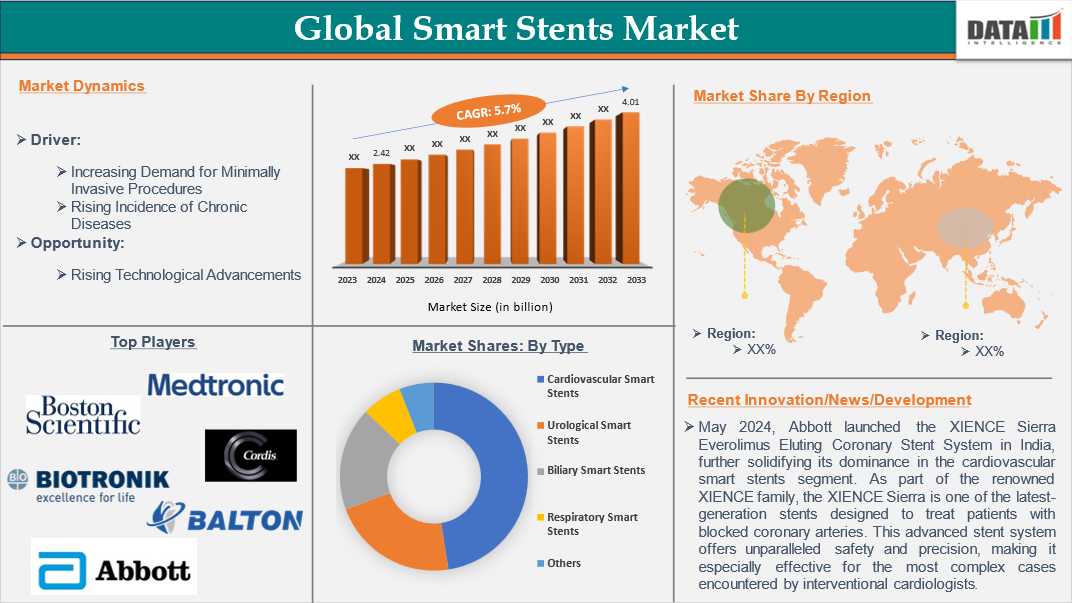
The global smart stents market is segmented based on the type, end-user, and region.
The Cardiovascular Smart Stents segment grew from US$ 1.18 billion in 2022 to US$ 1.28 billion in 2023, owing to rising adoption in the global market
Cardiovascular smart stents are expected to dominate the smart stents market due to the high prevalence of cardiovascular diseases (CVDs) and the increasing adoption of minimally invasive procedures. Cardiovascular diseases, including coronary artery disease and heart attacks, are among the leading causes of death globally, creating a substantial need for effective treatment options. Smart stents in this segment offer enhanced benefits such as real-time monitoring of blood flow, pressure, and vessel conditions, as well as drug delivery systems that can reduce the risk of restenosis (re-narrowing of the arteries). These advanced features provide more precise treatment, better patient outcomes, and faster recovery times, making them highly sought after in the cardiovascular space.
Additionally, with significant advancements in technology and increasing demand for minimally invasive surgeries, cardiovascular smart stents offer a compelling solution for both patients and healthcare providers. For instance, in May 2024, Abbott launched the XIENCE Sierra Everolimus Eluting Coronary Stent System in India, further solidifying its dominance in the cardiovascular smart stents segment. As part of the renowned XIENCE family, the XIENCE Sierra is one of the latest-generation stents designed to treat patients with blocked coronary arteries. This advanced stent system offers unparalleled safety and precision, making it especially effective for the most complex cases encountered by interventional cardiologists. The launch of this next-generation smart stent underscores the continued growth and innovation within the cardiovascular sector.
This combination of high demand for effective cardiovascular treatments and the benefits of advanced smart stent technologies is driving their dominance in the market.
Smart Stents Market Regional Share
North America led the Global Smart Stents Market in 2022 with a market size of US$0.74 billion and reached further to US$0.87 billion in 2023.
North America is expected to dominate the smart stents market due to high demand for minimally invasive procedures and a great ability in medical device innovation. The region's healthcare system is quick to adopt cutting-edge technologies, including smart stents, which align with the growing trend toward less invasive surgeries that offer faster recovery and better outcomes.
Leading market players in the region are driving innovation and development in this market. Additionally, North America's region is gaining strong regulatory approvals, strong research and development investments, and an aging population with increasing chronic diseases, create a significant demand for smart stents. For instance, in March 2022, Cordis received approval for the S.M.A.R.T. RADIANZ Vascular Stent System by the U.S. Food and Drug Administration (FDA). This self-expanding stent is specifically engineered for radial peripheral procedures, allowing for precise and efficient placement in the iliac and superficial femoral arteries (SFA). The approval of this innovative stent system enhances the existing RADIANZ™ Radial Peripheral System, which also includes the BRITE TIP RADIANZ™ Guiding Sheath and SABERX RADIANZ PTA Catheter. This comprehensive system is designed to optimize radial access, improve procedural outcomes, and provide high levels of patient satisfaction.
The launch of such cutting-edge technologies further strengthens the growing role of smart stents in minimally invasive treatments, marking a major step forward in the smart stents market. These factors are expected to combinedly drive the region’s growth.
Smart Stents Key Players
The global market players in the smart stents market are Cordis, Boston Scientific Corporation, Abbott, Medtronic, Balton, and Biotronik., among others.
Key Developments
| Company | Product-related development | Date | Strategic relevance |
|---|---|---|---|
| Abbott | XIENCE Skypoint™ expanded smart-stent-adjacent capability through broader sizing, including a 48 mm stent for long lesions and expansion options for large tapered vessels. | 2026 | Moves stent design toward more precise lesion-specific treatment, reducing overlap and improving procedural efficiency in complex PCI. |
| Medtronic | Neuroguard IEP™ System advanced the multifunctional stent concept with a 3-in-1 design combining a carotid stent, post-dilation balloon, and integrated embolic protection. | 2025 | Shows how stents are evolving from passive implants into integrated therapeutic platforms, a key pathway toward smarter stent systems. |
| BIOTRONIK | Orsiro Mission DES gained new indications for 1-month DAPT in high-bleeding-risk patients and calcified lesions; coverage was also expanded for more complex vessel anatomies. | 2025 | Reflects product evolution toward more personalized, lower-burden, and complexity-ready stent therapy. |
| Cordis | Cordis continues to market the S.M.A.R.T.® Vascular Stent System, a durable self-expanding platform with long-standing clinical positioning in peripheral lesions. | Ongoing | While not a sensor-enabled smart stent, it remains a relevant “smart-stent-adjacent” platform in naming, positioning, and endovascular design evolution. |
Industry / Emerging smart stent pipeline | EU-backed projects such as SMART-CAD and StentGuard are developing stents with remote monitoring, restenosis detection, and home surveillance, while recent literature highlights 3D-printed and instrumented implantable stents with sensing potential. | 2025–2026 | Confirms that the market is moving toward true smart stents with embedded monitoring and multifunctional capability, though commercialization is still early. |
| Metrics | Details | |
| CAGR | 5.7% | |
| Market Size Available for Years | 2022-2033 | |
| Estimation Forecast Period | 2025-2033 | |
| Revenue Units | Value (US$ Bn) | |
| Type | Cardiovascular Smart Stents, Urological Smart Stents, Biliary Smart Stents, Respiratory Smart Stents, Others | |
| Segments Covered | End-User | Hospitals, Ambulatory Surgical Centers (ASCs), Specialty Clinics |
| Regions Covered | North America, Europe, Asia-Pacific, South America, and Middle East & Africa | |
Why Purchase the Report?
- Technological Innovations: Reviews ongoing clinical trials, and product pipelines, and forecasts upcoming pharmaceutical advancements.
- Type Performance & Market Positioning: Analyzes product performance, market positioning, and growth potential to optimize strategies.
- Real-World Evidence: Integrates patient feedback and data into product development for improved outcomes.
- Physician Preferences & Health System Impact: Examines healthcare provider behaviors and the impact of health system mergers on adoption strategies.
- Market Updates & Industry Changes: Covers recent regulatory changes, new policies, and emerging technologies.
- Competitive Strategies: Analyzes competitor strategies, market share, and emerging players.
- Pricing & Market Access: Reviews pricing models, reimbursement trends, and market access strategies.
- Market Entry & Expansion: Identifies optimal strategies for entering new markets and partnerships.
- Regional Growth & Investment: Highlights high-growth regions and investment opportunities.
- Supply Chain Optimization: Assesses supply chain risks and distribution strategies for efficient Type delivery.
- Sustainability & Regulatory Impact: Focuses on eco-friendly practices and evolving regulations in healthcare.
- Post-market Surveillance: Uses post-market data to enhance product safety and access.
- Pharmacoeconomics & Value-Based Pricing: Analyzes the shift to value-based pricing and data-driven decision-making in R&D.
The global smart stents market report would provide approximately 45 tables, 46 figures, and 180 pages.
Target Audience
- Manufacturers: Pharmaceutical, Biotech Companies, Contract Manufacturers, Distributors, Hospitals.
- Regulatory & Policy: Compliance Officers, Government, Health Economists, Market Access Specialists.
- Technology & Innovation: R&D Professionals, Clinical Trial Managers, Pharmacovigilance Experts.
- Investors: Healthcare Investors, Venture Fund Investors, Pharma Marketing & Sales.
- Consulting & Advisory: Healthcare Consultants, Industry Associations, Analysts.
- Supply Chain: Distribution and Supply Chain Managers.
- Consumers & Advocacy: Patients, Advocacy Groups, Insurance Companies.
- Academic & Research: Academic Institutions.




























































