


SGLT-2 Inhibitors Market Size
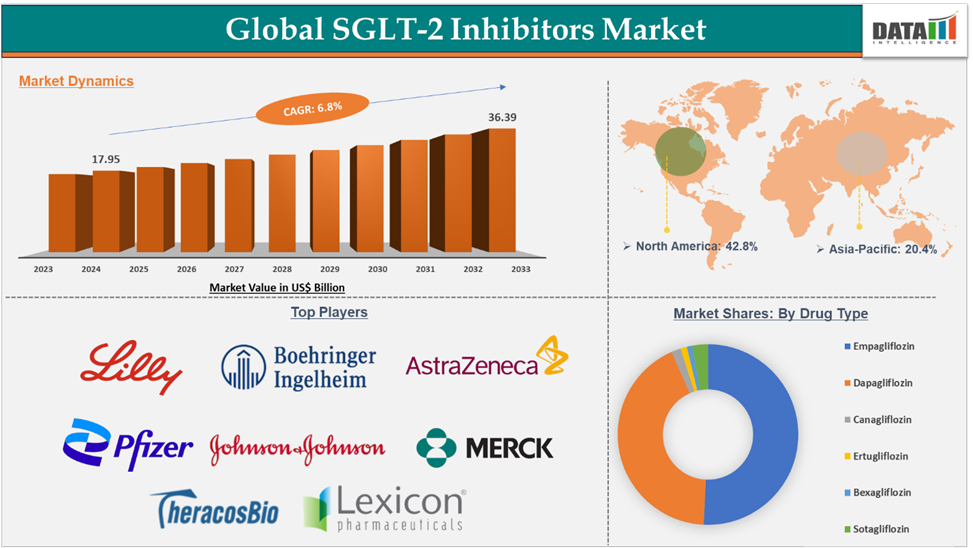
SGLT-2 Inhibitors Market reached US$ 19.23 billion in 2025 and is expected to reach US$ 34.45 billion by 2033, growing at a CAGR of 7.1% during the forecast period 2026-2033.
The SGLT-2 Inhibitors market is experiencing growth due to the rising prevalence of type 2 diabetes, rising research and development activities, and new product launches, etc. Moreover, the rising market access for SGLT-2 inhibitors in emerging countries is a significant opportunity for market growth. However, the high cost of treatment can significantly hinder their adoption, resulting in slow market growth.
SGLT-2 Inhibitors Market Definition
SGLT-2 (sodium-glucose cotransporter-2) inhibitors are prescription drugs approved for the treatment of type-2 diabetes, chronic kidney disease, and heart attacks. The drugs in this class include bexagliflozin, canagliflozin, dapagliflozin, empagliflozin, ertugliflozin, and sotagliflozin. These are oral drugs and are available in monotherapy or combination with other drugs such as metformin for the management of diabetes. Some SGLT-2 inhibitors were effective in protecting the kidney and promoting overall kidney health, hence recommended in chronic kidney disease (CKD) patients. These are also effective in reducing the risk of heart stroke, and failure, and preventing heart failure flare-ups.
Executive Summary
For more details on this report – Request for Sample
SGLT-2 Inhibitors Market Dynamics: Drivers & Restraints
The rising prevalence of diabetes is driving the market growth
The rising prevalence of diabetes is a major driver for the SGLT-2 inhibitors market growth. SGLT-2 inhibitors find their major application in type 2 diabetes patients. These drugs are effective in lowering blood glucose levels when given alone or in combination with metformin. The majority of the SGLT-2 inhibitors are recommended for use as adjunct therapy to diet and exercise. Globally, the number of people with obesity is rising, which is a predominant factor for type 2 diabetes incidence. SGLT-2 inhibitors are found to be effective in lowering body weight in obese individuals, Hence, the adoption of SGLT-2 inhibitors is anticipated to increase in the forecast period.
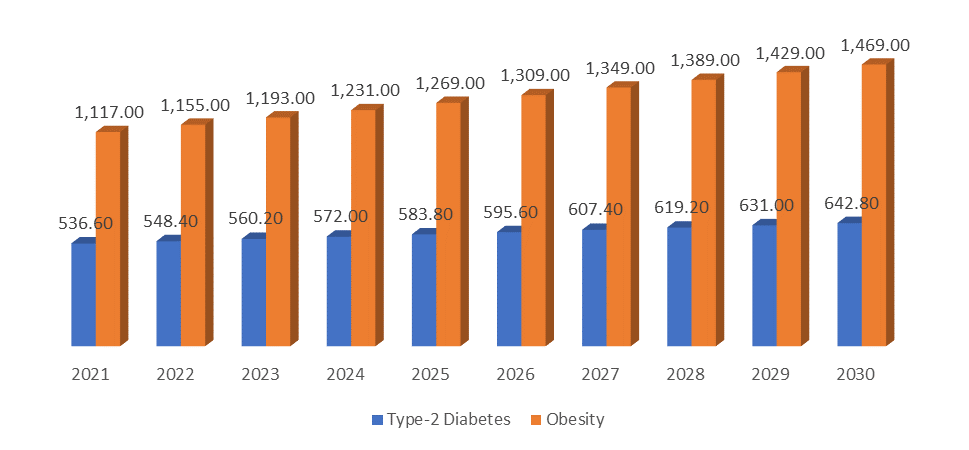
This alarming rise in patient population increases the total addressable patient size for SGLT-2 inhibitors and creates a huge demand in the forecasted period.
High cost of treatment may restrain the market growth
The high cost of SGLT-2 inhibitors may restrain the market growth in the forecasted period. Since the majority of the SGLT-2 inhibitors are newer agents and are sold under brand names, these drugs are more expensive than other oral antidiabetic medications. This high cost may result in lower adoption among the patient population living in low and middle-income countries.
Among all the second-line agents, SGLT-2 inhibitors were costly, as they are newer agents.
The majority of patients prefer sulfonylureas or DPP-4 inhibitors over SGLT-2 inhibitors due to the cost barrier.
SGLT-2 Inhibitors Market Segment Analysis
The global SGLT-2 Inhibitors market is segmented based on drug type, indication, distribution channel, and region.
Drug Type:
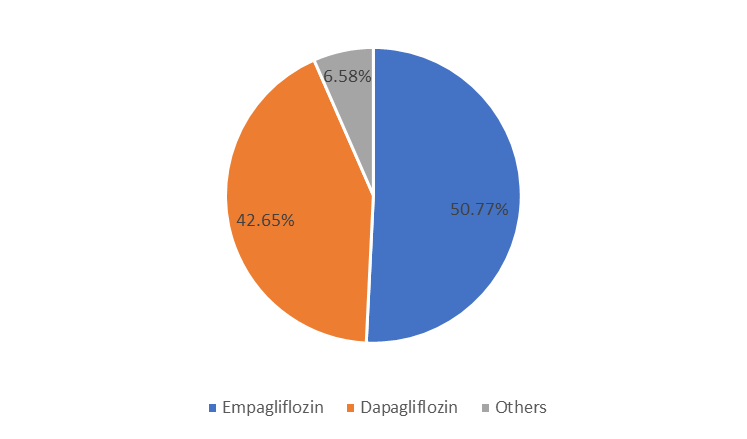
Empagliflozin is dominating the SGLT-2 inhibitors market with the highest share of 50.77%
Empagliflozin is a novel SGLT-2 inhibitor sold under the brand name Jardiance – co-manufactured by Boehringer Ingelheim Pharmaceuticals, Inc. and Eli Lilly and Company. Both companies share equally the ongoing development and commercialization costs of the Jardiance family of brands.
Indication: Chronic kidney disease (CKD) is the fastest-growing segment in the SGLT-2 Inhibitors market.
Chronic kidney disease (CKD) is the fastest-growing segment in the SGLT-2 inhibitor indications. The highest growth rate is attributable to recent product launches, therapy expansion of novel SGLT-2 inhibitors, and rising clinical evidence on the astounding benefits of SGLT-2 inhibitors in CKD patients.
SGLT-2 Inhibitors Market Geographical Analysis
North America is expected to hold a significant share of 41.9% of the SGLT-2 Inhibitors market
North America currently holds a significant market share in the SGLT-2 inhibitors market due to various factors, including higher demand for novel therapies, major revenue generated by market players, and higher prevalence of diabetes, chronic kidney diseases, and heart failure. Any emerging drug is expected to first get launched in the U.S. market due to higher demand, and all the SGLT-2 inhibitors in the current market were first launched in the U.S., providing first access to the patients in the country. Due to higher per-capita income and spending on healthcare, the SGLT-2 inhibitors are sold at higher prices in the North America market as compared to other nations. Due to this, manufacturers generate a majority of their revenue from the region.
For instance, Eli Lilly and Company stated that revenue of Jardiance (empagliflozin) increased 34 percent in the U.S., primarily driven by increased demand, and among the total US$ 9.1 billion revenue generated by the drug, a major portion is generated from the U.S.
Asia-Pacific is growing at the fastest pace in the SGLT-2 Inhibitors market, growing at a CAGR of 19.0% between 2026 to 2033.
The Asia-Pacific region in the SGLT-2 inhibitors market is expected to grow with the highest CAGR in the forecast period, mainly due to the rising diabetes population and product launches.
This alarming increase in the diabetes and CKD population provides a significant ground for market players to launch SGLT-2 inhibitors in the region. Several companies have already eyed the region and actively expanding their product reach.
SGLT-2 Inhibitors Market Major Players
The major players in the SGLT-2 Inhibitors market are TheracosBio, LLC, Johnson & Johnson Services, Inc., AstraZeneca, Boehringer Ingelheim International GmbH., Eli Lilly and Company., Pfizer Inc., Merck & Co., Inc., and Lexicon Pharmaceuticals, Inc., among others.
Key Developments
March 2026: AstraZeneca advanced R&D on next-generation SGLT-2 inhibitors with enhanced cardio-renal protection profiles, building on Farxiga's established efficacy in heart failure patients through ongoing Phase III trials targeting improved selectivity and reduced side effects.
January 2026: Boehringer Ingelheim / Eli Lilly launched an upgraded Jardiance (empagliflozin) combination formulation with optimized dosing for chronic kidney disease, incorporating technological advancements in sustained-release delivery to enhance patient adherence and therapeutic outcomes.
November 2025: Lexicon Pharmaceuticals expanded Inpefa (sotagliflozin) dual SGLT1/SGLT2 inhibitor indications via regulatory approval for broader heart failure applications, supported by new clinical data from SCORED trial demonstrating significant reductions in cardiovascular events.
Market Scope
Metrics | Details | |
CAGR | 7.1% | |
Market Size Available for Years | 2023-2033 | |
Estimation Forecast Period | 2026-2033 | |
Revenue Units | Value (US$ Mn) | |
Segments Covered | Drug Type | Bexagliflozin, Canagliflozin, Dapagliflozin, Empagliflozin, Ertugliflozin, Sotagliflozin |
Indication | Type-2 Diabetes, Chronic Kidney Disease (CKD), Heart Failure | |
Distribution Channel | Hospital Pharmacies, Retail Pharmacies, Online Pharmacies | |
Regions Covered | North America, Europe, Asia-Pacific, South America, and the Middle East & Africa | |



























































