


RTD Coffee Market Size and Forecast 2035
The global RTD Coffee market reached an estimated US$ 28.45 billion in 2025 and is expected to reach US$ 64.60 billion by 2035, growing with a CAGR of 8.55% during the forecast period 2026-2035. The category has moved beyond sweet canned coffee into a broad convenience-beverage platform spanning cold brew, dairy and plant-based lattes, black coffee, protein coffee, nitro beverages and premium espresso formats. Growth is supported by café culture, younger consumers, urban mobility, convenience retail, e-commerce and demand for beverages that combine stimulation, indulgence and portability.
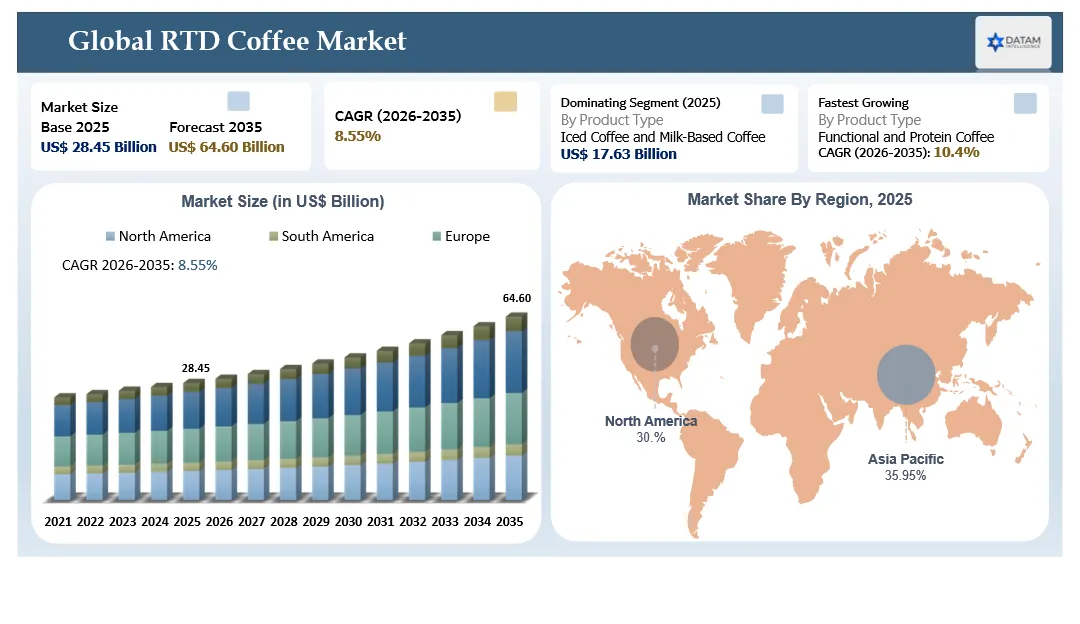
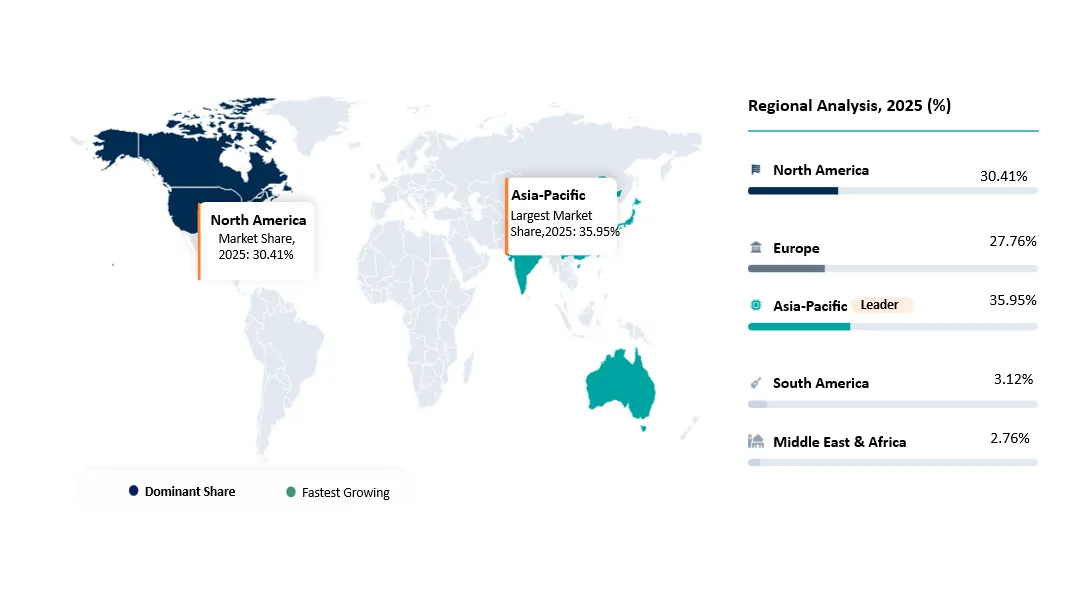
Asia-Pacific is the largest regional market because Japan, South Korea and parts of Southeast Asia have mature canned and bottled coffee cultures, extensive vending networks and strong convenience-store penetration. North America is a major premiumization center through cold brew, plant-based formulations, functional ingredients and large multi-serve formats. Europe is expanding through supermarket availability, branded café extensions and increased adoption of chilled coffee by younger consumers. India, China, Indonesia, Vietnam and the Gulf are important growth markets as modern retail, café exposure and disposable income increase.
The competitive structure includes global coffee and beverage groups, regional leaders, specialist cold-brew brands, dairy companies, plant-based beverage firms and private-label manufacturers. The market is attractive because it supports frequent consumption, line extensions and channel-specific packaging. It is also operationally demanding. Manufacturers must manage coffee quality, dairy or plant-based stability, thermal processing, sugar reduction, caffeine communication, refrigeration, package economics and volatility in coffee and aluminum prices. Companies that combine brand trust, flavor innovation and efficient distribution will be best positioned through 2035.
RTD Coffee Market Overview
| Metric | Value |
| 2025 Market Size | US$ 28.45 Billion |
| 2035 Market Size | US$ 64.60 Billion |
| CAGR (2026-2035) | 8.55% |
| Largest Region | Asia-Pacific |
| Fastest-Growing Region | Asia-Pacific |
| Largest Product Type | Iced Coffee and Milk-Based Coffee |
| Fastest-Growing Product Type | Functional and Protein Coffee |
RTD Coffee Product Innovation Pipeline Analysis
| Innovation Platform | Representative Participants | Format | Commercial Stage | Strategic Relevance |
Protein-enriched cold coffee | Starbucks, Chobani, dairy and sports-nutrition brands | RTD latte and cold brew with added protein | Commercial expansion | Combines coffee occasions with satiety, breakfast replacement and fitness positioning. |
Plant-based barista RTD coffee | Califia Farms, Danone, Nestlé, regional oat-milk brands | Oat, almond and coconut milk coffee | Commercial and expanding | Supports lactose-free, vegan and premium lifestyle positioning. |
Nitro and draft-style coffee | La Colombe, Starbucks, specialist cold-brew brands | Nitrogenated cans and bottles | Commercial niche | Offers café-like texture and premium differentiation without fresh preparation. |
Low-sugar and zero-sugar coffee | Global beverage groups and private labels | Reduced-sugar latte, black coffee and flavored variants | Commercial expansion | Addresses sugar scrutiny while maintaining daily-use convenience. |
| Functional coffee | Emerging wellness brands | Adaptogens, nootropics, electrolytes and added vitamins | Early commercial | Creates higher price points and expands coffee into wellness and performance occasions. |
Shelf-stable premium cold brew | Coffee roasters and co-packers | Aseptic carton, PET and canned concentrates | Scaling | Improves distribution reach and reduces dependence on refrigerated logistics. |
Regional flavor innovation | Asian and Middle Eastern beverage companies | Ube, matcha-coffee, coconut, cardamom and dessert flavors | Commercial experimentation | Builds local relevance and social-media visibility. |
RTD Coffee Market Key Takeaways
- Asia-Pacific is the largest market, supported by mature vending, convenience-store and canned-coffee cultures in Japan and South Korea and rapid growth in China, India and Southeast Asia.
- Cold brew and milk-based coffee remain major value pools, while functional, protein-enriched and plant-based formats are expected to grow faster from smaller bases.
- Convenience stores remain strategically important because RTD coffee is an impulse, commuter and immediate-consumption category, while online and quick commerce are expanding fastest in urban markets.
- Premiumization is increasingly based on bean origin, café-brand credentials, low sugar, barista-style texture, plant-based milk and functional nutrition rather than package size alone.
- Coffee, dairy, sugar, aluminum and freight volatility can materially affect margins, making procurement discipline and price-pack architecture central to category profitability.
- Product success depends on balancing flavor, caffeine delivery, sweetness, mouthfeel, shelf life, food safety and packaging cost across chilled and ambient formats.
- Brand extensions from cafés and established coffee companies have an advantage in trust, but specialist brands can differentiate through cold brew authenticity and functional positioning.
- Long-term market leadership will depend on local flavor development, route-to-market reach, sustainable packaging and the ability to manage repeated innovation without excessive SKU complexity.
RTD Coffee Industry Trends and Strategic Insights
- The category is moving toward hybrid consumption occasions that combine breakfast, energy, indulgence and wellness in a single portable beverage.
- Protein cold foam, high-protein lattes and functional cold brews are extending RTD coffee into sports nutrition and meal-adjacent use cases.
- Plant-based coffee continues to gain shelf space, particularly in premium urban channels, although formulation stability and ingredient cost remain challenges.
- Quick-commerce platforms are improving trial and repeat purchase by making chilled beverages available within minutes in dense urban markets.
- Packaging strategy is becoming more segmented, with cans used for single-serve energy positioning, PET for portability, cartons for multi-serve or ambient formats and glass for premium cues.
- Flavor innovation is becoming more localized and social-media-driven, including dessert, tropical, nut, spice and seasonal combinations that connect packaged coffee with café trends.
RTD Coffee Market Scope
| Metrics | Details |
| 2025 Market Size | US$ 28.45 Billion |
| 2035 Projected Market Size | US$ 64.60 Billion |
| CAGR (2026-2035) | 8.55% |
| Largest Market | Asia-Pacific |
| Fastest Growing Market | Asia-Pacific |
| By Product Type | Cold Brew, Iced Coffee, Latte and Cappuccino, Mocha and Flavored Coffee, Espresso, Nitro and Functional Coffee |
| By Coffee Format | Dairy-Based, Plant-Based, Black Coffee and Concentrated/Shot Formats |
| By Flavor Profile | Classic, Vanilla, Chocolate/Mocha, Caramel, Nut and Seasonal/Regional Flavors |
| By Packaging Type | Cans, PET Bottles, Glass Bottles, Cartons, Cups and Other Formats |
| By Distribution Channel | Convenience Stores, Supermarkets, Online/Quick Commerce, Cafés/Foodservice and Vending |
| By Consumer Group | Less than 18 Years, 18-35 Years, 35-55 Years, More than 55 Years |
| Report Insights Covered | Market Size, Share, Growth, Innovation Pipeline, Competitive Landscape, Company Profiles and Country-Level Opportunity |
Why does this report matter in 2026?
The year 2026 is an important decision point for the RTD Coffee market because the category is broadening rapidly while competitive intensity and input-cost risk remain high. Global beverage companies are expanding coffee portfolios, café brands are extending into retail, dairy and plant-based players are entering through protein and milk credentials, and specialist cold-brew brands are seeking scale. This creates more consumer choice but also raises the cost of shelf access, promotions and product differentiation.
The report matters because RTD coffee is not one homogeneous category. Commercial economics differ by chilled versus ambient distribution, dairy versus plant-based formulation, single-serve versus multi-serve packaging and mass-market versus premium positioning. Japan’s vending-led canned coffee system differs from North American cold brew, European chilled latte demand and India’s rapidly expanding urban cold coffee market. The study separates these models and evaluates where brand, channel and manufacturing capabilities create defensible advantage.
The timing is also important for portfolio and investment planning. Companies are deciding whether to build internal extraction and aseptic capacity, use co-packers, license café brands, enter quick commerce or acquire specialist brands. The report evaluates these choices alongside pricing, package economics, regulatory requirements, caffeine communication and sustainability. It supports decisions across innovation, sourcing, manufacturing, channel strategy, market entry and partnership selection.
RTD Coffee Market White Space & Investment Opportunities
- Protein-enriched RTD coffee offers a high-potential bridge between breakfast replacement, fitness nutrition and everyday caffeine occasions.
- Low-sugar, unsweetened and naturally sweetened products can capture consumers seeking lower calorie intake without abandoning flavored coffee.
- Plant-based coffee remains underpenetrated in many emerging markets and can grow through oat, coconut and local plant bases with region-specific flavor profiles.
- Premium black coffee and origin-led cold brew create opportunities for roasters to monetize specialty credentials outside cafés.
- Quick-commerce and direct-to-consumer subscriptions can improve trial, assortment and data collection for premium urban consumers.
- Affordable single-serve formats in India, Southeast Asia, Africa and Latin America can expand penetration where café prices remain high relative to income.
- Aseptic and shelf-stable technologies can reduce refrigerated logistics, enable wider geographic distribution and improve foodservice supply reliability.
RTD Coffee Future Market Transformation
The market is expected to transform from a packaged café substitute into a broader functional beverage platform. Traditional sweetened milk coffee will remain important, but growth will increasingly come from black cold brew, high-protein coffee, plant-based lattes, low-sugar formulations, concentrated shots and beverages that incorporate electrolytes, vitamins or other permitted functional ingredients. The line between coffee, energy drinks, breakfast beverages and sports nutrition will become less distinct.
Manufacturing and packaging will also change. More brands will use aseptic filling, advanced thermal processing, nitrogen dosing and improved emulsion systems to extend shelf life while preserving flavor. Digital demand forecasting and smaller production runs will support faster innovation, although successful companies will need stronger SKU discipline. Sustainability pressure will encourage lightweight cans and bottles, higher recycled content, carton use and improved recyclability claims that are credible across local waste systems.
By 2035, competitive portfolios are likely to be organized around consumer need states rather than conventional coffee types. Brands may offer morning protein, afternoon energy, low-caffeine refreshment, and premium indulgence lines. Retailers will use loyalty and purchase data to personalize promotions and optimize chilled-space allocation. Companies that connect formulation, package, channel and occasion strategy will create stronger repeat purchase than those relying on flavor extensions alone.
RTD Coffee Market Buyer Decision-Making Criteria
Consumers prioritize taste, caffeine effect, sweetness, texture, price, package convenience, and brand trust. Repeat purchase depends on whether the beverage delivers a consistent café-like experience without excessive calories or an artificial aftertaste. Buyers also consider dairy or plant-based preference, protein content, clean-label claims, package recyclability and portability. For premium products, origin, brewing method and café credentials can justify higher prices.
Retail and foodservice buyers evaluate sales velocity, margin, promotional support, shelf life, cold-chain requirements, package efficiency and supplier service levels. Convenience stores favor immediate-consumption formats with strong brand recognition and dependable delivery. Supermarkets require category differentiation and promotional planning. Online and quick-commerce platforms prioritize pack durability, inventory visibility and products that generate repeat demand. Manufacturers must therefore tailor pack size, price point and assortment by channel rather than applying one national architecture.
RTD Coffee Market Economic & Investment Analysis
RTD coffee is attractive because it converts a high-frequency beverage habit into packaged recurring revenue. The category can command higher prices than carbonated soft drinks and many traditional dairy beverages, particularly when products carry café branding, specialty coffee credentials, functional nutrition or premium packaging. Gross margins, however, are sensitive to coffee, milk, sugar, aluminum, PET, freight and refrigerated distribution costs. Profitability depends on scale, procurement, manufacturing utilization and channel mix.
Investment should distinguish between brand-led and manufacturing-led opportunities. Brand-led strategies focus on consumer acquisition, retail placement and innovation, while manufacturing-led strategies require extraction, blending, thermal processing, filling, quality assurance and often cold-chain infrastructure. Co-packing lowers initial capital needs but can constrain flexibility and margin. Internal capacity provides control but increases utilization risk. Companies should model demand by channel, package, and shelf-life requirement before committing to capacity.
The market also supports selective acquisition and licensing. Large beverage companies can acquire cold-brew or plant-based brands to gain credibility and innovation speed. Café chains can license their brands to packaged-beverage specialists. Dairy companies can enter through protein and milk systems, while coffee roasters can use co-packers to extend into retail. Investment value is highest where a company owns a differentiated brand or formulation and can scale through an existing distribution network.
RTD Coffee Investment Trends in the Market
- Capital is moving toward aseptic filling, cold-brew extraction, nitrogen dosing and flexible co-packing lines that can support several package formats.
- Global beverage companies are investing in café-brand extensions and regional RTD coffee launches to capture premium coffee occasions outside stores.
- Dairy and plant-based companies are funding protein-enriched and lactose-free coffee products that combine nutrition with caffeine convenience.
- Packaging investment is focused on lightweight cans, recycled-content PET, cartons and formats that improve shelf life or reduce refrigerated logistics.
- Quick-commerce, vending and convenience-store distribution are receiving investment because they align closely with immediate-consumption behavior.
- Acquisitions and licensing partnerships are increasingly used to combine specialist brand credibility with large-scale manufacturing and distribution.
Strategic Indicators for RTD Coffee Market
High Regulation Impact
Food safety, allergen labeling, nutrition claims, caffeine communication, packaging rules and recycling obligations shape formulation and commercialization. Dairy and plant-based products require careful allergen management, while functional ingredients must comply with local claims and additive rules. Products marketed to younger consumers face greater scrutiny around caffeine and sugar.
High Investment Activity
Investment is concentrated in cold brew, protein coffee, plant-based formulations, aseptic capacity, café-brand extensions and emerging-market distribution. Capital remains selective because shelf competition is intense and many launches fail to achieve repeat purchase. Investors favor brands with strong velocity, differentiated positioning and scalable route-to-market.
Supply Chain Disruption
Coffee crop variability, dairy inputs, plant-based ingredients, aluminum, PET, cartons and transport can disrupt production. Chilled products are exposed to refrigeration and service-level failures. Companies are diversifying origins, using hedging, qualifying alternate suppliers and simplifying formulations to improve resilience.
Pricing Volatility
Retail pricing is influenced by coffee futures, milk, sugar, packaging and promotions. Premium products can pass through some inflation, but mass-market products face strong price elasticity. Price-pack architecture, multi-serve formats and channel-specific promotions are used to protect volume and margins.
Procurement Pressure
Buyers increasingly assess availability, shelf life, service levels and promotional support alongside price. Manufacturers need dependable coffee, milk systems, stabilizers, flavors and packaging. Long-term contracts and co-packer relationships are important for seasonal peaks and new product launches.
New Technology Adoption
Cold extraction, high-pressure processing, aseptic filling, nitrogen infusion, advanced emulsions, flavor encapsulation and digital quality control are improving product quality and shelf life. AI-supported demand forecasting and formulation screening can reduce waste and accelerate innovation.
Regional Expansion Opportunity
Asia-Pacific remains the largest opportunity through mature Northeast Asian markets and rapidly expanding demand in China, India and Southeast Asia. North America offers premium functional growth, Europe offers chilled coffee expansion and the Gulf offers strong convenience and café-led adoption.
Government Policy Support
Packaging recycling mandates, sugar reduction policies, food-safety modernization and agricultural support can shape investment. Policy is generally indirect, but infrastructure for cold chains, retail modernization and recycling influences category economics.
Pricing Intelligence
Single-serve black coffee and mass-market cans compete on accessibility, while premium cold brew, plant-based and protein coffee command higher prices. A successful pricing strategy links pack size, caffeine, functional benefits and channel economics rather than relying on brand premium alone.
Disruption Analysis of RTD Coffee Market
Functional beverages are disrupting conventional RTD coffee by adding protein, vitamins, adaptogenic ingredients and other wellness cues. This expands the competitive set to include energy drinks, meal replacements and sports nutrition. Plant-based coffee is also changing category economics by creating premium price points and new ingredient partnerships, while low-sugar formulations challenge established sweetened profiles.
Quick commerce and direct-to-consumer models are disrupting distribution by reducing the importance of planned supermarket trips for chilled beverages. Café chains and influencer-led brands can test products faster, while private labels can use retailer data to identify gaps. Aseptic technology is disrupting the cold chain by enabling premium shelf-stable products. These shifts reward companies that can combine rapid innovation with manufacturing discipline and channel-specific execution.
RTD Coffee Market BCG Matrix: Company Evaluation
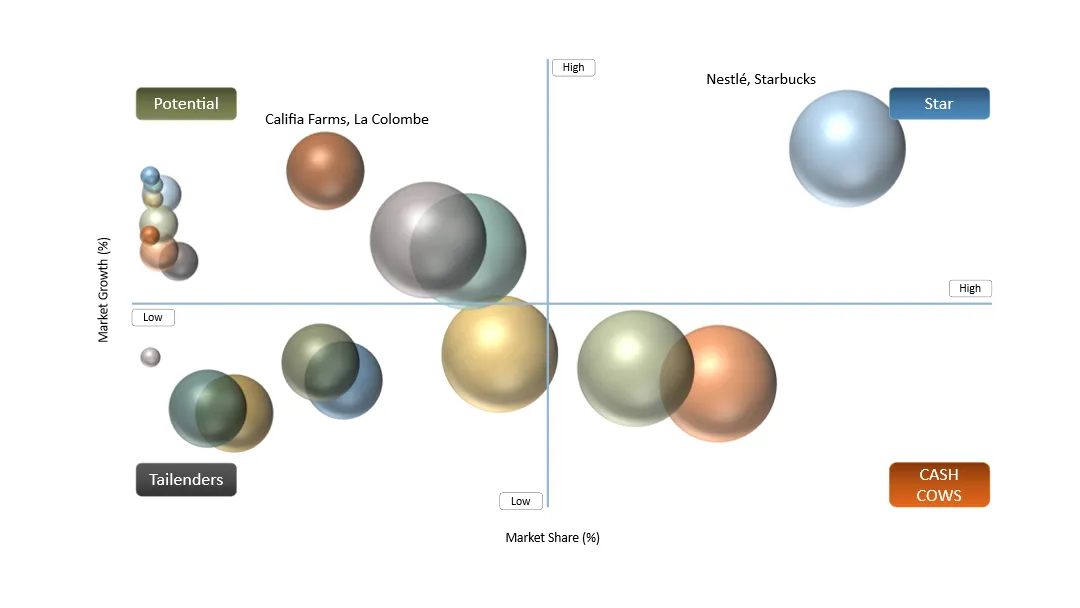
| Quadrant | Representative Companies | Rationale |
| Star | Nestlé, Starbucks, Suntory Beverage & Food | High market relevance, broad distribution and sustained innovation across formats and regions. |
| Potential | Califia Farms, La Colombe, Chobani, Tata Consumer Products | Fast-growing positions in plant-based, cold brew, protein and emerging-market formats. |
| Cash Cows | The Coca-Cola Company, PepsiCo, Asahi Group, UCC | Established distribution and beverage capabilities supporting recurring category revenue. |
| Tailenders | Smaller regional and specialty brands | Differentiated products but limited distribution, manufacturing scale or repeat-purchase evidence. |
STAR
Nestlé, Starbucks and Suntory are positioned as Stars because they combine recognized coffee brands, broad geographic reach, manufacturing capacity and route-to-market strength. Their portfolios span canned coffee, bottled coffee, café-branded products and regional flavors. Continued leadership will depend on lower-sugar innovation, functional formats and execution in high-growth Asian markets.
POTENTIAL
Califia Farms, La Colombe, Chobani and Tata Consumer Products represent Potential players because they are exposed to fast-growing plant-based, cold brew, protein and emerging-market segments. Their future position depends on distribution expansion, successful price-pack architecture and the ability to preserve brand differentiation as larger competitors enter similar spaces.
RTD Coffee Market Dynamics
Driver Impact Analysis
| Driver | Market Growth Impact | Demand Concentration | Impacted Use Case | Strategic Impact |
| Expansion of cold coffee culture | High | Global urban consumers | On-the-go refreshment | Expands daily consumption beyond hot coffee occasions. |
| Convenience and mobility | High | Cities and commuter markets | Immediate consumption | Supports convenience stores, vending and quick commerce. |
| Functional and premium innovation | Medium-High | North America, Europe, Asia | Protein, plant-based and specialty coffee | Raises price points and attracts new consumer groups. |
| Retail distribution expansion | Medium-High | Emerging markets | Supermarket and online access | Converts café awareness into packaged repeat purchase. |
Driver: Cold Coffee Culture and On-the-Go Consumption Expand the Category
The strongest growth driver is the normalization of cold coffee as a year-round beverage rather than a seasonal alternative. Younger consumers often enter coffee through iced lattes, flavored coffee and cold brew, making RTD formats a natural extension of café habits. Packaged products allow consumption during commuting, work, study, exercise and travel. This expands coffee occasions and supports premium pricing when brands deliver credible flavor, texture and caffeine performance.
Restraint Impact Analysis
| Restraint | Drag on Market Growth | Primary Impact Area | Impacted Use Case | Strategic Impact |
| Coffee and input-cost volatility | High | Margins and pricing | Mass-market formats | Creates frequent price increases and package redesign. |
| Sugar and caffeine scrutiny | Medium-High | Formulation and labeling | Sweetened and high-caffeine products | Raises reformulation and communication requirements. |
| Cold-chain and shelf-life complexity | Medium | Distribution | Dairy and chilled coffee | Limits geographic reach and increases waste risk. |
| Intense shelf competition | Medium | Retail access | New product launches | Increases promotional spending and failure rates. |
Restraint: Commodity Volatility and Health Scrutiny Pressure Margins
Coffee, milk, sugar, cocoa, aluminum and logistics can move sharply, while retailers resist frequent price increases. Sweetened coffee also faces scrutiny because some products contain substantial sugar and calories. High caffeine levels require careful communication, particularly for younger consumers and multi-serving packs. Manufacturers must reformulate without damaging taste, use hedging and sourcing strategies and design packages that protect margins while remaining affordable.
RTD Coffee Market Segment Analysis
The global RTD Coffee market is segmented based on product type, coffee format, flavor profile, packaging type, distribution channel, consumer group, and region.
By Product Type
Cold Brew and Iced Coffee Will Continue to Lead Value Creation
Cold brew and iced coffee will remain the largest product pool because they align closely with café habits and can be positioned across mass, premium and functional tiers. Milk-based lattes and cappuccinos provide broad appeal, while functional and protein coffee are expected to grow fastest. Nitro coffee remains a premium niche. Product strategy should consider caffeine intensity, sweetness, texture and channel because the same formula rarely works equally well in convenience stores, supermarkets and e-commerce.
By Coffee Format
Dairy-Based Coffee Will Remain Largest While Plant-Based Grows Faster
Dairy-based coffee remains the largest format because milk supports familiar latte taste, protein and broad consumer acceptance. Plant-based coffee will grow faster as oat, almond and coconut options expand in urban markets. Black coffee benefits from low-calorie positioning and coffee authenticity. Concentrated shots appeal to consumers seeking efficient caffeine delivery but compete directly with energy products.
By Flavor Profile
Classic Coffee Will Lead While Regional Flavors Accelerate Innovation
Classic and unflavored coffee will retain the largest share because it supports daily consumption and low-sugar positioning. Vanilla, mocha and caramel remain high-volume flavors, while hazelnut and seasonal profiles support premium and limited-edition launches. Regional flavors such as coconut, cardamom, ube and dessert-inspired profiles can improve local relevance and social-media engagement.
By Packaging Type
Cans Will Remain the Largest Single-Serve Format
Cans lead because they protect flavor, support ambient or chilled distribution, offer strong portability and fit vending and convenience-store systems. PET bottles are important for resealability and larger servings. Glass supports premium positioning but has weight and breakage disadvantages. Cartons are gaining relevance for multi-serve and shelf-stable products. Package choice must balance shelf life, cost, recycling infrastructure and consumer perception.
By Distribution Channel
Convenience Stores Will Control Immediate Consumption
Convenience stores remain central because RTD coffee is often purchased for immediate energy and refreshment. Supermarkets provide assortment and multi-pack opportunities, while online and quick commerce will grow fastest in dense cities. Cafés and foodservice offer brand-extension opportunities. Vending remains especially important in Japan and parts of Asia. Channel economics should guide pack size, pricing and promotional strategy.
By Consumer Group
Less than 18 Years Will Drive the Fastest Growth
Gen Z and young millennials are expected to drive the fastest growth because they favor cold beverages, café-inspired flavors, personalization and portable formats. Students and young professionals provide high-frequency demand around study and work. Fitness consumers are important for protein coffee. Older consumers remain valuable for classic, lower-sugar and trusted-brand products. Successful brands will avoid treating younger consumers as a single taste group and instead segment by occasion and need state.
RTD Coffee Market Geographical Penetration
Asia-Pacific RTD Coffee Market Trends
China is expanding rapidly as café culture, e-commerce and convenience retail expose younger urban consumers to cold coffee. Domestic and international coffee brands are launching bottled lattes, black coffee and premium cold brew. Price competition is significant, and local flavor adaptation is important. Growth will depend on repeat purchase beyond promotional trial and wider distribution outside top-tier cities. India is an emerging high-growth market supported by urban café culture, young consumers, modern trade and quick commerce. Cold coffee and latte formats have broad appeal, while affordable pack sizes are important for scale. South India has established coffee familiarity, but growth is expanding across major cities nationally. Companies need heat-stable formulations, strong cold-chain execution and regionally appropriate pricing.
Europe RTD Coffee Market Outlook
Europe’s RTD coffee market is gaining momentum as consumers seek convenient, premium and lower-sugar alternatives to traditional hot coffee and energy drinks. Growth is being supported by chilled latte, cold brew, plant-based and high-protein formats, with younger urban consumers driving demand through convenience stores, supermarkets and on-the-go channels. Major coffee and dairy companies are expanding branded portfolios, while private labels and specialist cold-coffee brands compete through barista-style taste, recyclable packaging, functional ingredients and lactose-free formulations. Germany is a leading European chilled coffee market with strong supermarket and discount retail penetration. Dairy-based iced coffee remains important, while lower-sugar, organic and plant-based products are gaining shelf space. Deposit systems and packaging regulation influence pack selection. Retailer private labels create price pressure, requiring branded players to differentiate through coffee quality, flavor and functional value.
Middle East and Africa RTD Coffee Market Outlook
The MEA region offers growth through young populations, café culture, high temperatures, convenience retail and premium shopping environments. The Gulf is the most developed opportunity, including flavored lattes and premium imported brands. Africa remains more fragmented, with affordability and cold-chain limits. Local manufacturing, shelf-stable formats and distributor partnerships can improve reach.
U.S. RTD Coffee Market Landscape
The U.S. is a major premium and innovation market, driven by cold brew, café-brand extensions, plant-based milk and protein coffee. Convenience stores, supermarkets and mass retail provide scale, while e-commerce supports specialty brands. The market is highly competitive and promotional. Growth will depend on lower-sugar products, functional differentiation, multi-serve formats and the ability to preserve quality across national distribution.
Japan RTD Coffee Market Outlook
Japan is one of the world’s most mature RTD coffee markets, supported by canned coffee, vending machines, convenience stores and a long-standing culture of hot and cold packaged coffee. Innovation focuses on black coffee, milk coffee, seasonal temperatures, smaller package sizes and brand trust. Growth is slower than in emerging markets but the country remains strategically important for product and vending innovation.
Brazil RTD Coffee Market Outlook
Brazil combines major coffee production with a developing packaged cold coffee market. Local supply supports coffee credentials, but traditional hot coffee remains dominant. Urban consumers, cafés, convenience formats and premium roasters are expanding interest. Opportunity is strongest in affordable milk coffee, black cold brew and products that connect Brazilian origin with modern convenience.
RTD Coffee Market Competitive Landscape
- Competition is shifting from standard sweetened coffee toward low-sugar, plant-based, protein, cold-brew and café-quality formats.
- Global beverage companies compete through distribution scale and portfolio breadth, while coffee specialists compete through authenticity, origin and brewing credentials.
- Café brands are extending into retail through licensing and partnerships, creating strong consumer recognition but requiring consistent packaged quality.
- Private-label products are increasing price pressure in supermarkets, especially in mature European markets.
- Competitive advantage depends on retail velocity, promotional efficiency, manufacturing reliability, package economics and the ability to localize flavors.
- Partnerships with dairy, plant-based, packaging, co-packing and quick-commerce companies are becoming central to speed and market reach.
Competitive intensity will rise as more companies enter functional and premium segments. Large companies can fund national distribution and promotion, but specialist brands can still win where authenticity and consumer community matter. Market share will be influenced by the ability to maintain product quality at scale, secure shelf space and build repeat purchase after introductory promotions. Companies with balanced portfolios across mass, premium and functional tiers will be more resilient to commodity inflation and changing consumer tastes.
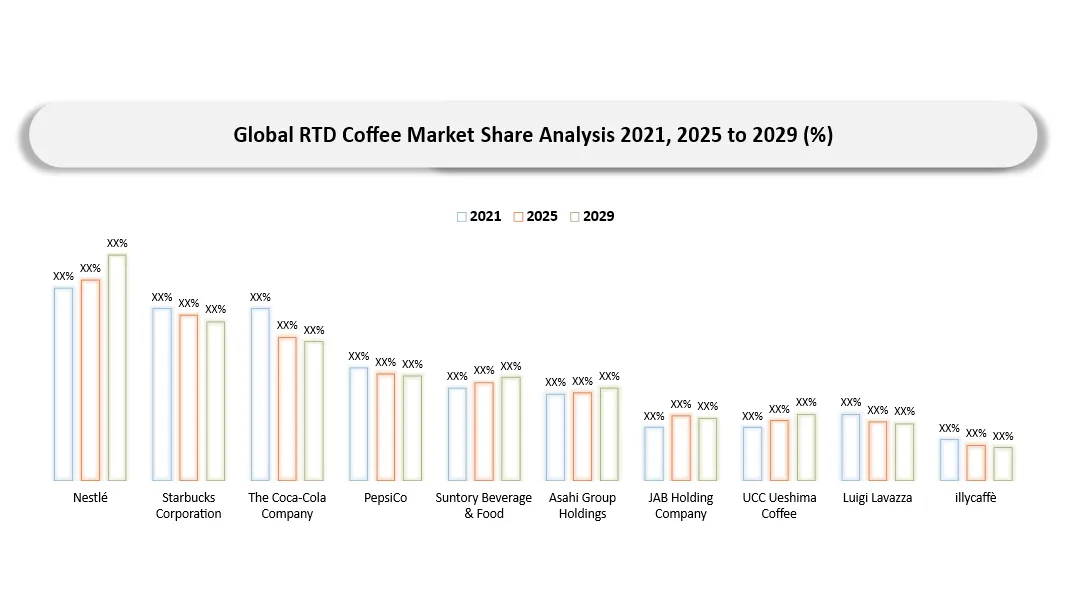
Key Companies of RTD Coffee Market
- Nestlé
- Starbucks Corporation
- The Coca-Cola Company
- PepsiCo
- Suntory Beverage & Food
- Asahi Group Holdings
- UCC Ueshima Coffee
- JAB Holding Company
- Luigi Lavazza
- illycaffè
- Califia Farms
- La Colombe Coffee Roasters
- Danone
- Chobani
- Lotte Chilsung Beverage
- Dong Suh Foods
- Tata Consumer Products
- Blue Bottle Coffee
- High Brew Coffee
- Arla Foods
RTD Coffee Market Major Pain Points
- Volatile coffee, dairy, sugar, cocoa, aluminum and freight costs.
- High promotional spending and intense competition for refrigerated shelf space.
- Difficulty reducing sugar without damaging taste and mouthfeel.
- Cold-chain, shelf-life and product-waste risk for chilled formats.
- Complexity of stabilizing plant-based and protein formulations.
- Caffeine and nutrition communication requirements across markets.
- Packaging sustainability expectations that differ by local recycling infrastructure.
- High failure rates for flavor extensions that generate trial but weak repeat purchase.
RTD Coffee Market Recent Developments
- February 2025: Happy Products expanded nationally, introducing Vanilla, Caramel and Mocha Lattes and Cold Brew across Albertsons stores in 34 U.S. states.
- March 2025: Death Wish Coffee launched premium canned lattes nationwide, extending its high-caffeine coffee brand into the RTD dairy coffee segment.
- March 2025: Florence by Mills Coffee entered RTD coffee, launching flavored iced lattes exclusively through Walmart in partnership with Collab Coffee.
- March 2025: Starbucks and PepsiCo launched Frappuccino Lite, expanding their North American Coffee Partnership portfolio with lower-calorie bottled coffee products.
- April 2025: Nestlé expanded Nescafé RTD coffee into India, Brazil, the Middle East and North Africa to target younger cold-coffee consumers.
- September 2025: Wandering Bear introduced protein-enriched Cold Brew Lattes in Double Latte, Vanilla and Mocha variants, each containing 11 grams of protein.
- October 2025: Second Cup, Labatt and Station Agro-Biotech formed a partnership to launch a new range of RTD cold-brew lattes in Canada.
- November 2025: Clearstone Capital acquired Brüst Beverages, supporting the Canadian protein-coffee brand’s production and U.S. distribution expansion.
- February 2026: Starbucks and PepsiCo announced Coffee & Protein RTD beverages, combining coffee with 22 grams of protein, prebiotic fiber and low sugar.
- June 2026: Lavazza partnered with Müller to enter chilled RTD coffee, launching four dairy-based products including Cappuccino, Latte Macchiato and Caramel Latte.
Analyst View / Opinion on RTD Coffee Market
The market is entering a phase in which growth remains strong but easy differentiation is disappearing. Cold brew, plant-based milk and café branding are now widely available. The next competitive layer will be built around functional nutrition, lower sugar, local flavors, package efficiency and channel execution. Brands that cannot demonstrate repeat purchase will struggle despite attractive launch concepts.
- Asia-Pacific will remain the largest regional market and the primary source of category-scale innovation in vending, cans and convenience retail.
- North America will continue to lead premium cold brew, plant-based and protein coffee development.
- Functional coffee will grow quickly, but claims and ingredient choices must remain credible and compliant.
- Convenience stores will remain central to immediate consumption, while quick commerce will add incremental urban demand.
- Input-cost management and package architecture will become as important as flavor innovation.
- Long-term leadership will depend on connecting consumer need states with strong manufacturing and distribution economics.
RTD Coffee Market Target Audience
| Industry | Who Should Buy This Report? | Reason to Buy This Report |
| Coffee and Beverage Companies | Strategy, innovation, category and business development teams | Assess market size, segments, channel growth and competitive positioning. |
| Dairy and Plant-Based Companies | Product managers, ingredient teams and commercial leaders | Identify coffee-based growth opportunities and formulation needs. |
| Retail and Convenience | Category managers, buyers and private-label teams | Evaluate assortment, pricing, consumer groups and product velocity. |
| Packaging and Co-Packing | Packaging suppliers, contract manufacturers and operations teams | Understand format demand, shelf-life requirements and capacity opportunities. |
| Investors and Consulting | Private equity, venture capital and strategy advisors | Assess growth, investment themes, acquisition targets and market-entry options. |
| Foodservice and Cafés | Café chains, distributors and licensing teams | Evaluate retail extensions and channel partnerships. |
Why Choose DATAM?
- Data-driven insights combining market sizing, consumption patterns, channel economics, pricing, innovation and country-level opportunity.
- Post-purchase analyst consultations for market entry, product portfolio, sourcing, partnership and channel strategy.
- Annual report updates covering launches, acquisitions, packaging changes, regulations and competitive developments.
- Specialized focus on emerging markets and channel-specific execution rather than generalized regional summaries.
- Actionable analysis connecting consumer trends with manufacturing, packaging, distribution and investment decisions.
What DATAM Uniquely Provides
- Ten-year forecasts across product type, coffee format, flavor, packaging, channel, consumer group and region.
- Innovation pipeline analysis covering protein, plant-based, functional, nitro and shelf-stable coffee.
- Buyer-focused analysis of shelf life, pricing, package economics, retail velocity and promotional requirements.
- Country-level views connecting coffee culture, convenience retail, e-commerce and affordability.
- Strategic recommendations for partnerships, capacity, acquisition, channel entry and local flavor development.
Questions This Report Answers
- How will the global RTD Coffee market evolve from 2025 through 2035?
- Which product, packaging and distribution segments offer the strongest growth?
- How will protein, plant-based and low-sugar coffee reshape competition?
- Which countries offer the best balance of scale, premiumization and channel expansion?
- How should companies manage commodity, packaging and cold-chain risk?
- Which companies are best positioned for acquisition, partnership or market entry?


























































