


Robotic Floor Scrubber Market Overview
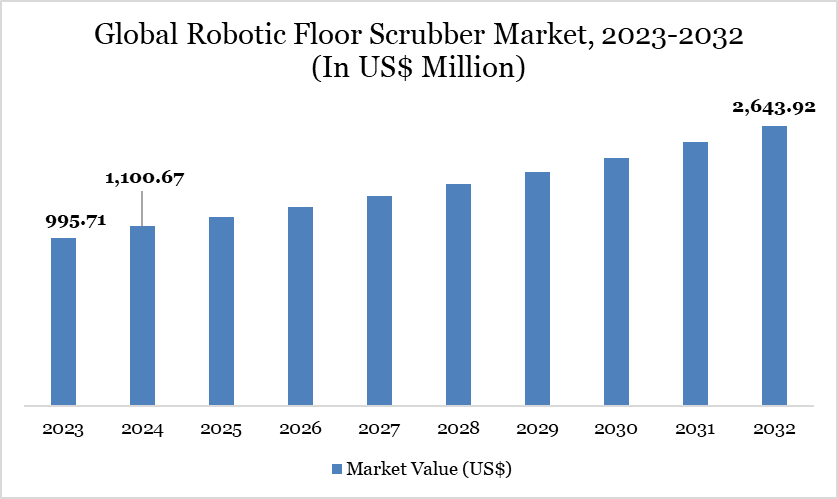
Robotic Floor Scrubber Market reached US$1,100.67 million in 2024 and is expected to reach US$2,643.92 million by 2032, growing at a CAGR of 11.69% during the forecast period 2025-2032.
The global robotic floor scrubber market is witnessing steady growth, driven by rising demand for efficient, cost-saving cleaning solutions in commercial and industrial spaces. Businesses are increasingly adopting autonomous cleaning robots to tackle labor shortages and ensure consistent hygiene standards.
Companies are innovating with advanced navigation, AI, and IoT integration to improve efficiency and reduce labor costs. For instance, in March 2024, Tennant Company unveiled its X4 ROVR, its first purpose-built autonomous floor scrubber powered by Brain Corp’s BrainOS, expanding its robotic portfolio to meet rising customer expectations. This highlights how partnerships and technological advancements are shaping competitive strategies.
Robotic Floor Scrubber Market Trend
A strong shift toward automation and AI is transforming the robotic floor scrubber market by enabling smarter, more efficient cleaning operations. Advanced AI algorithms and sensors help these robots navigate complex environments, avoid obstacles, and adapt to dynamic spaces with minimal human intervention. Businesses are increasingly adopting AI-driven floor scrubbers to reduce labor costs and improve cleaning consistency. The integration of IoT and machine learning also allows real-time monitoring, predictive maintenance, and performance optimization. This technological evolution aligns with the growing demand for sustainable, data-driven facility management.
For more details on this report - Request for Sample
Robotic Floor Scrubber Market Scope
| Metrics | Details |
| By Variant | Only Scrubber, Scrubber and Dryer |
| By Head Type | Disc, Cylindrical |
| By Run Time | Up to 4 hours, More than 4 hours |
| By End-User | Commercial, Industrial |
| By Region | North America, South America, Europe, Asia-Pacific, Middle East and Africa |
| Report Insights Covered | Competitive Landscape Analysis, Company Profile Analysis, Market Size, Share, Growth |
Robotic Floor Scrubber Market Dynamics
Rising Demand for Automation in Cleaning
The rising demand for automation in cleaning is significantly driving the growth of the global robotic floor scrubber market as industries, commercial spaces, and households increasingly seek efficient, labor-saving solutions. With the growing focus on hygiene and cleanliness in high-traffic areas, robotic floor scrubbers offer consistent, high-quality cleaning with minimal human intervention. Labor shortages and rising wages in many regions are pushing businesses to adopt automated cleaning technologies to reduce operational costs. Technological advancements such as AI navigation, real-time monitoring, and integration with facility management systems are making robotic scrubbers more effective and easier to deploy.
According to the International Federation of Robotics (IFR), with more than 2 million units sold in 2023, floor cleaning robots now account for nearly 57% of domestic service robots, underscoring their dominant role in the sector. This high adoption rate reflects a growing comfort and trust in autonomous cleaning systems across both residential and commercial segments. Retail chains, airports, and hospitals are among the early adopters, showcasing strong return on investment and operational efficiency. Additionally, post-pandemic hygiene awareness has created long-term demand for automated cleaning.
Maintenance and Repair Costs
Maintenance and repair costs are a significant restraint for the global robotic floor scrubber market, as they increase the total cost of ownership and can deter potential buyers. While these machines reduce labor expenses, they require regular upkeep such as brush replacements, battery servicing, and sensor calibrations to maintain performance. Unexpected breakdowns can lead to costly repairs and downtime, disrupting cleaning schedules in critical environments like airports, hospitals, or retail stores. Software updates, often essential for improved navigation and security, may also come with subscription fees or service charges. For smaller businesses with limited budgets, these ongoing costs can outweigh the perceived benefits of automation.
Additionally, the availability of spare parts and skilled technicians can vary by region, further complicating maintenance. In high-usage scenarios, wear and tear accelerates, increasing the frequency of servicing. This not only impacts operational costs but also raises concerns about long-term return on investment. As a result, some organizations delay or avoid adoption, preferring traditional cleaning methods with lower upkeep expenses. This ongoing cost barrier continues to slow the wider penetration of robotic floor scrubbers in price-sensitive markets.
Robotic Floor Scrubber Market Segment Analysis
The global robotic floor scrubber market is segmented based on variant, head type, run time, end-user and region.
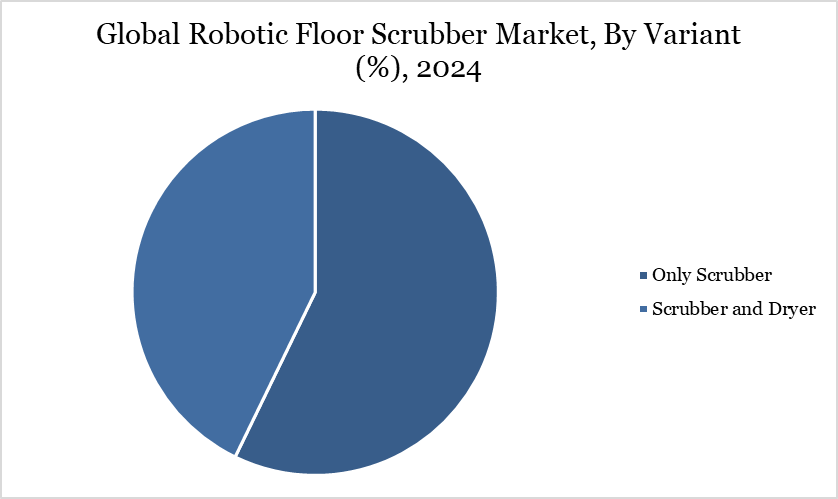
Scrubber & Dryer Leads Global Robotic Floor Scrubber Market Due to Dual-Function Efficiency and Time Saving
Scrubber & Dryer dominates the global Robotic Floor Scrubber Market due to its versatility in providing both deep cleaning and quick-drying capabilities, making it suitable for diverse commercial and industrial environments. These machines efficiently handle large floor areas, removing dirt, stains, and moisture in a single pass, which reduces downtime and enhances productivity. Their ability to work on various surfaces such as tiles, marble, and concrete boosts adoption across sectors like retail, healthcare, hospitality, and transportation hubs.
Technological innovations have further strengthened this segment’s position; for instance, in May 2024, Pudu Robotics unveiled its upgraded PUDU SH1 Smart Upright Scrubber Dryer at Interclean 2024, offering multidimensional cleaning for floors, glass, tabletops, and hard-to-reach areas. Equipped with air-liquid-debris separation, 27 kg down pressure, a 350 rpm brush, and 20 KPa suction, it tackles tough stains with high efficiency. Powered by eco-friendly lithium batteries and brushless motors, the PUDU SH1 meets ROHS standards, reducing water and chemical usage by up to 80% and cutting cleaning time by 70%. Such innovations not only improve operational performance but also align with sustainability goals, driving strong market preference for scrubber & dryer solutions worldwide.
Robotic Floor Scrubber Market Geographical Share
North America Holds a Significant Share in the Global Robotic Floor Scrubber Market Due to High Pool Ownership and Early Tech Adoption
North America holds a significant share in the global robotic scrubber market due to its strong adoption of automation technologies across commercial and residential sectors. The region’s aging population is driving increased demand for patient and elderly care robots, which complements the broader growth in home-use robotics—expected to be found in one out of every three households by 2030. This rising familiarity with robots encourages acceptance of autonomous cleaning solutions in both public and private spaces.
Furthermore, on June 24, 2025, Brain Corp and Tennant announced a strategic partnership aimed at enhancing service standards for autonomous floor scrubbers in the US and Canada. Their collaboration focuses on maximizing robot uptime through tailored service plans, proactive maintenance, and a skilled technician network, which ensures reliable operation and reduces downtime. This service-driven approach provides financial predictability for customers, boosting confidence in investing in advanced robotic cleaning technology. Consequently, North America’s strong infrastructure, innovation-friendly environment, and increasing emphasis on operational efficiency continue to propel its leading position in the global robotic scrubber market.
Technological Analysis
The global Robotic Floor Scrubber market is witnessing significant technological advancements that are transforming pool maintenance into a smarter, more efficient process. Modern Robotic Floor Scrubbers now integrate AI algorithms, multi-sensor navigation, and IoT connectivity for optimized cleaning performance and remote control. Manufacturers are focusing on cordless, energy-efficient designs that reduce manual labor and operational costs.
For instance, in August 2024, Beatbot set a new technological benchmark by unveiling the Beatbot iSkim Ultra, the world’s first intelligent robotic pool skimmer, which won the Muse Design Award Gold. This innovative device features industry-exclusive water clarification, advanced debris removal, and responsive app control, combining solar and battery charging for sustainable performance. Such innovations reflect the industry’s shift towards eco-friendly, smart pool solutions.
Robotic Floor Scrubber Market Major Players
The major global players in the market include Tennant Company, Nilfisk A/S, Kärcher (Alfred Kärcher SE & Co. KG), Hako GmbH, Avidbots Corp., ICE Robotics, Gaussian Robotics, Brain Corp, Fimap S.p.A, Pudu Technology Inc. and others.

Key Developments
In April 2024, Ontario-based robotics company Avidbots launched Kas, a fully autonomous floor scrubber designed specifically for tight and dynamic commercial spaces. Targeting industries such as retail, transportation, healthcare, and education, Kas aims to revolutionize cleaning by seamlessly navigating around people and objects. The company highlights Kas as a breakthrough in commercial cleaning robots, offering a touch-free experience, improved workforce efficiency, consistent productivity, and precise cleaning performance measurement.
In October 2024, Karcher India launched a range of advanced autonomous cleaning solutions, including robotic vacuum cleaners (RCV3, RCV5), an autonomous scrubber-dryer (KIRA B 50), and a cordless vacuum (KIRA CV 50), targeting airports, malls, hotels, and industrial applications. The company emphasized India as a key market with unique opportunities and plans to expand operations to capture 10% of its global revenue. Karcher also revealed plans to introduce AI capabilities soon, enabling cleaners to automatically detect floor types and optimize cleaning efficiency.
Why Choose DataM?
Data-Driven Insights: Dive into detailed analyses with granular insights such as pricing, market shares and value chain evaluations, enriched by interviews with industry leaders and disruptors.
Post-Purchase Support and Expert Analyst Consultations: As a valued client, gain direct access to our expert analysts for personalized advice and strategic guidance, tailored to your specific needs and challenges.
White Papers and Case Studies: Benefit quarterly from our in-depth studies related to your purchased titles, tailored to refine your operational and marketing strategies for maximum impact.
Annual Updates on Purchased Reports: As an existing customer, enjoy the privilege of annual updates to your reports, ensuring you stay abreast of the latest market insights and technological advancements. Terms and conditions apply.
Specialized Focus on Emerging Markets: DataM differentiates itself by delivering in-depth, specialized insights specifically for emerging markets, rather than offering generalized geographic overviews. This approach equips our clients with a nuanced understanding and actionable intelligence that are essential for navigating and succeeding in high-growth regions.
Value of DataM Reports: Our reports offer specialized insights tailored to the latest trends and specific business inquiries. This personalized approach provides a deeper, strategic perspective, ensuring you receive the precise information necessary to make informed decisions. These insights complement and go beyond what is typically available in generic databases.
Target Audience
Manufacturers/ Buyers
Industry Investors/Investment Bankers
Research Professionals
Emerging Companies





























































