


Quantum Interconnects Market Size and Forecast 2035
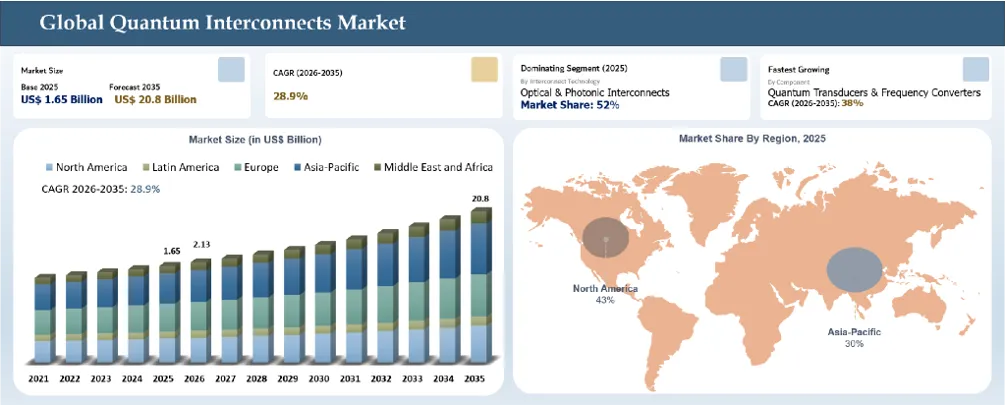
The global Quantum Interconnects market size reached USD 1.65 billion in 2025 and is forecasted to reach USD 20.8 billion by 2035, growing with a CAGR of 28.9% during the forecast period 2026-2035. Market growth is driven by the increasing investments in scalable quantum computing and quantum networking. For example, in 2025, the U.S. DARPA Quantum Benchmarking Initiative (QBI) identified 18 quantum computing firms for Stage A to test utility-scale quantum computing architectures that use quantum interconnect technologies. The IBM Quantum Network was enlarged to 300+ network members, among which there were 65+ business partners, 50+ industry clients, and 35+ Quantum Innovation Centers that help advance modular quantum computing infrastructure. The objective of IBM's Quantum Technology Atlas for 2026 is systems consisting of three modules of 120 qubits (total of 360 qubits) that perform 7,500 quantum gates in 2026 via modular interconnectivity. While there is a clear technological trend, keeping quantum coherence while transporting qubits and using different quantum technologies is still problematic in terms of commercialization.
This accomplishment proves the economic viability of quantum interconnect technologies through the demonstration of reliable and high-fidelity quantum communication using existing metro fiber optic networks. In April 2026, according to Outshift, Cisco and Qunnect successfully demonstrated a scalable quantum entanglement network over a distance of 17.6 km of commercial fiber in New York City that connects three quantum nodes from Brooklyn to Manhattan. In their research, both Cisco and Qunnect were able to generate 1.7 million+ entangled pairs per hour at the local facility and 5,400 entangled pairs per hour over the deployed fiber, with more than 99% polarization fidelity.
White-Space Opportunities for Government-Funded Quantum Communication Infrastructure and Cross-Border Network Deployment
In November 2025, the European Commission announced €389 million in funding under the Connecting Europe Facility (CEF) Digital Programme, with a selection of 56 projects to accelerate Europe's secure digital infrastructure, creating substantial opportunities across quantum communications, digital connectivity, and next-generation telecommunications. The investment prioritizes the deployment of the European Quantum Communication Infrastructure (EuroQCI), making quantum communications one of the highest-value strategic investment areas within the programme. Funding supports the deployment of cross-border quantum communication fiber links, integration of national quantum communication networks, development of satellite-to-ground quantum communication infrastructure for the future IRIS² constellation, and expansion of secure digital backbone networks. Beyond quantum communications, the programme also allocates funding to 5G infrastructure deployment, including 5G Smart Communities, 5G corridors for connected and automated mobility, and submarine and terrestrial backbone cable projects to improve high-capacity connectivity and digital resilience across the European Union. These investments are expected to accelerate the commercialization of quantum networking technologies while strengthening Europe's digital sovereignty and cross-border secure communications ecosystem. The programme provides EU grants covering 30% to 75% of project costs, while the broader CEF Digital Programme has a total budget of €1.5 billion for 2021–2027, demonstrating the EU's long-term commitment to secure digital and quantum connectivity.
The funding is expected to generate significant opportunities for companies across the quantum interconnect, optical networking, telecommunications, satellite communications, and digital infrastructure value chain. Quantum technology developers and networking companies such as Nokia, Cisco, Qblox, ID Quantique, LuxQuanta, ThinkQuantum, and Toshiba Europe are well positioned to benefit from the expansion of EuroQCI through the deployment of quantum communication systems, quantum key distribution (QKD) solutions, photonic networking equipment, and quantum interconnect technologies. Telecommunications infrastructure providers including Orange, Deutsche Telekom, Telefónica, TIM, and Proximus are expected to benefit from the rollout of cross-border fiber infrastructure and secure quantum communication networks. In addition, optical networking and fiber equipment suppliers such as Nokia, Ciena, Adtran, and Ericsson are likely to secure opportunities related to high-capacity optical transport, terrestrial backbone upgrades, and integration of quantum-enabled communication infrastructure, supporting the long-term growth of Europe's quantum internet ecosystem. The programme involves 220 partners across 28 countries, highlighting its broad commercial impact on Europe's quantum networking and digital connectivity value chain.
Quantum Interconnects Market Key Takeaways
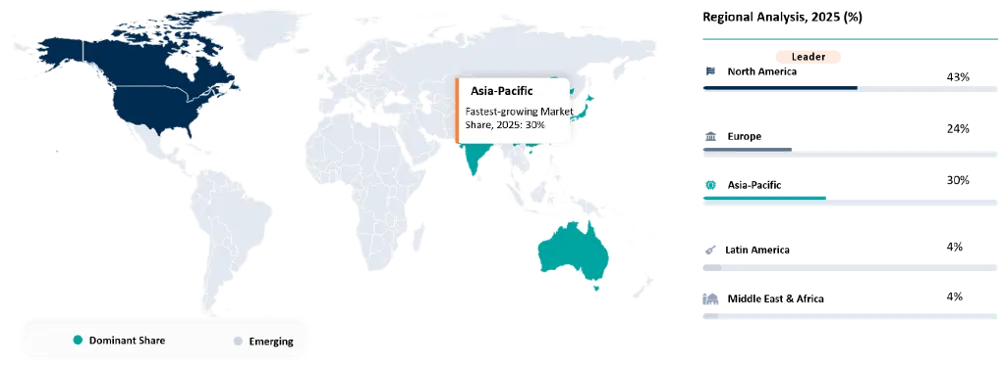
- North America established market leadership in 2025 by accounting for a 43% global market share. Regional dominance is supported by initiatives such as the U.S. Department of Energy's $625 million renewal funding across five national quantum centers.
- The Optical & Photonic Interconnects segment dominated the global market by capturing a 52% share in 2025. Growth in this segment is driven by low-loss long-distance qubit transmission and optical fiber compatibility.
- The European Commission allocated €389 million to 56 projects under the €1.5 billion CEF Digital Programme (2021–2027). The initiative provides project cost grants ranging from 30% to 75% and engages 220 partner organizations across 28 countries.
- Major national funding programs include India's National Quantum Mission with an eight-year outlay of ₹6,003.65 crore. Complementing this trend, Canada is driving workforce and technology development through its CAD 360 million National Quantum Strategy.
Quantum Interconnects Market Industry Trends and Strategic Insight
- Quantum hardware developers are replacing monolithic processor designs with modular quantum computing systems, increasing demand for high-fidelity quantum interconnects capable of linking multiple quantum processing units (QPUs) with minimal coherence loss.
- Integrated photonic platforms are becoming the leading approach for quantum interconnects because photons enable long-distance qubit transmission, compatibility with optical fiber infrastructure, and scalable quantum networking.
- Hardware developers are investing in quantum transducers that convert microwave-frequency qubits into optical photons, enabling superconducting quantum processors to communicate across optical quantum networks.
- Advanced cryogenic electronics, optical packaging, and heterogeneous chip integration are being optimized to minimize signal degradation between quantum processors and interconnect components.
- National quantum initiatives across North America, Europe, and Asia-Pacific are increasing funding for distributed quantum computing and secure quantum communication, creating long-term demand for quantum interconnect technologies.
Quantum Interconnects Market Scope
| Metrics | Details | |
| 2025 Market Size | USD 1.65 Billion | |
| 2035 Projected Market Size | USD 20.8 Billion | |
| CAGR (2026-2035) | 28.9% | |
| Largest Market | North America | |
| Fastest Growing Market | Asia-Pacific | |
| By Interconnect Technology | Optical & Photonic Interconnects, Microwave & Superconducting Interconnects, Microwave-to-Optical Quantum Transducers, Quantum Frequency Conversion Interconnects, Phononic & Acoustic Quantum Interconnects, Others | |
| By Connection Scale | On-Chip Interconnects, Chip-to-Chip & Die-to-Die Interconnects, Module-to-Module Interconnects, System-to-System Interconnects, Network Node-to-Node Interconnects | |
| By Component | Quantum Transducers & Frequency Converters, Optical Fibers, Waveguides & Coupling Components, Cryogenic Cables, Connectors & Packaging Interfaces, Quantum Routers & Switching Components, Quantum Repeaters, Quantum Memory Interfaces, Single-Photon Sources, Single-Photon Detectors, Synchronization & Control Electronics, Others | |
| By Quantum Platform | Superconducting Qubits, Trapped-Ion Qubits, Neutral Atom Qubits, Photonic Qubits, Semiconductor Spin Qubits, Color Center Qubits, Hybrid Quantum Systems, Others | |
| By Application | Modular Quantum Computing, Distributed Quantum Computing, Quantum Communication & Networking, Distributed Quantum Sensing, Quantum Timing & Synchronization, Others | |
| By End User | Government & Defense, Research Institutes & National Laboratories, Academic Institutions, Telecommunications, Cloud & Data Centers, Healthcare & Life Sciences, Banking, Financial Services & Insurance (BFSI), Industrial & Manufacturing, Others | |
| By Region | North America | U.S., Canada, Mexico |
| Europe | Germany, UK, France, Spain, Italy, Poland | |
| Asia-Pacific | China, India, Japan, Australia, South Korea, Indonesia, Malaysia | |
| Latin America | Brazil, Argentina | |
| Middle East and Africa | UAE, Saudi Arabia, South Africa, Israel, Türkiye | |
| Report Insights Covered | Competitive Landscape Analysis, Company Profile Analysis, Market Size, Share, Growth | |
Quantum Interconnects Market Disruption Analysis
Transition Toward Modular and Distributed Quantum Computing Architectures Reshaping the Quantum Interconnects Landscape
The disruption in the Quantum Interconnects Market is primarily driven by the industry's transition from monolithic quantum computers towards quantum computers that have a modular and distributed architecture in which multiple quantum processing units (QPUs) are connected via photonic and quantum communications channels. This change in architecture is leading to the shift of quantum interconnects from being an auxiliary part of quantum computing hardware to becoming an essential infrastructure technology for scalable and fault-tolerant quantum computing. In June 2025, IBM unveil their roadmap for fault-tolerant quantum computing, targeting 100 million quantum gates on 200 logical qubits by 2029.
In addition, the deployment of photonics and quantum networking infrastructure is driving the commercialization of high-fidelity quantum interconnect solutions. In June 2026, IBM announced a commitment to invest over USD 10 billion for five years towards advancing quantum computing research, manufacturing, ecosystem collaboration, and quantum modular systems. At the same time, developments in heterogeneous quantum-classical computing and chip-to-chip communication architectures have changed the course of hardware development, which will continue to drive up demand for photonic interconnects, microwave-to-optical transduction, and quantum networking technologies.
Quantum Interconnects Market BCG Matrix: Company Evaluation
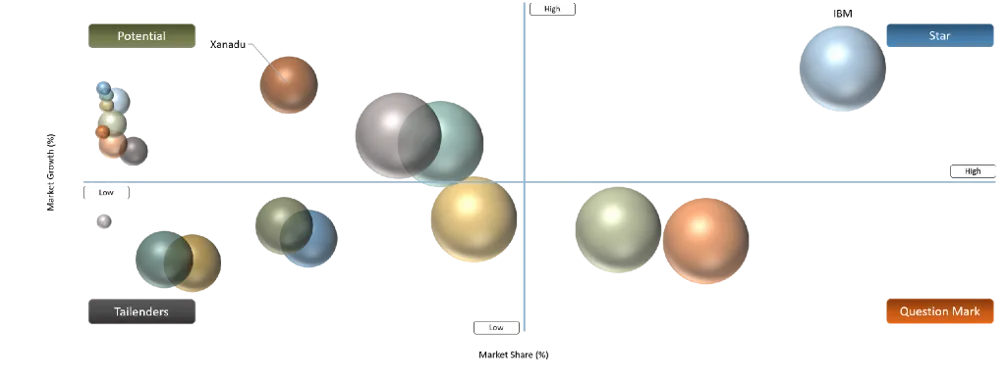
Stars include IBM, PsiQuantum, and IonQ because they combine strong technological leadership, substantial funding, and established quantum computing ecosystems with active development of quantum interconnect technologies. IBM is advancing modular quantum computing architectures that rely on high-performance processor-to-processor interconnects, while PsiQuantum is commercializing silicon-photonic quantum computing with integrated optical interconnects. Question Marks include Photonic Inc., Nu Quantum, Qunnect, and Rigetti Computing because they are developing advanced quantum interconnect technologies with significant commercial potential but remain in the early stages of large-scale commercialization.
Potential companies include Xanadu, Quandela, and QuiX Quantum, which possess strong expertise in photonic quantum computing and integrated photonic technologies that naturally support future quantum interconnect applications. Tailenders include Welinq and Aegiq because their current market participation is concentrated on enabling technologies such as quantum memories and single-photon sources rather than complete quantum interconnect platforms.
Quantum Interconnects Market Dynamics
Driver Impact Analysis
| Driver | Market Growth Impact (%) | Demand Concentration | Impacted Use Case | Strategic Impact |
Growing investments in distributed quantum computing are accelerating the deployment of scalable quantum networking and interconnect technologies. | 34% | Very High | Distributed quantum computing, modular QPU clusters, quantum networking | Accelerates commercialization of modular quantum architectures and establishes quantum interconnects as core infrastructure. |
Rapid advancements in integrated photonics are improving the performance, scalability, and manufacturability of photonic quantum interconnects. | 28% | High | Photonic quantum interconnects, optical quantum communication, quantum data centers | Improves scalability, lowers optical losses, and supports wafer-scale manufacturing of quantum interconnect hardware. |
Increasing development of fault-tolerant quantum computers is driving the need for reliable qubit communication across multiple quantum processing units (QPUs). | 26% | High | Fault-tolerant quantum computing, multi-QPU systems | Drives demand for high-fidelity processor-to-processor connectivity and next-generation interconnect platforms. |
Expansion of government-funded quantum networking and national quantum infrastructure programs is boosting commercialization of quantum interconnect solutions. | 20% | Medium to High | National quantum networks, research infrastructure, secure quantum communications | Strengthens public-private collaborations and accelerates deployment of quantum networking infrastructure. |
Advances in microwave-to-optical quantum transduction are enabling superconducting quantum processors to communicate through optical quantum networks. | 18% | Medium | Superconducting quantum computers, hybrid quantum systems | Enables long-distance quantum communication and interoperability between superconducting processors and photonic networks. |
Growing investments in distributed quantum computing are accelerating the deployment of scalable quantum networking and interconnect technologies
The increasing investments in distributed quantum computing are accelerating demand for scalable quantum interconnect solutions capable of facilitating coherent communication among various QPUs. The use of photonic interconnects, quantum transducers, and quantum networking solutions has become critical in achieving scalability of fault-tolerant quantum computers due to the shift towards modular quantum computing solutions from developers. In 2025, the U.S. DARPA Quantum Benchmarking Initiative (QBI), selected 11 companies to advance to stage B in November 2025, highlighting the growing industry focus on scalable quantum architectures that depend on high-performance interconnect technologies.
This will further consolidate the groundwork for scalable distributed quantum computing through the speedy creation of efficient quantum network architecture. In November 2025, according to Argonne National Laboratory, the US Department of Energy (DOE) extended the funding for the Argonne-led Q-NEXT National Quantum Information Science Research Center for the next five years, providing it with $125 million, of which $25 million is reserved for the fiscal year 2026. The renewed project is expected to concentrate on the development of distributed quantum entanglement, high-speed quantum networks, and remote-connected quantum processors, thus paving the way for the development of quantum interconnect technology.
Restraint Impact Analysis
| Restraint | Drag on Market Growth (%) | Primary Impact Area | Impacted Use Case | Strategic Impact |
Maintaining quantum coherence during qubit transmission over interconnects remains a major technical barrier to large-scale deployment. | 32% | Quantum state fidelity & coherence preservation | Distributed quantum computing, modular QPU architectures | Delays commercialization of large-scale fault-tolerant quantum systems by limiting reliable processor-to-processor communication. |
High optical losses and limited fidelity in quantum state transfer reduce the performance of long-distance quantum interconnects. | 26% | Photonic transmission efficiency | Quantum networking, quantum repeaters, quantum internet | Restricts long-distance entanglement distribution and increases quantum error correction requirements. |
Complex integration between superconducting, trapped-ion, photonic, and semiconductor qubit systems slows commercialization of heterogeneous quantum interconnects. | 22% | Multi-platform hardware interoperability | Hybrid quantum computing, heterogeneous quantum systems | Slows development of interoperable quantum ecosystems and increases integration complexity across hardware platforms. |
Dependence on cryogenic operating environments increases infrastructure complexity and deployment costs for quantum interconnect systems. | 18% | Cryogenic infrastructure & system engineering | Superconducting quantum computers, quantum data centers | Increases capital expenditure, operating costs, and limits scalability of commercial quantum computing infrastructure. |
Maintaining quantum coherence during qubit transmission over interconnects remains a major technical barrier to large-scale deployment
One of the main constraints that hinder the commercialization of the Quantum Interconnects Market is the problem of maintaining quantum coherence and entanglement during the transfer of qubits from one quantum processor to another. The state of the quantum system is very fragile in terms of photon loss, thermal noise, electromagnetic interference, and decoherence. This makes the process of processor-to-processor information transfer harder than that of classical data transfer. As quantum computing moves closer to modularity, even small errors in transmission affect the efficiency of quantum computing.
The results indicate that maintaining coherence in the process of transporting qubits is an essential problem, which affects the scalability and reliability of quantum interconnect architecture. In June 2026, a Nature Communications study reported coherent spin shuttling over an array of 10-quantum-dots arranged as a conveyor belt on a ²⁸Si/SiGe substrate. In the process, the research showed that inhomogeneity in valley splitting plays an important role in determining spin coherence and fidelity of qubit transport in the process. This research proves that reducing the valley-splitting inhomogeneity is vital in maintaining coherence of the qubit in transit, thereby ensuring efficient quantum computing and networking systems.
Quantum Interconnects Market Segment Analysis
The global Quantum Interconnects market is segmented based on interconnect technology, connection scale, component, quantum platform, application, end user, and region.
By Interconnect Technology, Optical & Photonic Interconnects Dominates the Quantum Interconnects Market
The Optical & Photonic Interconnects segment held the biggest market share of around 52% in the Quantum Interconnects Market in 2025 owing to their capability of sending quantum information over vast distances without any loss of signal or degradation, while maintaining quantum coherence and entanglement. In contrast to microwave interconnects, photonic interconnects are naturally capable of being integrated into the existing optical fiber network, which makes them the go-to choice for quantum computing, quantum processing, and quantum networks. The commercialization of photonic integrated circuits (PICs), single photon devices, and optical quantum links is adding to this segment’s dominance as quantum hardware vendors shift towards optical systems.
Leading companies including PsiQuantum, Xanadu, Photonic Inc., Quandela, QuiX Quantum, and Nu Quantum are rapidly investing in silicon photonics, photonic chips, and quantum optical networking technology to build the future generation quantum computing infrastructure. In 2025, IonQ showcased its quantum computing system that used photonic interconnect and remote entanglement to prove the scalability of quantum processor-to-processor communication. In addition to that, IBM is developing a modular quantum computer system that increasingly depends on optical quantum networking. Increased investments in quantum networking infrastructure, photonic quantum repeaters, and quantum internet development are likely to strengthen the supremacy of the Optical & Photonic Interconnects market.
Quantum Interconnects Market Geographical Penetration
Growing Quantum Computing Commercialization and National Quantum Infrastructure Investments Driving North American Leadership
North America is dominating the Quantum Interconnects Market in 2025, capturing about 43% of the market, owing to the presence of various quantum computer manufacturers, ample government investments, and the early adoption of modular quantum computers and quantum networks in the region. North America is home to leading firms like IBM, IonQ, Rigetti Computing, Qunnect, and PsiQuantum, among others, and also has national laboratories and research centers that have been working towards advancing the progress of photonic quantum interconnects, quantum transducers, and distributed quantum computing systems. The effective partnership of industry, academia, and governmental organizations has helped in building a sound ecosystem for quantum communication and processor-to-processor connectivity.
This deal helps to augment the capacity of IonQ to provide quantum network solutions with integrated services of quantum computing, quantum communication, and quantum interconnect within a single platform. In May 2025, IonQ Inc., a U.S.-based public quantum computing company, successfully acquired ID Quantique (IDQ), a Switzerland-based Quantum technology company, to build up its position in quantum networking and secure communications. This acquisition allowed IonQ to acquire ID Quantique’s knowledge about quantum key distribution (QKD), quantum-safe networking, and single-photon detection technologies and increase its competencies in quantum interconnects and quantum networking. At the time of the acquisition, ID Quantique’s quantum-safe security solutions were implemented in more than 60 countries while the number of its patents and patent applications for quantum technologies exceeded 300.
U.S. Quantum Interconnects Market Trends
The U.S. holds a dominant position in the Quantum Interconnects market on account of a well-developed quantum technology ecosystem, high government spending, the existence of prominent quantum computing companies, and quick commercialization of quantum networking hardware infrastructure. The country has an already well-developed research foundation that is backed by entities such as the National Quantum Initiative (NQI), the Department of Energy (DOE) National Laboratories, and prominent universities, all of which are driving quantum communication, quantum memory, and interconnect technologies developments. The U.S. government was also continuing its quantum technology initiatives through federal research programs via the National Quantum Initiative (NQI), where departments such as the DOE, NSF, and NIST were backing quantum information science R&D, infrastructure development, and commercialization activities. In November 2025, the DOE announced $625 million in funds to renew the five National Quantum Information Science Research Centers in order to bolster quantum hardware, quantum networking, and applications development.
This acquisition bolsters the ecosystem of quantum technology in the U.S. because of the advancement in the scalability of quantum interconnects, which facilitate connectivity between distributed quantum processors. In June 2025, IonQ Inc., a U.S.-based public quantum computing company, successfully acquired Lightsynq Technologies Inc., a U.S.-based Private quantum technology company that provides quantum memory and photonic networking solutions. This acquisition adds another feather to the cap of IonQ by incorporating the quantum networking technology from Lightsynq, which has a background in quantum memory, photonic connections, and quantum networking architecture. The technology used by Lightsynq consists of rare-earth quantum memory technology, which allows long-range quantum communication and connectivity between quantum processors.
Canada Quantum Interconnects Market Outlook
Canada is emerging as a significance player in the market of Quantum Interconnects Market, owing to its advanced quantum research environment, quantum initiatives supported by the government, and increasing cooperation among universities, telecommunication organizations, and quantum technology firms. The nation has carved out for itself a reputation in the field of quantum science as it has been making investments in this sphere through the National Quantum Strategy (NQS), worth CAD 360 million, which was initiated in order to encourage quantum research, commercialization, and work force creation.
The partnership is an added boost to Canada’s quantum technology ecosystem through the coming together of telecommunications infrastructure know-how and quantum technology research. In July 2026, Bell Canada, a Canada-based public telecommunication and digital communications company, has entered into a collaboration with Université de Sherbrooke, a Canada-based public research university, for the development of quantum technologies, cybersecurity, and next-generation artificial intelligence infrastructure in Canada. The cooperation will be directed at using the cutting-edge telecommunication infrastructure of Bell and the quantum research capabilities of Université de Sherbrooke.
Quantum Interconnects Market Competitive Landscape
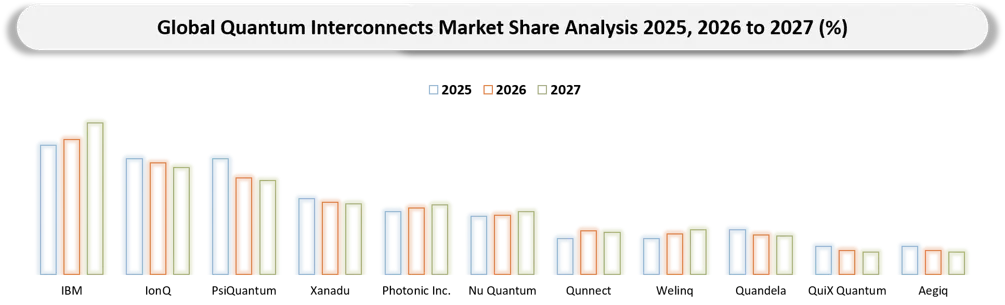
- The Quantum Interconnects market is characterized by three major participant groups: quantum computing hardware developers, photonic quantum networking specialists, and quantum communication infrastructure providers. Leading quantum computing companies such as IBM, IonQ, Rigetti Computing, and Xanadu focus on developing scalable quantum processors, modular quantum architectures, and technologies required for connecting multiple quantum systems. Photonic quantum technology companies including PsiQuantum, Photonic Inc., Quandela, QuiX Quantum, and Aegiq are advancing optical interconnects, photonic qubits, and quantum networking solutions aimed at enabling high-speed, low-loss communication between quantum processors. Companies such as Nu Quantum, Qunnect, and Welinq specialize in quantum networking hardware, quantum repeaters, and entanglement distribution technologies, supporting the development of future quantum internet infrastructure. This creates a highly innovation-driven competitive landscape where quantum processor scalability, photonic integration capability, networking performance, and strategic partnerships with research institutions and cloud providers define market competitiveness.
- Key players in the Quantum Interconnects market include IBM, IonQ, PsiQuantum, Xanadu, Photonic Inc., Nu Quantum, Qunnect, Welinq, Quandela, QuiX Quantum, Aegiq, and Rigetti Computing.
Key Developments
- January 2026: IonQ Inc., a U.S.-based public quantum computing company, announced an agreement to acquire SkyWater Technology Inc., a U.S.-based public semiconductor foundry and advanced manufacturing company, in a cash-and-stock transaction valued at approximately USD 1.8 billion.
- March 2026: SEALSQ Corp, a Switzerland-based public semiconductor and cybersecurity technology company, completed the acquisition of Miraex SA, a Switzerland-based private photonics-based quantum technology company, to strengthen its quantum technology portfolio and complete its Quantum Sovereign Vertical Stack.
- March 2025: Welinq, a France-based private quantum networking technology company, partnered with QphoX, a Netherlands-based private quantum technology company specializing in quantum transduction, to develop optical quantum interconnects for superconducting quantum computers.
- October 2025: Welinq, a France-based private quantum networking technology company, and QphoX, a Netherlands-based private quantum technology company specializing in quantum transduction and frequency conversion, partnered with Sorbonne University, a France-based public research university, to launch Project Meet-Q for advancing hybrid scalable quantum networking.
- February 2026: Government of India's National Quantum Mission (NQM) was being implemented by the Department of Science and Technology (DST), with a total outlay of ₹6,003.65 crore for eight years.
- November 2025: Roadrunner Venture Studios, a U.S.-based private deep-tech venture studio, partnered with Qunnect Inc., a U.S.-based private quantum networking technology company, to launch ABQ-Net, New Mexico’s first quantum network.
- July 2026: QTREX Quantum Ltd., an Israel-based public quantum technology and advanced electronics company, launched a Quantum Interconnect Research Program in collaboration with Northeastern University, a U.S.-based private research university, to advance cryogenic quantum interconnect technologies.
Key Procurement Priorities and Buyer Evaluation Criteria
- Organizations making investments in the Quantum Interconnects market, they are looking at the capability of providers to offer high-performance quantum interconnect solutions, which will allow reliable communication between quantum processors, quantum memories, and quantum computing networks. Providers’ competencies in low-loss optical links, quantum transducers, quantum repeaters, and interconnect architectures will be considered in the evaluation process.
- The purchasing decision-making process is getting impacted due to the rising demand for scalable fault-tolerant quantum computing, quantum networking facilities, quantum communications security, and integration of quantum systems within high-performance computing setups. Buyers are focusing on those solutions that will provide support for a higher number of qubits and modular quantum systems architecture.
- Buyers consider a range of parameters including quantum interconnect accuracy, transmission effectiveness, entanglement production speed, scalability, error-correction capabilities, latencies, and stability. The capability of suppliers to offer dependable quantum networking solutions, cryogenically compatible systems, and precision control mechanisms is very important for procurement purposes.
Why Choose DataM?
- Technological Innovations: Explores advancements in quantum interconnect technologies, including photonic quantum links, quantum repeaters, quantum transduction systems, and modular quantum architectures, enabling improved connectivity, reduced communication losses, and scalable integration of quantum processors for quantum computing, quantum networking, and quantum internet applications.
- Technology Performance & Market Positioning: Evaluates how different players deliver quantum interconnect solutions based on key performance parameters such as qubit connectivity, entanglement distribution efficiency, transmission fidelity, scalability, latency, and compatibility with existing quantum hardware platforms, highlighting how leading companies differentiate through advanced photonic, superconducting, and trapped-ion interconnect technologies.
- Real-World Evidence: Highlights adoption and development of quantum interconnect solutions across quantum computing platforms, secure communication networks, research testbeds, and cloud-based quantum services, demonstrating benefits such as enhanced quantum system scalability, improved processor connectivity, distributed computing capabilities, and advancement toward fault-tolerant quantum architectures.
- Market Updates & Industry Changes: Tracks key developments such as quantum networking demonstrations, government-funded quantum infrastructure programs, technology partnerships, research collaborations, and commercialization initiatives across North America, Europe, and Asia-Pacific, supporting the transition from experimental quantum systems toward scalable quantum networks.
- Competitive Strategies: Analyzes how leading companies expand through technology innovation, strategic partnerships, acquisitions, research collaborations, and ecosystem development to strengthen capabilities in quantum communication, quantum memory integration, photonic systems, and next-generation quantum computing architectures.
- Pricing & Market Access: Examines cost variations associated with quantum interconnect deployment based on system complexity, quantum hardware requirements, cryogenic infrastructure, photonic components, and integration levels, while analyzing access through quantum computing providers, research institutions, cloud quantum platforms, and specialized quantum technology developers.
- Market Entry & Expansion: Identifies growth opportunities driven by increasing investments in quantum computing, demand for distributed quantum processing, secure quantum communication requirements, and development of quantum internet infrastructure, while outlining strategies such as technology specialization, regional ecosystem partnerships, government collaborations, and scalable quantum network deployment.
Target Audience
- Quantum Computing Companies
- Quantum Hardware & Component Manufacturers
- Photonic Technology & Integrated Optics Companies
- Telecommunications & Network Infrastructure Providers
- Cloud Computing & Quantum-as-a-Service Providers
- Semiconductor & Advanced Computing Companies
- Government Agencies & Research Organizations


























































