


Postbiotics in Animal Feed Market Size
The global market for postbiotics in animal feed reached US$19.10 billion in 2025 and is expected to reach US$45.97 billion by 2035, growing at a CAGR of 9.12% during the forecast period 2026-2035.
The demand for postbiotics in the animal feed market is gaining momentum as the livestock industry shifts toward sustainable, antibiotic-free production systems. In poultry farming, where feed efficiency and gut health are critical, postbiotics offer a reliable alternative to antibiotic growth promoters (AGPs). Their proven ability to enhance immune response, improve feed conversion ratios, and reduce pathogen load aligns well with regulatory pressures and consumer expectations for clean-label, residue-free meat. Leading players such as Alltech and Cargill are already capitalizing on this shift by introducing postbiotic solutions tailored for intensive poultry production.
This trend is further supported by the global push for safer, more environmentally friendly animal nutrition practices. Postbiotics, being shelf-stable and easy to integrate into feed, provide operational and cost advantages to producers. In high-growth regions such as Southeast Asia and South America, where demand for protein is surging, poultry integrators are increasingly adopting postbiotic-based feed strategies to enhance productivity while meeting export standards. As scientific validation and commercial trials continue to prove efficacy, the adoption curve for postbiotics in animal feed is expected to steepen significantly in the coming years.
Postbiotics in Animal Feed Market Trend
A key trend accelerating the adoption of postbiotics in the animal feed market is the growing body of scientific validation and controlled commercial trials demonstrating their efficacy. Numerous peer-reviewed studies have confirmed that postbiotics derived from strains such as Lactiplantibacillus plantarum significantly improve gut health, enhance immune response, and support optimal growth performance in species such as poultry, swine, shrimp, and rabbits.
For instance, trials have shown that postbiotics improve feed conversion ratios and weight gain in broilers, while also reducing pathogenic bacteria like E. coli and Salmonella. These outcomes are critical to producers seeking antibiotic-free solutions that maintain or boost productivity under commercial farming conditions.
This increasing body of evidence is accelerating commercialization, as feed manufacturers and integrators translate scientific findings into viable, market-ready solutions. Leading companies are incorporating postbiotics into functional feed additives aimed at high-stress production environments, particularly in regions with strong regulatory restrictions on antibiotics. The reliable, measurable outcomes from commercial-scale trials are enabling faster adoption and de-risking investment in postbiotic innovation, positioning it as a strategic component in sustainable, high-performance animal nutrition programs.
Key Takeaways
- Rising restrictions on antibiotic growth promoters continue to accelerate commercial adoption of postbiotic feed additives.
- Poultry remains the largest opportunity owing to intensive production systems and increasing demand for improved feed conversion efficiency.
- Scientific validation from peer-reviewed studies and commercial trials is reducing adoption risk for livestock producers.
- North America maintains strong market leadership through regulatory support, innovation, and investments in functional nutrition.
- Asia-Pacific is becoming an important investment destination as protein consumption and commercial poultry production expand.
- Product innovation is increasingly focused on immune modulation, gut microbiome optimization, disease prevention, and production efficiency.
- Major animal nutrition companies are strengthening competitive positioning through R&D expansion, fermentation technologies, and strategic product launches.
Postbiotics in Animal Feed Market Scope
| Metrics | Details |
| Market Size (2025) | US$19.10 Billion |
| Market Size (2035) | US$45.97 Billion |
| CAGR (2026-2035) | 9.12% |
| Historic Years | 2023-2024 |
| Base Year | 2025 |
| Forecast Period | 2026-2035 |
| Segments Covered | Animal Type, Form, Function, Source, Region |
| Leading Region | North America |
| Fastest Growing Region | Asia-Pacific |
Postbiotics in Animal Feed Market Dynamics
Rising Demand for Antibiotic Alternatives
The global shift away from antibiotic growth promoters (AGPs) in animal agriculture is a major driver propelling the demand for postbiotics in animal feed. With increasing concerns about antimicrobial resistance (AMR), regulatory bodies across regions, particularly in the EU, North America, and parts of Asia, are enforcing strict limitations or bans on the use of antibiotics in livestock production. This has created a strong market need for safe, effective, and sustainable alternatives that can support animal health and productivity without compromising food safety.
Postbiotics offer a compelling solution in this context due to their proven ability to enhance gut health, modulate the immune system, and improve feed efficiency, without the risks associated with live microorganisms or antibiotic residues. Their ease of formulation, long shelf life, and stability during feed processing further increase their appeal to feed manufacturers and integrators. As consumer demand for antibiotic-free meat and dairy products rises, postbiotics are emerging as a strategic component in sustainable animal nutrition programs.
High product development costs
One of the primary barriers to the expansion of the postbiotics market in animal feed is the high cost of product development. Developing effective postbiotic formulations requires advanced R&D infrastructure, strain-specific fermentation processes, precision inactivation techniques, and thorough safety and efficacy testing. These activities are both time- and capital-intensive, particularly when developing species-specific formulations. Additionally, the need for high-quality microbial inputs and optimized culture media further drives up production costs, making it difficult for smaller feed manufacturers to enter the market.
Moreover, regulatory compliance and approval processes for new feed additives increase the financial burden on manufacturers. As postbiotics are still an emerging category in animal nutrition, companies must allocate substantial resources toward scientific validation, clinical trials, and regulatory documentation to secure product approvals across different regions. These high initial investments, combined with the uncertainty of return on investment, can slow market penetration and innovation, especially among startups and mid-sized players, despite the strong demand for antibiotic-free feed solutions.
Emerging Business Opportunities
The strongest commercial opportunities are expected to emerge where livestock productivity must increase while reducing antibiotic dependence.
Large poultry integrators across Southeast Asia and South America are increasingly adopting postbiotic nutrition strategies to satisfy export regulations and improve production efficiency. Feed manufacturers capable of developing stable formulations with demonstrated improvements in feed conversion, immune performance, and disease resistance are likely to secure long-term partnerships with commercial livestock producers.
Companion animal nutrition also represents an expanding revenue opportunity as manufacturers develop premium functional diets incorporating postbiotics for digestive health and immune support.
Growing investments in fermentation technology, precision microbial metabolites, and customized species-specific formulations are expected to create additional value across poultry, swine, aquaculture, dairy, and pet nutrition industries through 2035.
Postbiotics in Animal Feed Market Segmentation Analysis
The Postbiotics in Animal Feed Market is segmented by Animal Type (Poultry, Swine, Ruminants, Aquaculture, Others), Form (Powder, Liquid, Pellets), Function (Gut Health & Digestive Support, Immune Modulation, Growth Performance Enhancement, Disease Prevention & Health Management, Others), Source (Cell Wall Components, Metabolites, Heat-Killed or Inactivated Microorganisms, Other Bioactive Compounds), and Region – Share, Trends and Forecast to 2035.
Poultry Leads Commercial Adoption
Poultry continues to represent the largest application segment due to increasing pressure to eliminate antibiotic growth promoters while maintaining productivity. Postbiotics improve intestinal integrity, immune performance, feed utilization, and resistance against common pathogens, making them highly valuable for commercial broiler and layer operations.
The launch of Biostrong C-Protect by Cargill Animal Nutrition demonstrates increasing industry investment in targeted postbiotic formulations capable of reducing avian pathogenic E. coli while supporting egg production and flock performance.
Powder Form Gains Preference
Powder formulations remain widely adopted due to easier handling, excellent storage stability, compatibility with feed manufacturing processes, and consistent dosage across commercial feed production systems.
Gut Health and Immune Support Drive Functional Demand
Among functional applications, gut health optimization and immune modulation continue to generate the greatest commercial interest as producers seek long-term improvements in productivity without relying on pharmaceutical interventions.
Postbiotics in Animal Feed Market Regional Outlook
North America
North America continues to dominate the market owing to advanced animal nutrition research, strict regulations governing antibiotic use, and widespread adoption of precision livestock management practices.
Industry leaders such as Alltech, Cargill, and Kemin Industries continue investing heavily in postbiotic research while expanding commercial product portfolios across poultry, dairy, swine, aquaculture, and companion animal nutrition.
The publication of Alltech's white paper on dietary biotics further reflects the region's emphasis on evidence-based nutritional innovation.
Europe
Europe maintains strong growth prospects due to stringent regulations restricting antibiotic growth promoters and an increasing focus on sustainable livestock production under initiatives such as the EU Green Deal and Farm to Fork Strategy.
Feed manufacturers continue integrating postbiotics into nutritional programs designed to improve animal welfare while supporting productivity and environmental sustainability.
Asia-Pacific
Asia-Pacific is expected to experience the fastest expansion driven by increasing protein consumption, rapid industrialization of poultry and swine production, expanding aquaculture industries, and rising exports of meat products.
Commercial producers across Southeast Asia are increasingly adopting postbiotic feed programs to improve productivity, comply with export standards, and reduce antibiotic dependence while meeting growing domestic demand.
Sustainability Analysis
The animal nutrition sector is undergoing a major transformation, driven by sustainability targets, rising concerns over antimicrobial resistance, and increasing demands for animal welfare. In response, regulatory frameworks such as the EU Green Deal and Farm to Fork strategy are phasing out antibiotic growth promoters and zinc oxide. This shift has accelerated the demand for next-generation feed additives. Postbiotics have emerged as a reliable, stable alternative that supports gut health and enhances immune response, while ensuring consistency and safety in animal production systems.
Postbiotics offer significant operational advantages. Unlike probiotics, they do not require colonization or activation in the digestive tract. Their active metabolites, formed during controlled fermentation, act immediately and effectively on gut microbiota and epithelial cells. This stability and precision make them ideal for large-scale integration in feed strategies aimed at improving animal health and reducing input costs.
DSM, in collaboration with Lallemand and Royal DSM-Firmenich, has positioned itself at the forefront of this innovation. Its proprietary Lactobacillus LB postbiotic blend has shown measurable benefits in piglet production. Field trials highlight its effectiveness in enhancing feed conversion ratios, improving gut microbiome composition, and reducing dependency on antibiotics. These outcomes align directly with DSM’s long-term sustainability roadmap.
With mounting pressure to reduce the environmental footprint of livestock production, postbiotics represent a scalable solution for the future. As demand for antibiotic-free, high-efficiency animal proteins grows, companies that integrate postbiotic strategies will gain a competitive and sustainable edge in global markets.
Competitive Landscape
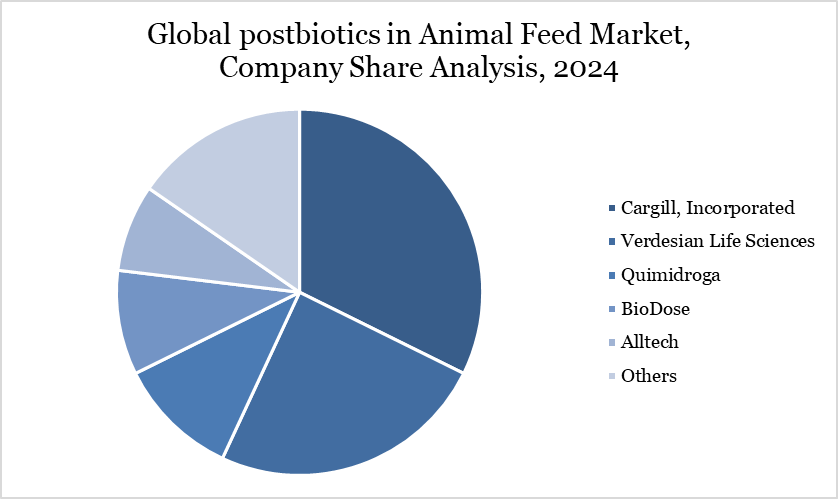
The major global players in the market include Cargill, Incorporated, Verdesian Life Sciences, Quimidroga, BioDose, Alltech, Lallemand Inc., Kemin Industries, Bioprox Healthcare and Amin Impex Pvt Ltd.
Key Developments
- May 2026: DSM-Firmenich expanded its postbiotics-based animal nutrition portfolio, focusing on gut-health improvement solutions for poultry and swine production systems across Europe and Asia-Pacific regions.
- April 2026: Cargill strengthened its animal feed additives division by scaling postbiotic ingredient integration into feed formulations aimed at improving feed efficiency and reducing antibiotic dependence in livestock production.
- March 2026: IFF (International Flavors & Fragrances) advanced fermentation-derived postbiotic technologies targeting immune modulation and digestive health enhancement in companion animals and livestock.
- February 2026: Adisseo launched enhanced postbiotic feed solutions designed to improve gut microbiota balance and performance outcomes in poultry and ruminants.
- January 2026: Novus International expanded its functional feed additive pipeline with new postbiotic-based formulations supporting stress reduction and productivity improvement in intensive livestock farming.
- December 2025: Alltech increased R&D investments in yeast-derived postbiotics to enhance immunity, nutrient absorption, and performance efficiency in monogastric animals.
- November 2025: Kemin Industries strengthened its gut health solutions portfolio by integrating postbiotic blends into feed additive systems for poultry and aquaculture applications.
- October 2025: Nutreco expanded field trials of postbiotic-enriched feed programs aimed at reducing antibiotic growth promoter (AGP) usage in livestock production systems.
- September 2025: Evonik Industries advanced fermentation-based feed additive innovations, focusing on postbiotic compounds for improved intestinal health and feed conversion ratios.
- August 2025: Land O’Lakes enhanced its animal nutrition research initiatives by evaluating postbiotic applications for dairy cattle productivity and metabolic health optimization.
Why Choose DataM?
Data-Driven Insights: Dive into detailed analyses with granular insights such as pricing, market shares and value chain evaluations, enriched by interviews with industry leaders and disruptors.
Post-Purchase Support and Expert Analyst Consultations: As a valued client, gain direct access to our expert analysts for personalized advice and strategic guidance, tailored to your specific needs and challenges.
White Papers and Case Studies: Benefit quarterly from our in-depth studies related to your purchased titles, tailored to refine your operational and marketing strategies for maximum impact.
Annual Updates on Purchased Reports: As an existing customer, enjoy the privilege of annual updates to your reports, ensuring you stay abreast of the latest market insights and technological advancements. Terms and conditions apply.
Specialized Focus on Emerging Markets: DataM differentiates itself by delivering in-depth, specialized insights specifically for emerging markets, rather than offering generalized geographic overviews. This approach equips our clients with a nuanced understanding and actionable intelligence that are essential for navigating and succeeding in high-growth regions.
Value of DataM Reports: Our reports offer specialized insights tailored to the latest trends and specific business inquiries. This personalized approach provides a deeper, strategic perspective, ensuring you receive the precise information necessary to make informed decisions. These insights complement and go beyond what is typically available in generic databases.
Report Benefits
This report supports:
- Animal feed manufacturers
- Livestock producers
- Feed additive suppliers
- Animal nutrition companies
- Biotechnology developers
- Investors and private equity firms
- Procurement and sourcing teams
- Corporate strategy and business development teams
It provides strategic market intelligence covering growth opportunities, competitive positioning, technological developments, regional investment prospects, product innovation, sustainability trends, and future commercialization strategies.
Target Audience
- Feed Manufacturers
- Livestock Producers
- Poultry Integrators
- Animal Nutrition Companies
- Biotechnology Companies
- Feed Ingredient Suppliers
- Industry Investors
- Investment Bankers
- Research Organizations
- Emerging Feed Additive Companies
- Government and Regulatory Agencies
Analyst Conclusion
The Postbiotics in Animal Feed Market is positioned for sustained expansion as livestock producers increasingly prioritize productivity, food safety, and sustainable production systems. Growing regulatory restrictions on antibiotics, expanding scientific validation, and continued innovation from leading animal nutrition companies are creating favorable conditions for wider commercial adoption. Organizations capable of developing scientifically proven, cost-effective, and species-specific postbiotic solutions will be well positioned to capitalize on rising global demand for antibiotic-free animal nutrition through 2035.


























































