


PFAS CRM Market Size and Overview
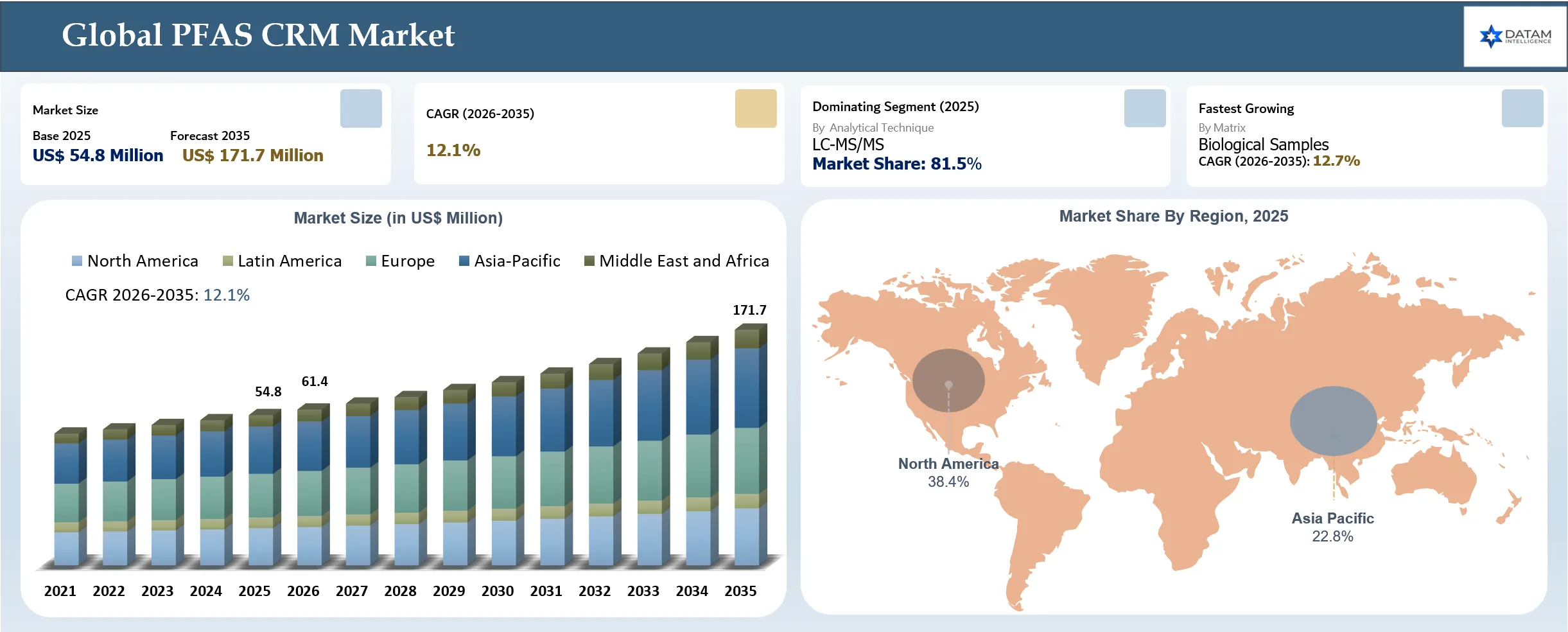
The global PFAS CRM market reached USD 54.8 million in 2025 and is expected to reach USD 171.7 million by 2035, growing with a CAGR of 12.1% during the forecast period 2026-2035, due to the increased monitoring regulations from the regulatory authorities on PFAS in drinking water, wastewater, soil, food, consumer goods, and industrial chemicals leading to the need for highly accurate and reliable certified reference material used in analytical tests and quality assurance in laboratories. The increased use of advanced analytical techniques, such as LC-MS/MS, HRMS, and GC-MS, coupled with the adoption of standardized methods like U.S. EPA Methods 533, 537.1, and 1633, has contributed to a rise in the demand for calibration standards and matrix-certified reference materials. Major manufacturers such as Agilent Technologies, Chiron AS, LGC Standards, Wellington Laboratories, and Merck have continued to diversify their range of PFAS CRM to meet evolving regulatory frameworks and ultra-trace analytical needs. Nevertheless, the expense involved in CRM development, the emergence of new PFAS analytes, and metrological traceability of PFAS compounds are some of the factors that affect market growth.
In March 2025, AccuStandard released the novel EN 17892 PFAS Certified Reference Material (CRM), which is intended for PFAS analysis in drinking water. This CRM consists of all 29 targeted PFAS substances listed in the EN 17892:2024 guideline. It helps laboratories perform an accurate calibration and validation of the LC-MS/MS method for the detection of PFAS in drinking water.
PFAS CRM Market Key Takeaways
- North America held the leading global position in this sector, accounting for an approximate 38.4% market share in 2025. This geographical dominance is supported by advanced testing infrastructure and early implementation of strict regulatory limits.
- The Liquid Chromatography-Tandem Mass Spectrometry (LC-MS/MS) segment commanded a dominant 81.5% market share in 2025. This overwhelming share is due to its superior sensitivity and ability to accurately handle ultra-trace quantification.
- Regulatory frameworks like U.S. EPA Method 1633 require environmental laboratories to track 40 specific PFAS analytes. These targets must be meticulously quantified across 12 distinct environmental matrices, including wastewater, soil, and tissue samples.
- Biomonitoring surveys conducted by the CDC’s NHANES indicate that PFAS traces are present in more than 97% of the U.S. population.
- The U.S. EPA National Primary Drinking Water Regulation finalized in 2025 capped maximum contaminant levels for PFOA and PFOS at an ultra-low 4 ppt.
PFAS CRM Market Industry Trends and Strategic Insight
- Expansion of regulatory PFAS Lists is increasing demand for multi-analyte CRMs like PFOA & PFOS in the effort to monitor more than hundreds of PFAS Substances. The transition is driving labs to shift from using single-analyte standards to comprehensive multi-component certified reference materials (CRMs).
- With the adoption of low-part-per-trillion (ppt) detection levels for environmental and drinking water analysis, the need for high-purity Certified Reference Materials (CRMs) has been greatly enhanced. Labs carrying out LC-MS/MS and HRMS analysis need CRMs that have very low uncertainty levels and metrological traceability.
- The growing use of isotope dilution mass spectrometry (IDMS) is accelerating demand for isotopically labeled PFAS standards.
- The demand is moving from solvent-based calibration standards to matrix-certified reference materials which mimic the matrix of drinking water, groundwater, wastewater, soils, sediments, biosolids, foods, and biological samples.
- The increase in PFAS monitoring projects in North America, Europe, and the Asia-Pacific region has led to a substantial influx of capital into setting up new analytical laboratories and expanding environmental testing laboratories. The creation of every new PFAS laboratory necessitates the acquisition of the corresponding certification, quality control, proficiency, and validation samples of PFAS CRMs.
PFAS CRM Market Scope
| Metrics | Details | |
| 2025 Market Size | USD 54.8 million | |
| 2035 Projected Market Size | USD 171.7 million | |
| CAGR (2026-2035) | 12.1% | |
| Largest Market | North America | |
| Fastest Growing Market | Asia-Pacific | |
| By Product Type | Native PFAS CRMs, Stable Isotope-Labeled (SIL) PFAS CRMs, Others | |
| By PFAS Chemical Class | Perfluoroalkyl Carboxylic Acids (PFCAs), Perfluoroalkane Sulfonic Acids (PFSAs), Fluorotelomer Compounds (FTs), Perfluoroalkane Sulfonamides & Sulfonamidoethanols (FOSAs & FOSEs), Others | |
| By Matrix | Water, Drinking Water, Surface Water, Groundwater, Wastewater, Soil & Sediment, Biological Samples, Serum & Plasma, Blood, Urine, Tissue, Food & Feed, Consumer Products & Packaging, Aqueous Film-Forming Foam (AFFF), Others | |
| By Regulatory Method | EPA Methods, EPA 533, EPA 537.1, EPA 1633, EPA 8327, ASTM Methods, ISO Methods, DIN Methods, AOAC Methods, Others | |
| By Analytical Technique | Liquid Chromatography-Tandem Mass Spectrometry (LC-MS/MS), Liquid Chromatography-High Resolution Mass Spectrometry (LC-HRMS), Gas Chromatography-Mass Spectrometry (GC-MS), Other Analytical Techniques | |
| By End User | Environmental Testing Laboratories, Government & Regulatory Laboratories, Food & Consumer Product Testing Laboratories, Pharmaceutical & Biotechnology Laboratories, Industrial Manufacturing Laboratories, Academic & Research Institutes, Contract Research Organizations (CROs) | |
| By Region | North America | U.S., Canada, Mexico |
| Europe | Germany, UK, France, Spain, Italy, Poland | |
| Asia-Pacific | China, India, Japan, Australia, South Korea, Indonesia, Malaysia | |
| Latin America | Brazil, Argentina | |
| Middle East and Africa | UAE, Saudi Arabia, South Africa, Israel, Türkiye | |
| Report Insights Covered | Competitive Landscape Analysis, Company Profile Analysis, Market Size, Share, Growth | |
PFAS CRM Market Disruption Analysis
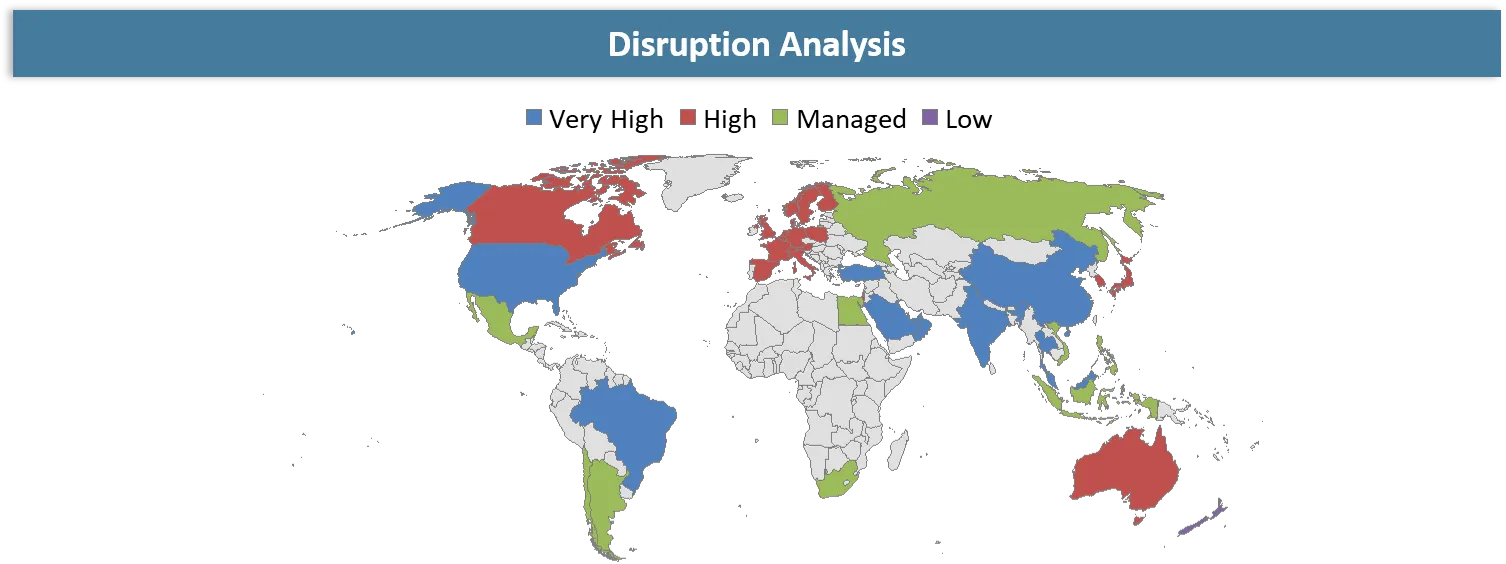
Lower Regulatory Detection Limits Driving a New Generation of Ultra-Trace PFAS Certified Reference Materials
The PFAS CRM (Certified Reference Material) market is reshaping due to the emergence of new regulatory requirements with much lower PFAS detection limits for environmental and water analysis. In 2025, the introduction of strict MCLs (maximum contaminant levels) for PFAS and an increase in the use of methods like U.S. EPA Method 1633. These changes made it necessary for laboratories to have certified reference materials that could enable ppt (parts per trillion) and even sub-ppt level quantitation. In order to achieve this, laboratories are moving to using ultra-pure CRMs instead of traditional calibration standards.
This regulatory change is disrupting the traditional CRM market by adding more technical challenges for the production of CRM. The producers of CRM have been improving their purification techniques, isotopically labeled CRM, and matrix-certified CRM to cater to the changing performance standards of the laboratory. Environmental laboratories are also enhancing their analytical methods in accordance with more stringent requirements for accreditation and regulations, which means that the demand for high-quality PFAS CRM will keep on repeating itself. As the detection limits continue to get lower and more PFAS compounds are added under regulation in 2025-2026, the market for CRM is moving towards precision-certified CRM.
PFAS CRM Market BCG Matrix: Company Evaluation
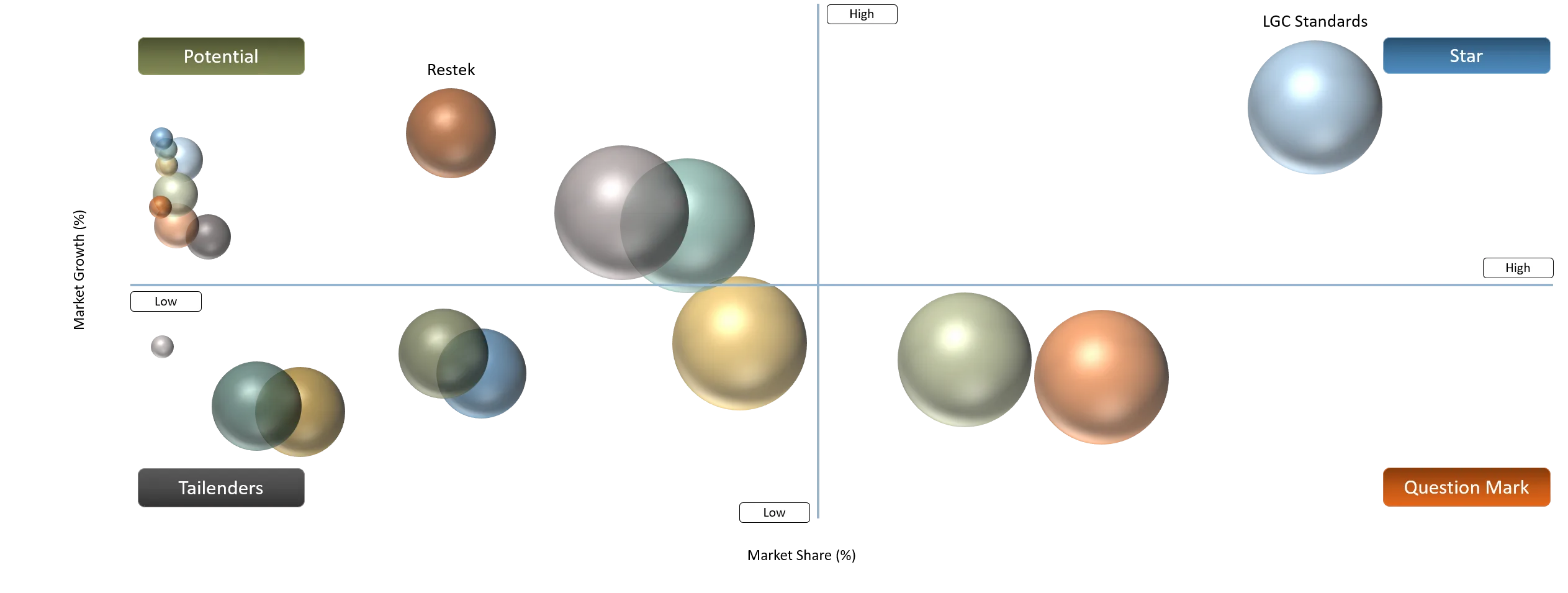
Star companies are LGC Standards, Wellington Laboratories, and Merck because they have the most comprehensive portfolio of PFAS CRMs, robust ISO 17034 accreditation for production, and good global distribution systems. They are considered to be the best suppliers of native PFAS standards, isotopically labelled standards, matrix certified reference materials, and proficiency testing materials. Question mark companies are AccuStandard, Cambridge Isotope Laboratories Inc., Agilent Technologies, Antylia Scientific (Chiron AS and ZeptoMetrix), and FUJIFILM Wako Pure Chemical Corporation. These companies fit this classification since they are making an effort to increase their portfolio of PFAS reference materials.
Potential companies are Restek, CPAchem Ltd., Inorganic Ventures, and Analytika Ltd. They possess expertise in the production of analytical reference material and calibration solutions and are increasingly developing their PFAS CRM portfolio. Tailenders include Labmix24 GmbH and Chiron AS. Although they participate in the PFAS reference materials market, their activities are comparatively focused on specialized product distribution, regional supply, or niche analytical applications.
PFAS CRM Market Dynamics
Driver Impact Analysis
| Driver | Market Growth Impact (%) | Demand Concentration | Impacted Use Case | Strategic Impact |
Growing Adoption of LC-MS/MS and High-Resolution Mass Spectrometry has created strong demand for high-purity certified reference materials.
| 30% | Very High | Environmental testing laboratories, drinking water analysis, wastewater monitoring, food safety laboratories | Accelerates demand for isotopically labeled PFAS standards, ultra-trace calibration solutions, and next-generation CRM portfolios supporting EPA and ISO methods. |
Rising Laboratory Accreditation and Quality Assurance Requirements are accelerating the adoption of certified reference materials for instrument calibration, method validation, measurement uncertainty assessment, and routine quality control. | 22% | High | ISO/IEC 17025-accredited laboratories, regulatory agencies, contract testing laboratories | Strengthens recurring CRM procurement, increases preference for ISO 17034-certified suppliers, and creates long-term customer retention through compliance-driven purchasing. |
Increasing Demand for Isotopically Labeled PFAS Standards to improve analytical accuracy and compensate for matrix effects. | 18% | High | LC-MS/MS laboratories, research institutions, pharmaceutical and environmental laboratories | Expands premium CRM product sales, encourages development of isotope-dilution analytical workflows, and increases supplier differentiation through specialty standards. |
Governments and industries are investing heavily in PFAS contamination assessment and remediation of drinking water, groundwater, industrial sites, airports, and military facilities. | 20% | Medium–High | Environmental remediation projects, municipal water utilities, consulting laboratories | Creates sustained demand for calibration standards and quality control materials throughout long-term monitoring and remediation programs. |
Growth in Matrix-Certified Reference Materials for water, soil, sediments, biosolids, food, and biological samples to validate complete analytical workflows and demonstrate compliance with international quality standards. | 15% | Medium | Multi-matrix environmental laboratories, food testing laboratories, academic research | Promotes expansion of matrix-specific CRM portfolios, supports adoption of EPA Method 1633 and international validation protocols, and increases value-added CRM offerings. |
Growing Adoption of LC-MS/MS and High-Resolution Mass Spectrometry has created strong demand for high-purity certified reference materials
The increasing deployment of LC-MS/MS and HRMS methods for ultra-trace PFAS analysis is one of the key factors boosting the demand for high-purity PFAS Certified Reference Materials (CRMs). As the authorities keep reducing allowable levels and expanding the list of compounds monitored for PFAS, it becomes necessary to have high-quality standards with minimal uncertainty levels and metrological traceability. Thus, in 2025, due to the implementation of EPA method 1633 and the introduction of low parts-per-trillion (ppt) PFAS testing in the U.S., the consumption of isotopically labeled standards and multi-component calibration solutions with LC-MS/MS was significantly increased. EPA Method 1633 requires laboratories to quantify 40 PFAS compounds in wastewater, groundwater, surface water, soil, sediment, biosolids, landfill leachate, and tissue samples using LC-MS/MS, creating recurring demand for certified calibration standards and quality control materials.
For instance, in September 2025, Springer Nature reported the development of BAM-B003, the first Certified Reference Material (CRM) for measuring per- and polyfluoroalkyl substances (PFAS) in textiles. This product was developed according to ISO 17034 and ISO 33405. The CRM offers certified values for 18 PFAS substances that can be used for laboratory method validation, calibration, and quality control.
Restraint Impact Analysis
| Restraint | Drag on Market Growth (%) | Primary Impact Area | Impacted Use Case | Strategic Impact |
The high cost and Complexity of PFAS CRM Development require ultra-high-purity raw materials, extensive homogeneity and stability testing, ISO 17034 certification, and metrological traceability. | 26% | CRM Manufacturing & Product Certification | Development of new PFAS CRMs, calibration standards, and matrix-certified reference materials | Increases R&D and certification costs, extends commercialization timelines, and limits the entry of new CRM manufacturers. |
Limited Availability of High-Purity Native and Isotopically Labeled PFAS Standards creates supply bottlenecks and increases manufacturing costs. | 22% | Raw Material Procurement & Supply Chain | Production of isotopically labeled standards, multi-component CRMs, and custom reference materials | Creates supply constraints, increases lead times and product prices, and limits portfolio expansion for emerging PFAS analytes. |
High Dependence on Specialized Analytical Infrastructure such as LC-MS/MS and HRMS | 18% | Laboratory Infrastructure | Environmental testing laboratories, research institutions, food safety laboratories | Restricts CRM adoption to laboratories with advanced analytical capabilities, reducing penetration in developing markets. |
The limited number of Accredited PFAS CRM manufacturers leads to longer delivery times during periods of high demand. | 16% | Global Supply Capacity | Regulatory testing laboratories, government agencies, contract testing organizations | Concentrates market share among a few suppliers, reduces supply flexibility, and increases procurement risks during regulatory-driven demand surges. |
The high cost and Complexity of PFAS CRM Development require ultra-high-purity raw materials, extensive homogeneity and stability testing, ISO 17034 certification, and metrological traceability
Commercialization of PFAS CRMs is limited due to the high cost and complexity of manufacturing and certification. Commercial manufacturing of PFAS CRMs involves the use of ultra-high purity PFAS compounds, homogeneity and stability testing, SI traceability for value assignment, and adherence to ISO 17034 and ISO Guide 35. The burden has increased considerably since 2025-2026 following the expansion in regulation. As an illustration, U.S. EPA Method 1633 demands that laboratories determine 40 PFAS analytes within 12 different environmental matrices, including wastewater, groundwater, surface water, soil, sediment, biosolids, landfill leachate, fish tissue, plant tissue, and animal tissue. Each analyte specified in the method demands the provision of calibration standards, isotopically labeled internal standards, and quality control materials. The regulatory landscape is becoming increasingly complex. The U.S. EPA National Primary Drinking Water Regulation that was finalized in 2025 set the maximum contaminant level of PFOA and PFOS at 4 ppt while controlling five other PFAS using the Hazard Index approach.
For instance, in April 2025, LCGC International highlighted the growing concerns from PFAS scientists regarding the low availability of high-purity PFAS reference standards required for analysis and method validation. It was pointed out that currently only 6% of about 10,000 PFAS identified by the European Chemicals Agency (ECHA) possess commercially available reference standards, leading scientists to urge manufacturers to ensure greater availability of such reference standards.
PFAS CRM Market Segmentation Analysis
The global PFAS CRM market is segmented based on product type, PFAS chemical class, matrix, regulatory method, analytical technique, end user, and region.
LC-MS/MS Maintains Market Leadership Through Regulatory Standardization and Ultra-Trace PFAS Quantification
The LC-MS/MS (Liquid Chromatography-Tandem Mass Spectrometry) segment is dominating the PFAS Certified Reference Materials (CRMs) Market, with a market share of around 81.5% in the year 2025. This high growth in the segment is due to its superior sensitivity, selectivity, and quantitative Ability to detect PFAS in ultra-trace amounts that are required by environmental regulations and food safety rules. With growing government initiatives related to the PFAS monitoring programs, accredited laboratories need more CRMs compatible with LC-MS/MS technology for calibration and method validation purposes. The market position of LC-MS/MS has gained further strength during 2025–2026, owing to growth in laboratory capacity and enhanced compliance measures. As per the survey conducted by NHANES of the Centers for Disease Control and Prevention (CDC), biomonitoring of PFAS presence has been reported in more than 97% of the population in the United States, which is motivating further investment in high-performance analytics.
In 2025, ECHA advanced its proposal for restricting the use of PFAS, involving more than 10,000 PFAS substances, thus motivating European laboratories to expand their LC-MS/MS testing capability. These factors will fuel further demand for LC-MS/MS compatible native PFAS standards, isotopically labeled CRMs, and matrix certified reference materials.
PFAS CRM Market Geographical Penetration
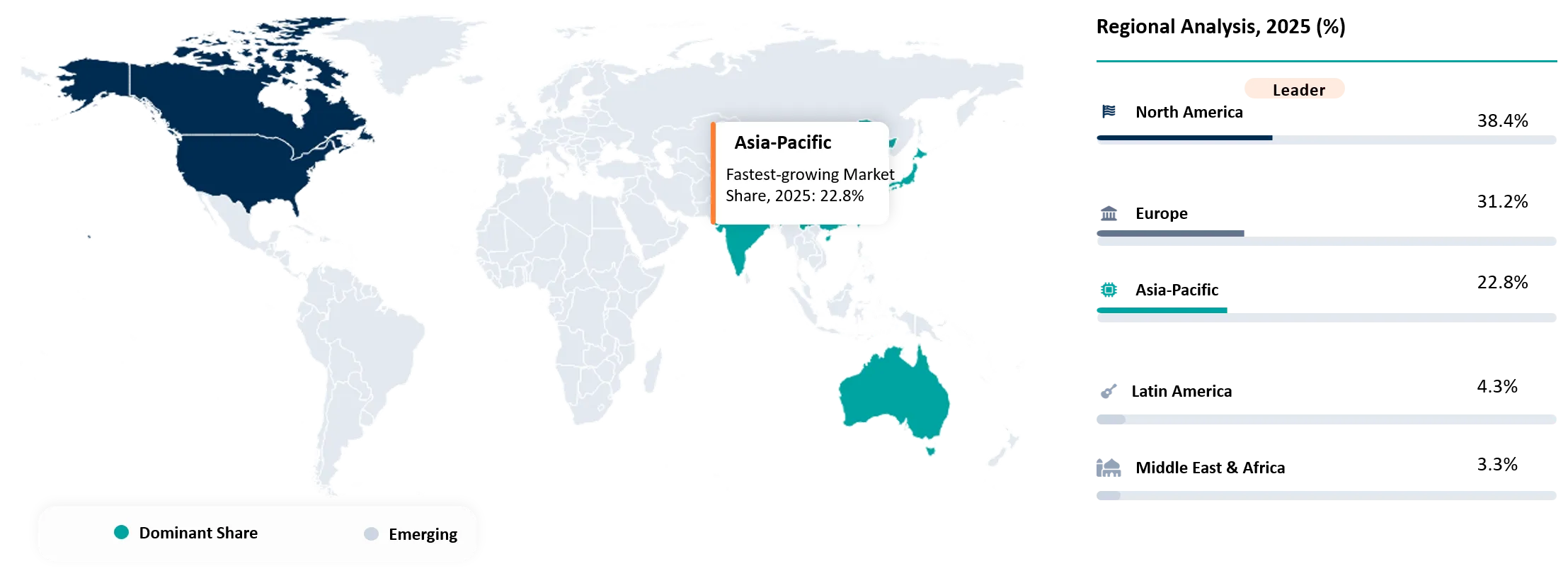
North America Leads the PFAS Certified Reference Materials Market Through Regulatory Leadership and Advanced Laboratory Infrastructure
The North American region is dominating the PFAS CRMs Market, with an approximate market share of 38.4% in 2025. The leading contribution of the region is attributed to the strictness of the PFAS regulatory framework, environmental testing infrastructure, and the existence of major CRM manufacturers, including Wellington Laboratories, AccuStandard, Agilent Technologies, Cambridge Isotope Laboratories, Inorganic Ventures, and SPEX CertiPrep. Implementation of PFAS monitoring programs in the area of drinking water, wastewater, soil, biosolids, food, and industrial products has increased the demand for CRMs that can be used for instrument calibration, method validation, and laboratory quality assurance processes. In May 2025, the US EPA released US$9 billion under the Bipartisan Infrastructure Law towards identifying PFAS and other emerging contaminants in the drinking water system.
For instance, in September 2025, LGC Standards, a private organization in the UK, launched a new portfolio of ISO 17034 requirements of 13C-labelled PFAS that can be used by laboratories in testing PFAS through the use of U.S. EPA Method 1633. In addition to releasing the 24-analyte Extraction Internal Standard (EIS) mixture, the company released 7-analyte Non-Extraction Internal Standard (NIS) mixture and a wide variety of 13C-labelled single compound reference standards.
U.S. PFAS CRM Market Trends
The United States holds the dominant position in the North American PFAS CRMs Market owing to its well-established PFAS regulation policy, advanced environmental analysis facilities, and high presence of international CRM brands, including AccuStandard, Agilent Technologies, Cambridge Isotope Laboratories, Inorganic Ventures, Restek, and SPEX CertiPrep. The United States has developed one of the most sophisticated PFAS analysis environments worldwide, fueled by the wide availability of LC-MS/MS and HRMS instruments in environmental, food safety, pharmaceutical, and government laboratories. Moreover, the Centers for Disease Control and Prevention (CDC) keeps on finding traces of PFAS in more than 97% of the U.S. population.
For instance, in July 2025, Restek Corporation, a U.S.-based, privately held analytical chemistry company, expanded its PFAS by adding two new multicomponent PFAS CRMs—PFAS 3 Standard and PFAS 4 Standard—to its suite of PFAS reference materials.
Canada PFAS CRM Market Outlook
Canada is emerging as one of the fastest-growing countries in the North American PFAS Certified Reference Materials (CRMs) Market owing to increasing PFAS regulations, rising number of environmental monitoring programs, and availability of CRMs suppliers catering to the global analysis requirements. Canada has established a robust PFAS testing ecosystem, which includes regulatory authorities, accredited environmental testing laboratories, and scientific organizations requiring use of certified reference materials for measurement of PFAS chemicals in drinking water, soils, sediments, biological matrices, and industrial wastes. The presence of a top CRM manufacturer, Wellington Laboratories, that is among the world's leading producers of PFAS standards in native form as well as isotopically labeled form, further reinforces the status of Canada in the PFAS CRM supply chain.
For instance, in February 2026, Wellington Laboratories, a Canada -based private reference standards manufacturer, participated in the International Symposium on Plastics and Associated PFAS , where the company presented regarding developments in PFAS analytical testing as well as the significance of isotopically labelled PFAS reference standards and certified reference materials (CRMs).
PFAS CRM Market Competitive Landscape
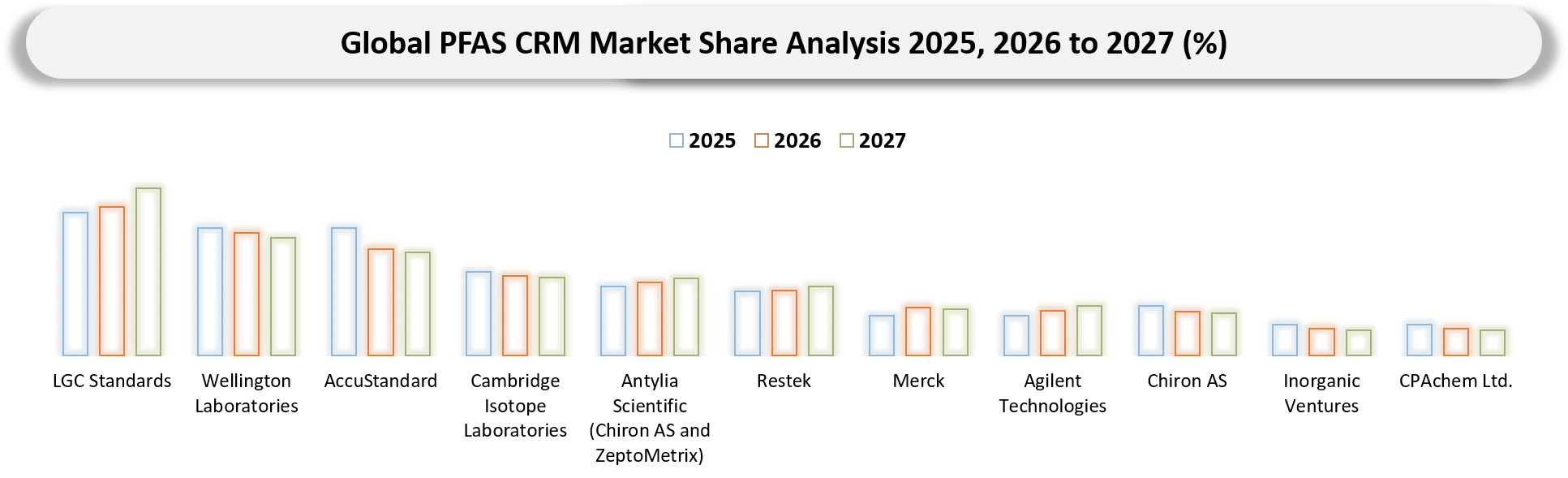
- Three main categories of participants are dominating the PFAS CRMs market – certified reference material manufacturers across the globe, experts in analytical standards development, and providers of integrated laboratory solutions. The leading players of the market include LGC Standards, Wellington Laboratories, AccuStandard, Cambridge Isotope Laboratories (CIL), and Merck (Supelco), providing a comprehensive portfolio of native PFAS standards, isotopically-labeled reference materials, matrix-certified reference materials, and calibration mixtures for analytical methodologies according to EPA, ISO, ASTM, and DIN analytical methods. On the other hand, Antylia Scientific (Chiron AS and ZeptoMetrix), Agilent Technologies, Restek, FUJIFILM Wako Pure Chemical Corporation, and CPAchem Ltd. mainly concentrate on the development of PFAS analytical standards and solutions of laboratory workflows. Inorganic Ventures, Analytika Ltd., and Labmix24 GmbH mainly compete by offering custom-made reference materials and regional distribution. This results in a highly regulated competitive landscape where ISO 17034 accreditation, metrological traceability, analytical purity, and fast growth of PFAS analyte portfolio are critical for the competitiveness of the market players.
- Key players include LGC Standards, Wellington Laboratories, AccuStandard, Cambridge Isotope Laboratories, Antylia Scientific (Chiron AS and ZeptoMetrix), Merck, Agilent Technologies, Restek, Chiron AS, Inorganic Ventures, CPAchem Ltd., FUJIFILM Wako Pure Chemical Corporation, Analytika Ltd., and Labmix24 GmbH.
PFAS CRM Market Key Developments
- May 2025, BAM (Federal Institute for Materials Research and Testing), a German federal research institute, developed BAM-B003, a certified PFAS reference material (CRM) derived from used outdoor clothing. The CRM contains 18 certified PFAS compounds and was developed in accordance with ISO 17034 to support laboratories in validating analytical methods, ensuring measurement traceability, and improving the accuracy of PFAS testing in textile materials.
- November 2025, AccuStandard, a U.S.-based manufacturer of certified reference materials, expanded its PFAS portfolio by introducing new PFAS Certified Reference Materials (CRMs) for environmental testing applications.
- April 2026, Cambridge Isotope Laboratories (CIL), a U.S.-based manufacturer of stable isotope-labelled compounds and analytical reference standards, expanded its PFAS environmental resources by introducing new ultrashort-chain PFAS reference standards, enhanced support for U.S. EPA Method 1633A, and TOP Assay analytical workflows.
- June 2026, Merck KGaA, a Germany-based science and technology company, announced the acquisition of Bio-Techne, a U.S.-based life sciences company, to strengthen its Life Science business by expanding its portfolio of analytical technologies, research reagents, and laboratory solutions.
- September 2025, LGC Standards, a UK-based manufacturer of certified reference materials, expanded its Dr. Ehrenstorfer PFAS portfolio by launching new 13C-labelled PFAS reference materials to support U.S. EPA Method 1633 and Method 1633A.
Key Procurement Priorities and Buyer Evaluation Criteria
- PFAS CRMs are becoming more commonly purchased by organizations because of their ability to supply reference materials that are ISO 17034-certified, SI traceable, highly pure, have low measurement uncertainty, and comply with international analytical techniques like EPA 533, EPA 537.1, EPA 1633, ASTM, and ISO.
- The purchasing of products is now being determined to a great extent by the fast-growing regulatory framework regarding PFAS, the widespread usage of LC-MS/MS and LC-HRMS, and the constant addition of new PFAS analytes. The purchasers prefer suppliers who can quickly produce native PFAS standards, isotopically labeled standards, matrix-certified reference material, and customized calibration solutions.
- Buyers assess their suppliers using the quality of the certificate, metrological traceability, homogeneity and stability performance, the number of analytes covered, lot-to-lot consistency, long-term product availability, and accreditation. The capacity to provide ultra-trace certified reference materials with known uncertainties and full technical documentation has become a vital purchasing parameter for accredited laboratories.
Why Choose DataM?
- Regulatory Intelligence & Compliance Analysis: Tracks evolving PFAS regulations, including EPA, ISO, ASTM, DIN, AOAC, REACH, and national drinking water standards, providing detailed insights into how regulatory changes influence demand for certified reference materials across environmental, food, pharmaceutical, and industrial testing laboratories.
- Product Portfolio & Technology Assessment: Evaluates PFAS CRM offerings across native PFAS standards, stable isotope-labeled standards, matrix-certified reference materials, calibration mixtures, and custom reference solutions, highlighting how manufacturers differentiate through analyte coverage, purity, metrological traceability, and compatibility with LC-MS/MS and LC-HRMS analytical methods.
- Real-World Laboratory Adoption: Analyzes the adoption of PFAS CRMs across environmental monitoring, drinking water testing, wastewater analysis, food safety, biomonitoring, pharmaceutical quality control, and industrial compliance testing, demonstrating how certified reference materials improve analytical accuracy, method validation, laboratory accreditation, and quality assurance.
- Market Updates & Industry Developments: Monitors key developments, including new PFAS CRM launches, expansion of isotopically labeled standards, laboratory accreditation trends, regulatory updates, proficiency testing programs, and strategic collaborations among leading CRM manufacturers to support rapidly evolving PFAS testing requirements.
- Competitive Benchmarking: Provides detailed analysis of leading suppliers, including LGC Standards, Wellington Laboratories, Merck, AccuStandard, Cambridge Isotope Laboratories, Agilent Technologies, Antylia Scientific (Chiron AS), Restek, CPAchem, and FUJIFILM Wako, evaluating competitive positioning based on product breadth, ISO 17034 accreditation, global distribution, technical expertise, and regulatory alignment.
- Pricing & Procurement Intelligence: Explains pricing variations based on PFAS analyte complexity, isotope labeling, matrix certification, purity specifications, uncertainty values, packaging format, and custom CRM development, while evaluating procurement priorities adopted by accredited laboratories, government agencies, and commercial testing organizations.
- Market Entry & Growth Strategy: Identifies growth opportunities driven by expanding PFAS regulations, increasing environmental remediation activities, wider adoption of LC-MS/MS and HRMS platforms, laboratory accreditation requirements, and global PFAS monitoring programs, while outlining strategies such as portfolio expansion, development of emerging PFAS standards, regional distribution partnerships, and investment in ISO 17034-certified manufacturing capabilities to strengthen long-term market presence.
Target Audience
- Certified Reference Material (CRM) Manufacturers
- PFAS Analytical Standards Manufacturers
- Environmental Testing Laboratories
- Commercial Analytical Testing Laboratories
- Government & Regulatory Agencies
- National Metrology Institutes (NMIs)
- Water Utilities & Drinking Water Authorities


























































