


Nuclear Air Filtration Market Size and Overview
The global Nuclear Air Filtration market reached USD 2.78 billion in 2025 and is expected to reach USD 5.07 billion by 2035, growing with a CAGR of 6.2% during the forecast period 2026-2035. The market expansion is supported by increasing nuclear capacity additions, according to International Atomic Energy Agency (IAEA) which stated that the worldwide number of nuclear power plants, in the range of 420 would produce the highest-ever amount of electricity in 2025, while the World Nuclear Association 9WNA) estimates that over 63 reactors were under construction worldwide, boosting the need for filtration and ventilation solutions for nuclear applications. IEA stated that the generation of electricity from nuclear power reached the highest level in 2025, promoting investments in nuclear reactor upgrades, uranium fuel cycle facilities, and nuclear waste treatment facilities where high-efficiency air filtration is obligatory. At the same time, the development of Small Modular Reactors (SMRs) and the construction of uranium conversion, enrichment, and fabrication plants will increase purchases of HEPA filters, adsorbers, and ventilation systems for containment. The leading manufacturers strive to develop high-efficiency filtration technologies able to meet more and more stringent safety requirements; however, long qualification processes, compliance regulations, and high lifecycle cost are among the main obstacles for market players.
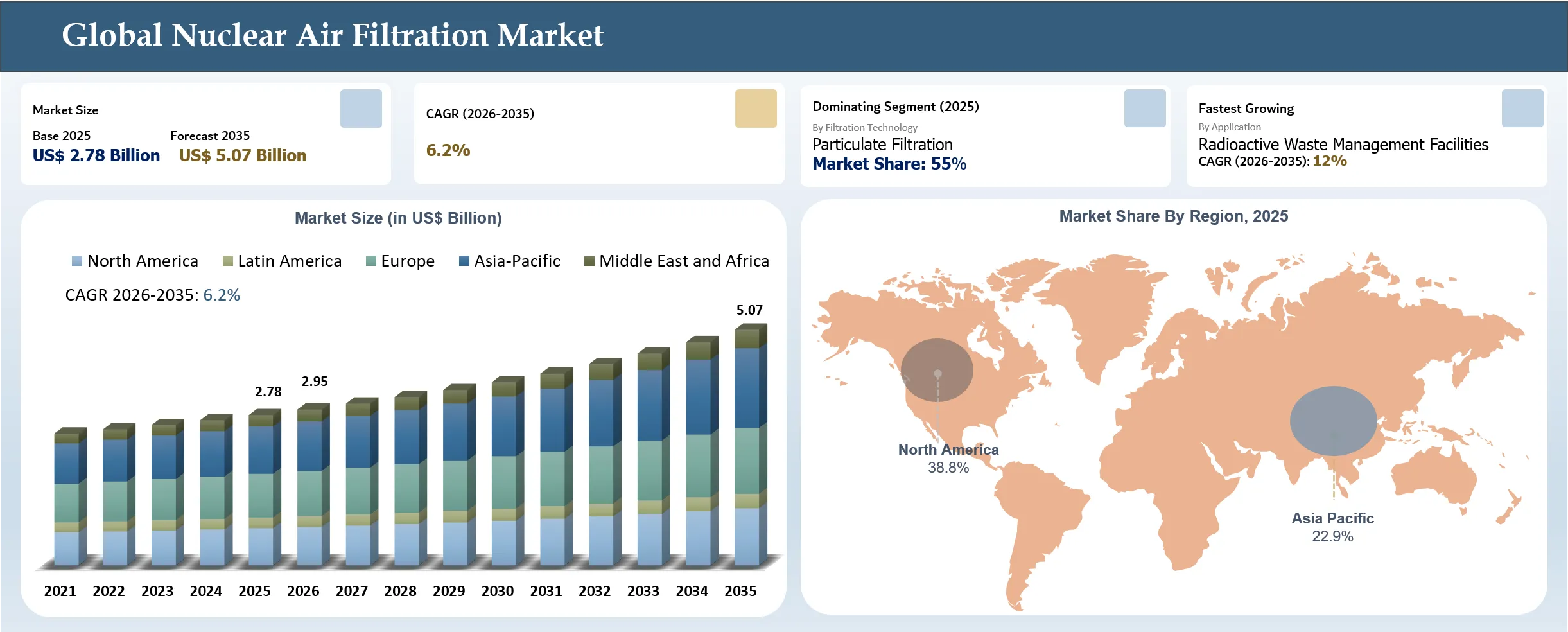
An increase in nuclear generation capacity will result in higher requirements for advanced nuclear air filtration systems, since all the new power units and fuel cycle facilities require certification in the field of containment and ventilation due to the tough nuclear safety standards. In June 2025, as per Newsfile Corp., the article highlights that Camfil is preparing for the quick expansion of the U.S. nuclear power industry through the supply of advanced nuclear-grade air filtration and HVAC equipment to both current and future nuclear plants. The article states that there are more than 200 nuclear energy plants that are either in planning, proposal, or discussion stages within the United States, which means that there is an increased need for HEPA filters, Bag-In/Bag-Out (BIBO) containment systems, and gas-tight filtration units that do not allow the leakage of radioactivity into the air. It is further indicated that the U.S. government expects to triple the production of nuclear energy within the country by 2050, whereas the U.S. Department of Energy registered a 20% rise in nuclear reactor projects in 2023.
White-Space Opportunities Driven by U.S. Nuclear Energy Expansion for the Nuclear Air Filtration Market
In April 2025, Camfil, a Sweden-based manufacturing and engineering company that specializes in premium air filtration solutions and air pollution control systems, highlighted that the resurgence of nuclear energy in the United States is creating significant long-term opportunities for nuclear air filtration, containment ventilation, and nuclear HVAC systems, as every new reactor, fuel-cycle facility, and life-extension project requires certified airborne contamination control infrastructure. The article notes that the U.S. government aims to triple domestic nuclear energy capacity by 2050, while the U.S. Department of Energy reported a 20% increase in planned nuclear reactor projects in 2023, signaling sustained investment across the nuclear sector. These capital-intensive projects create substantial downstream demand for nuclear-grade HEPA filters, HEGA (activated carbon) filters, Bag-In/Bag-Out (BIBO) containment systems, gas-tight filter housings, and confinement ventilation systems, all of which are essential for meeting stringent nuclear safety and regulatory requirements.
The expanding investment landscape is expected to benefit companies across the nuclear air filtration value chain. Camfil is well positioned to supply nuclear-grade HEPA/HEGA filters, CamContain housings, and BIBO systems for reactor operations, maintenance, and decommissioning projects. Other leading filtration manufacturers such as AAF International, MANN+HUMMEL, Parker Hannifin, Donaldson Company, and Freudenberg Filtration Technologies are expected to benefit from growing procurement of high-efficiency air filtration solutions for nuclear facilities. Engineering, procurement, and construction companies including Fluor Corporation, Bechtel, Jacobs, AECOM, and Westinghouse Electric Company are likely to secure opportunities related to nuclear plant construction, ventilation system integration, and facility modernization. In addition, reactor developers such as NuScale Power, GE Hitachi Nuclear Energy, TerraPower, X-energy, and Holtec International are expected to drive demand for advanced nuclear HVAC and air filtration systems as new reactors move from planning to deployment, creating long-term opportunities for suppliers of nuclear air filtration technologies.
Nuclear Air Filtration Market Key Takeaways
- North America led the global market in 2025, holding a dominant 38.8% market share due to widespread reactor refurbishments and safety modernizations.
- The U.S. government aims to triple domestic nuclear capacity by 2050, backed by over 200 nuclear plants in planning stages and a 20% increase in DOE reactor projects.
- The Waste Isolation Pilot Plant’s new ventilation system added 22 HEPA filters, expanding facility airflow from 170,000 cfm to 540,000 cfm.
- Expanding nuclear power projects account for a 30% growth impact on market demand, while stringent regulatory qualifications exert a 12% growth drag.
Nuclear Air Filtration Market Industry Trends and Strategic Insight
- Expansion of nuclear power programs is creating sustained demand for nuclear-grade air filtration systems. The resurgence of reactor construction, life-extension projects, and fuel cycle investments is increasing procurement of HEPA filtration, activated carbon adsorption, and engineered containment ventilation systems across new-build and retrofit nuclear facilities.
- Advanced reactor and Small Modular Reactor (SMR) deployment is shifting product development toward compact, modular air handling systems.
- Integrated particulate and radioactive iodine capture technologies are gaining commercial attention. New nanofiber–activated carbon composite filtration media combine ultra-high particulate removal with enhanced radioactive iodine adsorption, enabling more efficient nuclear air purification while reducing secondary waste generation.
- Lifecycle extension of aging nuclear reactors is generating retrofit opportunities for filtration suppliers. Utilities upgrading ventilation infrastructure to satisfy evolving safety and environmental regulations are replacing legacy air treatment systems with higher-efficiency nuclear-qualified filtration technologies, creating a significant aftermarket revenue stream.
- Localization of nuclear supply chains is strengthening domestic manufacturing of critical filtration components. Governments are prioritizing resilient nuclear infrastructure and domestic sourcing of safety-critical equipment, encouraging regional production of nuclear-grade filters, containment ventilation systems, and air treatment assemblies to reduce dependence on imported components.
Nuclear Air Filtration Market Scope
| Metrics | Details | |
| 2025 Market Size | USD 2.78 Billion | |
| 2035 Projected Market Size | USD 5.07 Billion | |
| CAGR (2026-2035) | 6.2% | |
| Largest Market | North America | |
| Fastest Growing Market | Asia-Pacific | |
| By Product Type | HEPA Filters, ULPA Filters, Activated Carbon Filters, Prefilters, Combination Filtration Systems, Others | |
| By Filtration Technology | Particulate Filtration, Gas & Radioiodine Filtration, Combined Particulate and Gas Filtration, Others | |
| By Application | Nuclear Fuel Fabrication, Nuclear Power Plants, Research Reactors & Laboratories, Radioactive Waste Management Facilities, Nuclear Decommissioning, Nuclear Medicine & Radioisotope Production Facilities, Others | |
| By Region | North America | U.S., Canada, Mexico |
| Europe | Germany, UK, France, Spain, Italy, Poland | |
| Asia-Pacific | China, India, Japan, Australia, South Korea, Indonesia, Malaysia | |
| Latin America | Brazil, Argentina | |
| Middle East and Africa | UAE, Saudi Arabia, South Africa, Israel, Türkiye | |
| Report Insights Covered | Competitive Landscape Analysis, Company Profile Analysis, Market Size, Share, Growth | |
Nuclear Air Filtration Market Disruption Analysis
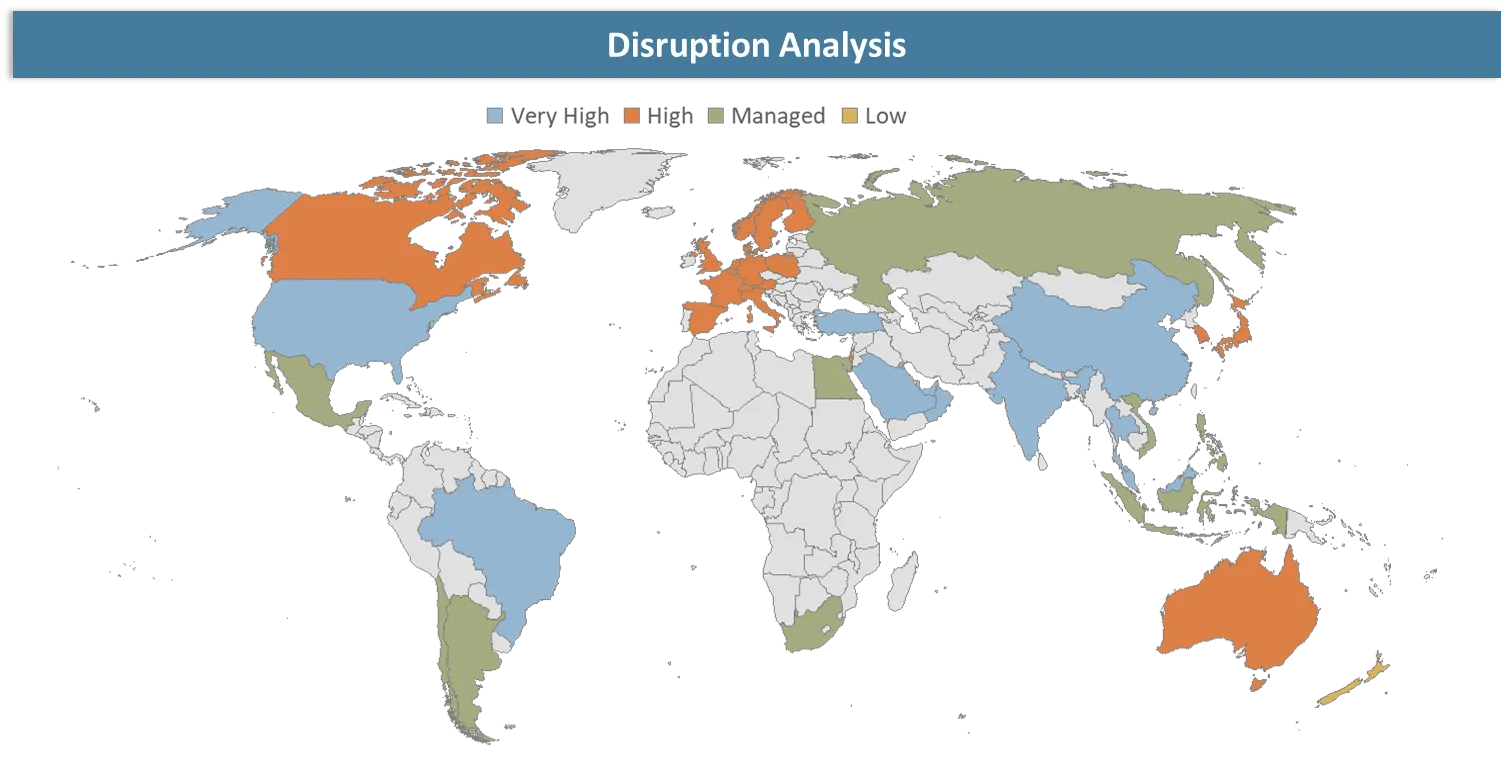
Resurgence of Nuclear Energy and Advanced Reactor Deployment Reshaping Nuclear Air Filtration Requirements
The disruption in the Nuclear Air Filtration Market is primarily driven by the transition of nuclear facility infrastructure through the use of advanced reactors, the fuel cycle of which is being expanded, and the upgrading of current facilities. The growing utilization of Small Modular Reactors (SMRs), micro-reactors, and the fourth generation of nuclear reactors is changing the trend to demand small, modular, and efficient air filtration systems that would provide radiological containment through advanced safety regulations. Such innovative nuclear facilities would have higher demands for airborne contaminant control through the filtration of radioactive particles and iodine adsorption and digital ventilation system monitoring.
This market shift is further supported by significant nuclear investments during 2025-2026, the U.S. Department of Energy (DOE) announced a USD 900 million funding opportunity program for promoting the commercialization of small modular reactors (SMR) that were designed and manufactured in America, which will lead to the development of advanced nuclear infrastructure and will increase the demand for nuclear safety systems, including nuclear grade air filtration and containment ventilation technologies. Also, the DOE advanced reactor program and the funding of the next generation of nuclear reactors will be driving the demand for nuclear-grade HEPA filters, activated carbon filters, and advanced containment ventilation solutions. At the same time, existing nuclear power plants are being updated with advanced multi-stage air filtration and monitoring technologies in order to ensure improved contamination management, extend the life cycle of their equipment, and meet the new safety regulations.
Nuclear Air Filtration Market BCG Matrix: Company Evaluation
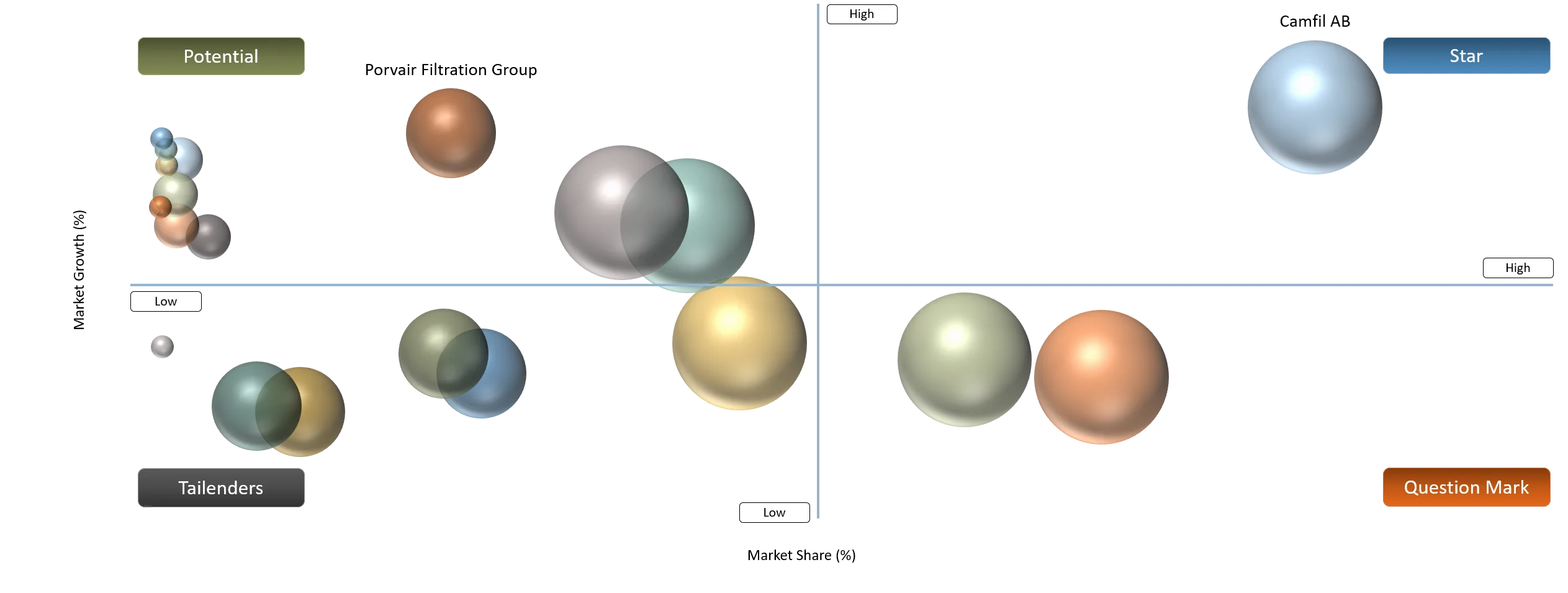
Stars include Camfil AB and AAF International because they hold strong positions in nuclear-grade air filtration through extensive product portfolios covering HEPA filters, activated carbon filtration systems, iodine adsorbers, and containment ventilation solutions. These companies have established relationships with nuclear utilities, fuel cycle facilities, and government nuclear organizations, enabling them to benefit from rising investments in reactor modernization, SMR deployment, and radioactive contamination control infrastructure. Question Marks include Pall Corporation, Filtration Group Corporation, and Parker Hannifin Corporation, as these companies possess advanced filtration expertise and broad industrial filtration capabilities but face increasing competition from specialized nuclear filtration providers.
Potential includes Porvair Filtration Group, MANN+HUMMEL, and Nippon Muki Co., Ltd., which benefit from strong filtration technology capabilities and expertise in high-purity air filtration applications. These companies have opportunities to capture growth from increasing demand for advanced reactors, research facilities, semiconductor-nuclear crossover clean environments, and specialized contamination control systems. Tailenders include Lydall, as its involvement in the nuclear air filtration market is primarily focused on specialty filtration materials and high-performance media rather than complete nuclear air filtration systems.
Nuclear Air Filtration Market Dynamics
Driver Impact Analysis
| Driver | Market Growth Impact (%) | Demand Concentration | Impacted Use Case | Strategic Impact |
Expansion of nuclear power generation and advanced reactor projects is increasing demand for nuclear-grade HEPA filter solutions across new and existing facilities. | 30% | North America, Asia-Pacific, and Europe due to reactor construction, lifetime extension programs, and nuclear infrastructure upgrades. | Nuclear power plants, advanced reactors, uranium fuel cycle facilities, radioactive waste management sites. | Increases demand for certified nuclear-grade HEPA filters, activated carbon systems, and containment ventilation solutions; encourages manufacturers to expand nuclear-qualified product portfolios. |
Rising deployment of Small Modular Reactors (SMRs) and Generation IV reactors is driving the adoption of compact, high-efficiency filtration systems. | 25% | North America and Asia-Pacific, supported by advanced reactor development programs and commercialization initiatives. | SMRs, microreactors, research reactors, next-generation nuclear demonstration facilities. | Accelerates development of modular filtration units, integrated ventilation systems, and digitally monitored air-cleaning technologies designed for advanced reactor architectures. |
Modernization of aging nuclear infrastructure is accelerating the replacement of legacy ventilation systems with upgraded radioactive particulate and iodine filtration technologies. | 22% | North America and Europe, where a large installed base of operating reactors requires refurbishment and safety upgrades. | Existing nuclear power plants, decommissioning projects, radioactive waste treatment facilities. | Creates a strong retrofit and replacement market for HEPA filters, iodine adsorbers, and multi-stage filtration systems while extending supplier lifecycle service opportunities. |
Government support for nuclear energy expansion and domestic nuclear supply chain development is creating new opportunities for nuclear filtration equipment manufacturers. | 20% | United States, European Union, China, India, and other countries strengthening nuclear energy independence. | Uranium enrichment facilities, nuclear fuel fabrication plants, reactor construction projects, national nuclear laboratories. | Improves market opportunities for local manufacturing of nuclear-qualified filtration components and reduces dependence on imported safety-critical filtration technologies. |
Adoption of digital monitoring and predictive maintenance technologies is driving demand for intelligent filtration systems with real-time performance tracking and optimized replacement cycles. | 15% | Developed nuclear markets including North America, Europe, Japan, and South Korea. | Nuclear ventilation systems, containment exhaust systems, reactor auxiliary systems, controlled nuclear environments. | Shifts the market from traditional filter replacement cycles toward condition-based maintenance, enabling suppliers to integrate sensors, monitoring platforms, and lifecycle management services. |
Expansion of nuclear power generation and advanced reactor projects is increasing demand for nuclear-grade HEPA filter solutions across new and existing facilities
The expansion of nuclear power generation and advancements in reactors have become a major factor that is fueling the requirement for nuclear-grade air filtration systems such as HEPA filters, carbon-based filtration systems, and containment ventilation systems. The nuclear industry globally is witnessing an emerging cycle of investments due to life extension, new-build reactors, and advanced reactors that have higher requirements for air contamination control. In 2025, the IEA announced that nuclear energy production would witness its peak level due to enhanced reactor availability and capacity addition.
The installation of the WIPP Safety Significant Confinement Ventilation System is a testament to the increased significance of state-of-the-art nuclear air filtration systems in ensuring safety standards at current nuclear sites. In March 2025, according to the U.S. Department of Energy (DOE) Office of Environmental Management, the Waste Isolation Pilot Plant (WIPP) achieved a major milestone with the successful completion of the commissioning of its Safety Significant Confinement Ventilation System (SSCVS), which is a new advanced system of large-scale ventilation designed to enhance radioactive contamination control at the underground nuclear waste repository located in Carlsbad, New Mexico. The Safety Significant Confinement Ventilation System is equipped with 22 HEPA filters that filter out exhaust air prior to its release into the environment. In addition, this advanced ventilation system is meant to increase airflow from 170,000 cfm (cubic feet per minute) to 540,000 cfm, which will ensure enhanced safety of workers and long-term operation of nuclear waste management operations.
Restraint Impact Analysis
| Restraint | Drag on Market Growth (%) | Primary Impact Area | Impacted Use Case | Strategic Impact |
High qualification requirements and stringent regulatory approvals for nuclear-grade filtration systems increase product development complexity and extend commercialization timelines. | 12% | Product certification, regulatory compliance, and technology commercialization | Nuclear power plants, radioactive waste facilities, research reactors, and nuclear fuel-cycle facilities requiring qualified HEPA/ULPA and iodine filtration systems | Delays product deployment cycles, increases R&D and testing costs, and strengthens the position of established suppliers with certified nuclear filtration capabilities. |
Complex decommissioning procedures and strict handling requirements for radioactive-contaminated filters increase operational costs and waste management challenges. | 10% | Filter disposal, maintenance operations, and radioactive waste handling | Nuclear reactor decommissioning, spent filter replacement, and radioactive contamination control systems | Raises lifecycle costs for filtration systems and encourages development of reusable, easily disposable, and advanced waste-minimization filtration technologies. |
Limited availability of nuclear-qualified filtration components and specialized manufacturing capabilities creates supply chain constraints for critical filtration systems. | 11% | Supply chain reliability and component manufacturing | Nuclear-grade HEPA filters, activated carbon iodine filters, and customized ventilation filtration assemblies | Increases procurement lead times, creates dependency on specialized suppliers, and limits rapid scaling of nuclear air filtration production capacity. |
High dependence on nuclear industry expansion cycles makes the market vulnerable to delays in reactor construction and nuclear infrastructure projects. | 9% | Market demand growth and project deployment timelines | New nuclear power plants, small modular reactors (SMRs), and nuclear facility upgrades | Slows revenue growth during periods of delayed nuclear investments and pushes suppliers to focus on retrofit, maintenance, and existing reactor filtration markets. |
High qualification requirements and stringent regulatory approvals for nuclear-grade filtration systems increase product development complexity and extend commercialization timelines
One of the key limitations that hinder fast deployment of nuclear air filtration systems is the high level of qualification required as well as the rigorous regulatory approval process of nuclear filtration equipment. While traditional industrial air filtration systems do not require any particular qualifications or approvals, nuclear air filtration systems such as HEPA filters, ULPA filters, and iodine adsorption systems should meet nuclear safety criteria such as performance testing in case of radioactive contamination, pressure differentials, filtration efficiency, etc. In 2025, regulatory agencies and nuclear operators focused on improving confinement ventilation and contamination control, thus making life harder for filtration providers for nuclear applications.
The NRC regulation requirement is stringent and complicates the compliance issue for manufacturers of nuclear equipment, as it calls for elaborate qualifications, documentation, and validation procedures before deployment. In June 2025, U.S. Nuclear Regulatory Commission (NRC) regulation (ML25184A128) clearly indicates that any nuclear installations and safety systems are subjected to tough regulatory scrutiny, which entails the need to comply with a licensing process and thorough quality assurance, verification, and safety assessment procedures before their use. NRC regulation stresses the necessity for stringent scrutiny of nuclear systems in order to assure that safety criteria are met by the system, thereby making the certification process more challenging for producers of nuclear safety systems.
Nuclear Air Filtration Market Segment Analysis
The global nuclear air filtration market is segmented based on product type, filtration technology, application, and region.
Particulate Filtration Dominating Nuclear Air Filtration Demand Due to Stringent Radiation Safety and Contamination Control Requirements
The particulate filtration segment dominates the nuclear air filtration market by filtration technology, representing 55% market share in 2025, due to the mandatory need to filter out radioactive particles, aerosols, and airborne contaminants at nuclear facilities. There is heavy dependence on particulate filtration technology, especially HEPA filtration technology, at nuclear power plants, fuel fabrication facilities, research reactors, radioactive waste handling facilities, and nuclear medicine centers.
Leading nuclear filtration manufacturers, including Camfil, AAF International, and Pall Corporation, have been working on high-efficiency particulate filters that offer superior particle removal capabilities, extended service life, and greater resistance to radiation for nuclear operations. Furthermore, growing capital investments in SMRs, advanced reactors, and fuel cycle facilities over 2025-2026 are generating further demand for particulate filtration systems due to their importance in maintaining a contamination-free environment. Thus, the presence of stringent nuclear safety norms, growth in the nuclear industry, and the requirement for effective radioactive particle removal keep particulate filtration systems as the major contributor of revenues for nuclear air filtration systems.
Nuclear Air Filtration Market Geographical Penetration
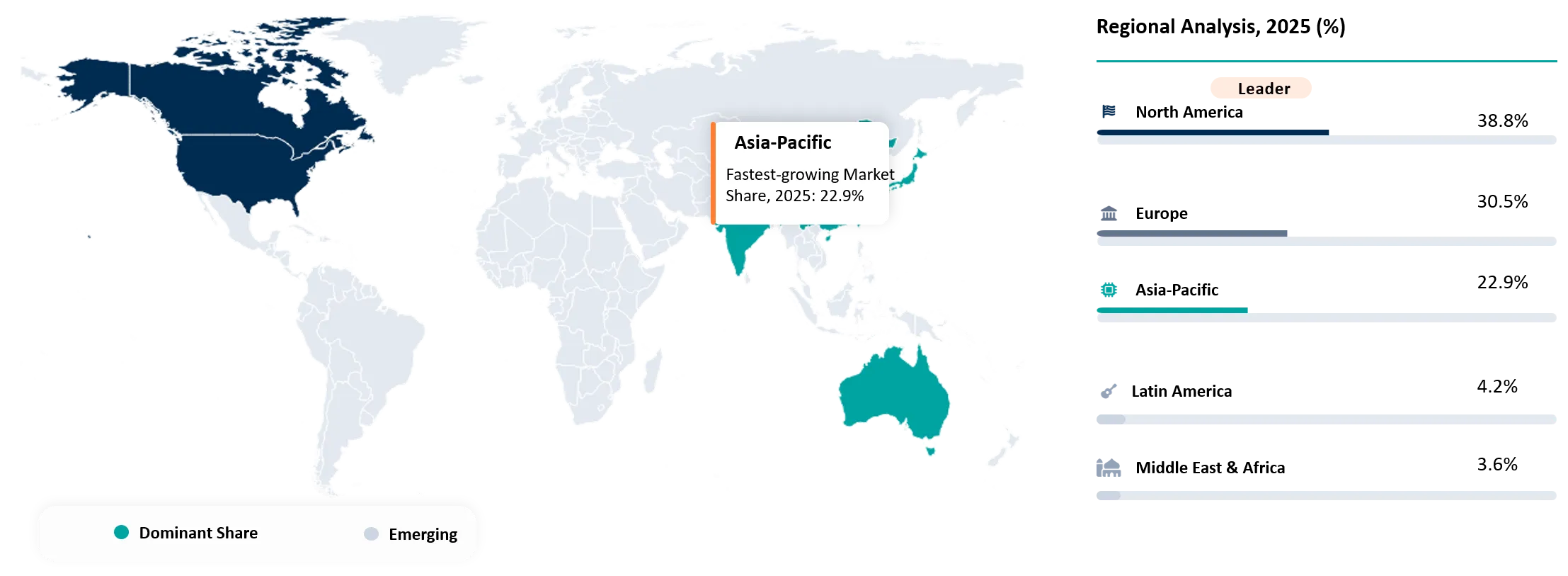
Nuclear Safety Modernization and Reactor Expansion Driving North America’s Dominance in Nuclear Air Filtration Market
The North American region holds a dominant position in the nuclear air filtration market, with a 38.8% market share in 2025, thanks to the large number of nuclear power facilities operating in the region, strict regulations on radioactive contamination control, and modernization projects in nuclear facilities. The high interest of the region in prolonging the life of reactors, developing new-generation reactors, and improving safety systems has contributed to the rapid deployment of dedicated air filtration systems.
The recent expansion in the area of nuclear filtration technology by Camfil USA indicates that there is a growing need for high-end HEPA filtration and engineered ventilation technology in nuclear and critical infrastructure facilities of North America. In March 2026, Camfil USA, the American subsidiary of Camfil, an air filter production company based in Sweden, published a video demonstrating their specially designed air filters for critical applications like nuclear containment facilities. Camfil proudly announced that they managed to deliver over 2 dozen specially designed containment housings, industrial fans, and AG-1 certified HEPA filters for a major critical facility project in less than one year. Camfil has 29 manufacturing plants, 6 R&D centers, and sales offices in over 35 countries with 5,700 employees worldwide, making their presence stronger in the nuclear air filters market in North America.
U.S. Nuclear Air Filtration Market Trends
The U.S. holds a dominant position in the North American nuclear air filtration market, due to its large fleet of nuclear power plants, strong infrastructure for nuclear safety, high standards of regulations, and continued efforts toward modernizing reactors and next-generation nuclear power. The fact that one of the largest commercial fleets of nuclear reactors is present in the USA, along with nuclear fuel cycle plants, research facilities, and facilities for radioactive waste management, gives rise to constant demand for specialized filtration products like nuclear HEPA filters and gas filtration equipment.
The emergence of Natrium® reactor technology at TerraPower showcases the growing commitment toward building the next generation of nuclear power plants within the United States, leading to a forecasted increase in demand for nuclear safety equipment, such as ventilation and nuclear-grade air filters. In February 2025, TerraPower LLC, a U.S.-based advanced nuclear reactor developer company, announced vendor agreements for its reactor program named Natrium®, achieving a major milestone in the process of purchasing for an advanced nuclear plant that will be built in Wyoming State. The company has granted vendor agreements to several contractors to aid the production and construction readiness of the reactor, thus developing the nuclear supply chain in the country for advanced reactors. Natrium® is a 345 MWe advanced sodium-cooled fast reactor with energy storage ability.
Canada Nuclear Air Filtration Market Outlook
Canada is emerging as the fastest-growing country in the North American nuclear air filter market, due to its nuclear infrastructure, reactor refurbishment projects, and emphasis on developing SMRs. The nation's nuclear industry uses efficient air filtration techniques such as HEPA particulate filters, activated carbon filtration system, and combined filtration system for maintaining radiation protection standards in nuclear power plants, research centers, and radioactive waste handling facilities.
The long-term SMR engineering contract clearly demonstrates increased interest in nuclear infrastructure development in North America and the consequent need for nuclear safety systems, such as containment ventilation and nuclear air filtration systems. In May 2026, TkinsRéalis Group Inc., a Canada-based engineering services provider and nuclear technology firm, signed a 20-year Strategic Alliance Agreement with First American Nuclear (FANCO), an advanced nuclear reactor development firm based in the U.S., in order to provide EPCM services for the EAGL-1 SMR projects in North America exclusively. This agreement involves services worth up to USD 250 million in the first five years and includes reactor design engineering, engineering processes, quality programs, conceptual balance-of-plant systems design, and nuclear steam supply systems review.
Nuclear Air Filtration Market Competitive Landscape
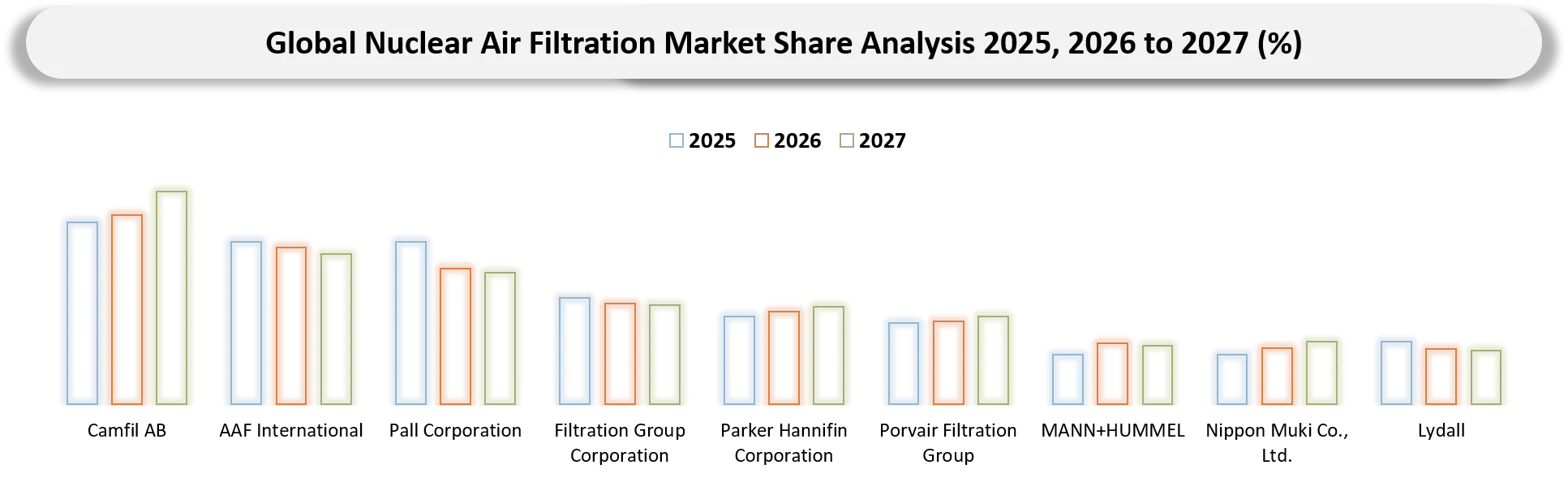
- The nuclear air filtration market is characterized by three key participant groups: specialized nuclear filtration providers, diversified filtration technology companies, and industrial air-quality solution manufacturers. Leading companies such as Camfil AB, AAF International, Pall Corporation, Filtration Group Corporation, Parker Hannifin Corporation, Porvair Filtration Group, MANN+HUMMEL, Nippon Muki Co., Ltd., and Lydall compete through advanced HEPA filtration systems, activated carbon filtration technologies, containment ventilation solutions, and radiation-resistant air filtration products for nuclear power plants, research reactors, nuclear fuel facilities, radioactive waste management sites, and nuclear medicine applications. The market is highly compliance-driven, where nuclear certifications, filtration efficiency, long-term reliability, and experience in safety-critical environments determine competitive positioning. Camfil AB and AAF International maintain strong positions in nuclear-grade HEPA filtration, while Pall Corporation, Parker Hannifin Corporation, and Porvair Filtration Group leverage advanced filtration engineering capabilities for highly controlled nuclear environments.
- Key players include Camfil AB, AAF International, Pall Corporation, Filtration Group Corporation, Parker Hannifin Corporation, Porvair Filtration Group, MANN+HUMMEL, Nippon Muki Co., Ltd., and Lydall.
Nuclear Air Filtration Market Recent Developments
- June 2026 – Nuclear decommissioning drives demand for advanced air filtration systems
Nuclear decommissioning projects are increasingly adopting portable HEPA and iodine filtration systems to control radioactive particulates and airborne contaminants during DECON, SAFSTOR and dismantling activities. New solutions are emphasizing high-efficiency filtration, carbon adsorption and compliance with nuclear safety requirements. - May 2026 – DOE updates guidance for nuclear air-cleaning systems
The U.S. Department of Energy continued publishing and updating technical guidance covering nuclear air-cleaning systems, including filter housing integrity, in-place testing, pressure boundaries, quality assurance and safe filter replacement. The guidance reinforces the need for specialized filtration systems engineered for nuclear facilities. - April 2026 – Nuclear facilities strengthen fire protection for HEPA filtration systems
Updated DOE fire-protection guidance highlights redundant HEPA filtration trains and ventilation configurations that maintain confinement performance during maintenance or potential loss of a filter assembly. This is supporting demand for reliable, redundant nuclear air-cleaning infrastructure. - February 2026 – Camfil advances air filtration solutions for nuclear decommissioning
Camfil highlighted the deployment of industrial air cleaners combining pre-filtration and HEPA filtration to control hazardous dust and airborne particulates during nuclear facility demolition and reactor decommissioning activities. The systems are designed to maintain negative pressure and protect workers during challenging dismantling operations. - January 2026 – AAF expands nuclear-grade filtration solutions
AAF continued strengthening its nuclear air-filtration portfolio with nuclear-grade HEPA filters, pre-filters, carbon adsorbers, BIBO housings, filter walls and air-cleaning systems for reactor, turbine and auxiliary buildings. The solutions target high-reliability applications requiring stringent nuclear quality and safety standards. - October 2025 – Advanced nanofiber-activated carbon composites improve nuclear air purification
Researchers reported a multifunctional nanofiber-activated carbon composite capable of simultaneously capturing fine particulate matter and radioactive iodine. The technology achieved 99.98% PM₀.₃ filtration while providing high iodine-capture capacity, highlighting the potential for lower-resistance, multifunctional nuclear air-cleaning systems. - 2025–2026 – High-performance nuclear HEPA filters target longer service life
Nuclear filtration manufacturers are advancing HEPA designs with higher media area, greater airflow capacity and lower pressure resistance. AAF's latest nuclear-grade HEPA technology, for example, is designed for 99.99% efficiency at 0.3 microns, with versions capable of continuous operation at elevated temperatures and resistance to irradiation. - 2025–2026 – Nuclear filtration systems increasingly integrate multi-stage protection
Modern nuclear air-cleaning systems are combining moisture separators, pre-filters, HEPA filters, carbon adsorbers, fans and dampers to address both particulate and gaseous radioactive contaminants. This integrated approach is becoming important across reactor buildings, auxiliary facilities and radioactive-waste handling areas.
Key Procurement Priorities and Buyer Evaluation Criteria
- Suppliers chosen by buyers from the Nuclear Air Filtration Market are the ones that have the capacity to deliver efficient filtration systems with nuclear-grade standards to ensure effective elimination of radioactive particles, aerosols, and contaminants. Buyers tend to prefer filtration companies that manufacture high-efficiency particulate air (HEPA) filters, activated carbon systems, containment ventilation, and radiation-resistant filtration technology.
- The procurement decision-making process is now becoming more impacted by the increasing emphasis placed on the life extension of nuclear reactors, the implementation of advanced reactors, the development of small modular reactors (SMRs), and the upgrade of current ventilation and safety systems in 2025-2026. The evaluation criteria of suppliers by nuclear operators and facility owners depend on their capacity for meeting contamination control requirements.
- Some of the factors that are considered by buyers include effectiveness of the filtration process, effectiveness in removing particles, resistance to radiation, pressure characteristics, longevity of filters, reliability of the company, and whether or not the filters meet all the nuclear safety standards. The ability to provide certified nuclear HEPA filters, activated carbon adsorption systems, and custom-made air handling systems for containment areas and radioactive waste storage areas is essential in the procurement process.
Why Choose DataM?
- Technological Innovations: Explores advancements in nuclear air filtration technologies, including high-efficiency particulate air (HEPA) filtration, activated carbon filtration, radiation-resistant filter materials, and advanced containment ventilation systems, enabling improved radioactive particle removal, enhanced safety performance, and reliable operation across nuclear power plants, research facilities, and radioactive waste management sites.
- Product Performance & Market Positioning: Evaluates how leading filtration providers differentiate their solutions based on filtration efficiency, particle capture capability, pressure drop optimization, radiation tolerance, filter lifespan, regulatory compliance, and operational reliability, highlighting competitive advantages among companies offering nuclear-grade filtration systems for critical environments.
- Real-World Evidence: Highlights adoption of nuclear air filtration solutions across commercial nuclear reactors, nuclear fuel-cycle facilities, research reactors, medical isotope production units, and radioactive material handling facilities, demonstrating benefits such as improved contamination control, enhanced worker safety, regulatory compliance, and reduced operational risks.
- Market Updates & Industry Changes: Tracks key developments such as nuclear reactor modernization programs, small modular reactor (SMR) deployments, facility safety upgrades, advanced filtration system installations, and government investments in nuclear energy infrastructure during 2025–2026, supporting the transition toward more reliable and efficient nuclear air management systems.
- Competitive Strategies: Analyzes how leading companies expand through filtration technology innovation, nuclear certification capabilities, strategic partnerships, customized engineering solutions, and expansion of global service networks to address increasing demand for safety-critical air filtration systems across the nuclear industry.
- Pricing & Market Access: Explains pricing variations based on filter grade, filtration technology, customization requirements, certification standards, system capacity, and maintenance contracts, along with access through nuclear equipment suppliers, engineering contractors, facility operators, and specialized filtration manufacturers supporting global nuclear infrastructure.
- Market Entry & Expansion: Identifies growth opportunities driven by reactor lifetime extensions, advanced reactor development, SMR commercialization, nuclear power capacity additions, and stricter contamination control requirements, while outlining strategies such as regional manufacturing expansion, regulatory approvals, technology differentiation, and partnerships with nuclear operators to strengthen global market presence.
Target Audience
- Nuclear Power Plant Operators and Utilities
- Nuclear Reactor Developers and Engineering Companies
- Nuclear Filtration System Manufacturers and Technology Providers
- Nuclear Fuel Cycle and Radioactive Waste Management Organizations
- Government Agencies and Nuclear Regulatory Bodies
- Nuclear Research Institutions and Laboratories
- Engineering, Procurement, and Construction (EPC) Contractors



























































