


LEO Satellite Market Size and Overview
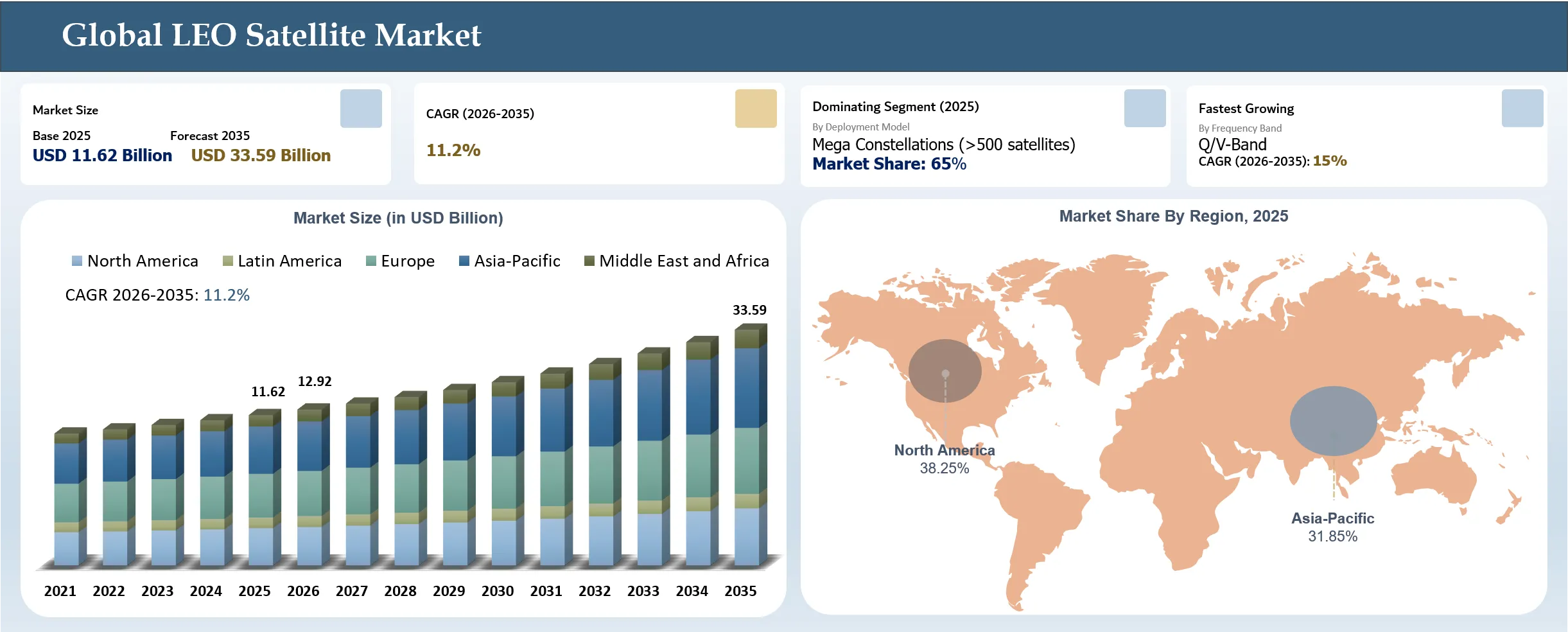
The global LEO satellite market reached USD 11.62 billion in 2025 and is expected to reach USD 33.59 billion by 2035, growing with a CAGR of 11.2% during the forecast period 2026-2035. The market is seeing sustained expansion as satellite operators accelerate LEO satellite deployment to provide low-latency broadband services, device-to-device connectivity, and high-throughput communications in underserved and mobile markets. In April 2026, the high rate of deployment is evident in ISRO, which noted that 4,198 operational satellites were launched into space in 2025, while 9,396 of the 10,749 total Starlink satellites launched remained in orbit at year-end.
LEO connectivity is also becoming commercialized through fast constellation development and launches. In July 2025, Starlink added more than 2,300 satellites via over 100 launches as well as entered 42 new countries and regions. It will further increase the demand for LEO satellites within the context of broadband connectivity, mobile connectivity, enterprise communications, aviation, maritime, defense, and remote-area connectivity, although orbital congestion, spectrum coordination, constellation development expenses, and space debris will be critical barriers to market development.
White-Space Opportunities for European LEO Satellite Infrastructure and Sovereign Satellite Communications
In September 2026, European space programs are directing their largest identified investment toward LEO satellite communications and sovereign satellite infrastructure, led by the European Union’s IRIS² constellation, whose overall contract is expected to exceed €3 billion (USD 3.46 billion). Within this program, €500 million (USD 577 million) has been committed to Thales Alenia Space for government payloads serving 330 LEO satellites, while Airbus is responsible for the constellation’s first layer of at least 66 satellites.
Beyond satellite manufacturing and payloads, investment is expanding into secure government communications, constellation interoperability, satellite ground infrastructure, launch services, space autonomy, and military satellite networks. The European Space Agency has additionally proposed €1 billion (USD 1.15 billion) annually for 10 years, totaling €10 billion (USD 11.54 billion) from 2029, to strengthen Europe’s independent space capabilities, including the ability to launch European astronauts without relying on U.S. spacecraft.
Other LEO-related investment announced around the same Paris space summit includes €1 billion (USD 1.15 billion) from Eutelsat for 229 additional Airbus-built LEO satellites for the OneWeb network, while Amazon committed to six additional Ariane 6 launches, bringing its total commissioned Ariane launches to 24 through 2031 for its LEO satellite program.
The investment is expected to create significant opportunities across the LEO satellite value chain. Thales Alenia Space, a joint venture between Thales and Leonardo, benefits by supplying secure government payloads for IRIS² LEO satellites, while Airbus benefits through satellite platforms, spacecraft manufacturing and integration for the IRIS² constellation and additional OneWeb satellites for Eutelsat. Eutelsat benefits as the satellite operator involved in the LEO segment of IRIS² and through the continued expansion of its OneWeb constellation.
In satellite operations and constellation management, SES and Hispasat can benefit through their participation in the SpaceRISE consortium, while OHB can benefit from satellite platform development and spacecraft manufacturing. In ground-segment infrastructure, Telespazio, Thales SIX and Indra can benefit from satellite-ground integration, mission-control systems, secure communications infrastructure and network management.
In telecommunications and connectivity integration, Deutsche Telekom and Orange can benefit from integrating satellite connectivity with terrestrial telecom networks and extending broadband coverage to underserved and strategic locations. In defense and government communications, Hisdesat and Thales can benefit from increasing requirements for secure governmental and military connectivity, while Arianespace can benefit from additional European launch demand supporting LEO constellation deployment.
LEO Satellite Market Key Takeaways
- North America led the global market in 2025, accounting for a 38.25% revenue share. Meanwhile, the Asia-Pacific region recorded the second-largest share at 31.85%.
- Mega constellations consisting of more than 500 satellites dominated the deployment model segment in 2025. This segment commanded a 65% share of the overall global market.
- Viasat and Space42 established Equatys with an initial joint equity contribution of USD 800 million split equally at USD 400 million each. An additional USD 200 million planned by Space42 brings total potential investment to USD 1 billion.
- The European Space Agency proposed allocating €1 billion (USD 1.15 billion) annually over 10 years, starting in 2029. This initiative totals €10 billion (USD 11.54 billion) aimed at strengthening independent space capabilities.
- The EU’s IRIS² program committed €500 million (USD 577 million) to Thales Alenia Space for government payloads across 330 LEO satellites. Additionally, Airbus was appointed to build the initial layer consisting of at least 66 satellites.
LEO Satellite Market Industry Trends and Strategic Insight
- Direct-to-device connectivity is becoming a core LEO satellite growth model, with operators moving beyond fixed broadband toward satellite-to-smartphone messaging, voice, emergency services, and data connectivity.
- LEO networks are increasingly converging with 5G non-terrestrial networks (NTN), creating interoperability between satellites, mobile networks, connected devices, and terrestrial infrastructure rather than operating as standalone satellite systems.
- Standardized NTN architectures are gaining strategic importance, as operators seek network roaming, device compatibility, and economies of scale instead of relying exclusively on proprietary satellite communication ecosystems.
- LEO satellite services are expanding from connectivity toward data-centric applications, particularly Earth observation, geospatial intelligence, defense, industrial monitoring, and analytics, increasing the value of the data layer alongside satellite infrastructure.
- Satellite semiconductor demand is becoming a strategic enabling layer for LEO expansion, as higher-volume constellation deployment requires radiation-tolerant processors, RF components, power-management devices, and advanced communications electronics.
LEO Satellite Market Scope
| Metrics | Details | |
| 2025 Market Size | USD 11.62 Billion | |
| 2035 Projected Market Size | USD 33.59 Billion | |
| CAGR (2026-2035) | 11.2% | |
| Largest Market | North America | |
| Fastest Growing Market | Asia-Pacific | |
| By Satellite Mass | Nano Satellites (1–10 kg), Micro Satellites (10–100 kg), Small Satellites (100–500 kg), Medium Satellites (500–1,000 kg), Large Satellites (>1,000 kg) | |
| By Orbit Mass | Sun-Synchronous Orbit (SSO), Polar Orbit, Equatorial Orbit, Inclined Orbit | |
| By Propulsion Type | Chemical, Electric, Hybrid | |
| By Frequency Band | L-Band (1–2 GHz), S-Band (2–4 GHz), C-Band (4–8 GHz), X-Band (8–12 GHz), Ku-Band (12–18 GHz), Ka-Band (26–40 GHz), Q/V-Band (33–75 GHz) | |
| By Deployment Model | Single Satellite Missions, Small Constellations (2–50 satellites), Large Constellations (51–500 satellites), Mega Constellations (>500 satellites) | |
| By Application | Communication, Earth Observation (EO) & Remote Sensing, Navigation & Positioning, Scientific Research & Exploration, Surveillance & Reconnaissance, Others | |
| By End-User | Commercial Operators, Government & Civil Agencies, Defense & Military Organizations, Others | |
| By Region | North America | U.S., Canada, Mexico |
| Europe | Germany, UK, France, Spain, Italy, Poland, Netherlands, Switzerland | |
| Asia-Pacific | China, India, Japan, Australia, South Korea, Indonesia, Malaysia | |
| Latin America | Brazil, Argentina | |
| Middle East and Africa | UAE, Saudi Arabia, South Africa, Israel, Türkiye | |
| Report Insights Covered | Competitive Landscape Analysis, Company Profile Analysis, Market Size, Share, Growth | |
LEO Satellite Market Disruption Analysis
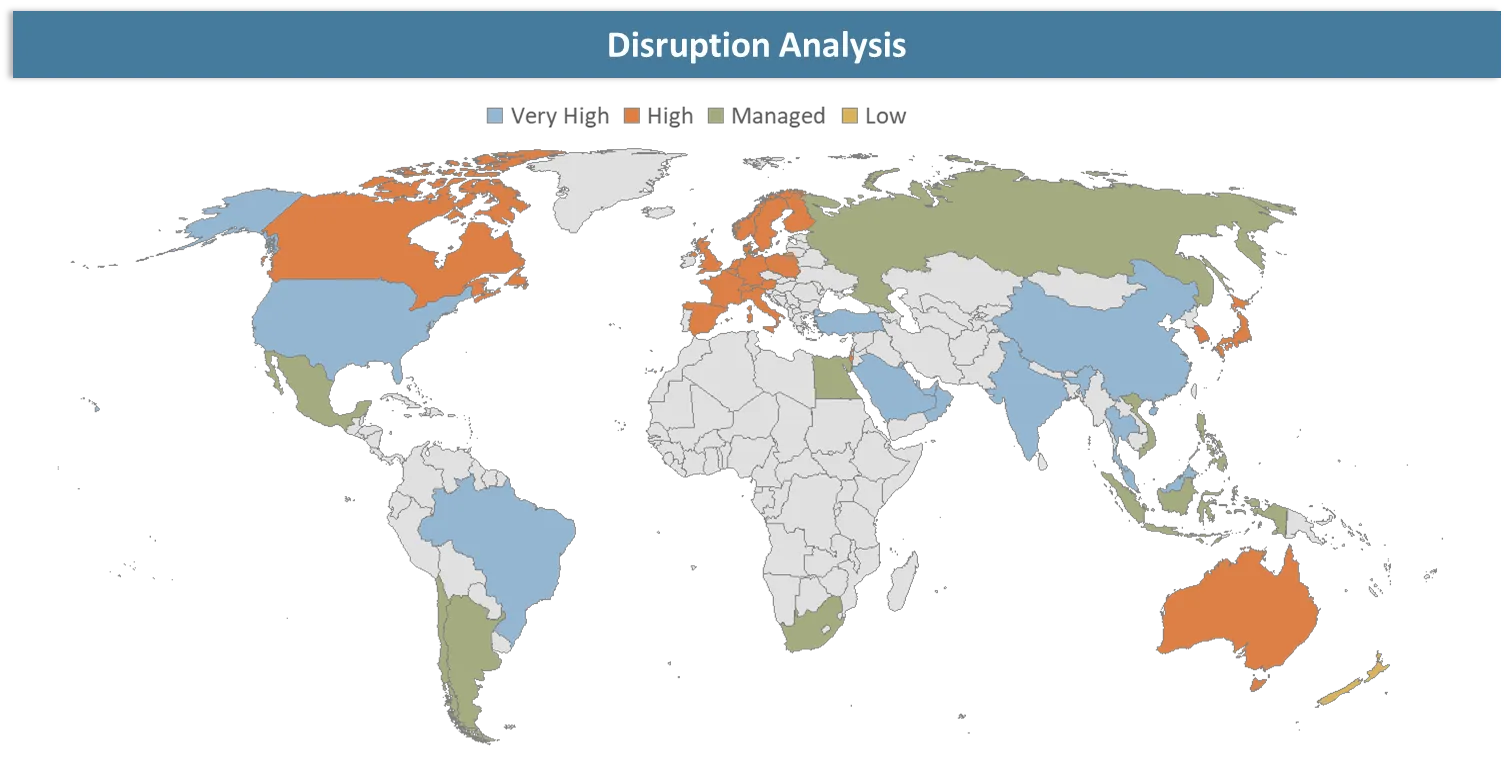
Shift Toward Direct-to-Device Connectivity and 5G NTN Reshaping the LEO Satellite Market
The disruptive change in the LEO Satellite market is mainly because of the increasing popularity of direct-to-device (D2D) technology and 5G non-terrestrial networks (NTN), which are revolutionizing the conventional satellite communications approach. The D2D approach enables regular smartphones, wearable devices, and IoT devices to communicate with LEO satellites in a direct manner without the need for any satellite terminals.
The disruption is growing even faster because of the way satellite operators and telecom firms are now integrating LEO networks into the 4G/5G ground-based infrastructure along with the NTN technology standards. In February 2025, according to Reuters, Eutelsat, Airbus, MediaTek, Sharp, and Rohde & Schwarz had completed the world’s first-ever 5G Non-Terrestrial Network (NTN) trial using OneWeb LEO satellites, establishing a 5G link from space and enabling the interoperability of the satellite and terrestrial networks. The trial was carried out under the European Union’s €10.6 billion (USD 11.1 billion) IRIS² satellite program, which is scheduled to have 270 LEO and 18 MEO satellites operational by 2030.
LEO Satellite Market BCG Matrix: Company Evaluation
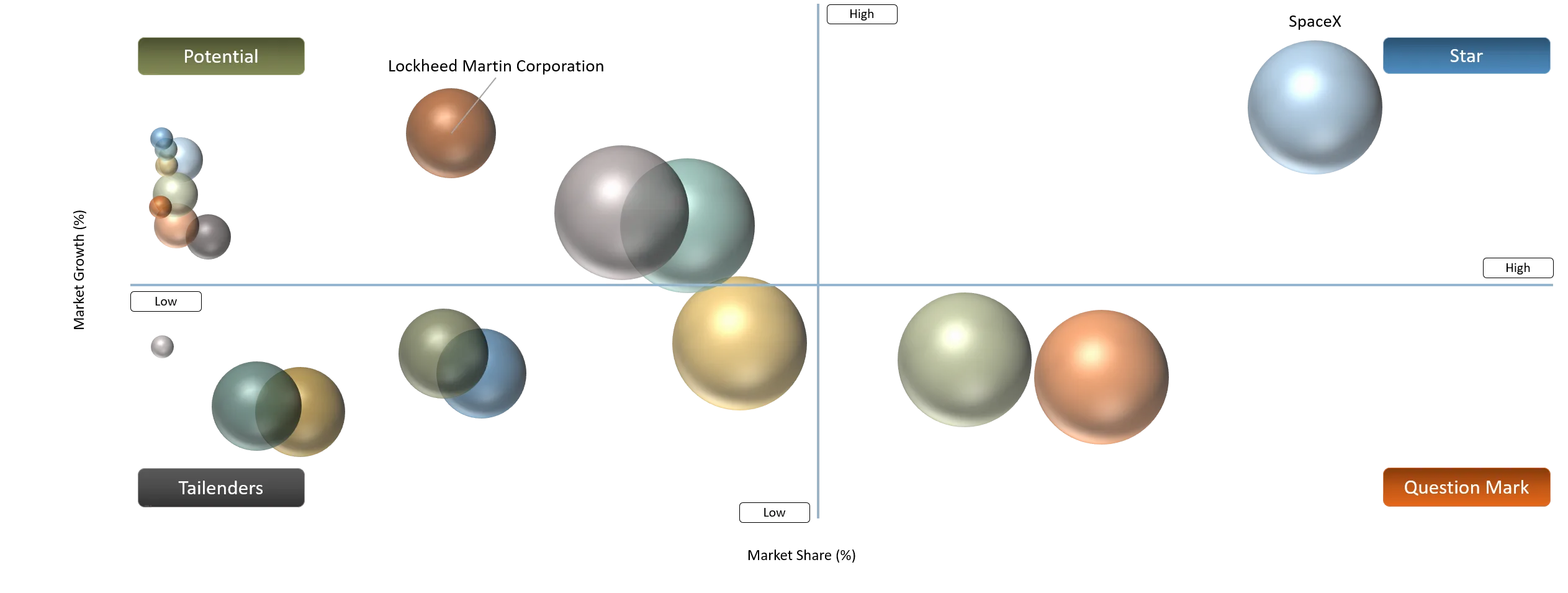
Stars include SpaceX, Airbus Defence and Space, and OneWeb Satellites, as these companies have strong positions in LEO constellation deployment, satellite communications, and large-scale network infrastructure. Question Marks include MDA Space, Maxar Technology, Northrop Grumman Corporation, and Thales Alenia Space, which have strong satellite engineering and manufacturing capabilities but compete across broader space markets rather than relying exclusively on LEO commercial connectivity.
Potential includes Lockheed Martin Corporation, Boeing Satellite Systems, Mitsubishi Electric Corporation, and OHB SE, which possess significant aerospace and satellite-development capabilities and benefit from growing government, defense, Earth-observation, and communications demand in LEO. Tailenders are not identified among the 11 selected companies because each maintains a meaningful technological, manufacturing, defense, or constellation-related presence in the LEO ecosystem.
LEO Satellite Market Dynamics
Driver Impact Analysis
| Driver | Market Growth Impact (%) | Demand Concentration | Impacted Use Case | Strategic Impact |
Growing demand for high-speed, low-latency satellite broadband is accelerating the deployment of large LEO satellites. | 35% | High – North America, Europe, Asia Pacific | Rural broadband, enterprise connectivity, maritime connectivity, aviation broadband, remote-area communications | Accelerates mega-constellation deployment, satellite manufacturing, launch demand, and ground-station infrastructure while positioning LEO networks as a complement to terrestrial broadband. |
Rising direct-to-device (D2D) connectivity is driving LEO satellite adoption by enabling smartphones and other devices to connect directly with satellites. | 25% | High – North America, Asia Pacific, Europe | Smartphone messaging, emergency communications, voice/data connectivity, IoT, mobile coverage extension | Expands the addressable market beyond dedicated satellite terminals and drives partnerships between LEO operators and mobile network operators, increasing satellite-to-smartphone integration. |
Increasing integration of LEO satellites with 5G and non-terrestrial networks (NTN) is expanding satellite-based connectivity beyond traditional broadband applications. | 20% | High – Asia Pacific, Europe, North America | 5G backhaul, NTN connectivity, connected vehicles, industrial IoT, remote communications | Moves LEO satellites toward integration with terrestrial telecom infrastructure and increases demand for standardized NTN-compatible satellite, antenna, and network technologies. |
Expansion of commercial mega-constellations by major satellite operators is increasing LEO satellite deployment and network capacity worldwide. | 20% | High – North America, Europe, Asia Pacific | Global broadband, enterprise networks, government communications, defense connectivity, maritime and aviation services | Raises satellite production volumes and launch requirements while increasing competitive pressure on constellation scale, network coverage, latency, spectrum utilization, and service pricing. |
Growing demand for high-speed, low-latency satellite broadband is accelerating the deployment of large LEO satellite
The growing demand for reliable and fast broadband where the terrestrial network is not sufficient is promoting the launch of large LEO satellite constellations. The 2025 Progress Report of Starlink confirmed the rising use of LEO broadband networks as seen in the number of customers and their geographical spread. The growing need for reliable broadband connections at rural and remote sites, as well as those on maritime vessels, airplanes, and other platforms, makes LEO networks an effective substitute for terrestrial broadband networks.
In parallel, the rapidly growing demand for satellite data has been pushing up the demand for greater capacity in LEO networks and more LEO satellites. In August 2025, the Telecoms stated that LEO satellite constellations are expected to bring USD 15 billion in annual revenue in 2026, whereas the number of global LEO communications satellites is expected to grow to over 15,000 to 18,000 in five constellations by the end of 2026. The volume of global satellite data traffic could rise by 20 times by the end of 2025, thereby putting a lot of pressure on raising satellite capacity, reach, and the number of simultaneous users. The states that there were already more than 100 ground stations for LEO satellites operating in 2025, and more than 100 additional ground stations will be required to support several developing constellations.
Restraint Impact Analysis
| Restraint | Drag on Market Growth (%) | Primary Impact Area | Impacted Use Case | Strategic Impact |
Increasing orbital congestion and space-debris risks are constraining LEO satellite deployments by raising collision-avoidance requirements and operational risks. | 25% | Orbital operations, space traffic management, satellite safety | Mega-constellations, broadband satellites, Earth observation, defense satellites | Increases collision-avoidance and debris-mitigation requirements, raising operational costs and constraining orbital deployment flexibility. |
Growing spectrum congestion and interference among expanding LEO constellations are limiting the efficient use of shared satellite communication frequencies. | 20% | Spectrum allocation, frequency coordination, network interference | Broadband connectivity, D2D communications, 5G NTN, satellite IoT | Increases spectrum-coordination complexity and encourages operators to adopt advanced frequency-management, beamforming, and interference-mitigation technologies. |
High satellite replacement and constellation maintenance requirements are increasing lifecycle costs because LEO satellites have relatively short operational lifetimes. | 30% | Satellite manufacturing, launch operations, lifecycle management | Broadband constellations, D2D networks, Earth observation, government communications | Creates recurring capital requirements for satellite production and launches, favoring operators with vertically integrated manufacturing and reliable launch access. |
Increasing regulatory and orbital-management requirements are creating compliance challenges for operators planning large-scale LEO constellations. | 25% | Licensing, orbital coordination, debris mitigation, spectrum regulation | Commercial broadband, D2D, government and defense constellations | Extends deployment timelines and increases compliance costs while making regulatory expertise, orbital coordination, and responsible end-of-life planning strategic capabilities. |
Increasing orbital congestion and space-debris risks are constraining LEO satellite deployments by raising collision-avoidance requirements and operational risks
One of the major restraints affecting the expansion of LEO satellite constellations is the growing congestion in orbiting bands that are already extensively used. With an increasing number of commercial constellations being launched, satellites have to co-exist with other non-functional satellites, rocket bodies, and space debris, thus increasing the complexities of orbital management. An increased number of objects leads to an increased probability of encounters and demands higher capabilities for conjunction analysis, risk assessment, maneuvering, and post-mission disposal procedures.
In addition, in April 2025, the ESA’s Space Environment highlights the growing scale of the debris problem. ESA reported that approximately 40,000 objects are currently tracked, including around 11,000 active payloads, while the actual number of debris objects larger than 1 cm is estimated at more than 1.2 million, including more than 50,000 objects larger than 10 cm. At around 550 km altitude, ESA found that the number of debris objects posing a threat is now of the same order of magnitude as the number of active satellites.
LEO Satellite Market Segment Analysis
The global LEO satellite market is segmented based on satellite mass, orbit mass, propulsion type, frequency band, deployment model, application, end-user, and region.
Mega Constellations Driving LEO Satellite Market Dominance Through Large-Scale Network Deployment
The mega-constellation (>500 satellites) segment dominates the LEO satellite market, accounting for an estimated 65% market share in 2025, as satellite operators increasingly deploy hundreds or thousands of spacecraft to achieve continuous coverage, higher network capacity, lower latency, and service redundancy. The economics of LEO broadband favor constellation-scale deployment because a large number of satellites is required to maintain persistent coverage and distribute traffic across multiple orbital planes.
The combination of accelerated launches, manufacturing capacity, and dedicated launch infrastructure strengthens the mega-constellation deployment model across the LEO satellite market. In March 2026, according to Amazon, Amazon Leo had already deployed more than 200 satellites, with another 200+ satellites stacked and ready for launch. The company planned more than 20 missions in its second year of deployment, more than doubling its annual launch rate, while its dedicated satellite production facility had capacity to manufacture up to 30 satellites per week. Amazon also invested more than USD 200 million in infrastructure and service upgrades at ULA launch facilities at Cape Canaveral, enabling higher launch capacity. In addition, Amazon had secured a launch manifest exceeding 100 missions, providing capacity for 800+ additional satellites.
LEO Satellite Market Geographical Penetration
Strong Commercialization and Large-Scale Constellation Deployment in North America
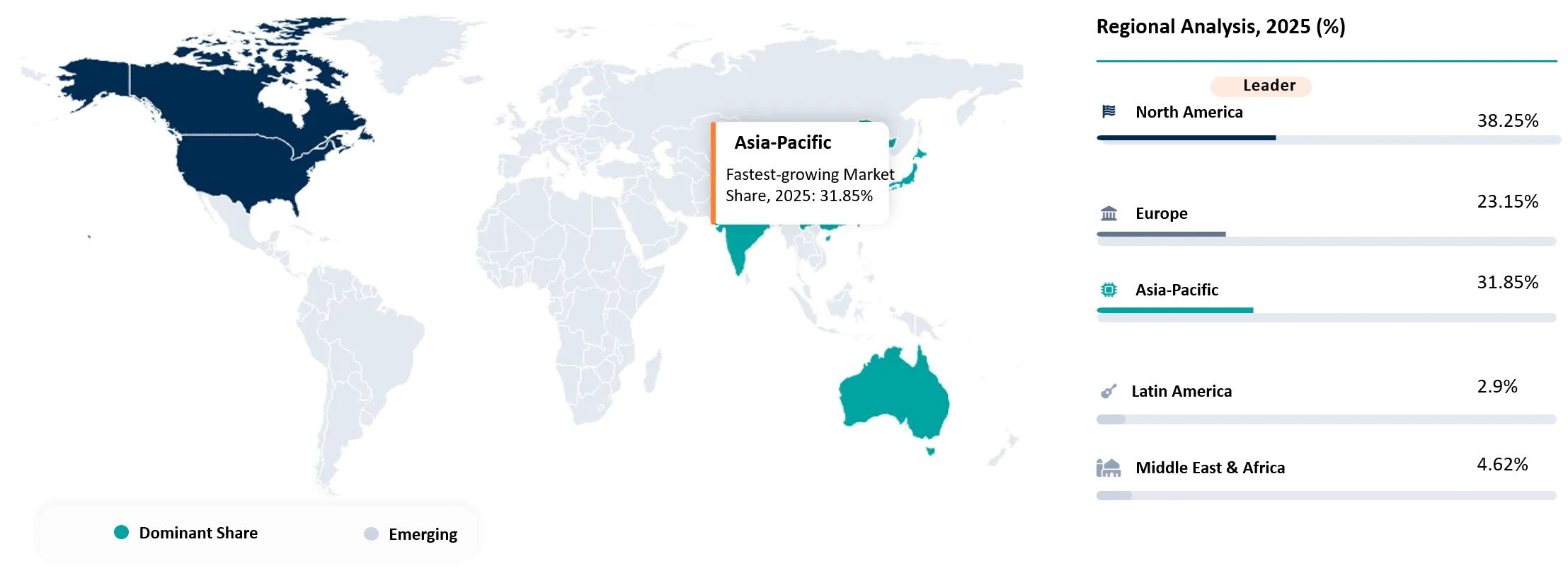
The North American region dominates the LEO satellite market, accounting for 38.25% of the global market in 2025, supported by strong commercial satellite deployment, advanced space infrastructure, high government and defense spending, and the presence of major LEO operators. The region benefits from an integrated ecosystem of satellite manufacturers, launch providers, telecommunications companies, and technology firms, enabling rapid commercialization of broadband, direct-to-device (D2D), Earth observation, and secure government connectivity services.
The growing reliance on secure, always-on connectivity across defense, public safety, transportation, and energy sectors is accelerating enterprise adoption of LEO satellite networks. In October 2025, according to Omdia, enterprises with mission-critical connectivity requirements are expected to spend USD 15.3 billion on LEO satellite connectivity by 2030, with broadband connectivity accounting for 94% of enterprise LEO revenues and direct-to-device (D2D) services representing the remaining 6%. North America is projected to remain the largest regional opportunity, led by the United States, with 37% of the enterprise LEO market opportunity, while Oceania and Eastern/Southeastern Asia are expected to increase their share from 9% in 2025 to 33% by 2030.
U.S. LEO Satellite Market Trends
The U.S. holds a dominant position in the North American LEO satellite market, supported by a mature commercial space ecosystem, large-scale LEO constellation deployment, advanced launch capabilities, and strong participation from satellite operators, technology companies, and government agencies. The country benefits from the presence of major LEO operators such as SpaceX and Amazon, alongside an established network of launch providers, satellite manufacturers, telecommunications companies, and ground-infrastructure suppliers.
Defense organizations are increasingly turning to commercial LEO constellations to strengthen resilient, low-latency communications and reduce reliance on traditional satellite infrastructure. In July 2025, according to Telco Magazine, governments are increasingly adopting commercial LEO satellite networks for defense and mission-critical communications. The U.S. Space Force, a U.S.-based government defense organization, began evaluating commercial LEO constellations, primarily SpaceX, a U.S.-based aerospace and satellite-communications company, and its Starlink network, for tactical communications, while the European Union supranational government organization committed USD 13 billion to the IRIS² multi-orbit satellite constellation, supporting secure and resilient connectivity.
Canada LEO Satellite Market Outlook
Canada is an important country in the North American LEO satellite market, supported by its established satellite communications industry, government-backed space infrastructure, and growing focus on sovereign connectivity for rural, remote, Arctic, and defense applications. The country is strengthening its LEO capabilities through Telesat Lightspeed, while domestic satellite manufacturing through MDA Space is creating an integrated ecosystem for spacecraft production, network operations, and high-capacity satellite communications.
Canada’s growing focus on advanced satellite communications is accelerating the deployment of high-capacity LEO infrastructure and optical data-relay technologies. In January 2026, Kepler Communications, a Canada-based satellite-communications company, launched its first operational optical data-relay constellation in LEO, bringing its first tranche into commercial service. The deployment has contributed to Kepler’s 33 satellites deployed to date, establishing what the company describes as the first commercial real-time optical relay network in LEO. The network is designed to provide resilient, high-speed optical connectivity for real-time data delivery, on-orbit computing, and hosted payload missions, strengthening opportunities across Canada’s LEO satellite communications and space-data infrastructure ecosystem.
Rapid Constellation Deployment and Expanding Space Infrastructure in Asia-Pacific Region
The Asia-Pacific is the fastest-growing region in the LEO satellite market, accounting for 31.85% of the global market in 2025, supported by increasing investments in satellite constellations, expanding launch capabilities, government-backed space programs, and rising demand for high-speed connectivity across geographically dispersed and underserved areas. China, India, Japan, South Korea, and other regional economies are strengthening their domestic satellite and launch ecosystems, while commercial operators are expanding broadband, Earth observation, IoT, and non-terrestrial network applications.
South Korea’s expanding NewSpace ecosystem is driving strategic collaboration across satellite manufacturing, payload development, ground infrastructure, and space-based communications. In January 2026, according to Asia Pacific Satellite, a South Korea-based satellite-communications company, LeoSpace, a South Korea-based space-optics and small-satellite payload company, secured strategic investments from Contec, a South Korea-based satellite ground-station operator, and AP Satellite, with both investors acquiring minority equity stakes; however, the investment amount and ownership ratios were not disclosed. The companies plan to integrate satellite payloads, ground stations, operations, and communication services, while pursuing small- and micro-satellite constellation missions and overseas NewSpace opportunities.
Japan LEO Satellite Market Trends
Japan is a key country in the Asia-Pacific LEO satellite market, supported by its advanced space-technology ecosystem, established satellite manufacturing capabilities, domestic launch infrastructure, and strong government commitment to commercializing space services. The country is increasingly focusing on LEO activities, satellite communications, Earth observation, and satellite-data utilization, while also strengthening domestic capabilities to reduce dependence on overseas space infrastructure.
Japan’s push for sovereign LEO connectivity is accelerating government-backed investment in domestic satellite communications and direct-to-device infrastructure. In July 2026, Japan’s government selected a Rakuten Mobile-led consortium involving AST SpaceMobile to develop a domestic low-Earth-orbit (LEO) satellite communications network under the J-LEO project, with government support of ¥150 billion (approximately USD 926 million) over three years. Rakuten Mobile, a Japan-based telecommunications company, will lead the domestic satellite service initiative, while AST SpaceMobile, a U.S.-based satellite-communications company, will provide LEO satellite technology for direct-to-device connectivity.
LEO Satellite Market Competitive Landscape
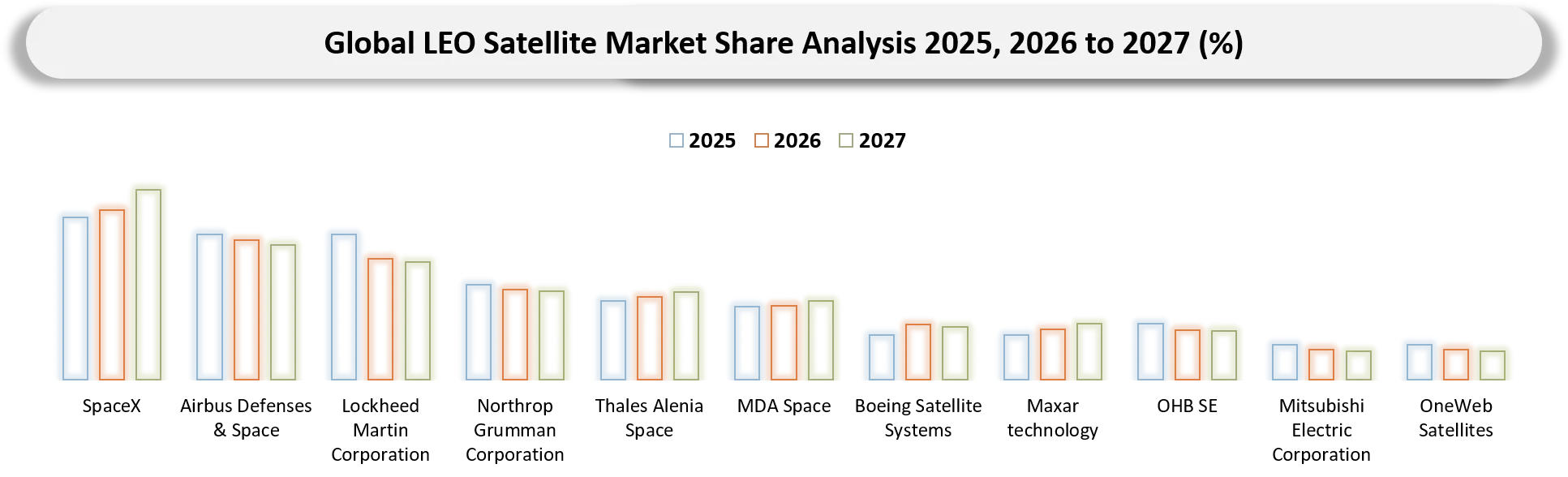
- The LEO satellite market is characterized by three key participant groups: vertically integrated LEO constellation operators, diversified aerospace and defense companies, and specialized satellite manufacturers. SpaceX leads the commercial LEO connectivity segment through its vertically integrated Starlink ecosystem, combining satellite manufacturing, launch capabilities, network infrastructure, and broadband services. Airbus Defence and Space and OneWeb Satellites focus on global satellite connectivity, enterprise communications, government services, and constellation infrastructure. MDA Space, Maxar Technology, and Thales Alenia Space specialize in satellite manufacturing, advanced spacecraft systems, payloads, and Earth observation technologies, while Lockheed Martin, Northrop Grumman, and Boeing Satellite Systems maintain strong capabilities in defense, government satellite systems, and secure space infrastructure. OHB SE and Mitsubishi Electric Corporation contribute through satellite platforms, communications systems, Earth observation, and specialized space technologies. It’s creating a highly technology-driven competitive landscape where constellation scale, satellite manufacturing capabilities, launch access, network integration, technological innovation, and government relationships define competitiveness.
- Key players include SpaceX (U.S.), Airbus Defence and Space (Germany), Lockheed Martin Corporation (U.S.), Northrop Grumman Corporation (U.S.), Thales Alenia Space (France), MDA Space (Canada), Boeing Satellite Systems (U.S.), Maxar Technology (U.S.), OHB SE (Germany), Mitsubishi Electric Corporation (Japan), and OneWeb Satellites (UK).
Key Developments
- September 2026: Viasat, a U.S.-based satellite-communications company, and Space42, a UAE-based satellite and space-technology company, agreed to establish Equatys, a shared space-and-ground infrastructure platform for direct-to-device (D2D) satellite connectivity. The venture involves USD 800 million in initial combined equity contributions, with USD 400 million each from Viasat and Space42, while Space42 plans an additional USD 200 million in a future funding round, taking the potential investment to USD 1 billion.
- February 2026: Eutelsat Group, a France-based satellite-communications operator, secured nearly €1 billion (USD 1.15 billion) in Export Credit Agency financing to support the procurement of additional OneWeb LEO satellites.
- September 2026: Open Cosmos, a UK-based satellite infrastructure and space-technology company, raised €300 million (USD 346 million) to expand satellite mass manufacturing and accelerate its connectivity and real-time intelligence services.
- September 2026: Pixxel, an India-based space-technology and Earth-observation company, raised USD 100 million in Series C funding, marking the largest funding round for an Indian space-technology company to date and bringing its total funding to USD 195 million.
- June 2026: MDA Space, a Canada-based space-technology and satellite-systems company, agreed to acquire Blue Canyon Technologies, a U.S.-based spacecraft and satellite-components manufacturer, from RTX, a U.S.-based aerospace and defense company, for USD 620 million in cash.
- November 2025: Kratos Defense & Security Solutions, a U.S.-based defense and national-security technology company, agreed to acquire Orbit Technologies, an Israel-based satellite-communications and defense technology company, for USD 356.3 million.
Key Procurement Priorities and Buyer Evaluation Criteria
- Organizations investing in the LEO Satellite Market increasingly select satellite operators and technology partners based on their ability to provide reliable, low-latency, high-capacity connectivity, scalable constellation architectures, and consistent service coverage across commercial and remote operating environments.
- The procurement decision-making process is increasingly influenced by the expansion of mega-constellations, direct-to-device connectivity, 5G non-terrestrial networks (NTN), satellite-based IoT, and growing requirements for resilient broadband infrastructure, making network interoperability and future scalability important purchasing considerations.
- Buyers evaluate factors such as satellite reliability, network availability, latency, coverage footprint, throughput, spectrum efficiency, cybersecurity, orbital maneuverability, and collision-avoidance capabilities when selecting LEO satellite operators or technology providers.
Why Choose DataM?
- Technological Innovations: Explores advancements in LEO satellite technologies, including high-throughput satellites, electric propulsion, optical inter-satellite links, direct-to-device connectivity, and 5G non-terrestrial networks, highlighting their role in improving coverage, latency, capacity, and network efficiency.
- Product Performance & Market Positioning: Evaluates satellite and constellation solutions based on coverage, network capacity, latency, reliability, power efficiency, satellite lifetime, spectrum utilization, and scalability, highlighting how leading players differentiate across broadband, Earth observation, defense, enterprise, maritime, and aviation applications.
- Real-World Evidence: Highlights the deployment of LEO satellite technologies across broadband connectivity, direct-to-device services, remote communications, Earth observation, IoT, maritime connectivity, aviation, and government applications, demonstrating their practical contribution to continuous connectivity and data delivery.
- Market Updates & Industry Changes: Tracks constellation deployments, satellite launches, manufacturing capacity expansions, launch agreements, D2D developments, 5G NTN trials, government space programs, and investments across North America, Asia-Pacific, and Europe, providing insight into the evolution of the global LEO ecosystem.
- Competitive Strategies: Analyzes how leading companies strengthen their positions through mega-constellation deployment, vertical integration, satellite manufacturing, launch partnerships, network expansion, technology development, and collaborations with telecommunications operators and government agencies.
- Pricing & Market Access: Examines pricing and market-access dynamics across satellite broadband, enterprise connectivity, government services, D2D connectivity, and specialized satellite applications, including the influence of satellite terminals, network infrastructure, service models, spectrum requirements, and deployment scale.
- Market Entry & Expansion: Identifies opportunities driven by rural broadband, D2D connectivity, 5G/6G NTN, satellite IoT, Earth observation, defense, maritime and aviation connectivity, while assessing strategies such as constellation expansion, regional partnerships, local manufacturing, launch diversification, and integration with terrestrial networks.
Target Audience 2026
- LEO Satellite Operators & Constellation Developers
- Satellite Manufacturers & Spacecraft Developers
- Telecommunications & Mobile Network Operators
- Launch Service Providers
- Ground Infrastructure & Terminal Providers
- Government & Civil Space Agencies
- Defense & Military Organizations





























































