


Japan Hospital Outsourcing Services Market Overview
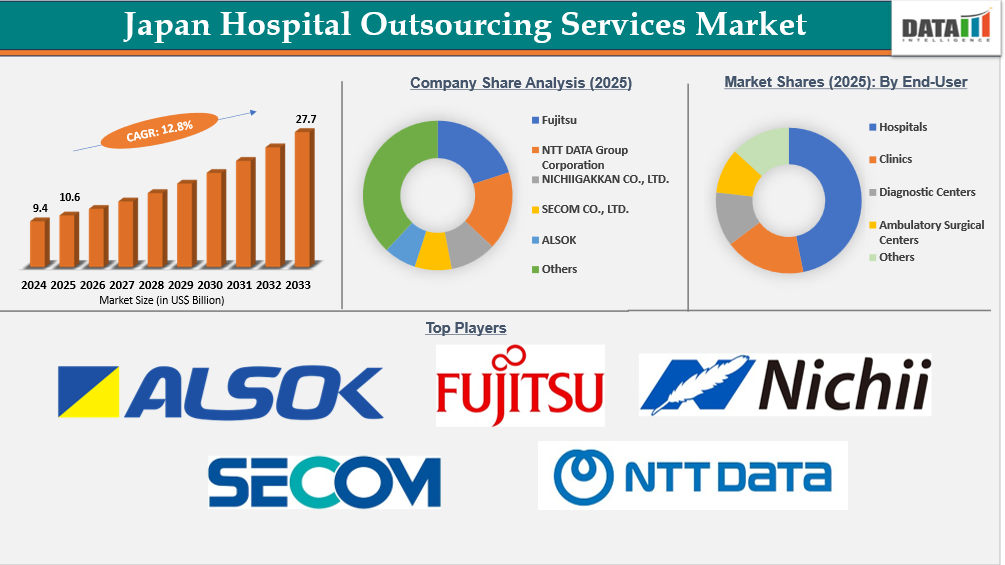
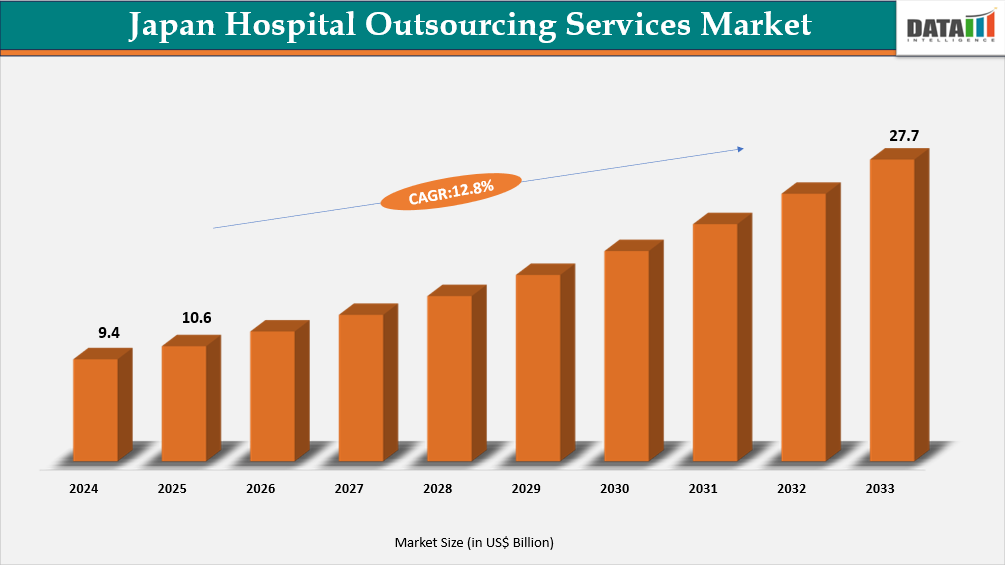
The Japan hospital outsourcing services market reached US$9.4 Billion in 2024, rising to US$10.6 Billion in 2025 and is expected to reach US$27.7 Billion by 2033, growing at a CAGR of 12.8% from 2026 to 2033.
The market is expanding because of Japan's aging population, increasing hospitalization rates, and ongoing lack of healthcare workers, which are forcing hospitals to outsource administrative and non-core tasks. Around 29% of Japanese citizens are 65 years of age or older, and a significant 75% of hospitalized patients are 65 or older, indicating a fundamentally high level of healthcare usage. With 8,122 hospitals as of 2023, Japan has a sizable institutional backbone that creates demand for services that are outsourced.
In order to increase operational efficiency and control cost constraints under the national health insurance system, hospitals are progressively outsourcing revenue cycle management, medical billing, IT infrastructure, property management, sanitation, and security services. Additionally, the demand for managed outsourcing and specialized IT services is rising due to digital transformation initiatives, the growing use of electronic medical records (EMR), and strict regulatory compliance requirements. This is sustaining the market's long-term, steady growth.
Hospital Outsourcing Services Market Industry Trends and Strategic Insights
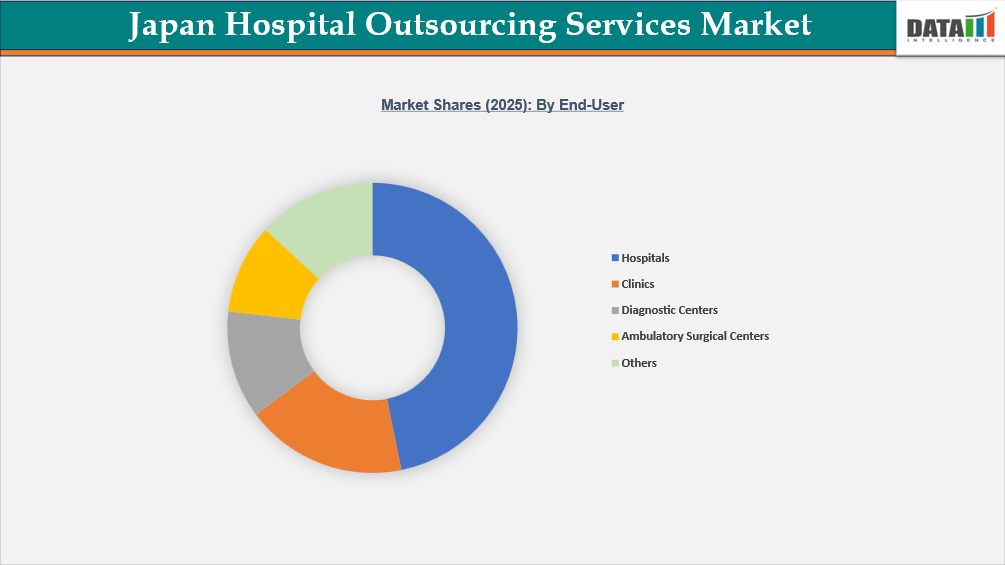
- By end-user, hospitals led the Japan hospital outsourcing services market, capturing the largest revenue share of 46.8%% in 2025.
Japan Hospital Outsourcing Services Market Size and Future Outlook
- 2025 Market Size: US$10.6 Billion
- 2033 Projected Market Size: US$27.7 Billion
- CAGR (2026–2033): 12.8%
Market Dynamics
Aging Population and Rising Hospitalization Rates
Japan's population is aging at one of the fastest rates in the world. According to the Cabinet Office of Japan's 2025 Annual Report on the Ageing Society, around 29.3% of the country's population was 65 years of age or older. Nationwide, healthcare usage has dramatically grown as a result of this demographic transition. Notably, older persons make up a majority of inpatient days in Japan, accounting for almost 75% of hospitalized patients who are 65 years of age or older. This is because older adults often remain longer and receive more intensive care than younger patients.
This concentration of hospital consumption among elderly people has put ongoing operational and financial strain on healthcare organizations. Rising admissions, chronic illness management requirements, and longer inpatient treatment are putting further strain on hospital manpower, infrastructure, and administrative systems. As a result, hospitals are progressively outsourcing non-core operations, including medical billing, revenue cycle management, IT system maintenance, facilities management, cleaning, catering, and security services, to increase efficiency and reduce costs. With the population continuing to age, structural factors are projected to be a significant development driver for the Japan hospital outsourcing services market.
Segmentation Analysis
The Japan hospital outsourcing services market is segmented based on service category, end-user, hospital ownership, outsourcing model, and contract type.
Hospital Segment Dominates Japan Hospital Outsourcing Services Market
The Japanese hospital outsourcing services market is divided into hospitals, clinics, diagnostic centers, ambulatory surgical centers, and others. Hospitals lead the market, accounting for over 46.80% of total end-user share, owing to their huge operational size, high inpatient loads, and sophisticated administrative and IT infrastructure needs. Hospitals heavily outsource services such as revenue cycle management, medical billing, IT system support, facility management, sanitation, catering, and security to meet cost challenges and workforce shortages.
According to the Statistical Handbook of Japan 2025, Japan had 8,122 hospitals and 104,894 medical clinics as of October 2023. Even though clinics are considerably more numerous, hospitals handle significantly higher patient loads, inpatient treatments, and complex medical operations, increasing their demand for structured outsourcing solutions. Clinics make up the second-largest market, mostly outsourcing billing and cloud-based IT services to alleviate administrative expenses. Overall, hospitals continue to dominate outsourcing demand in Japan due to their operational complexity, regulatory compliance requirements, and higher service intensity, strengthening their position as the market's end-user segment.
Competitive Landscape
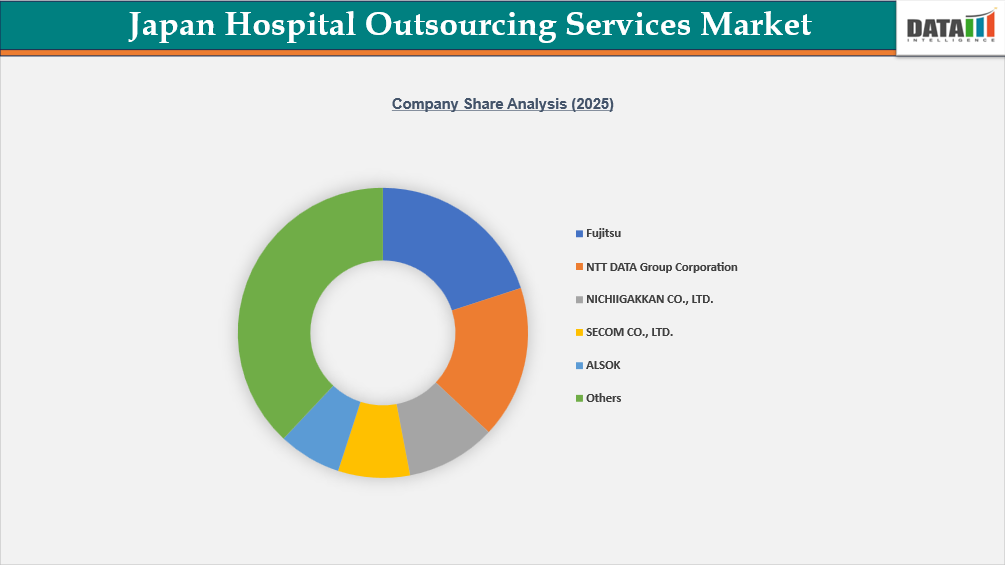
The Japanese hospital outsourcing services market is somewhat specialized, with domestic leaders and worldwide integrated service providers competing in the IT, administrative, security, and facilities management categories. Fujitsu Limited and NTT DATA Group Corporation are key players in healthcare IT outsourcing, while NICHIIGAKKAN CO., LTD. provides medical administrative services, SECOM CO., LTD. and ALSOK provide hospital security and integrated facility management, and TOKAI Holdings Corporation, NIPPON KANZAI Co., Ltd., and AEON DELIGHT CO., LTD. provide environmental and infrastructure support services. Global companies such as Sodexo and ISS Japan Co., Ltd. are also involved in non-clinical hospital outsourcing.
The factors that influence market competitiveness in Japan's healthcare sector include data security and operational rules, digital transformation capabilities, labor cost effectiveness, comprehensive outsourcing solutions (IT, administrative, and facilities services), and long-term service contracts.
Key Developments
- In January 2026, M-INT Co., Ltd. signed a business partnership with Software Service Co., Ltd., which would serve around 1,000 medical institutions in Japan. The collaboration enables one-click medical resource searches from EMR systems, as well as automatic master data updates, thereby promoting digital transformation and the adoption of IT outsourcing in healthcare operations.
- In October 2025, the National Hospital Organization Tokyo Medical Center published a procurement notice for outsourcing the operation and maintenance of its hospital information system beginning in January 2026. This indicates an increase in hospital outsourcing of IT system management services as institutions seek specialized external expertise to maintain complex digital infrastructure.
- In November 2024, Siemens Healthineers Japan and Social Medical Corporation Ryokusenkai formed a managed equipment services (MES) outsourcing agreement to update and manage medical equipment settings at Yoneseri Hospital in Kagoshima Prefecture. The multi-year cooperation uses outsourced equipment management and AI automation to boost operational efficiency and enhance advanced clinical care.
What Sets This Japan Hospital Outsourcing Services Market Intelligence Report Apart
- Latest Data & Forecasts – Comprehensive and up-to-date market intelligence with forecasts through 2033, covering Japan hospital outsourcing demand by service category, end-user, hospital ownership, outsourcing model, contract type, and deployment type.
- Regulatory Intelligence – In-depth assessment of Japan’s healthcare regulatory and compliance framework influencing hospital outsourcing adoption, including Ministry of Health, Labour and Welfare (MHLW) guidelines, Act on the Protection of Personal Information (APPI), healthcare data security standards, labor regulations governing outsourcing contracts, and public hospital governance policies impacting service procurement and vendor partnerships.
- Competitive Benchmarking – Structured benchmarking of leading domestic and global outsourcing providers based on service portfolio breadth (IT, administrative, facility management), contract models, technological capabilities, hospital partnerships, pricing structures, and strategic expansion initiatives.
- Actionable Strategies & Cost Dynamics – Strategic insights into outsourcing adoption trends, integrated service models, public-private collaboration opportunities, digital transformation strategies, labor cost pressures, and operational efficiency optimization, supported by expert perspectives from healthcare administrators, IT integrators, facility managers, and industry consultants.


























































