


Japan Electronics Market Size
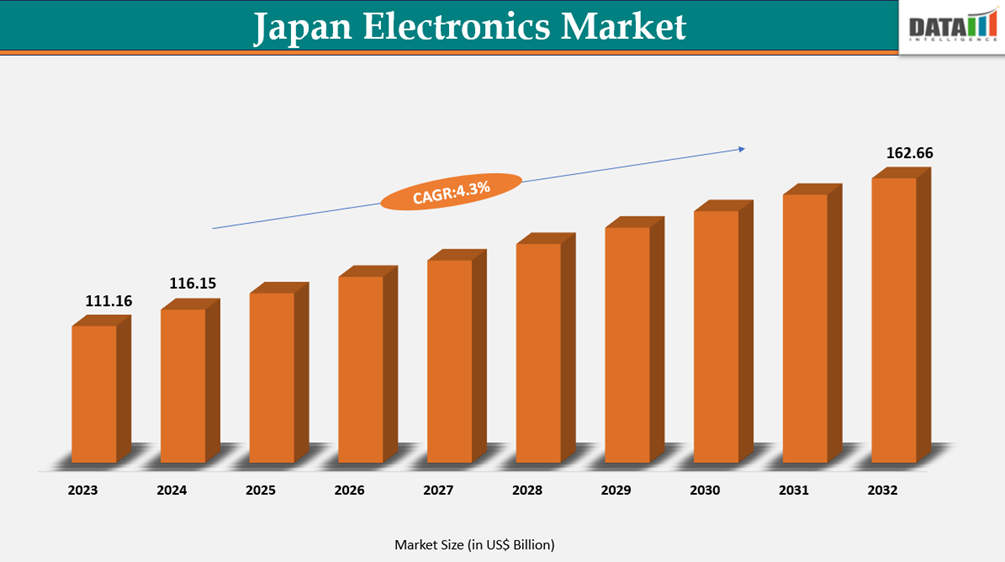
Japan Electronics Market size reached US$ 116.15 billion in 2025 and is expected to reach US$ 176.46 billion by 2035, growing with a CAGR of 4.3% during the forecast period 2026-2035.
The Japan electronics market is one of the most advanced and dynamic technology landscapes globally, renowned for its innovation, precision manufacturing, and early adoption of cutting-edge technologies. The sector encompasses a broad range of products, including consumer electronics, industrial electronics, semiconductors, electronic components, and emerging technologies such as robotics, IoT devices, and smart home systems. Japanese electronics firms have historically led global innovation, with companies like Sony, Panasonic, Toshiba, and Sharp setting benchmarks in product quality, reliability, and technological sophistication.
Consumer electronics remain a significant driver, fueled by high domestic demand for smartphones, wearables, home appliances, and audiovisual equipment. Simultaneously, the industrial electronics segment including semiconductors, sensors, and control systems supports Japan’s robust manufacturing ecosystem, powering automotive, robotics, energy, and industrial automation sectors. The market benefits from strong research and development capabilities, strategic collaborations, and government initiatives aimed at promoting next-generation technologies, such as 5G, AI, and robotics, under the Society 5.0 framework.
Japan Electronics Market Scope
| Metrics | Details |
| By Product Type | Consumer Electronics (Audio/Video, Mobile Devices, Computing, Gaming, Home Appliances, Others), Industrial Electronics (Process Control Systems, Industrial Automation, Test & Measurement, Power Electronics Others), Telecom & Networking Equipment (Core Network Equipment, Access Equipment, Enterprise Networking), Medical Electronics (Diagnostic Imaging, Patient Monitoring, Therapeutic Devices Wearable Medical Devices), Automotive Electronics, Semiconductors & Components |
| By Price Range | Premium / High-End, Mid-Range / Value, Budget / Economy |
| By End User | Consumer (B2C), Enterprise / Corporate (B2B), Government & Public Sector, Small & Medium Businesses (SMBs) |
| By Distribution Channel | Consumer (B2C), Enterprise / Corporate (B2B), Government & Public Sector, Small & Medium Businesses (SMBs) |
| Report Insights Covered | Competitive Landscape Analysis, Company Profile Analysis, Market Size, Share, Growth |
Get a concise, data-driven view of market growth, emerging technologies, competitive trends, investment opportunities, and future prospects everything you need to make smarter business decisions. Request Your Sample Report Today & Stay Ahead of the Competition!
Key Takeaways
- Semiconductors and electronic components remain strategically important to Japan's electronics ecosystem.
- AI, robotics, automotive electrification and industrial automation are creating new sources of electronics demand.
- Sony and TSMC's planned US$4.69 billion image-sensor joint venture in Kumamoto highlights Japan's growing semiconductor investment momentum.
- The planned facility targets volume production from 2029, creating a long-term opportunity for image sensors used in smartphones, vehicles and AI-enabled machines.
- Japan's 2025 electronics exports included approximately ¥2.28 trillion of industrial electronic equipment and ¥465.39 billion of consumer electronic equipment.
- Automotive electronics, power semiconductors and sensors are expected to benefit from EV and autonomous-driving development.
- Robotics and factory automation remain important structural growth areas because of Japan's advanced manufacturing base and labor constraints.
- Semiconductor materials, equipment and specialized components remain key areas where Japan maintains significant global competitiveness.
- Future competition will increasingly depend on AI capabilities, semiconductor technology, supply-chain resilience, advanced manufacturing and strategic international partnerships.
Japan Electronics Market Dynamics
Rising Global Demand for Semiconductors Accelerates Industrial and Consumer Electronics Adoption
The global semiconductor industry is experiencing unprecedented growth, driven by surging demand across both industrial and consumer electronics sectors. In the industrial domain, semiconductors underpin automation, smart manufacturing, and robotics. Rising adoption of Industry 4.0 technologies, including IoT-enabled machinery and AI-powered production lines, has intensified reliance on high-performance chips, catalyzing operational efficiency and predictive maintenance capabilities. These developments have propelled semiconductor consumption in sectors such as automotive, aerospace, and industrial automation, positioning semiconductors as a critical enabler of digital transformation.
Consumer electronics represent another significant growth vector, with smart devices, wearables, and connected home appliances fueling chip demand. The proliferation of 5G-enabled smartphones, tablets, and laptops has further amplified the need for advanced processors, memory, and sensors. Rising consumer expectations for enhanced performance, faster processing, and energy efficiency continue to drive innovation and adoption. Moreover, the expansion of e-commerce and digital entertainment ecosystems is accelerating production of high-tech consumer electronics, further bolstering semiconductor requirements.
Intense International Competition Pressures Prices and Reduces Profit Margins
Intense international competition exerts significant pressure on businesses operating in global markets, fundamentally affecting pricing strategies and profit margins. As firms face competitors offering similar products or services across borders, price differentiation becomes a primary tool to attract consumers. This environment often triggers price wars, where companies’ lower prices to maintain or expand market share, directly compressing profit margins. Global competitors with cost advantages-such as access to cheaper labor, raw materials, or advanced technology-can offer lower prices sustainably, forcing domestic firms to either reduce costs or accept reduced profitability.
The impact of international competition also extends to operational efficiency. Companies must invest in process optimization, automation, and supply chain enhancements to maintain cost competitiveness. At the same time, quality and innovation remain crucial differentiators; firms cannot rely solely on low pricing without risking brand dilution or consumer dissatisfaction. Exchange rate volatility further complicates pricing decisions, as fluctuations can make exports more expensive or imports cheaper, influencing both revenue and costs.
Japan Electronics Market Artificial Intelligence and Advanced Electronics Manufacturing Analysis
The Japan Electronics Market remains one of the world's most technologically advanced electronics ecosystems, driven by continuous innovation in artificial intelligence (AI), semiconductor technologies, advanced materials, robotics, and precision manufacturing. Japan's leadership in high-performance electronic components, image sensors, automotive electronics, factory automation equipment, industrial robots, and semiconductor manufacturing equipment continues to strengthen its position in the global electronics value chain. AI-powered manufacturing, digital twins, intelligent production systems, and smart factory technologies are enabling manufacturers to improve productivity, product quality, operational efficiency, and supply chain resilience.
Japanese electronics companies are increasingly investing in next-generation semiconductors, power electronics, advanced packaging, silicon photonics, quantum technologies, and AI-enabled consumer electronics to maintain global competitiveness. Growing investments in digital transformation, industrial automation, electric mobility, and sustainable electronics manufacturing are expected to significantly strengthen commercialization opportunities throughout the forecast period.
Japan Electronics Market Semiconductor and Advanced Components Analysis
Japan continues to play a critical role in the global semiconductor ecosystem through its leadership in semiconductor materials, wafer manufacturing equipment, advanced electronic components, image sensors, sensors, and precision manufacturing technologies. Increasing global demand for AI processors, high-bandwidth memory (HBM), automotive semiconductors, power devices, and advanced packaging technologies is creating significant opportunities for Japanese manufacturers.
Government initiatives supporting domestic semiconductor production, strategic partnerships with global chip manufacturers, and investments in advanced fabrication facilities are expected to strengthen Japan's long-term competitiveness in the semiconductor industry.
Japan Electronics Market Consumer Electronics and Smart Devices Analysis
Japan remains a global innovation hub for premium consumer electronics, imaging technologies, gaming systems, display technologies, home appliances, wearable devices, and audio-visual equipment. The integration of artificial intelligence, Internet of Things (IoT), edge computing, and cloud connectivity is accelerating the development of intelligent consumer products offering enhanced automation, personalization, and energy efficiency.
Growing demand for connected home technologies, smart appliances, next-generation gaming devices, and AI-powered imaging solutions is anticipated to create new growth opportunities for domestic manufacturers.
Japan Electronics Market Automotive Electronics and Industrial Automation Analysis
The rapid transition toward electric vehicles, autonomous driving technologies, and connected mobility is significantly increasing demand for advanced automotive electronics across Japan. Electronic control units (ECUs), power semiconductors, sensors, battery management systems, lidar, radar, and vehicle connectivity platforms continue to become essential components of next-generation mobility solutions.
At the same time, Japan's global leadership in industrial robotics, factory automation, motion control systems, programmable logic controllers (PLCs), and precision manufacturing equipment continues supporting widespread adoption of Industry 4.0 technologies across domestic and international manufacturing industries.
Japan Electronics Market Sustainability and Green Electronics Analysis
Sustainability has become a strategic priority for Japan's electronics industry. Manufacturers are investing in energy-efficient semiconductors, recyclable electronic materials, environmentally responsible manufacturing processes, low-carbon production facilities, and circular economy initiatives.
Increasing adoption of renewable energy, carbon neutrality commitments, resource-efficient manufacturing, and electronic waste recycling programs is expected to strengthen long-term competitiveness while supporting national sustainability objectives.
Japan Electronics Market Segment Analysis
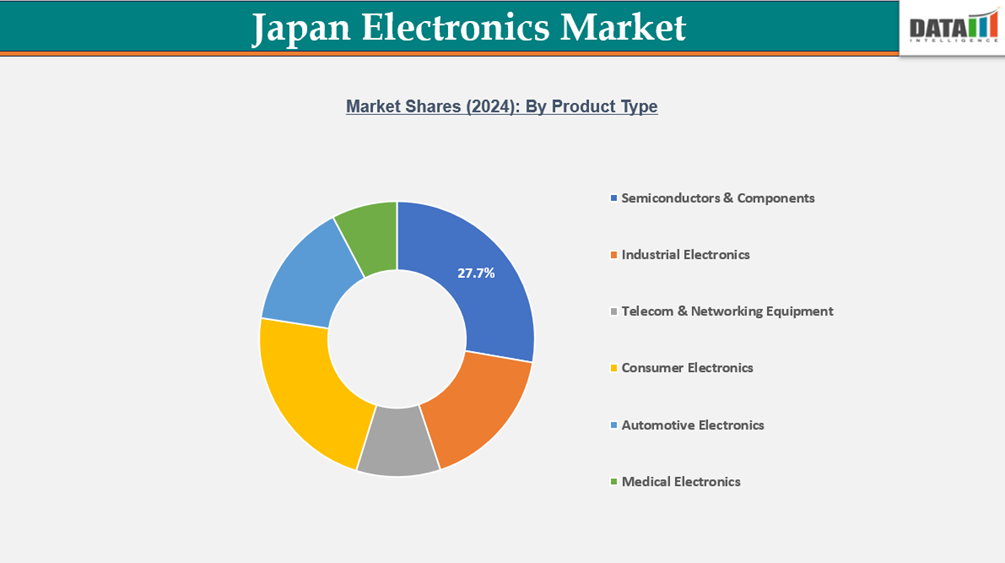
Japan electronics market is segmented based on the product type, price range, end user and distribution channel.
Electronics Tradition, Craftsmanship, and Global Prestige Drive Market Leadership
Consumer electronics remain the dominant segment in Japan’s electronics market, upheld by a legacy of precision engineering, quality mastery, and cultural reverence for craftsmanship. Rooted in decades of expertise, Japanese electronics have evolved beyond early adoption of Western technologies to establish their own global identity defined by reliability, innovation, and meticulous design. Boutique manufacturers and R&D labs are reinforcing this legacy by combining traditional engineering principles with advanced materials and localized software ecosystems, producing limited-edition models that emphasize authenticity and superior user experience.
The growing appreciation for premium and ultra-premium devices, both domestically and internationally, has positioned Japanese electronics as a luxury good and an experiential product. Exports to Europe, the U.S., and Asia-Pacific continue to rise as global connoisseurs seek unique features crafted with specialized components or rare materials. Meanwhile, domestic consumers, especially millennials, are showing renewed interest in homegrown craftsmanship through brand heritage centers and tech showcase events.
Tech Innovation and Localized Aesthetics Fuel Rapid Market Expansion
Wearable technology and smart home devices are the fastest-growing segments in Japan’s electronics market, propelled by creativity, feature diversity, and rising consumer preference for seamless, integrated living. Tech companies are leveraging Japan’s rich design heritage-minimalist aesthetics, intuitive interfaces, cultural motifs, and a focus on harmony-to craft unique, culturally-inspired products that differentiate themselves from global counterparts. This localization of design and user experience not only enhances functionality but also appeals to younger consumers seeking authenticity and innovation.
Rapid innovation in feature experimentation, limited-edition collaborations, and small-batch premium offerings are reshaping Japan’s position within the global tech renaissance. Manufacturers are integrating sustainable production methods, transparent supply chains, and aesthetic branding to attract eco-conscious and design-driven audiences. The versatility of IoT devices in creating connected ecosystems aligns with the growing smart-city culture across Japan’s urban centers, particularly in Tokyo and Osaka.
Japan Faces Intense Global Competition Impacting Prices and Profit Margins
Japan’s industries are increasingly influenced by intense international competition, pressuring prices and compressing profit margins. Global rivals offering similar high-quality products often leverage cost advantages, advanced technology, and efficient production processes, forcing Japanese firms to innovate while maintaining cost-effectiveness. Price wars have become common, compelling companies to balance competitive pricing with sustainable profitability.
Operational efficiency is critical Japanese companies invest in automation, lean manufacturing, and optimized supply chains to control costs without compromising quality. Innovation and differentiation remain key, as consumers seek unique features and advanced functionalities in products ranging from electronics to automotive components. Exchange rate fluctuations further impact export competitiveness, affecting revenues and costs.
While intense competition challenges margins, it drives Japanese companies toward higher efficiency, technological advancement, and global market adaptability, enabling them to sustain profitability and remain competitive in a rapidly evolving international landscape.
Japan Electronics Market Sustainability Analysis
Sustainability has become a core strategic focus for businesses in Japan, driven by environmental regulations, consumer expectations, and global corporate responsibility trends. Companies are increasingly adopting eco-friendly practices, such as reducing carbon emissions, optimizing energy consumption, and minimizing waste across production and supply chains. Resource efficiency and circular economy principles are emphasized to ensure long-term operational viability while lowering environmental impact.
Japanese firms also integrate social sustainability by fostering safe working conditions, employee well-being, and ethical sourcing. Corporate governance mechanisms ensure accountability, transparency, and adherence to sustainability standards, which enhance brand reputation and stakeholder trust. Moreover, investors and international partners increasingly favor companies demonstrating measurable environmental, social, and governance (ESG) performance.
Japan Electronics Market Investment and Strategic Collaboration Analysis
Japan continues to strengthen its position as a global electronics powerhouse through large-scale public and private investments focused on semiconductor manufacturing, artificial intelligence, advanced materials, robotics, and next-generation digital infrastructure. The Japanese government has committed billions of dollars to revitalize domestic semiconductor production under its national economic security strategy. One of the most significant developments is the establishment of Rapidus Corporation, which is developing a 2-nanometer semiconductor manufacturing facility in Hokkaido with government support and technology collaboration from IBM and imec, aiming to begin advanced chip production before the end of the decade. This initiative is intended to reduce supply chain dependence and position Japan among the world's leading advanced semiconductor manufacturing nations.
Major global semiconductor manufacturers are also expanding their presence in Japan. Taiwan Semiconductor Manufacturing Company (TSMC), in partnership with Sony Semiconductor Solutions, Denso Corporation, and Toyota Motor Corporation, is constructing and expanding semiconductor manufacturing facilities in Kumamoto Prefecture to meet rising demand from the automotive, industrial automation, and consumer electronics sectors. In parallel, Micron Technology has announced multi-billion-dollar investments to expand DRAM manufacturing in Hiroshima, focusing on next-generation High Bandwidth Memory (HBM) technologies that support AI accelerators and high-performance computing applications.
Strategic partnerships between Japanese electronics companies, universities, government research organizations, and international technology leaders continue accelerating innovation across AI, robotics, quantum computing, advanced packaging, and photonics. Companies such as Sony Group, Hitachi, Fujitsu, NEC, Mitsubishi Electric, and Panasonic Holdings are collaborating with academic institutions and international research centers to develop AI-enabled manufacturing, quantum computing platforms, smart mobility technologies, and sustainable electronics manufacturing processes. These collaborations are strengthening Japan's innovation ecosystem while improving supply chain resilience and global competitiveness.
Japan Electronics Market Emerging Technologies Analysis
Japan remains at the forefront of next-generation electronics innovation through continuous development of artificial intelligence, advanced semiconductor technologies, robotics, photonics, and intelligent manufacturing platforms. AI-powered manufacturing systems are increasingly being deployed across electronics factories to automate inspection processes, optimize production scheduling, predict equipment failures, and improve product quality. Manufacturers are integrating digital twins, machine vision, and machine learning algorithms into production environments to increase operational efficiency while reducing manufacturing costs.
Japan is also making significant progress in quantum computing, with companies such as Fujitsu, NEC, Hitachi, and NTT investing heavily in quantum hardware, quantum communication technologies, and hybrid quantum-classical computing platforms. These technologies are expected to transform complex optimization, financial modeling, pharmaceutical research, logistics planning, and advanced materials development over the coming decade.
Advanced semiconductor packaging technologies, including 2.5D and 3D chip integration, chiplet architectures, and silicon photonics, are becoming increasingly important as AI processors demand greater computing performance and energy efficiency. Japanese manufacturers continue to lead the global supply of semiconductor materials, photoresists, silicon wafers, ceramic substrates, and precision manufacturing equipment essential for advanced chip fabrication.
Japan also continues expanding its leadership in industrial robotics and humanoid robotics. Companies including Fanuc, Yaskawa Electric, Kawasaki Heavy Industries, and Mitsubishi Electric are integrating artificial intelligence, computer vision, edge computing, and collaborative robotics into next-generation manufacturing systems. Simultaneously, Japanese telecommunications companies are actively participating in international 6G research initiatives to develop ultra-high-speed communications that will support autonomous mobility, smart cities, connected healthcare, and industrial IoT ecosystems.
Japan Electronics Market Future Market Trends (2026-2035)
The Japan Electronics Market is expected to maintain strong long-term growth as semiconductor manufacturing, artificial intelligence, advanced robotics, electric mobility, and digital transformation continue reshaping global technology industries. Government-backed semiconductor initiatives, including continued investment in Rapidius and expansion of domestic fabrication capacity, are expected to strengthen Japan's strategic role in the global semiconductor supply chain while supporting national economic security objectives.
Demand for AI infrastructure will continue driving growth in high-performance semiconductors, advanced memory devices, image sensors, power electronics, optical communication components, and semiconductor manufacturing equipment. Japanese companies are expected to benefit from rising global investments in AI data centers, cloud computing infrastructure, edge computing, and high-performance networking technologies.
The transition toward electric vehicles and intelligent transportation systems will further accelerate demand for automotive semiconductors, battery management systems, power modules based on silicon carbide (SiC) and gallium nitride (GaN), lidar sensors, radar systems, and advanced driver assistance technologies. At the same time, continued expansion of Industry 4.0 initiatives will strengthen demand for industrial robots, programmable automation systems, precision sensors, digital factory platforms, and intelligent manufacturing software.
Japan is also expected to play a leading role in future quantum computing, photonics, advanced materials, medical electronics, renewable energy electronics, and next-generation communication technologies such as 6G. Increasing investment in sustainable manufacturing, carbon-neutral production facilities, electronics recycling, and circular economy initiatives will further enhance the global competitiveness of Japanese manufacturers. Supported by strong government policies, world-class research capabilities, strategic international collaborations, and continuous technological innovation, Japan is expected to remain one of the world's leading centers for high-value electronics manufacturing and next-generation technology development through 2035.
Japan Electronics Market Competitive Landscape
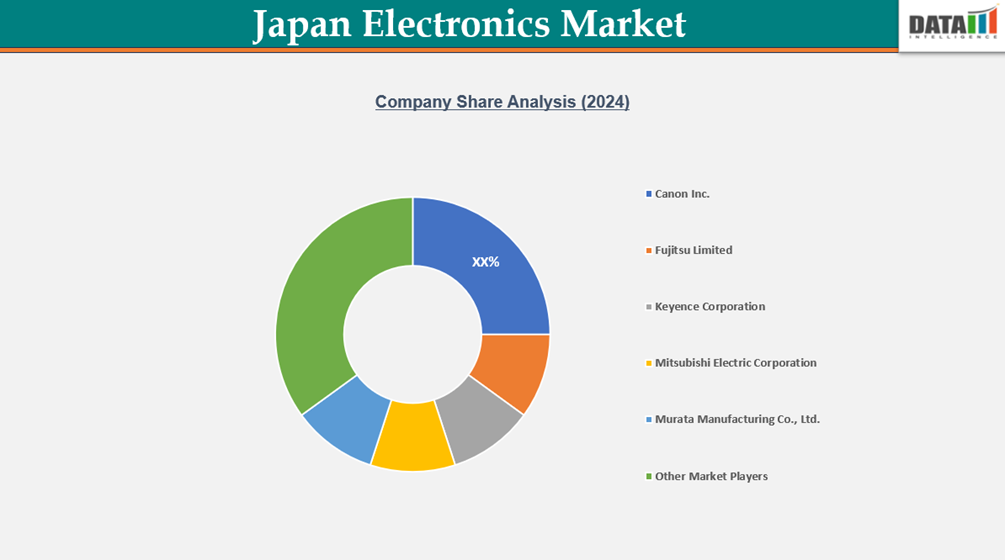
- Japan electronics market in Japan is dominated by a mix of leading domestic producers. Canon Inc., Fujitsu Limited, Keyence Corporation, Mitsubishi Electric Corporation, Murata Manufacturing Co., Ltd., NEC Corporation, Nintendo Co., Ltd., Panasonic Holdings Corporation, Sony Group Corporation, and TDK Corporation collectively hold a significant market presence through strong brand recognition, diversified product portfolios, and strategic distribution across domestic and international markets.
- A second tier of smaller or niche electronics firms focuses on specialized offerings such as industrial automation solutions, high-precision components, and gaming peripherals. These producers leverage advanced technology, innovation, and targeted R&D to address gaps in performance, efficiency, and product customization within the market.
- The broader market remains fragmented, with emerging firms experimenting in areas like AI integration, IoT-enabled devices, renewable energy electronics, and miniaturized components. Market expansion is fueled by rising domestic and global demand for high-tech solutions, government support for technological innovation, and Japan’s reputation as a leader in electronics manufacturing and innovation.
Key Developments in Japan Electronics Market
- July 2026: Sony Group Corporation expanded its semiconductor and imaging sensor business by advancing next-generation CMOS image sensors and AI-enabled electronics solutions for consumer and industrial applications.
- July 2026: Panasonic Holdings Corporation strengthened its electronics portfolio through continued investments in energy-efficient appliances, industrial automation, and advanced battery technologies supporting smart manufacturing.
- June 2026: Mitsubishi Electric Corporation enhanced its factory automation and power electronics business by introducing AI-enabled industrial solutions for manufacturing, infrastructure, and energy management.
- June 2026: Canon Inc. expanded its imaging and semiconductor equipment portfolio by advancing lithography and precision imaging technologies for semiconductor manufacturing and healthcare applications.
- May 2026: Murata Manufacturing Co., Ltd. strengthened its electronic components business by expanding production of multilayer ceramic capacitors (MLCCs) and advanced sensor technologies for automotive and AI applications.
- May 2026: TDK Corporation advanced its electronic components portfolio by expanding high-performance batteries, sensors, and passive components for electric vehicles, industrial equipment, and consumer electronics.
- April 2026: Fujitsu Limited continued accelerating digital transformation initiatives through AI, quantum computing, and advanced computing solutions for enterprise and public sector customers.
- April 2026: NEC Corporation strengthened its AI and telecommunications portfolio by advancing next-generation networking, cybersecurity, and digital infrastructure solutions.
- March 2026: Keyence Corporation expanded its factory automation portfolio by introducing advanced machine vision, sensing, and industrial inspection technologies for smart manufacturing.
Why Choose DataM?
- Data-Driven Insights: Dive into detailed analyses with granular insights such as pricing, market shares and value chain evaluations, enriched by interviews with industry leaders and disruptors.
- Post-Purchase Support and Expert Analyst Consultations: As a valued client, you gain direct access to our expert analysts for personalized advice and strategic guidance, tailored to your specific needs and challenges.
- White Papers and Case Studies: Benefit quarterly from our in-depth studies related to your purchased titles, tailored to refine your operational and marketing strategies for maximum impact.
- Annual Updates on Purchased Reports: As an existing customer, enjoy the privilege of annual updates to your reports, ensuring you stay abreast of the latest market insights and technological advancements. Terms and conditions apply.
- Specialized Focus on Emerging Markets: DataM differentiates itself by delivering in-depth, specialized insights specifically for emerging markets, rather than offering generalized geographic overviews. This approach equips our clients with a nuanced understanding and actionable intelligence that are essential for navigating and succeeding in high-growth regions.
- Value of DataM Reports: Our reports offer specialized insights tailored to the latest trends and specific business inquiries. This personalized approach provides a deeper, strategic perspective, ensuring you receive the precise information necessary to make informed decisions. These insights complement and go beyond what is typically available in generic databases.
Target Audience
This report is designed to support stakeholders across Japan’s electronics ecosystem by providing actionable market intelligence, industry insights, and strategic analysis to evaluate market opportunities, technological advancements, competitive positioning, and future growth prospects.
The report is valuable for:
- Manufacturers and Industry Leaders: Companies involved in semiconductors, consumer electronics, industrial automation, automotive electronics, telecommunications, robotics, healthcare electronics, advanced materials, renewable energy, defense electronics, and precision manufacturing seeking market expansion and competitive insights.
- Technology and R&D Professionals: Research teams, semiconductor engineers, product developers, and innovation leaders tracking emerging technologies, product advancements, and next-generation electronics solutions.
- Business and Strategy Executives: C-suite executives, technology strategists, and business leaders leveraging market intelligence for investment planning, strategic decisions, and long-term growth initiatives.
- Supply Chain and Procurement Professionals: Supply chain managers, sourcing specialists, and procurement teams analyzing supplier landscapes, manufacturing trends, and operational opportunities.
- Investors and Financial Institutions: Investment firms, venture capitalists, analysts, and consulting organizations evaluating market potential, industry trends, and investment opportunities within Japan’s electronics sector.
- Government and Research Organizations: Policymakers, academic institutions, and research bodies assessing industry developments, regulatory trends, innovation ecosystems, and technology-driven economic growth.
- Sustainability and Emerging Technology Stakeholders: Sustainability managers and technology ecosystem participants exploring advancements in energy-efficient electronics, green manufacturing, and future technology applications.


























































