


Japan Assistive Devices Market Size
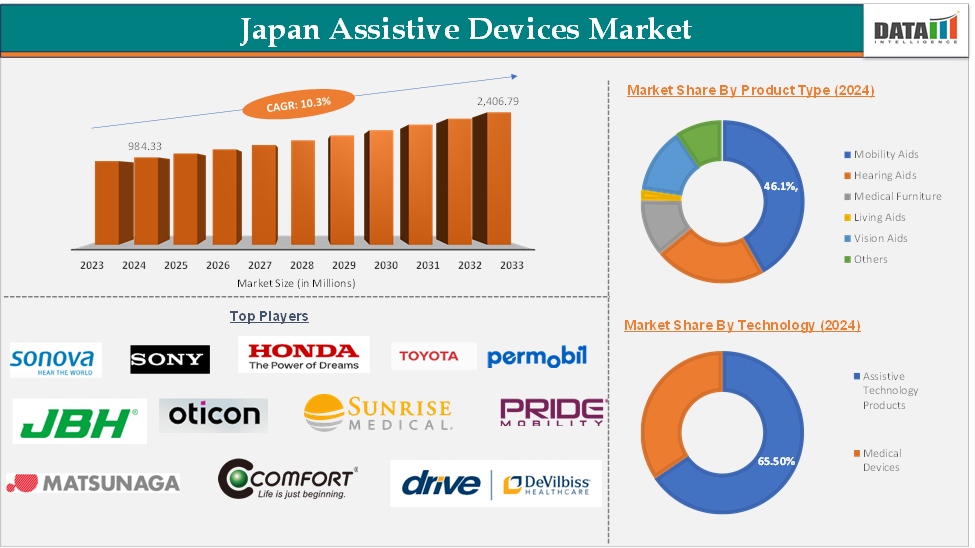
Japan Assistive Devices Market reached US$ 1,085.7 million in 2025 and is expected to reach US$ 2,406.8 million by 2033, growing at a CAGR of 10.3% during the forecast period 2026-2033
The Japan assistive devices market refers to the sector providing products and technologies that help people with disabilities or age-related impairments maintain independence and improve quality of life, including mobility aids, sensory devices, and smart home solutions.
Driven by Japan’s rapidly aging population, the highest proportion of elderly citizens globally, along with a rising prevalence of chronic diseases and disabilities, the market is expanding steadily. Key opportunities stem from advances in AI, robotics, and IoT, which are making devices more intuitive, personalized, and effective, as well as strong government support and policy initiatives aimed at improving accessibility and affordability.
Current trends include a shift toward home-based and personalized care, integration of smart technologies, and growing demand for mobility impairment devices due to conditions like arthritis and stroke.
Executive Summary
For more details on this report – Request for Sample
Japan Assistive Devices Market Drivers
Innovations in assistive technology
Innovations in assistive technology have significantly contributed to the growth of the Japanese assistive devices market, with developments enhancing both the accessibility and functionality of products designed for individuals with disabilities and the elderly population. In the mobility aids sector, new lightweight, comfortable wheelchairs have been introduced, offering longer battery life and greater user independence.
The integration of artificial intelligence (AI) further personalizes these technologies, making them more intuitive and efficient. These advancements are transforming assistive devices into essential tools that significantly improve quality of life, especially as Japan’s aging population continues to drive demand for such technologies.
For instance, in January 2025, Yamaha Motor is taking a major leap forward with the global launch of its JWG-1 electric wheelchair power unit. The company’s first full redesign in a decade. The JWG-1 is designed to retrofit manual wheelchairs, transforming them into electric-powered models with enhanced features such as improved LCD controller visibility, a new lever throttle, greater maximum load capacity, increased torque, and a lighter battery. All these factors demand the Japan assistive devices market.
Japan Assistive Devices Market Restraints
High cost of assistive devices
One of the significant constraints facing the Japanese assistive devices market is the high cost of assistive devices, which limits accessibility for many potential users. Products like advanced mobility aids (e.g., powered wheelchairs, smart scooters) and hearing aids can be expensive due to the cost of cutting-edge technology, advanced materials, and customized features.
For instance, high-quality powered wheelchairs can range from ¥500,000 to ¥1,500,000 ($3,500 to USD 10,000) in Japan, while hearing aids can cost around ¥100,000 to ¥400,000 ($700 to USD 3,000) for top-end models.
Such high costs create significant financial barriers for many individuals, especially in a market where a substantial proportion of the population is elderly and may have fixed incomes. The demand for assistive devices is also increasing with Japan's aging demographic. By 2025, nearly 30% of the population will be 65 years or older, putting further strain on consumers’ ability to afford these devices.
Furthermore, public and insurance coverage for these products is often limited, which exacerbates the affordability issue, making it harder for many people to access the assistive devices they need to maintain their independence and quality of life. Thus, the above factors could be limiting the Japan assistive devices market's potential growth.
Japan Assistive Devices Market Segment Analysis
The Japan assistive devices market is segmented based on product type, technology, and end-user.
Product Type:
The mobility aids product type segment is expected to hold 46.1% of the Japan assistive devices market in 2025
The mobility aids segment is a cornerstone of the Japanese assistive devices market, addressing the critical needs of an aging and mobility-impaired population. This segment includes a wide range of products from manual and powered wheelchairs to walkers, rollators, canes, and scooters that are designed to improve mobility and independence.
Advanced features such as lightweight materials, enhanced battery performance, and even smart technology integrations like autonomous driving assistance are making these devices more efficient and user-friendly. These innovations not only help users move more safely and comfortably but also support greater independence in daily life.
Additionally, key players in the industry have innovative launches that would drive this segment's growth in the Japanese assistive devices market. For instance, in December 2024, May Mobility launched an autonomous vehicle (AV) service in Fukuoka, Japan, in collaboration with Toyota's e-Palette mobility platform. This service, which operates at Toyota Motor Kyushu’s Miyata factory, uses a customized version of the e-Palette battery-electric vehicle to provide an efficient and effective transit option for factory employees and guests. These factors have solidified the segment's position in the Japan assistive devices market.
Japan Assistive Devices Market Major Players
The major players in the Japan assistive devices market include Sonova., Sony B.V., Honda Motor Co., Ltd., Toyota, Matsunaga, WHILL, Inc., Oticon Inc., Comfort., Anhui JBH Medical Apparatus Co., Ltd, Sunrise Medical, Permobil, DRIVE MEDICAL GMBH & CO. KG, Invacare Corporation, Pride Mobility Products Corp., and HurryCane, among others.
Key Developments
- AI-Powered Robotic Caregiving Solutions Gain Momentum in Japan
Japan is accelerating adoption of AI-enabled assistive robotics to address caregiver shortages caused by its aging population. In 2025, researchers in Tokyo demonstrated the humanoid caregiving robot “AIREC,” designed to assist elderly patients with mobility and daily care tasks. - Yamaha Motor Launched the Next-Generation JWG-1 Electric Wheelchair Unit
Yamaha Motor introduced the redesigned JWG-1 electric wheelchair power unit in 2025, featuring improved torque, lighter batteries, enhanced controller visibility, and better retrofit compatibility for manual wheelchairs. The launch reflects rising demand for smart mobility assistance technologies in Japan. - Digital Accessibility Platforms Expand Across Japan’s Transport Infrastructure
Transreport partnered with Hankyu Corporation to launch Passenger Assistance Web, a digital accessibility platform allowing passengers with mobility challenges to pre-register support requirements before travel across Japan’s railway networks. - Smart Hearing Assistance Technologies Enter Consumer Healthcare Markets
Japanese audio technology companies are increasingly entering the assistive hearing segment. Audio-Technica launched its Mimio hearing-assistance earbuds and portable speaker systems designed for users with mild-to-moderate hearing loss, highlighting convergence between consumer electronics and assistive healthcare. - Robotic Mobility and Exoskeleton Innovation Accelerates
Japanese manufacturers and mobility innovators are investing heavily in advanced robotic mobility systems, stair-climbing wheelchairs, and wearable assistive technologies. Toyota showcased its “Walk Me” autonomous mobility concept at the Japan Mobility Show 2025, reflecting growing innovation in next-generation mobility assistance solutions.
Market Scope
Metrics | Details | |
CAGR | 10.3% | |
Market Size Available for Years | 2023-2033 | |
Estimation Forecast Period | 2026-2033 | |
Revenue Units | Value (US$ Mn) | |
Segments Covered | Product Type | Mobility Aids, Hearing Aids, Medical Furniture, Living Aids, Vision Aids, Others |
Technology | Assistive Technology Products, Medical Devices | |
End-User | Hospitals, Home Care Settings, Assisted Living Facilities, Others | |




























































