


Market Size and Growth
The Global Global Intratumoral Cancer Therapies Market reached USD 0.89 billion in 2025 and is projected to witness lucrative growth by reaching USD 2.36 billion by 2033 is expected to exhibit a CAGR of 12.9% during the forecast period 2026-2033,. The global intratumoral cancer therapies market is experiencing robust growth, driven by the rising prevalence of solid tumors and the growing preference for targeted, localized cancer treatments that minimize systemic toxicity. Intratumoral therapies, which involve direct administration of therapeutic agents into tumors, are transforming cancer care by inducing strong local immune responses and enhancing tumor antigen presentation.
Furthermore, a strong clinical pipeline supported by biotech innovation and favorable regulatory pathways is accelerating market development. Leading players such as Amgen Inc. (developer of Imlygic), Daiichi Sankyo Company, Limited (developer of Delytact for glioma), and Shanghai Sunway Biotech Co., Ltd. (commercializer of Oncorine in China) are at the forefront of innovation, while emerging companies continue to expand the landscape with novel intratumoral immunotherapies in clinical stages.
Key Market highlights
- North America accounted for approximately 41.9% of the global Intratumoral Cancer Therapies market in 2024 and is expected to maintain its dominant position throughout the forecast period. The region’s leadership is supported by a robust biopharmaceutical ecosystem, strong regulatory frameworks, and high adoption rates of advanced immuno-oncology treatments. The presence of key market players, extensive clinical research activities, and rapid integration of novel intratumoral agents.
- Asia-Pacific holds around 19.4% of the global market and is projected to be the fastest-growing region during the forecast period. Growth in this region is fueled by improving healthcare infrastructure, rising awareness of intratumoral therapies, and increasing cancer prevalence across major economies such as China, Japan, and India.
- By intratumoral agent, oncolytic viruses remain the dominant segment, accounting for approximately 46.8% of the global intratumoral cancer therapies market in 2024. Their leadership is driven by the proven efficacy of viral-based therapies in stimulating systemic anti-tumor immune responses and enhancing the effectiveness of checkpoint inhibitors.
Market Size & Forecast
- 2025 Market Size: USD 0.89 billion
- 2033 Projected Market Size: USD 2.36 billion
- CAGR (2026–2033): 12.9%
- North America: Largest market in 2024
- Asia Pacific: Fastest-growing market
For more details on this report, Request for Sample
Market Dynamics:
Source: DataM Intelligence
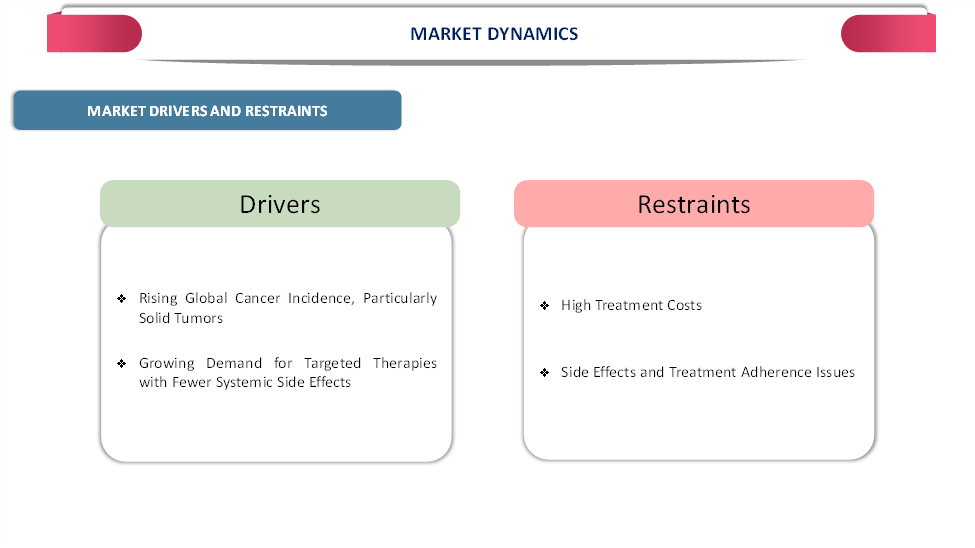
Driver: Rising Global Cancer Incidence, Particularly Solid Tumors
The rising global incidence of solid tumors is a key factor driving the growth of the intratumoral cancer therapies market. As cancers such as lung, breast, colorectal, prostate, and stomach become increasingly prevalent, there is a growing demand for localized, targeted treatments that can effectively attack tumors while minimizing systemic side effects.
Intratumoral therapies, which deliver agents directly into the tumor microenvironment, address the limitations of traditional therapies by enhancing local immune activation and tumor destruction with improved safety profiles. This approach is especially valuable for difficult-to-treat or inoperable tumors and aligns with the broader trend toward personalized oncology care.
According to the International Agency for Research on Cancer (IARC), nearly 20 million new cancer cases were diagnosed worldwide in 2022, with lung cancer being the most common, accounting for about one in eight cases globally. Breast, colorectal, prostate, and stomach cancers also represent significant portions of the cancer burden.
Additionally, it is estimated that 27 million new cancer cases are expected to be reported by 2035, and 32.6 million new cancer cases by 2045. This increasing incidence and prevalence of tumors underscores the urgent need for innovative therapies such as intratumoral treatments, fueling both clinical interest and market expansion.
With the rising cancer incidence, several pharmaceutical and biotech companies are initiating trials that are expected to get approvals with their efficiency and effectiveness. Thus, the above factors are expected to drive the overall intratumoral market growth.
Restraint: Limited Number of Approved Intratumoral Therapies Globally
The limited number of approved intratumoral therapies globally remains a significant factor hampering the growth of the Intratumoral Cancer Therapies market. Despite promising clinical results and growing research interest, only a few therapies have received regulatory approval across key markets. This scarcity of approved products restricts treatment accessibility and limits physicians’ ability to adopt intratumoral approaches widely.
Market Segmentation Analysis
The global intratumoral cancer therapies market is segmented by intratumoral agent, cancer type, end user and region.
Treatment: The oncolytic viruses segment is estimated to have 46.8% of the intratumoral cancer therapies market share.
The oncolytic viruses segment is emerging as one of the most promising areas within the intratumoral cancer therapies market, owing to its unique mechanism of action and growing clinical success. These viruses not only directly infect and lyse cancer cells but also stimulate a systemic antitumor immune response by exposing tumor antigens. This localized and dual-action approach makes oncolytic viruses especially well-suited for intratumoral administration, as they can be delivered directly to tumor sites, ensuring high local efficacy while minimizing systemic toxicity.
Recent developments have further validated this segment’s potential. In March 2024, ImmVira’s MVR‑T3011 IT received FDA fast track designation for recurrent or metastatic head and neck squamous cell carcinoma, marking a major step forward for HSV-based oncolytic platforms that incorporate immune-stimulatory payloads like PD-1 antibodies and IL-12.
Similarly, in December 2024, EpicentRx’s AdAPT‑001, an oncolytic adenovirus designed to inhibit TGF-β, was granted fast-track designation for recurrent soft tissue sarcoma in late 2024, reflecting the growing use of OVs in difficult-to-treat tumors. Beyond regulatory momentum, oncolytic viruses are increasingly being combined with immune checkpoint inhibitors to overcome resistance and enhance therapeutic outcomes.
With rising cancer incidence, especially solid tumors suitable for localized injection, and a rapidly expanding pipeline of engineered viral candidates, the oncolytic viruses segment is expected to capture a significant share of the global intratumoral cancer therapies market over the coming years.
The adenovirus segment is estimated to have 29.8% of the intratumoral cancer therapies market share.
The adenovirus segment is projected to emerge as the fastest-growing segment in the global Intratumoral Cancer Therapies market, driven by its high transduction efficiency, strong immunogenic profile, and versatility in delivering therapeutic genes directly into tumor cells. Adenoviral vectors are showing promising clinical outcomes in solid tumors such as head and neck, pancreatic, and liver cancers due to their ability to stimulate robust local immune responses and induce tumor regression. Ongoing research into next-generation adenoviral platforms, combined with rising collaborations between biotechnology firms and academic institutions, is accelerating development pipelines. Additionally, the increasing number of adenovirus-based candidates entering advanced clinical trials is expected to expand treatment availability and fuel market growth over the coming years.
Market Geographical Share
The North America intratumoral cancer therapies market was valued at 41.9% market share in 2024
North America is currently holding a dominant portion in the intratumoral cancer therapies market due to its robust oncology ecosystem, strong regulatory support, and high disease burden, and it is expected to continue throughout the forecast period. The region benefits from a supportive regulatory framework that frequently grants designations like Fast Track, expediting the development of novel therapies.
According to the International Agency for Research on Cancer, in 2022, approximately 2.67 million new cancer cases were reported in North America, and this number is projected to rise to around 3.42 million by 2035, highlighting the urgent need for more effective and targeted treatment options. The increasing burden of solid tumors makes the region an ideal environment for the development and deployment of intratumoral therapies
North America is emerging as a leading region in the intratumoral cancer therapies market, fueled by a growing pipeline of innovative therapies, increased clinical trial activity, and strong regulatory and research infrastructure. The region's momentum is reflected in recent developments. For instance, in June 2025, Intensity Therapeutics, Inc. announced that initial patients in its Phase 2 INVINCIBLE-4 trial showed high levels of tumor necrosis within eight days of receiving its intratumoral candidate INT230-6, before starting standard-of-care treatment. Such advancements highlight the region’s active role in driving forward intratumoral immunotherapy innovation. These factors position North America as a critical growth driver for the intratumoral cancer therapies market.
The European intratumoral cancer therapies market was valued at 21.9% market share in 2024
Europe holds a significant position in the global Intratumoral Cancer Therapies market, supported by a strong foundation of oncology research, favorable reimbursement policies, and widespread adoption of advanced cancer treatment modalities. The region benefits from robust investments in immuno-oncology, increasing clinical trial activity across countries such as Germany, the U.K., and France, and regulatory initiatives from the European Medicines Agency (EMA) promoting the development of innovative therapies. In addition, well-established healthcare infrastructure and a growing focus on personalized medicine continue to reinforce Europe’s leadership in the clinical adoption of intratumoral therapies.
The Asia-Pacific intratumoral cancer therapies market was valued at 19.4% market share in 2024
The Asia-Pacific region is anticipated to be the fastest-growing market for Intratumoral Cancer Therapies, driven by rapid improvements in healthcare infrastructure, increasing cancer incidence, and rising government support for biotechnology and oncology research. Expanding access to advanced treatment modalities, growing participation in international clinical trials, and rising investments from local biotech companies are propelling regional market expansion.
Countries such as China, Japan, and South Korea are at the forefront of this growth, actively developing and commercializing novel intratumoral agents, positioning the Asia-Pacific as a key hub for innovation and future market opportunities.
Market Competitive Landscape
The major players in the intratumoral cancer therapies market include Pfizer Inc., Bristol Myers Squibb Company, BridgeBio Pharma, Inc., Boston Scientific Corporation, among others.
Market Scope
| Metrics | Details | |
| CAGR | 12.9% | |
| Market Size Available for Years | 2025-2033 | |
| Estimation Forecast Period | 2026-2033 | |
| Revenue Units | Value (US$ Bn) | |
| Segments Covered | Intratumoral Agent | Oncolytic Viruses, Adenovirus, Others |
| Cancer Type | Melanoma, Breast Cancer, Prostate Cancer Lung Cancer, Head and Neck Cancer, Others | |
| End User | Hospitals, Cancer Research Centers, Specialty Clinics, Others | |
| Regions Covered | North America, Europe, Asia-Pacific, South America, and the Middle East & Africa | |
The global intratumoral cancer therapies market report delivers a detailed analysis with 70 key tables, more than 66 visually impactful figures, and 195 pages of expert insights, providing a complete view of the market landscape.
Suggestions for Related Report:
For more pharmaceutical-related reports, please click here



























































