


Global Interior Fit-Out Market Size
The global interior fit-out market reached US$ 69.63 billion in 2025 and is expected to reach US$ 150.33 billion by 2035, growing at a CAGR of 8.0% during the forecast period 2026–2035.
The global interior fit-out market is witnessing steady growth, fueled by rising demand across commercial offices, retail, hospitality, healthcare, and residential spaces. Interior fit-outs, which convert bare structures into fully functional and customized environments, are becoming indispensable for modern workplaces and lifestyle projects. Market expansion is further supported by rapid urbanization, growing emphasis on employee productivity, sustainability-focused building practices, and the adoption of smart technologies. Additionally, strategic collaborations between developers, contractors, and design firms are reshaping industry dynamics.
The United States remains the largest market for interior fit-outs, driven by strong activity in the corporate, retail, and hospitality sectors. For instance, Google’s Bay View Campus in California, which incorporated WELL-certified interiors, modular layouts, and sustainable design solutions to enhance workplace performance. Backed by corporate expansion, robust real estate investment, and sustainability initiatives, the U.S. continues to lead global advancements in the interior fit-out industry.
Japan is also emerging as a key market, supported by urban redevelopment projects and rising investment in modern office and retail interiors. The hospitality sector is also seeing significant activity, with luxury projects such as the Four Seasons Hotel Tokyo at Otemachi showcasing premium interiors and eco-conscious finishes. Combined with government-backed smart city initiatives and partnerships with global design and build firms, Japan is expected to accelerate adoption of advanced fit-out solutions across both commercial and hospitality sectors.
Interior Fit Out Market Key Takeaways
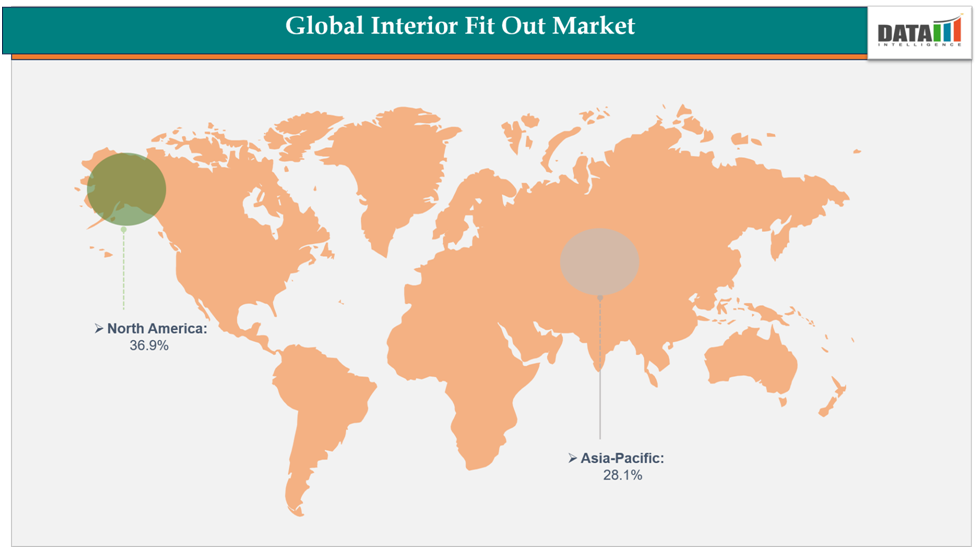
- North America held 36.9% in 2025: Strong commercial real estate activity, workplace redesign, sustainability programs, and demand for flexible office environments underpin the region's leading position.
- Asia-Pacific accounted for 28.1% in 2025: Rapid urbanization, corporate expansion, hospitality investment, and retail development make the region the fastest-growing geographic market.
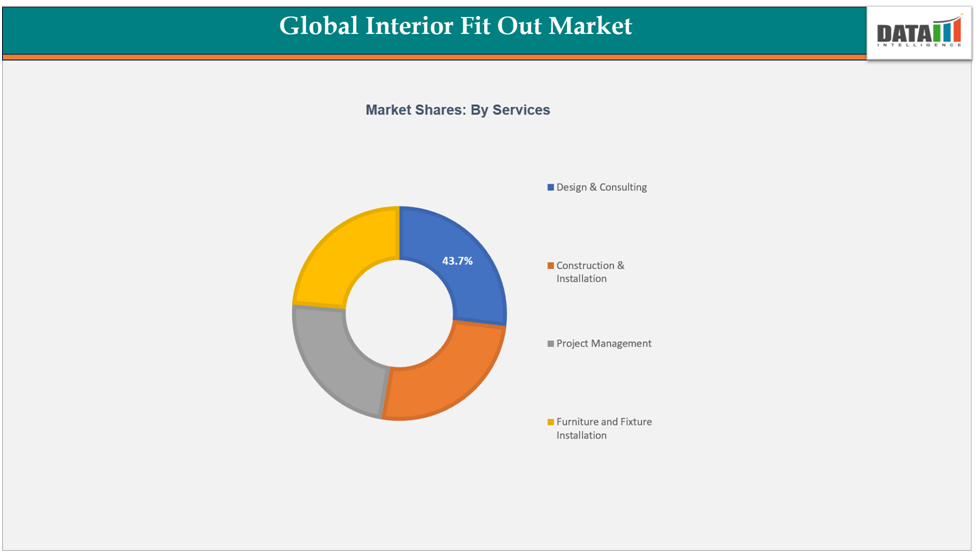
- Construction & Installation represented 43.7%: The segment benefits directly from demand for partitions, flooring, ceilings, lighting, furniture, and other elements required to convert developed spaces into operational environments.
- Cost management is becoming a strategic priority: India's medium-specification office fit-out costs increased 4.5%, reaching INR 5,788 per sq. ft. from INR 5,546, while Mumbai reached INR 6,588 per sq. ft. and New Delhi INR 6,068 per sq. ft.
- Workplace strategy is influencing procurement: Hybrid work, flexible layouts, employee well-being, sustainability, and smart-office requirements are increasingly influencing how organizations allocate fit out budgets.
Interior Fit Out Market Scope
| Metric | Details |
| Market Size in 2025 | US$ 69.63 billion |
| Market Size by 2035 | US$ 150.33 billion |
| CAGR | 8.00% |
| Historic Years | 2023-2024 |
| Base Year | 2025 |
| Forecast Period | 2026-2035 |
| 2023 Market Size | US$ 59.75 billion |
| 2024 Market Size | US$ 64.47 billion |
| Source Forecast Value | US$ 128.88 billion in 2033 |
| Leading Region | North America |
| Fastest-Growing Region | Asia-Pacific |
Interior Fit Out Market Size & Forecast
2025 Market Size: US$ 69.63 billion
2035 Projected Market Size: US$ 150.33 billion
CAGR (2026–2035): 8.0%
North America: Largest market in 2025
Asia-Pacific: Fastest-growing market
Interior Fit Out Market Drivers & Restraints
Driver: Rising demand for modern workplaces, co-working spaces, and flexible office layouts.
The global interior fit out market, encompassing companies providing design, project management, and execution services, has become an essential part of the construction and real estate ecosystem. By focusing on modern, functional, and sustainable workplace solutions, service providers are enabling businesses to adapt to changing workforce dynamics, including hybrid working models, agile environments, and wellness-focused spaces. The importance of the market lies in its ability to transform raw spaces into efficient, brand-aligned environments that enhance productivity and employee satisfaction.
For instance, In September 2025, Icework’s new workspace in Business Bay was recently completed with a fit-out designed to foster a modern, efficient, and inspiring environment for their team. The project focused on transforming the design vision into a fully functional workplace that not only supports daily operations but also cultivates collaboration and growth. This reflects how interior fit out solutions are increasingly aligned with corporate strategies to improve workplace efficiency and innovation, further fueling the demand for modern and flexible office layouts across global markets.
Restraint: High initial cost of premium interior fit outs and advanced materials.
Despite the strong growth trajectory, the interior fit out market faces significant cost-related challenges that can affect adoption, particularly in cost-sensitive regions. Inflationary pressures, rising commodity prices, and higher construction expenses are pushing fit-out costs upward, creating budgetary concerns for businesses.
For instance, according to JLL’s Asia Pacific Fit-Out Cost Guide 2023/2024, the average cost to fit out workplaces with medium specifications across India increased by 4.5%, with per sq. ft. costs rising to INR 5,788 from INR 5,546 in the previous year. Mumbai remains the most expensive market at INR 6,588 per sq. ft., followed by New Delhi at INR 6,068 per sq. ft. Such rising costs highlight how inflation and supply chain volatility are placing pressure on project budgets, potentially slowing down market growth.
While cost escalations present challenges, interior fit out providers are actively adopting strategies to mitigate these impacts. Companies are increasingly emphasizing design efficiency, modular fit-out solutions, and sustainable material sourcing to deliver high-quality spaces without proportionally higher costs. Additionally, flexible contracting models, value engineering, and technology-driven project management tools are helping clients optimize budgets while ensuring timely delivery.
As a result, even with cost inflation, businesses continue to view fit-outs as long-term investments in productivity, talent retention, and brand positioning. This perspective ensures that demand remains resilient, particularly in fast-growing economies where modern workplaces are critical to competitiveness.
For more details on this report : Request for Sample
Interior Fit Out Market Segmentation Analysis
The global interior fit out market is segmented based on type of fit out, application, services and region.
Services: The Construction & Installation segment accounts for an estimated 43.7% of the global interior fit out market.
The construction &installation segment covers the main activities of interior fit outs, such as installing partitions, flooring, ceilings, lighting, and furniture, while also ensuring the space is functional and aligned with the client’s design vision.
Growth in this segment is being driven by the increasing demand for modern offices, co-working spaces, retail stores, hotels, and residential projects. For instance, in 2024, Ice work's new office in Business Bay was delivered with a complete fit-out focused on creating an efficient and collaborative environment showing how companies are using interior design to support productivity and team growth.
Major international players such as AECOM, ISG, Turner & Townsend, and Al Tayer Stocks lead the market by managing large, complex projects. At the same time, regional companies are growing by offering affordable, modular, and sustainable solutions that meet local needs. In India, the cost of fit outs has been rising due to inflation and material prices. According to JLL’s 2023/2024 report, fit-out costs increased by 4.5%, with Mumbai (INR 6,588 per sq. ft.) and New Delhi (INR 6,068 per sq. ft.) being the most expensive cities for office projects.
Looking ahead, the construction & installation segment is expected to stay the dominant part of the market. While challenges like rising costs and supply chain delays remain, the shift towards efficient designs, sustainable materials, and modular construction will help keep projects cost-effective and timely. Demand is set to remain strong, especially in North America, Asia-Pacific, and the Middle East, where businesses are actively upgrading workplaces, hotels, and retail spaces.
Interior Fit Out Market Geographical Analysis
The North American interior fit-out market was valued at 36.9% market share in 2025
The North American interior fit-out market accounted for 36.9% of the global share in 2025, making it the largest regional contributor. Growth in this region is supported by the strong demand for modern workplaces, co-working hubs, and flexible office layouts, particularly in the U.S. Major corporations are investing heavily in reimagining office spaces to improve collaboration, productivity, and employee well-being. In addition, the region is experiencing rising demand for retail and hospitality fit outs, reflecting ongoing consumer spending and lifestyle upgrades. The presence of global fit out leaders, coupled with advanced project management capabilities and high adoption of sustainable construction practices, reinforces North America’s leadership in the market.
The Asia-Pacific interior fit-out market was valued at 28.1% market share in 2025
The Asia-Pacific interior fit-out market held 28.1% of the global share in 2025 and is projected to be the fastest-growing region during the forecast period. This growth is driven by rapid urbanization, expansion of commercial real estate, and large-scale investments in hospitality and retail projects. Countries such as India, China, and Japan are leading demand, with rising corporate spending on modern offices and growing consumer interest in premium retail and residential interiors.
Importantly, organizations in the Asia-Pacific are continuing to adjust their hybrid work policies to favor more in-person attendance as the office sector regains its central role in commercial real estate. According to JLL’s Global Office Fit-Out Costs Guide 2025, Asia-Pacific has the lowest average office fit-out cost globally at US$ 1,460 per sqm, compared to the global average of US$ 1,830, and far below North America’s US$ 3,070 per sqm. This cost advantage, combined with rapid economic growth, makes the region attractive for companies investing in modern workplaces.
Meanwhile, India is experiencing cost inflation with fit-out prices rising by 4.5% in 2023, while Japan and China are seeing increased adoption of sustainable and technology-enabled designs. The mix of affordability, urban growth, and evolving corporate strategies ensures that Asia-Pacific will remain the fastest-growing interior fit out market worldwide.
Interior Fit Out Market Competitive Landscape
The major players in the interior fit out market include Creative Edge, LYNCO LTD, Lindner SE, Jones Lang LaSalle IP, Inc., AECOM, Overbury, Depa Group, INFYA, Creative Shelf, ALEC FITOUT
Creative Edge: Creative Edge is a leading player in the global interior fit out market, specializing in workspace design, commercial interiors, and turnkey fit-out solutions across offices, retail, and hospitality sectors. The company focuses on delivering functional, aesthetically appealing, and technology-enabled spaces that enhance productivity and customer experience. With strong design expertise, project management capabilities, and collaborations with real estate developers and corporate clients, Creative Edge continues to drive innovation in modular layouts, sustainable materials, and smart office solutions, reinforcing its position as a key contributor to the global interior fit out industry.
Interior Fit Out Market Recent Developments
August 2026: In North America, interior fit-out demand continued to be shaped by workplace modernization, hybrid-office requirements, and higher-performance workspaces. JLL reported that global fit-out costs increased by 2–6% over the previous year, keeping cost optimization a major priority.
July 2026: In Asia-Pacific, particularly India, organized interior execution continued expanding through technology-enabled delivery, modular solutions, and multi-city operations. IKEA India announced plans to more than double its investment in India by 2030, supporting the broader interiors and furnishings ecosystem.
June 2026: In Europe, fit-out projects increasingly emphasized sustainable materials, energy efficiency, adaptive reuse, and flexible workplace environments, as companies sought to improve building performance and reduce lifecycle costs.
May 2026: In India, Godrej Interio expanded its footprint across 100 new cities and planned another 102 stores for FY27, supporting demand for organized furniture, fixtures, and interior solutions.
April 2026: Globally, the industry increasingly focused on BIM, digital visualization, smart interiors, modular construction, sustainable materials, and AI-assisted design, while demand continued across corporate offices, hospitality, healthcare, residential, retail, and institutional projects.
Target Audience
- Interior fit out contractors and construction companies
- Architecture, engineering, and design firms
- Commercial real estate developers and property owners
- Furniture, fixtures, lighting, flooring, and interior material manufacturers
- Smart workplace and building technology providers
- Hospitality and retail operators
- Corporate real estate and workplace strategy teams
- Procurement and sourcing departments
- Investment firms and private equity investors
- Infrastructure and public-sector project developers
- Construction project management companies
- Sustainability and ESG teams
- Business strategy and corporate development teams
Conclusion: Where the Commercial Case Is Strengthening
The global interior fit out market is evolving from a project-execution category into a broader business-environment investment. The market's estimated expansion from US$ 69.63 billion in 2025 to approximately US$ 150.33 billion by 2035, based on the source's 8.0% CAGR, reflects continued demand for modern, flexible, sustainable, and technology-enabled spaces.
North America enters the forecast period with the strongest regional position, while Asia-Pacific offers the most compelling growth profile because of urbanization, corporate expansion, redevelopment, hospitality investment, and comparatively competitive office fit-out costs. The 43.7% share attributed to Construction & Installation also highlights the continuing importance of execution capability within the value chain.
The central commercial challenge will be balancing higher expectations for workplace quality, sustainability, technology, and customization against inflation and project-cost pressure. Contractors and suppliers that can deliver this balance through modular solutions, efficient project management, value engineering, and integrated services are better positioned to compete.
For corporate buyers, developers, investors, and procurement leaders, monitoring the interior fit out market now is increasingly relevant because decisions around workplace and property interiors directly influence how effectively organizations use their real estate assets. Through 2035, the strongest commercial opportunities are likely to be found where design quality, cost discipline, sustainability, and operational performance converge.





























































