


Industrial Carousel Market Overview
The global industrial carousel market reached US$ 944.68 million in 2025 and is expected to reach US$ 1,613.65 million by 2035, growing with a CAGR of 5.5% during the forecast period 2026-2035. Industrial carousel applications have become more common due to the greater focus that warehouses, manufacturing facilities, and logistics centers place on automation, efficiency and efficient space usage. With the rapid expansion of the internet, retailing, and logistics industries, there has been an increased need for efficient storage density, reduced picker downtime, and improved efficiency levels. The deployment of industrial robots in logistics and warehouse operations has also been observed by the International Federation of Robotics.
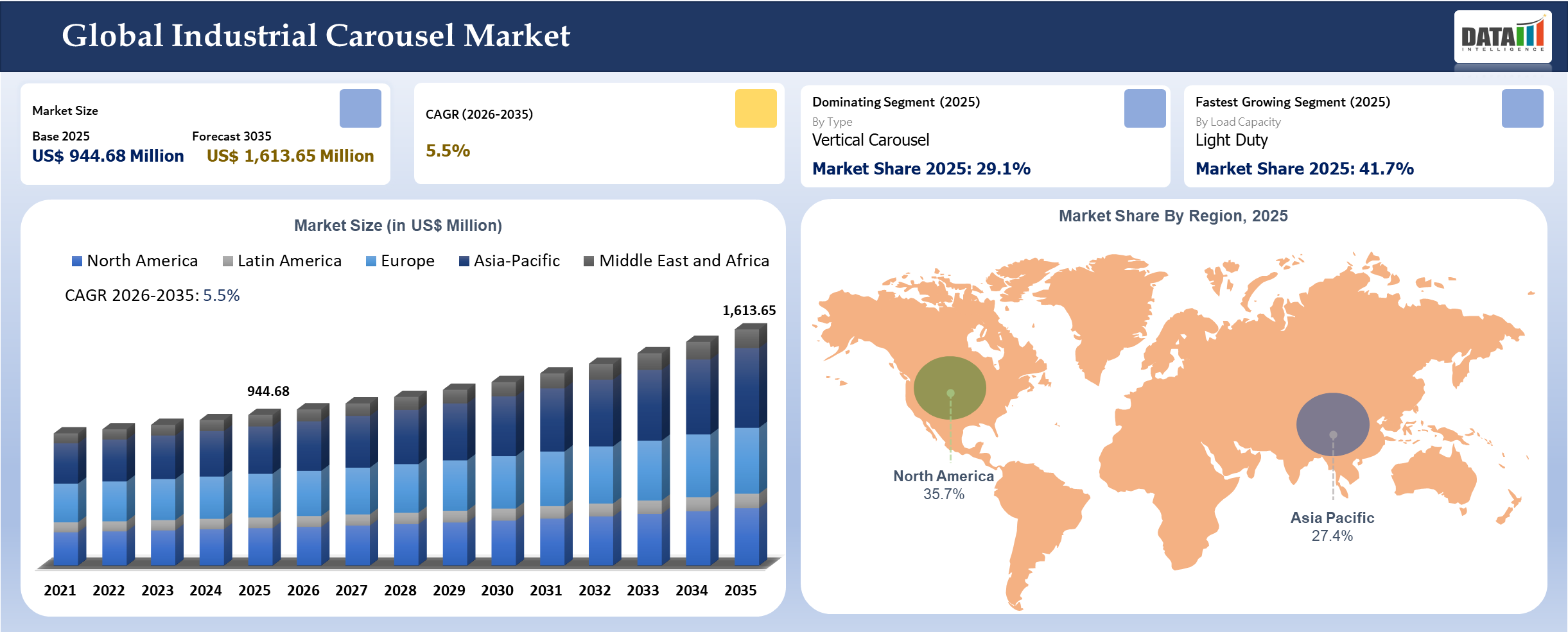
With an increase in interactions between the industrial carousel system and WMS, IoT sensors, and inventory analysis using artificial intelligence, the traditional storage system is becoming smarter. The use of digital transformation in manufacturing and logistics procedures through government and other industry bodies has led to innovations such as Industry 4.0 in Europe and Asia through investments in smart factories and storage facilities.
Industrial Carousel Industry Trends and Strategic Insights
- Europe remains the most influential region for demand creation and competitive benchmarking in the current market structure.
- Vertical Carousel is the most commercially important segment because it aligns with current buying behavior, installed base requirements and near-term scaling feasibility.
- The strongest growth trigger is warehouse labor productivity gains from dense goods to person storage, while the main execution risk is longer sales cycles and capex sensitivity in mid-size warehouses.
Market Scope
| Metrics | Details | |
| 2025 Market Size | US$ 944.68 Million | |
| 2035 Projected Market Size | US$ 1,613.65 Million | |
| CAGR (2026-2035) | 5.5% | |
| Largest Market | North America | |
| Fastest Growing Market | Asia-Pacific | |
| By Type | Vertical Carousel, Horizontal Carousel, Rotary Bin and Shelving Carousel, Specialized Work in Process Carousel | |
| By Load Capacity | Light Duty, Medium Duty, Heavy Duty | |
| By Picking Mode | Goods to Person, Batch Picking, Zone Picking, Parts Buffering | |
| By Deployment | Standalone, Integrated with WMS and ERP, Integrated with ASRS | |
| By Ceiling Height Utilization | Below 5 m, 5 m to 10 m, above 10 m | |
| By Application | Spare Parts Storage, MRO and Tool Crib, E-Commerce Fulfillment, Manufacturing Buffer Storage, Healthcare and Pharma Storage | |
| By End-User | Automotive, Aerospace, Industrial Manufacturing, Retail and Logistics, Healthcare | |
| By Region | North America | U.S., Canada, Mexico |
| Europe | Germany, UK, France, Spain, Italy, Poland | |
| Asia-Pacific | China, India, Japan, Australia, South Korea, Indonesia, Malaysia | |
| Latin America | Brazil, Argentina | |
| Middle East and Africa | UAE, Saudi Arabia, South Africa, Israel, Turkiye | |
| Report Insights Covered | Competitive Landscape Analysis, Company Profile Analysis, Market Size, Share, Growth | |
Disruption Analysis
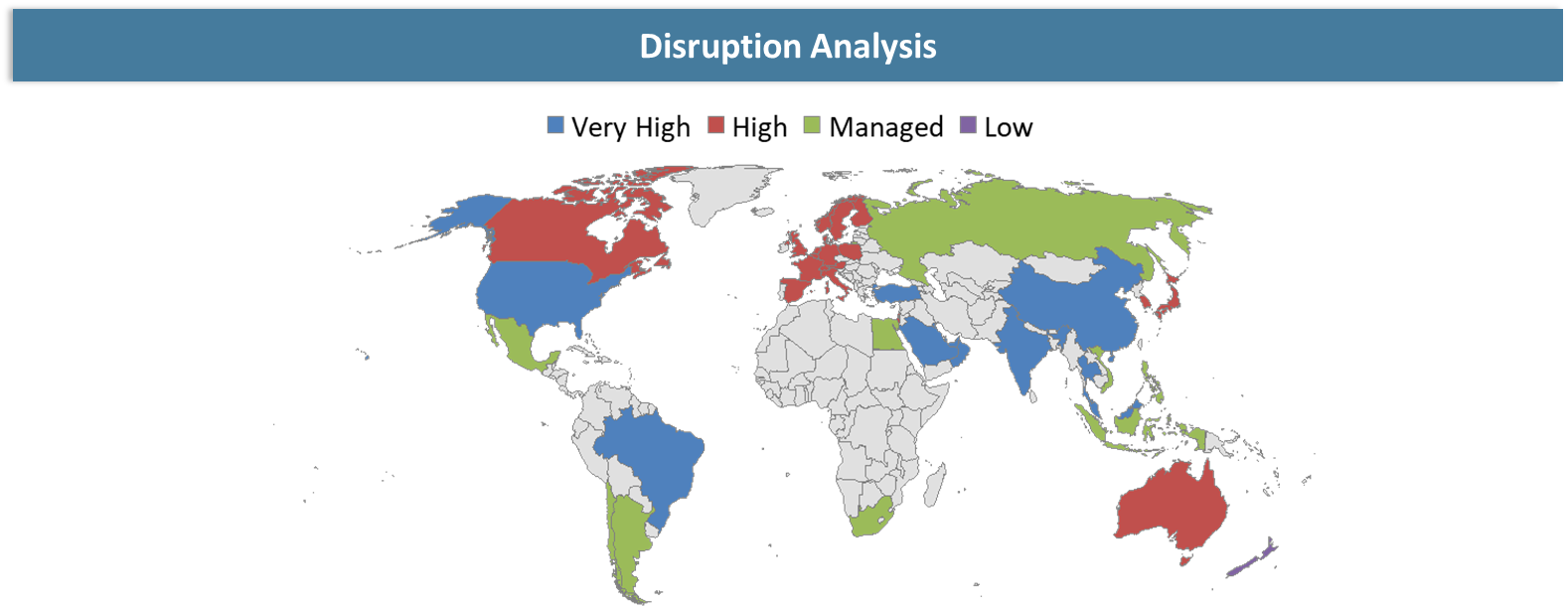
The emergence of autonomous mobile robots (AMRs) and goods-to-person systems has transformed the concept of material handling efficiency, posing a threat to standalone carousel systems that may become obsolete in high-throughput facilities. The migration towards cloud-based warehouse management systems and digital twins is creating an industry where the source of value is software rather than hardware, necessitating that suppliers position themselves as solution companies instead of equipment providers. Fluctuations in demand arising from e-commerce businesses and just-in-time manufacturing are making more and more companies consider flexibility and scalability in their storage systems. Sustainability considerations have also gained significance, with eco-friendly solutions and circular economy approaches becoming more relevant when it comes to procurement.
BCG Matrix: Company Evaluation
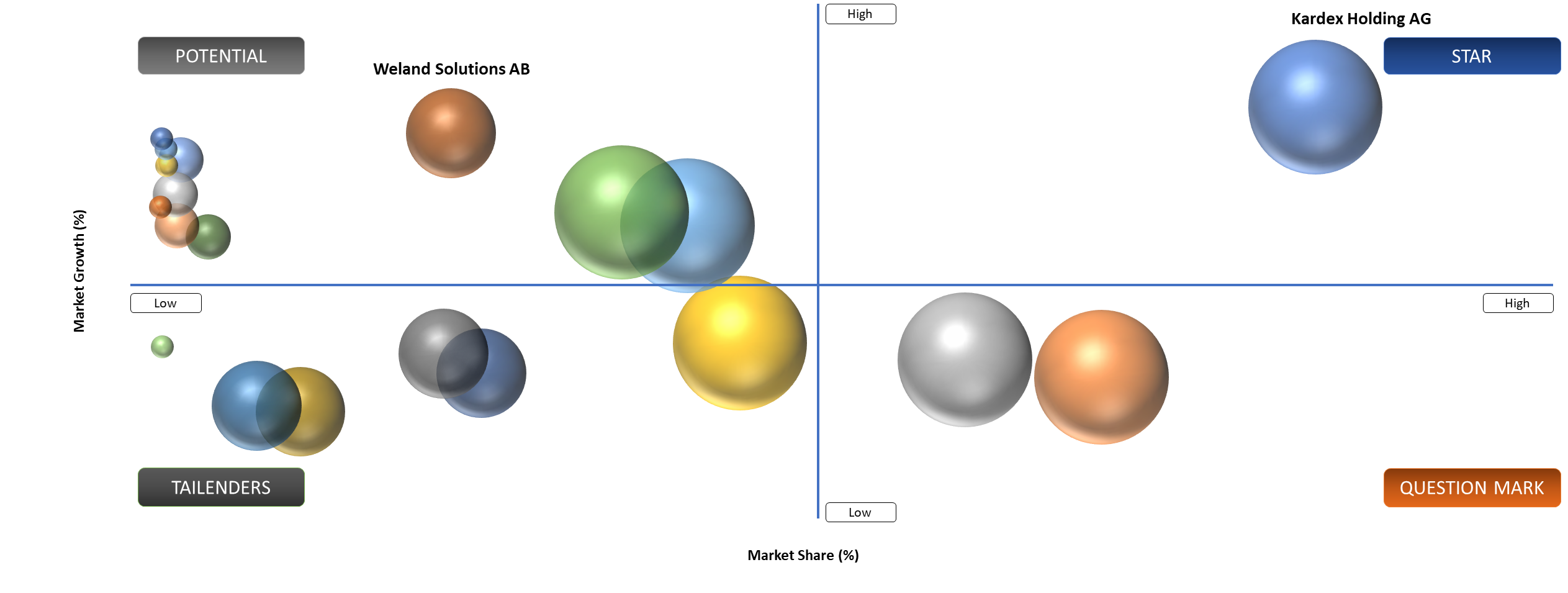
In BCG terms, the most likely Stars in the industrial carousel market are vendors that combine visible revenue momentum with a strong technology or channel position. In most cases, the lead group includes Kardex Holding AG, SSI SCHAEFER Group and Hanel GmbH and Co. KG because these companies influence product standards, customer qualification cycles and investment direction.
Market Dynamics
Warehouse labor productivity gains from dense goods to person storage
The primary growth factor is increased efficiency of the warehouse labor due to the dense storage ratio of goods to people. Consumers are becoming more demanding and now they look for products that can not only work but also deliver a good return on investment and implementation time. The commercial relevance of this factor lies in its ability to affect both first-time purchases and repeat business. In terms of vendor offerings, the driver favors companies that have the ability to standardize what needs to be standardized while leaving room for customized applications. Such vendors will have an easier time keeping their margins high, closing sales faster and developing their channel approaches. Medium-term growth of this factor is expected to help both premium and volume categories.
Longer sales cycles and capex sensitivity in mid-size warehouses
The main constraint relates to prolonged sales cycles and capital expenditure sensitivities at medium-sized warehouses. Although there may be a demand present, such a constraint could cause qualification delays, restricted market sizes or reduced willingness to pay. At the practical level, the above-mentioned constraint influences the conversion rate of interest into orders. The market where standards are fragmented, regulatory landscape is uncertain and infrastructure development is not complete, demonstrates high potential in theory but low commercialization depth in reality.
Segmentation Analysis
The global industrial carousel market is segmented based on the type, load capacity, picking mode, deployment, ceiling height utilization, application, end-user and region.
Vertical Systems Redefine Space Efficiency and Smart Warehouse Optimization
The vertical carousels segment seems to be the one that will attract the most interest from users who have limited space on their floors. The use of vertical space means that manufacturing plants, parts warehouses and medical supplies warehouses can store large amounts of stock while retaining controlled access. It is a particularly appealing prospect for brownfield projects since firms can enhance density without having to rebuild their entire warehouse infrastructure. It becomes even more pertinent when considering developed industrial sectors where brownfield development makes much more sense than setting up a new distribution center. Software support has also become an integral part of the offering. Vertical carousel makers now offer stock accuracy, operator assistance and mistake prevention in addition to their hardware products.
Geographical Penetration
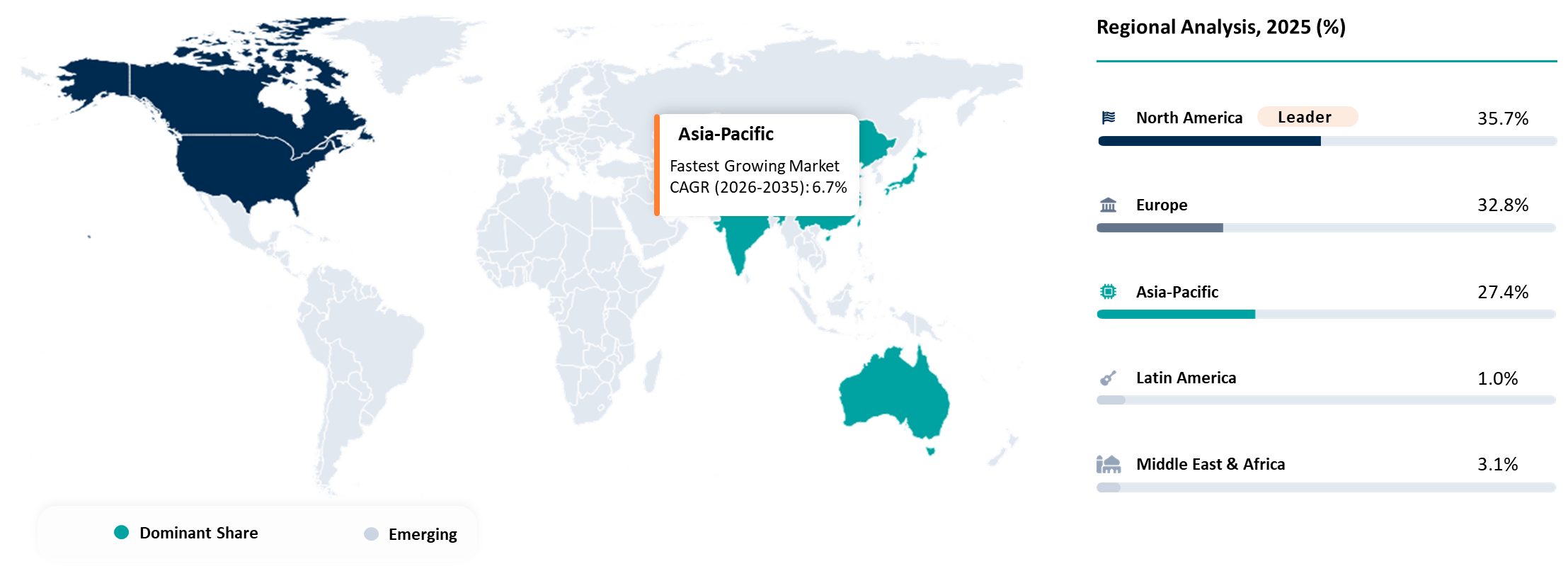
Europe Leads Industrial Carousel Market as Warehouse Modernization, Labor Pressures and Resilience-Driven Automation Reshape Storage Strategies
Europe stands out in this market as the most significant geography from a strategic standpoint, with Germany and Netherlands ranking as the two countries where the dynamics associated with the business model, operations and imminent changes will be most apparent. Warehouse modernizations in Europe are necessitated by labor-related pressures, energy-efficient building utilization and automation within an already built infrastructure. The application of industrial carousel systems works well in such conditions, as they allow for higher density and pick productivity without having to engage in complete greenfield automation. Europe offers a solid track record of industrial distribution and parts logistics, industries that benefit from controlled access storage and reliable retrieval methods. An emerging trend in terms of purchase criteria is that the decision-making on storage automation includes considerations of resilience and workforce as opposed to simply investing in capex costs.
Germany Industrial Carousel Market Outlook
Germany stands out as unique since the activities of production, maintenance, repair operations (MRO) and technical product distribution ensure the presence of a substantial installed base requiring parts-driven storage solutions. The shortage of labor and its associated inefficiencies, space efficiency and goods-to-person systems represent a good business opportunity. The trend in warehouse purchasing in Germany is that the systems bought are those ensuring process reliability. Customers seek systems to reduce search efforts, controlling stock effectively and ensuring efficient delivery of high-service levels, independent of easily accessible labor forces. The robustness of the solution matters in Germany.
Netherlands Industrial Carousel Market Outlook
The Netherlands is influential because it combines logistics sophistication with persistent pressure on space and throughput. Distribution hubs serving cross-border trade need compact systems that can support accuracy and fast order handling. Dutch warehouse operators are also relatively open to process redesign when the payback is clear. Carousels, therefore, benefit from being framed as labor productivity and footprint optimization tools rather than as niche storage equipment.
Growth is also linked to micro fulfillment and parts logistics. Smaller, high-service operations often need dense automated storage in buildings where expansion is difficult, making the Dutch market a useful indicator for broader European adoption.
Competitive Landscape
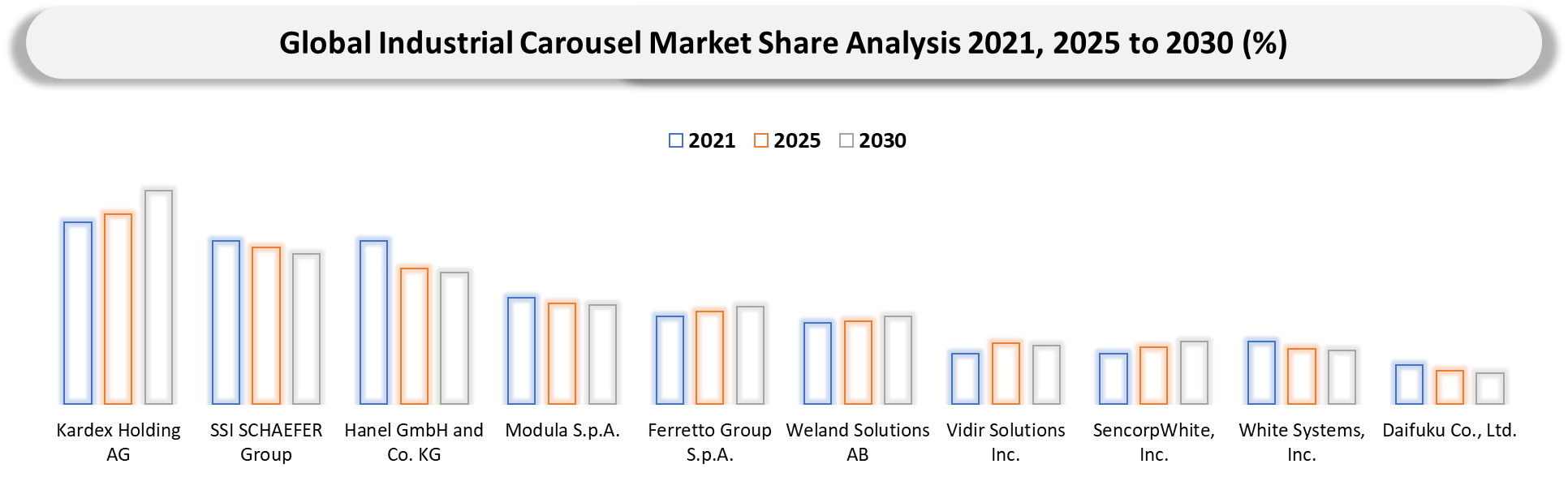
- The competitive landscape is led by a mix of global leaders and focused specialists, with Kardex Holding AG, SSI SCHAEFER Group, Hanel GmbH and Co. KG and Modula S.p.A. shaping category standards. Market positioning depends on portfolio breadth, application depth, route to market strength and the ability to support customers after the initial sale.
- Buyers are increasingly using operational proof, implementation risk and service responsiveness as final selection criteria. It makes execution quality, not just technical capability, an important determinant of commercial conversion and long-term share stability.
Key Developments
- September 2025: SSI SCHAEFER Group extended its partnership with BD Rowa to integrate pharmaceutical robotics with WAMAS software, enhancing automated storage and traceability systems.
- June 2025: SSI SCHAEFER Group delivered a fully automated 30,000 sqm warehouse for Apotea, strengthening high-throughput logistics automation using advanced intralogistics and storage technologies.
- March 2025: SSI SCHAEFER Group introduced FastBots solution, enabling high-speed goods-to-person automation, achieving up to 10,000 cycles/hour in warehouse operations.
- February 2025: Daifuku Co., Ltd. highlighted as a key ASRS leader investing in advanced automated storage technologies, including carousel-based solutions for global logistics automation.
- February 2025: Murata Machinery, Ltd., recognized among leading ASRS providers advancing automated storage technologies supporting high-efficiency material handling and carousel system integration.
January 2025: Kardex Holding AG launched upgraded vertical lift modules with enhanced automation, improving storage density, picking accuracy and warehouse digitalization capabilities.
Why Choose DataM?
- Data-Driven insights: Dive into detailed analyses with granular insights such as pricing, market shares and value chain evaluations, enriched by interviews with industry leaders and disruptors.
- Post-Purchase Support and Expert Analyst Consultations: As a valued client, gain direct access to our expert analysts for personalized advice and strategic guidance, tailored to your specific needs and challenges.
- White Papers and Case Studies: Benefit quarterly from our in-depth studies related to your purchased titles, tailored to refine your operational and marketing strategies for maximum impact.
- Annual Updates on Purchased Reports: As an existing customer, enjoy the privilege of annual updates to your reports, ensuring you stay abreast of the latest market insights and technological advancements. Terms and conditions apply.
- Specialized Focus on Emerging Markets: DataM differentiates itself by delivering in-depth, specialized insights specifically for emerging markets, rather than offering generalized geographic overviews. The approach equips our clients with a nuanced understanding and actionable intelligence that are essential for navigating and succeeding in high-growth regions.
- Value of DataM Reports: Our reports offer specialized insights tailored to the latest trends and specific business inquiries. The personalized approach provides a deeper, strategic perspective, ensuring you receive the precise information necessary to make informed decisions. The insights complement and go beyond what is typically available in generic databases.
Target Audience 2026
- Manufacturing & Warehousing Companies: Automotive manufacturers, e-commerce fulfillment centers and industrial warehouses utilizing industrial carousel systems for efficient storage, order picking and inventory management.
- Logistics & Supply Chain Operators: Third-party logistics (3PL) providers, distribution centers and cold storage operators deploying vertical and horizontal carousel systems to optimize space utilization and improve throughput.
- Retail & E-commerce Companies: Large retail chains and online marketplaces leveraging automated storage and retrieval solutions to streamline order fulfillment, reduce picking errors and enhance delivery efficiency.
- Pharmaceutical & Healthcare Organizations: Hospitals, pharmaceutical manufacturers and medical device companies using industrial carousels for secure, organized storage of drugs, surgical tools and critical inventory.
- Government & Institutional Facilities: Defense warehouses, postal services and public sector storage facilities adopting carousel systems for high-density storage and efficient material handling.
- OEMs & Automation Solution Providers: Industrial automation companies and carousel system manufacturers focusing on product innovation, robotics integration and smart warehouse solutions.
- Investors & Private Equity Firms: Investment firms monitoring growth in warehouse automation, intralogistics and Industry 4.0-driven material handling technologies.
- System Integrators & Distributors: Automation integrators, equipment distributors and service providers involved in installation, customization, maintenance and aftermarket support of carousel systems.


























































