


Immersive Technology in Advertising Market Overview
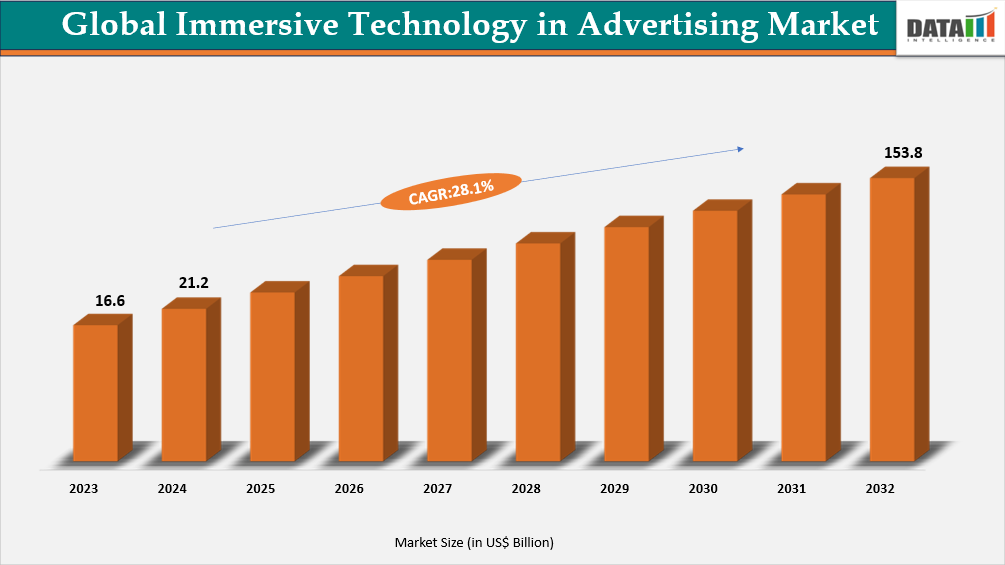
The global immersive technology in advertising market reached US$16.6 billion in 2023, rising to US$21.2 billion in 2024 and is expected to reach US$153.8 billion by 2032, growing at a CAGR of 28.1% from 2025 to 2032.
The market for immersive technology in advertising is undergoing a major shift due to the convergence of augmented reality (AR), virtual reality (VR), and extended reality (XR) applications across industries. Because smartphones are so widely used and have more processing capacity, immersion experiences are becoming more and more popular in sectors including media, entertainment, education, and healthcare. Businesses are increasingly using these technologies for enhanced user engagement, operational efficiency, and training.
While augmented reality (AR) features like virtual try-ons are revolutionizing the way consumers buy, virtual reality (VR) is used in manufacturing and healthcare for risk-free training, remote assistance, and simulations. The emergence of the Metaverse has provided businesses with new means of engaging with clients in virtual environments, encouraging the use of AR and VR technologies for collaboration, events, and business.
The market is also being driven by scalable platforms that enable real-time interaction, multilingual engagement, and faster global campaign execution. Advertisers increasingly seek immersive storytelling to differentiate their brands and strengthen emotional connections. In April 2025, Coca-Cola demonstrated this shift by launching a global immersive holiday campaign in just 60 days using Microsoft Azure’s AI-ready ecosystem, creating a real-time 3D Santa that engaged over one million consumers across 43 markets and 26 languages, setting a new benchmark for AI-powered advertising.
Immersive Technology in Advertising Market Industry Trends and Strategic Insights
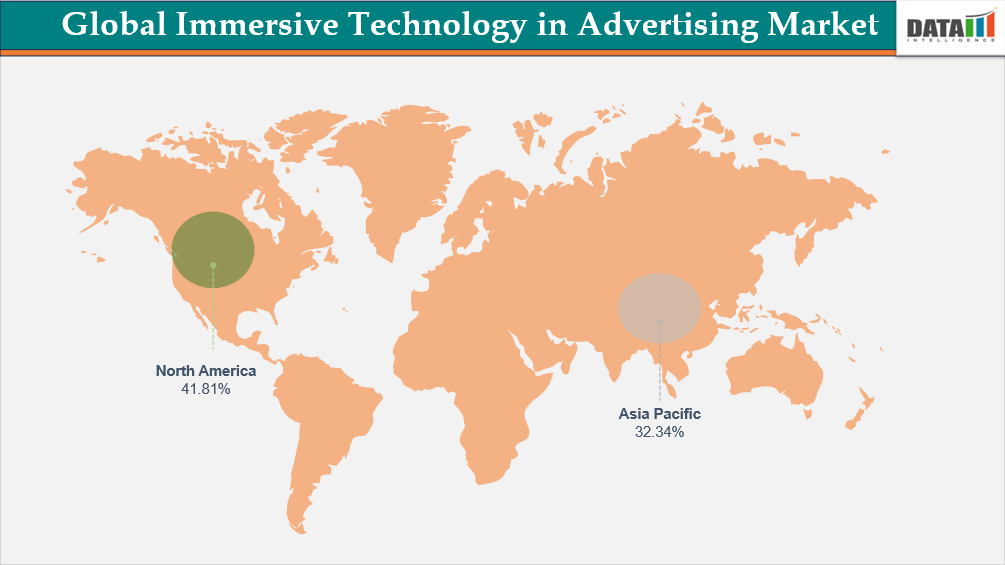
- North America leads the global immersive technology in advertising market, capturing the largest revenue share of 41.81% in 2024.
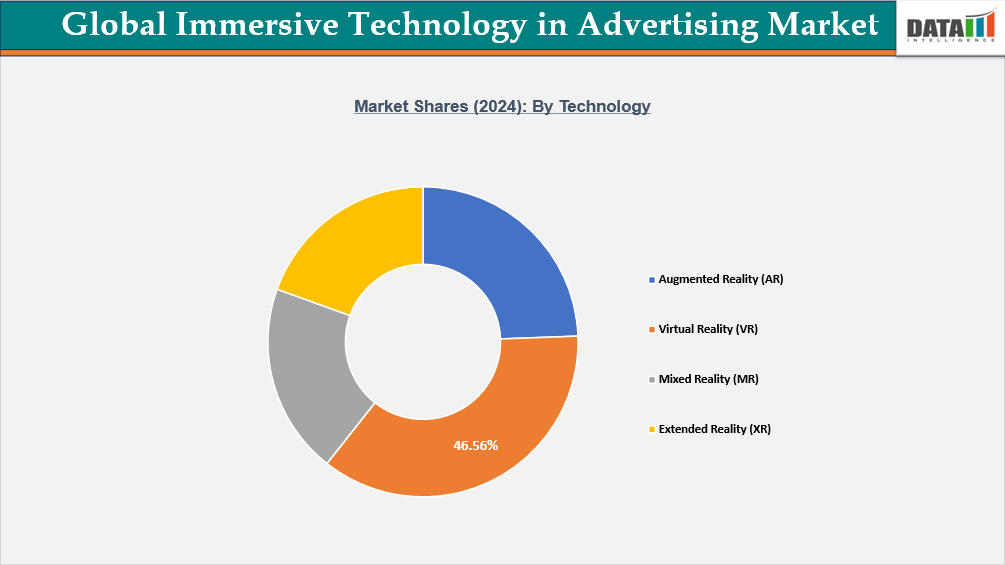
- By Deployment segment, virtual reality (VR) led the global immersive technology in advertising market, capturing the largest revenue share of 46.56% in 2024.
Global Immersive Technology in Advertising Market Size and Future Outlook
- 2024 Market Size: US$21.2 billion
- 2032 Projected Market Size: US$153.8 billion
- CAGR (2025–2032): 28.1%
- Dominating Market: North America
- Fastest Growing Market: Asia-Pacific
Market Scope
| Metrics | Details |
| By Technology | Augmented Reality (AR), Virtual Reality (VR), Mixed Reality (MR), Extended Reality (XR) |
| By Deployment | Mobile Devices, Head-Mounted Displays, Smart Glasses, Kiosks, Web-Based Platforms |
| By Application | Product Visualization, Virtual Try-Ons, Gamified Advertisements, Location-Based Advertising, social media Filters, Others |
| By End-User | Retail & E-commerce, Media & Entertainment, Automotive, Healthcare, Travel & Tourism, Others |
| By Region | North America, South America, Europe, Asia-Pacific, Middle East and Africa |
| Report Insights Covered | Competitive Landscape Analysis, Company Profile Analysis, Market Size, Share, Growth |
For More Detail information Request for Free Sample
Market Dynamics
Increase in Industry-Wide AR/VR Adoption
The growing adoption of AR and VR across industries is significantly boosting the immersive technology in advertising market by enabling brands to create highly interactive and engaging consumer experiences. Businesses in retail, automotive, entertainment, and real estate are leveraging AR/VR to showcase products virtually, conduct immersive demos, and deliver personalized content. This widespread adoption is driving demand for advanced hardware, software platforms, and AI-powered analytics that can measure engagement and optimize campaigns. As more sectors integrate AR/VR into their marketing strategies, advertisers are increasingly investing in immersive solutions to capture consumer attention and enhance brand recall.
Moreover, the proliferation of affordable AR/VR devices and improved accessibility through mobile platforms and head-mounted displays is accelerating market growth. Enhanced technologies, such as spatial computing, gesture tracking, and mixed reality experiences, allow advertisers to craft compelling narratives that resonate with diverse audiences. The adoption trend is also encouraging the development of standardized frameworks and tools for content creation, reducing production complexity and cost. Overall, industry-wide AR/VR integration is positioning immersive advertising as a mainstream marketing channel, driving innovation and expanding market opportunities.
Segmentation Analysis
The global immersive technology in advertising market is segmented based on technology, deployment, application, end-user and region.
Rising Demand for Interactive Content Drives Virtual Reality Growth in Advertising
Virtual reality (VR) has seen tremendous growth due to its widespread use in sectors including gaming, entertainment, healthcare, and education, with the biggest revenue share in the immersive technology in the advertising industry. VR's capacity to produce completely immersive virtual worlds improves user involvement and provides lifelike teaching and entertainment simulations.
Businesses are investing heavily in VR solutions as customer demand for interactive content increases. Continuous developments in software and technology have greatly enhanced the accessibility and general user experience of VR systems, further supporting this trend. VR was formerly dependent on large, wired headgear that was connected to powerful computers.
A major catalyst for VR’s leadership is the surge in technological advancements like 5G, which enables smoother, high-quality immersive experiences. A strong example is Bharti Airtel’s launch of India’s first immersive VR advertisement on October 2, 2022. By leveraging ultra-fast, low-latency 5G to deliver life-like 3D visuals and seamless interaction, Airtel demonstrated how VR can revolutionize real-time advertising engagement.
AR Driving Engagement and Reach in Immersive Advertising
Augmented Reality (AR) holds a significant share in the Immersive Technology in Advertising Market because it enables brands to overlay digital content onto the real world, creating interactive and engaging consumer experiences. AR campaigns drive higher user engagement and recall compared to traditional ads, making them attractive for retail, e‑commerce, and experiential marketing. Its accessibility via smartphones and tablets allows advertisers to reach a wider audience without the need for expensive hardware. Additionally, AR analytics provide measurable insights into consumer behavior, enhancing campaign effectiveness and ROI.
Geographical Penetration
Dominating Region: North America as a Catalyst for Immersive Technology in Advertising
North America stands as one of the leading regions in immersive technology in the advertising market, propelled by high digital ad spending, advanced infrastructure, and strong consumer appetite for interactive experiences. AR adoption is mainstream in 2025, with nearly 60% of the US population and almost all users of social and messaging apps expected to be frequent AR users. Over 90% of American shoppers already use AR or are open to using it for shopping, and 98% of those who have tried AR found it helpful in making purchase decisions. Younger consumers are leading the way, with 92% of Gen Z say they want to use AR tools for e-commerce. Retailers such as Walmart and Nike has embraced AR-powered product visualization, while automotive companies like Ford and GM deploy VR showrooms to enhance customer journeys.
US Immersive Technology in Advertising Market Outlook
In 2025, AR adoption in the US will have become mainstream, with nearly 60% of the population and most social app users engaging with AR regularly. Over 90% of shoppers use or are open to AR for shopping, and 98% of users find it helpful for purchase decisions, especially among Gen Z. Retailers like Walmart and Nike leverage AR for product visualization, while automotive brands such as Ford and GM use VR showrooms to enhance customer experiences. Strong technological infrastructure, including widespread 5G coverage, VR headset adoption, and AR-enabled smartphones, supports these immersive advertising experiences.
Canada Immersive Technology in Advertising Market Trends
In Canada, the immersive technology advertising market is growing steadily, driven by increasing AR and VR adoption among consumers and brands. Retailers and e-commerce platforms are using AR for product visualization, while automotive and real estate sectors implement VR showrooms and virtual tours. High smartphone penetration and expanding 5G networks support seamless immersive experiences. Canadian consumers, particularly younger demographics, are showing strong engagement with interactive advertising formats, boosting market demand.
Fastest Growing Region: Asia-Pacific Records the Fastest Growth Driven by Rising Food Safety Demand and Blockchain Adoption
The Asia-Pacific region holds a significant share in the Immersive Technology in Advertising Market due to rapid digital adoption, high smartphone penetration, and expanding 5G infrastructure. Major markets like China, Japan, South Korea, and India are investing heavily in VR, AR, and XR technologies for marketing campaigns. The growing e-commerce sector and rising consumer demand for interactive and personalized experiences further boost immersive advertising adoption. Additionally, supportive government initiatives and tech innovation hubs in the region accelerate the deployment and integration of immersive technologies in advertising.
India Immersive Technology in Advertising Market Insights
India has rapidly become a key market in the global immersive‑technology advertising boom, thanks to a combination of rising 5G / broadband penetration, smart‑TV adoption and heavy usage of platforms like YouTube India. As of September 2025, YouTube India rolled out an “India‑first” feature allowing advertisers to target urban and rural audiences separately — enabling brands to craft ads finely tuned to regional behavior, language and purchasing power, boosting the effectiveness of immersive campaigns.
China Immersive Technology in Advertising Market Industry Growth
China holds a significant share in the immersive technology advertising market, driven by rapid adoption of AR/VR devices and strong e-commerce integration. In June 2025, Chinese AR glasses maker Rokid expanded into international markets by launching its AR Spatial eyewear on Alibaba’s AliExpress platform, offering a $100 discount on the US$650 device, showcasing China’s push to globalize immersive tech. The lightweight glasses, featuring spatial computing via a Qualcomm-powered hub and “cinema mode” experience, illustrate how hardware innovation enables more interactive and engaging advertising experiences. By leveraging AliExpress’s BigSave programme, Rokid aims to boost overseas adoption, reinforcing China’s role as both a producer of immersive devices and a hub for technologically advanced advertising solutions.
Technology Analysis
The immersive technology in advertising market is increasingly driven by innovations in augmented reality (AR), virtual reality (VR), and mixed reality (MR) platforms that enhance consumer engagement through interactive and personalized experiences. Advanced hardware developments, such as lightweight AR glasses and high-resolution VR headsets, are enabling brands to deliver immersive content with minimal latency and realistic 3D visuals. Integration of AI-powered analytics and spatial computing allows advertisers to track consumer interactions in real time, optimizing campaigns for higher conversion rates. Recent collaborations, such as the February 2024 partnership between EmdoorVR and Ultraleap Limited, highlight the push toward cost-effective MR headset designs that simplify deployment for OEMs while incorporating sophisticated hand-tracking and SLAM capabilities.
Competitive Landscape

- The competitive landscape of the immersive technology in advertising market is characterized by intense innovation and rapid evolution, with players focusing on hardware, software, and content ecosystem development to differentiate themselves.
- The landscape is dominated by a handful of global players, including, Google LLC, Meta Platforms, Inc., Microsoft Corporation, Apple Inc., Snap Inc., Unity Technologies, Sony Corporation, Samsung Electronics Co., Ltd., NVIDIA Corporation, HTC Corporation.
- Companies are increasingly competing based on technological capabilities such as high-resolution displays, low-latency performance, advanced tracking systems, and seamless integration with digital advertising platforms. Strategic partnerships and collaborations are common, aimed at combining expertise in AR/VR/MR hardware, AI-driven analytics, and immersive content creation to deliver more engaging and measurable advertising solutions.
Key Developments
- In August 2024, to speed up the bank's deployment of generative AI, ANZ Bank and Microsoft Corporation established Australia's first AI Immersion Center at their Melbourne headquarters.
- In May 2024, Google LLC and Magic Leap, Inc. formed a strategic alliance to develop augmented reality (AR) technologies. The goal of this partnership was to create cutting-edge AR experiences and solutions by combining Google LLC's technological platforms with Magic Leap, Inc.'s optical and augmented reality expertise.
- In February 2025, Meta Platforms, Inc. made Meta for Education generally available, expanding access to immersive learning applications and XR-based content environments. This supports the broader immersive technology market by increasing adoption of mixed reality platforms that can later be leveraged for branded engagement and experiential advertising use cases.
- Snap Inc. introduced Sponsored AI Lenses, a new advertising format powered by Snap’s generative AI technology. This is a direct market development because it gave advertisers a new immersive ad unit that blends augmented reality, AI-powered creativity, and branded user interaction.
Investment & Funding Landscape
The investment and funding landscape for immersive technology in advertising market is witnessing robust growth, driven by increasing demand for AR, VR, and MR solutions in brand engagement. Investors are channeling capital into startups and established firms developing hardware, software platforms, and AI-powered analytics to enhance interactive advertising experiences. Venture capital, private equity, and strategic corporate investments are fueling R&D, enabling innovations like gesture tracking, spatial computing, and haptic feedback.
| Company | Investment/Funding | Year | Details | |
| Meta | Investment of US$100 Billion | 2025 | Meta announced a US$100 billion investment in its extended reality (XR) portfolio, including AR smart glasses, VR headsets, mixed reality Quest devices, and metaverse services, signalling an aggressive push into immersive technology. The move follows the success of last year’s Ray-Ban Meta AI smart glasses and comes amid rising competition from Samsung’s upcoming Moohan XR headset. | |
What Sets This Global Immersive Technology in Advertising Market Intelligence Report Apart
- Latest Data & Forecasts – Comprehensive, up-to-date insights and projections through 2032. Coverage includes global value by Deployment, source, distribution channel, end-user and application segments (sleep disorders, jet lag, shift-work). Scenario forecasts with region-level splits (North America, Europe, Asia-Pacific, South America, Middle East and Africa) and sensitivity to factors such as regulatory reclassification and raw-material costs.
- Regulatory Intelligence – Actionable analysis of regulatory frameworks that materially affect Immersive Technology in Advertising commercialization, revenue by country, allowable label claims, permitted doses, import/export controls and advertising restrictions.
- Competitive Benchmarking – Standardized profiling and benchmarking of leading pharma and nutraceutical players, contract manufacturers and e-commerce specialists active in the market.
- Geographic & Emerging Market Coverage – Region-by-region market sizing, growth drivers, reimbursement dynamics, cultural/consumer behavior and market access considerations. Focus on high-growth or regulatory-uncertain markets.
- Actionable Strategies – Identify opportunities for launching innovative products, while leveraging strategic partnerships and supply chain integration for maximum ROI.
- Pricing & Cost Analysis – In-depth assessment of price trends, raw material costs and sustainability-driven cost efficiencies across regional markets.
- Expert Analysis – Insights from industry experts such as clinical sleep specialists, regulatory affairs professionals and key manufacturing companies.




























































