


HVAC Sensors Market Size and Overview
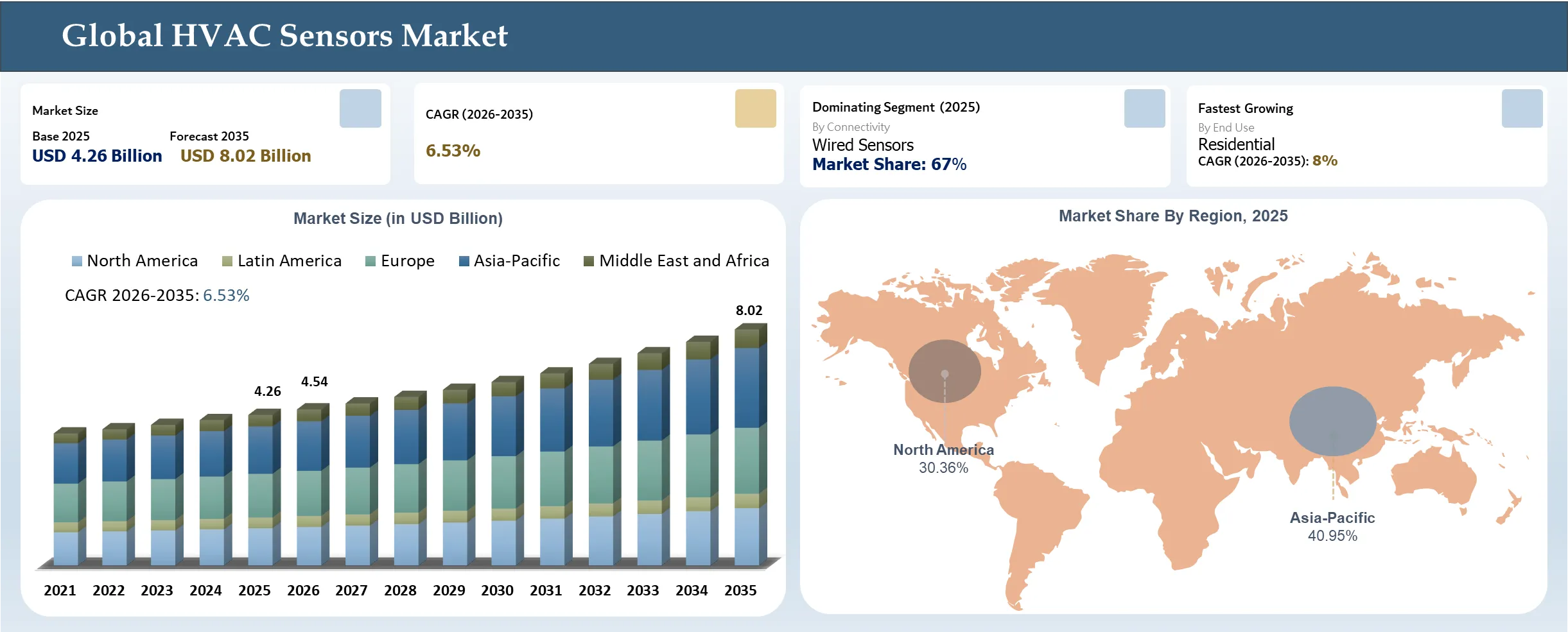
The global HVAC sensors market reached USD 4.26 billion in 2025 and is expected to reach USD 8.02 billion by 2035, growing with a CAGR of 6.53% during the forecast period 2026-2035. The market is advancing as building operators increasingly deploy sensing technologies to improve HVAC energy efficiency, ventilation, indoor air quality, and equipment diagnostics. The market is also being shaped by the development of higher-accuracy, modular, and multifunctional HVAC sensors. In April 2026, E+E Elektronik announced three new sensors-AVS701, HTS401, and TDS501 that were to be showcased at Sensor+Test 2026, along with HVAC sensors that measure temperature, humidity, CO₂, airflow, and differential pressure.
The HTS401 measures temperature with an accuracy of up to ±0.95% RH and ±0.1°C, while the EE600 differential-pressure sensor allows measuring pressure accurately, with ±0.5% of the full-scale measurement range and 1,000 Pa or 10,000 Pa. The company has also developed a TDS501 sensor that measures the dew point continuously, allowing measurements in the range down to -70°C, and an AVS701 sensor that has proven to have 20 times the service life in harsh conditions.
White-Space Opportunities for HVAC Sensors in Building Energy Management and Decarbonization
In May 2025, the European Commission launched an €84 million (USD 95.3 million) Horizon Europe funding call to support research and innovation for using energy in buildings more efficiently, affordably and sustainably. The highest investment is €15 million (USD 17.0 million) each across four areas: on-site innovative robotic and automated solutions for sustainable building renovation and construction; innovative pathways for low-carbon and climate-resilient building stock; innovative approaches for the deployment of Positive Energy Districts; and phasing out fossil fuels in energy-intensive industries through renewable-energy integration.
For the HVAC sensors market, the €12 million (USD 13.6 million) smarter-buildings allocation represents the strongest directly relevant opportunity, as the topic specifically calls for upgrading Building Energy Management Systems and technical equipment, improving energy demand, grid flexibility and indoor environmental quality; the €12 million technical-building-systems area also supports opportunities for sensor-enabled HVAC monitoring and control.
Additional investment areas include the European Commission’s Innovation Fund 2025 auctions, which attracted almost €10 billion (USD 11.32 billion) in funding requests from European industry for industrial heat decarbonisation and hydrogen production.
The funding creates opportunities for companies developing HVAC sensors, building automation, energy-management platforms, HVAC controls and smart-building technologies. Siemens, Schneider Electric, Johnson Controls, Honeywell, Danfoss and Carrier can potentially benefit from the smarter-buildings investment through building-management systems, connected HVAC controls, environmental sensing, energy monitoring and intelligent equipment optimisation.
Johnson Controls, Siemens, Schneider Electric and Carrier can also benefit from the technical building-systems allocation through integration of sensors, controls and energy-efficient HVAC equipment into new and renovated buildings. Low-carbon and climate-resilient building-stock investment creates additional opportunities for Siemens, Schneider Electric, Johnson Controls, and Honeywell through smart-building renovation, automated energy management, and indoor-environment monitoring.
HVAC Sensors Market Key Takeaways
- Asia-Pacific led the global market in 2025 with a 40.95% share, driven by rapid commercial construction and smart building adoption. A key regional deal includes an audit approval for HGGaoli to supply LG with AC temperature sensors, generating over USD 10 million annually.
- Wired sensors held the largest market share at 67% in 2025 due to their reliability and existing building automation system integration. Meanwhile, up to 15–20% of installed sensors are typically inoperable or deliver inaccurate data.
- European Innovation Fund 2025 auctions attracted nearly €10 billion (USD 11.32 billion) in funding requests for heat decarbonization and hydrogen production. Max investment caps under the Horizon program reach €15 million (USD 17.0 million) across four core development sectors.
- The European Commission launched an €84 million (USD 95.3 million) Horizon Europe funding call for building energy efficiency. This initiative includes €12 million (USD 13.6 million) directly assigned to smarter buildings and technical building systems.
HVAC Sensors Market Industry Trends and Strategic Insights
- Multi-parameter sensing is becoming a core product direction, with manufacturers combining temperature, humidity, CO₂, particulate matter, VOC, and pressure measurement within fewer devices to simplify HVAC system architecture and installation.
- AI-enabled sensor data is shifting HVAC sensors from measurement components toward predictive control infrastructure, as automated fault detection and diagnostics increasingly use operational HVAC data to identify abnormal equipment behaviour and optimise system performance.
- Demand-controlled ventilation is increasing the strategic value of occupancy-linked sensing, allowing HVAC systems to adjust outdoor-air intake and zone conditions according to actual occupancy and measured pollutant levels rather than fixed schedules.
- Sensor manufacturers are increasingly designing for modular replacement and flexible installation, enabling sensing elements or components to be exchanged without replacing the complete sensor assembly and making retrofit deployment easier.
- HVAC sensor development is increasingly converging with building automation and energy-management systems, positioning sensors as continuous data sources for automated setpoint adjustment, ventilation optimisation, equipment-health monitoring, and portfolio-level building management.
HVAC Sensors Market Scope
| Metrics | Details | |
| 2025 Market Size | USD 4.26 Billion | |
| 2035 Projected Market Size | USD 8.02 Billion | |
| CAGR (2026-2035) | 6.53% | |
| Largest Market | Asia-Pacific | |
| Fastest Growing Market | Asia-Pacific | |
| By Sensor Type | Temperature Sensors, Humidity Sensors, Pressure Sensors, Air Quality Sensors, Smoke & Gas Sensors, Occupancy & Motion Sensors, Flow Sensors, Other Sensors | |
| By Connectivity | Wired Sensors, Wireless Sensors | |
| By Installation Type | Duct-Mounted Sensors, Wall-Mounted Sensors, Outdoor Sensors, Others | |
| By End Use | Residential, Commercial, Industrial | |
| By Region | North America | U.S., Canada, Mexico |
| Europe | Germany, UK, France, Spain, Italy, Poland, Netherlands, Switzerland | |
| Asia-Pacific | China, India, Japan, Australia, South Korea, Indonesia, Malaysia | |
| Latin America | Brazil, Argentina | |
| Middle East and Africa | UAE, Saudi Arabia, South Africa, Israel, Türkiye | |
| Report Insights Covered | Competitive Landscape Analysis, Company Profile Analysis, Market Size, Share, Growth | |
HVAC Sensors Market Disruption Analysis
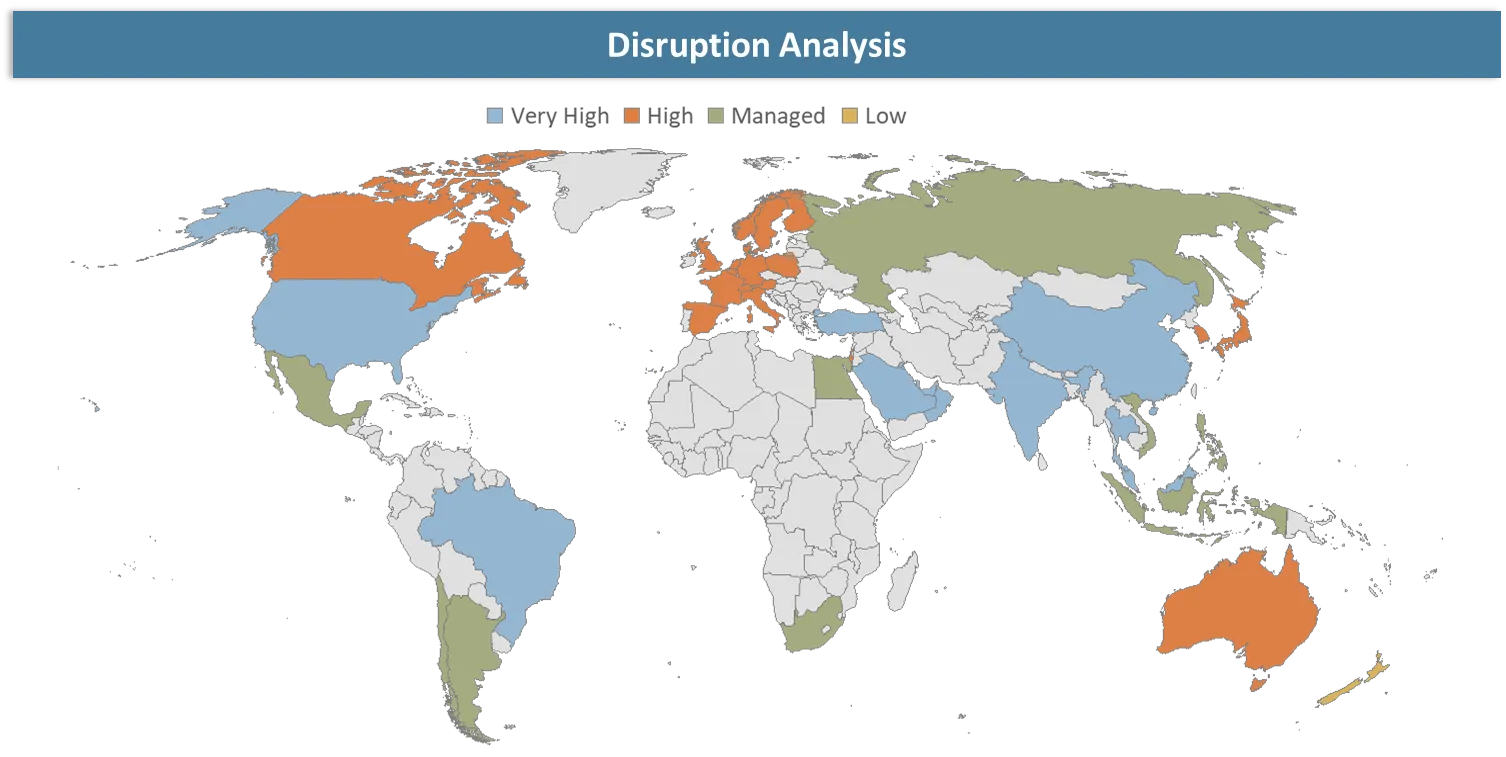
Shift Toward Connected, AI-Enabled and Multi-Parameter Sensing Platforms Reshaping HVAC Sensor Architecture
The disruption in the HVAC sensors market is primarily associated with the transition from standalone, measurement-focused sensors toward connected, multi-parameter sensors that are interconnected and continuously transmit information about the environment and equipment to Building Automation Systems (BAS). While classical HVAC technologies use separate sensors for measuring the temperature, humidity, pressure, or air quality, new platforms combine these parameters and integrate them into an interconnected system of digital controls, occupant analytics, etc.
Furthermore, AI-optimized HVAC controls are accelerating the shift toward sensor systems capable of supplying continuous, high-quality operational data for intelligent building management faster. In February 2026, according to the National Institute of Standards and Technology (NIST), U.S. commercial buildings use around 18% of total primary energy and 35% of total electricity, out of which 35-40% is consumed by HVAC systems. Additionally, as noted by NIST, 60% of large commercial buildings over 4,600 m2 have installed building automation systems while only 13% of small commercial buildings have such a system installed, indicating a deployment gap for smart HVAC sensing and controls.
HVAC Sensors Market BCG Matrix: Company Evaluation

Stars include Honeywell International Inc., Siemens AG, Johnson Controls International plc, and Schneider Electric SE, as these companies have broad HVAC sensing portfolios and strong positions in building automation, connected controls, indoor-air-quality monitoring, and smart-building infrastructure. Question Marks include Emerson Electric Co., TE Connectivity Ltd., and Sensirion AG, which have strong sensing technologies and are expanding their presence across HVAC, environmental monitoring, and smart-building applications.
Potential includes Belimo Holding AG and Danfoss A/S, which benefit from strong positions in HVAC control, airflow management, refrigeration, and building-system components and can leverage these capabilities to expand their sensor portfolios. Tailenders include Vaisala Oyj, whose environmental measurement technologies have strong relevance to HVAC applications, particularly humidity, temperature, CO₂, and indoor-air-quality monitoring, but whose overall business exposure extends considerably beyond HVAC sensors.
HVAC Sensors Market Dynamics
Driver Impact Analysis
| Driver | Market Growth Impact (%) | Demand Concentration | Impacted Use Case | Strategic Impact |
Rising demand for energy-efficient HVAC systems is driving the adoption of sensors for real-time monitoring and optimised heating, cooling, and ventilation. | 30% | Commercial buildings, offices, hospitals, retail facilities, and energy-intensive buildings | Energy optimisation, temperature control, ventilation management, equipment performance monitoring | Increases demand for accurate temperature, humidity, pressure, airflow, and occupancy sensors that enable continuous HVAC optimisation and reduce energy waste. |
Growing adoption of smart buildings and IoT-enabled HVAC controls is increasing demand for connected and wireless sensors. | 25% | Smart commercial buildings, offices, retail chains, hotels, campuses, and retrofit projects | Remote HVAC monitoring, wireless zone control, building automation, demand-controlled ventilation | Accelerates migration from conventional wired/standalone sensors toward connected, interoperable, and wireless sensor networks that feed building-management platforms. |
Integration of AI with HVAC control systems is driving demand for high-frequency sensor data to enable predictive optimisation and fault detection. | 22% | Large commercial buildings, data centres, hospitals, industrial facilities, and advanced building-management systems | Predictive maintenance, automated fault detection, HVAC optimisation, equipment diagnostics | Shifts sensors from basic measurement devices into data-generation infrastructure for AI-based control. |
Increasing deployment of low-cost smart sensors is expanding HVAC monitoring across residential, commercial, and public buildings. | 15% | Residential buildings, small and medium commercial buildings, schools, public facilities, and retrofit applications | Indoor-air-quality monitoring, room-level temperature control, occupancy sensing, retrofit HVAC monitoring | Low-cost IoT sensing reduces the entry barrier for buildings without sophisticated automation systems, particularly smaller facilities where BAS penetration remains limited. |
Rising demand for energy-efficient HVAC systems is driving the adoption of sensors for real-time monitoring and optimized heating, cooling, and ventilation
The increasing emphasis on building energy efficiency is accelerating the adoption of HVAC sensors for monitoring and adaptive control of heating, cooling, and ventilation systems. In view of the need to cut down energy usage and minimise operating costs, sensors in HVAC controls are assuming increasing significance for the continuous measurement of temperature, humidity, pressure, flow of air, occupancy, and indoor air quality. The HVAC systems are able to modify their operational parameters based on actual building conditions, as well as diagnostic and predictive maintenance requirements.
In parallel, the integration of IoT-enabled HVAC monitoring is strengthening the business case for sensor-based energy optimisation and predictive maintenance. In November 2025, according to Energy in Buildings & Industry (EiBI), space cooling alone contributes to almost 20% of total electricity usage in buildings worldwide, thus highlighting the importance of HVAC efficiency as part of the energy management strategy. The same source cites a live case study from IMS Evolve at a big retail chain in North America, where the implementation resulted in USD 15.1 million in energy cost savings from 1,800 stores, with estimated savings amounting to USD 42 million if implemented in 5,000 stores. The IoT-based technology delivered a return-to-normal operations by store opening of 99.5%, along with a 99.3% automated re-run success rate.
Restraint Impact Analysis
| Restraint | Drag on Market Growth (%) | Primary Impact Area | Impacted Use Case | Strategic Impact |
Sensor inaccuracies, faults, and calibration requirements can reduce HVAC control reliability and increase maintenance needs. | 25% | Sensor reliability and maintenance | Temperature/humidity monitoring, air-quality monitoring, HVAC equipment control | Encourages suppliers to improve sensor accuracy, self-calibration, diagnostics, and long-term stability. |
Lack of interoperability among sensors, controllers, and building management systems from different vendors can hinder seamless HVAC sensor integration. | 23% | System integration and communication protocols | Building automation, smart buildings, centralized HVAC management | Increases demand for interoperable sensors supporting standardized protocols and multi-vendor BMS integration. |
Integration complexity with heterogeneous legacy HVAC infrastructure can slow the deployment of advanced sensor-based systems. | 28% | Retrofit deployment and infrastructure compatibility | Existing commercial buildings, institutional facilities, industrial HVAC retrofits | Creates additional gateway, wiring, commissioning, and controller-upgrade requirements, slowing advanced sensor adoption in older facilities. |
Inconsistent and unreliable sensor data can reduce the effectiveness of AI-enabled HVAC monitoring, optimisation, and predictive control. | 24% | Data quality and AI-enabled HVAC control | Predictive maintenance, automated optimisation, fault detection, AI-based building management | Drives demand for sensor validation, redundancy, data-quality monitoring, edge processing, and intelligent fault-detection capabilities. |
Integration complexity with heterogeneous legacy HVAC infrastructure can slow the deployment of advanced sensor-based systems
One of the key restraints affecting the HVAC sensors market is the difficulty of integrating advanced sensors with heterogeneous legacy HVAC infrastructure. In most cases, these legacy systems have multiple layers of HVAC controls, various communication protocols, basic thermostats, and varying versions of building-automation systems. The integration of advanced sensors may involve the addition of protocol gateways, rewiring, upgrading of HVAC controllers, configuration of software, and commissioning.
In addition, the complexity of integrating heterogeneous legacy HVAC infrastructure is highlighted by MDPI, which analysed 89 peer-reviewed studies on Building Energy Management Systems published between 2019 and 2025. The review found that intelligent BEMS adoption continues to face a lack of standardised interoperability frameworks and complexity in integrating heterogeneous legacy infrastructure. It also reported that hybrid AI-IoT systems achieved energy-efficiency improvements of 20% to 40%, depending on building type and control granularity, demonstrating the performance potential of advanced sensor-connected HVAC systems while highlighting the integration requirements needed to achieve these benefits.
HVAC Sensors Market Segment Analysis
The global HVAC sensors market is segmented based on sensor type, connectivity, installation type, end use, and region.
Dominance of Wired Sensors in HVAC Systems Driven by Reliable, Continuous Connectivity
The wired sensors segment dominated the HVAC sensors market, accounting for a market share of 67% in 2025, owing to the preference for hard-wired technology in HVAC systems. Wired sensors are highly relevant for scenarios that require constant and reliable transmission of data such as temperature, humidity, pressure, airflow, and air quality to the centralised HVAC control units. The existing compatibility of wired sensors with building automation system infrastructure makes them highly advantageous compared to wireless architectures.
The installed-base advantage of wired sensing is further reinforced by the reliability challenges affecting HVAC sensor networks. In May 2025, Johnson Controls reported that typically 15-20% of sensors are inoperable or do not provide accurate data, highlighting the importance of dependable sensor connectivity and continuous data availability for HVAC control systems. The company is therefore applying AI to compensate for missing or unreliable sensor data until maintenance or replacement can be performed, indicating that the next stage of wired HVAC sensing is shifting toward reliable connectivity combined with intelligent data validation and fault management.
HVAC Sensors Market Geographical Penetration
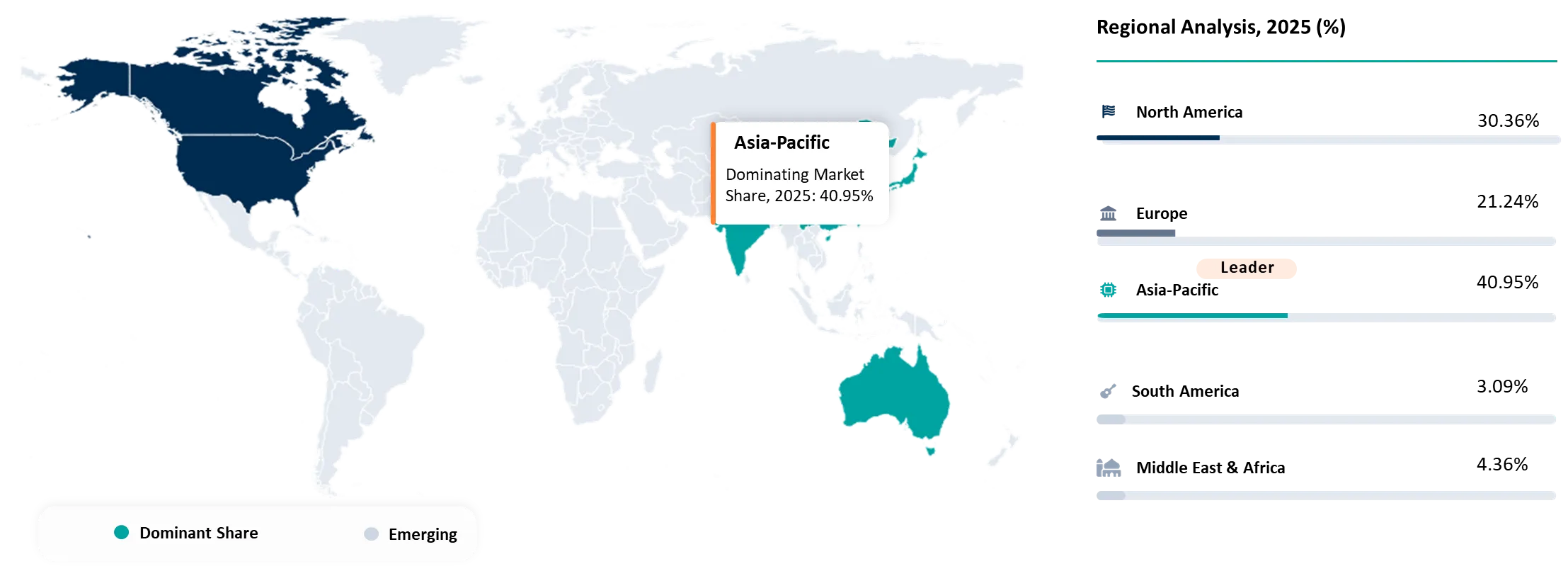
Rapid Adoption of Smart Building Controls and Connected HVAC Sensing in Asia-Pacific Strengthening Regional Market Leadership
The Asia-Pacific region dominated the HVAC sensors market with an estimated 40.95% market share in 2025, supported by expanding smart-building deployment, commercial construction, industrial automation, and increasing demand for energy-efficient HVAC operation across major economies. The region's diverse building stock is creating demand for temperature, humidity, CO₂, occupancy, pressure, and indoor-air-quality sensors that can feed building-management and HVAC control systems.
The partnership strengthens the adoption of advanced ultrasonic flow-sensing technologies across Asia-Pacific HVAC and cooling applications. In March 2025, Allengra SRL, a Romania-based ultrasonic flow-sensor and flowmeter technology company, announced a distribution partnership with Accutherm, a Taiwan-based sensor manufacturer and distributor, to expand ultrasonic flowmeter solutions across Mainland China, South Korea, Japan, and Taiwan. The partnership targets the HVAC heating and cooling sector, heat pumps, heating equipment, and data-centre cooling, with the ultrasonic flowmeters offering little to no pressure drop, fast response times, no moving parts, and a lifetime of more than 12 years.
China HVAC Sensors Market Trends
China is the dominant country in the Asia-Pacific HVAC sensors market, supported by its large building stock, rapid adoption of intelligent building technologies, and increasing integration of HVAC controls with digital energy-management systems.
The collaboration strengthens the adoption of advanced temperature-sensing technologies for air-conditioning applications in the Chinese HVAC market. In January 2026, Xiaogan Huagong Gaoli Electronics Co., Ltd. (HGGaoli), a China-based sensor and thermal-management technology company, announced a strategic collaboration with LG, a South Korea-based consumer electronics and home-appliance company, after HGGaoli’s self-developed air-conditioning temperature sensor successfully passed LG’s customer qualification audit and was approved for mass production in the second half of 2025. The project is projected to generate more than USD 10 million in annual sales.
Japan HVAC Sensors Market Outlook
Japan is a major country in the Asia-Pacific HVAC sensors market, supported by its mature HVAC industry, high emphasis on building energy efficiency, and rapid integration of digital technologies into building operations. Japan’s 2025 Strategic Energy Plan sets a target for new houses and buildings constructed from FY2030 onward to achieve energy-efficiency performance at the ZEH/ZEB standard, while the government is promoting digital technologies and AI to visualise energy consumption and improve operational efficiency.
The development strengthens refrigerant leak-detection capabilities for next-generation HVAC systems using low-GWP and highly flammable R290 refrigerants. In February 2025, Asahi Kasei Microdevices Corporation (AKM), a Japan-based semiconductor and sensing-device company, through its subsidiary Senseair AB, a Sweden-based gas-sensing technology company, developed the RDS R290 refrigerant detection system for highly flammable R290 (propane) refrigerants used in HVAC applications. The system incorporates the Sunlight R290 NDIR sensor core, complies with IEC 60335-2-40, and provides a measurement range of 0-100% LFL with ±2.5% LFL accuracy, an operating temperature range of -40°C to 70°C, and an expected lifespan of more than 15 years.
North America’s Smart-Building Modernization and HVAC Digitalisation Supporting Sensor Demand
North America accounted for 30.36% of the global HVAC sensors market in 2025, making it the second-largest regional market, supported by the extensive installed base of commercial HVAC systems, building automation infrastructure, and increasing investment in energy-efficient building operations. The region is seeing greater integration of temperature, humidity, occupancy, CO₂, pressure, airflow, and indoor-air-quality sensors with building-management systems to improve HVAC performance and enable data-driven building operations.
The joint venture strengthens the development and commercialisation of advanced gas-sensing technologies for HVAC and indoor-environment applications in North America. In December 2025, Cubic Sensor & Instrument Co., Ltd., a China-based gas-sensor and gas-analysis technology company, formed Cubic Innovaer with Innovaer Technologies, a North America-based sensing solutions and application-engineering company, as a joint venture focused on the development, customisation, and integration of high-performance sensing technologies for HVAC, automotive, medical, industrial safety and environmental monitoring applications.
U.S. HVAC Sensors Market Outlook
The U.S. is the dominant country in the North American HVAC sensors market, supported by its extensive commercial building stock, established HVAC infrastructure, and increasing deployment of connected building controls. The U.S. Department of Energy's 2025 building-controls initiatives emphasise advanced sensing, interoperable controls, fault detection, and automated optimisation to improve building energy performance.
The launch strengthens the integration of multi-parameter sensing into smart thermostats for connected HVAC management in the U.S. market. In December 2025, Resideo Technologies, Inc., a U.S.-based home comfort, sensing and controls technology company, launched the Honeywell Home X8S smart thermostat in the U.S., integrating temperature control with humidity monitoring, volatile organic compound (VOC) tracking, estimated CO₂ levels, indoor air-quality monitoring, HVAC performance alerts and Smart Room Sensors. The thermostat is priced at USD 219.99, while Resideo’s sensing and controls technologies are deployed across more than 150 million residential and commercial spaces globally.
HVAC Sensors Market Competitive Landscape
- The HVAC sensors market is characterised by three key participant groups: integrated building-automation and HVAC companies, diversified sensing and automation suppliers, and specialised environmental-sensing manufacturers. Honeywell International, Siemens, Johnson Controls, and Schneider Electric compete through broad HVAC sensing portfolios integrated with building-management, automation, and energy-management platforms. Emerson, TE Connectivity, and Sensirion strengthen the market through specialised sensing, measurement, connectivity, and environmental-monitoring technologies, while Belimo, Danfoss, and Vaisala focus more strongly on HVAC control, airflow, pressure, temperature, humidity, and indoor-air-quality applications. It's creating an ecosystem-driven competitive structure in which sensor accuracy, connectivity, interoperability, HVAC-control integration, and ability to supply complete building solutions determine competitive positioning.
- The competitive landscape includes Honeywell International Inc. (U.S.), Siemens AG (Germany), Johnson Controls International plc (Ireland), Schneider Electric SE (France), Emerson Electric Co. (U.S.), TE Connectivity Ltd. (Switzerland), Sensirion AG (Switzerland), Belimo Holding AG (Switzerland), Danfoss A/S (Denmark), and Vaisala Oyj (Finland).
Key Developments
- January 2026: Senseair AB, a Sweden-based gas-sensing technology company and subsidiary of Asahi Kasei Microdevices (AKM), a Japan-based semiconductor and sensing-device company, launched the S12 CO₂ sensor for demand-controlled ventilation (DCV), indoor-air-quality monitoring and HVAC applications.
- April 2026: Hitma, a Netherlands-based industrial automation, instrumentation and HVAC solutions company, introduced the Produal RTX and RTX-D room transmitters from Produal Oy, a Finland-based building-automation and HVAC measurement technology company, for precise HVAC control and building automation.
- July 2026: Metis Engineering, a U.K.-based sensor technology and engineering company, launched Air Wise, a CAN-based air-quality sensor specifically designed for HVAC and ventilation systems.
- February 2025: Danfoss India, the India subsidiary of Danfoss, a Denmark-based climate and engineering technology company, launched seven new HVACR solutions at ACREX India 2025.
- September 2025: Zhejiang Chunhui Intelligent Control Co., Ltd., a China-based industrial automation and fluid-control technology company, received acceptance from the Shenzhen Stock Exchange for its application to acquire a 61.31% stake in Zhejiang Chunhui Instrument Co., Ltd., a China-based temperature-sensor and heating-component manufacturer.
- September 2025: Accuenergy Inc., a Canada-based energy measurement and building-automation technology company, launched its first BAS sensor portfolio for smarter building automation, comprising the AcuPRE differential-pressure sensor series, AcuHUM relative-humidity and temperature sensor series, and AcuTEMS temperature sensor series.
- January 2026: AtmosAir Solutions, a U.S.-based indoor air purification, sensor and monitoring technology company, announced a strategic partnership with Smartcon Solutions, a U.S.-based smart-building solutions and cloud software company, to integrate AtmosAir’s 24/7 Awair real-time indoor-air-quality monitoring technology with Smartcon’s NeuroCore building automation and energy-management platform.
Key Procurement Priorities and Buyer Evaluation Criteria
- Organisations investing in the HVAC Sensors Market increasingly select suppliers based on their ability to provide accurate, reliable, and application-specific sensors for temperature, humidity, pressure, airflow, CO₂, occupancy, and indoor-air-quality monitoring across HVAC systems.
- The procurement decision is increasingly influenced by the transition toward smart buildings, IoT-enabled HVAC systems, AI-based controls, and real-time energy optimisation, requiring sensors that can continuously deliver high-quality data to building-management and automation platforms.
- Buyers evaluate measurement accuracy, response time, long-term stability, operating range, calibration requirements, sensor lifetime, and resistance to environmental conditions when selecting HVAC sensor suppliers, particularly for critical commercial, industrial, healthcare, and data-centre applications.
Why Choose DataM?
- Technological Innovations: Explores advancements in HVAC sensing technologies, including multi-parameter sensors, wireless connectivity, IoT-enabled monitoring, AI-ready sensing, occupancy detection, and indoor-air-quality measurement, enabling more precise HVAC control, energy optimisation, and predictive maintenance.
- Product Performance & Market Positioning: Evaluates how HVAC sensor manufacturers differentiate through measurement accuracy, response time, reliability, connectivity, operating range, installation flexibility, interoperability, and integration with building-management and automation systems.
- Real-World Evidence: Highlights the deployment of HVAC sensors across commercial buildings, offices, hospitals, hotels, data centres, industrial facilities, and residential buildings, demonstrating their role in real-time environmental monitoring, demand-controlled ventilation, equipment diagnostics, energy optimisation, and occupant comfort.
- Market Updates & Industry Changes: Tracks developments in smart-building controls, connected HVAC systems, AI-enabled building management, wireless sensor deployment, indoor-air-quality monitoring, and energy-efficiency initiatives across Asia-Pacific, North America, Europe, and other major markets.
- Competitive Strategies: Analyses how leading companies such as Honeywell, Siemens, Johnson Controls, Schneider Electric, Emerson, TE Connectivity, Sensirion, Belimo, Danfoss, and Vaisala strengthen their positions through sensor innovation, connected platforms, strategic partnerships, HVAC automation integration, and expansion into intelligent building solutions.
- Pricing & Market Access: Evaluates pricing differences according to sensor type, measurement accuracy, connectivity architecture, installation configuration, sensing parameters, communication protocols, and integration requirements, while assessing access through HVAC equipment manufacturers, building-automation providers, system integrators, distributors, and direct sales channels.
- Market Entry & Expansion: Identifies growth opportunities created by energy-efficient buildings, smart-building modernisation, IoT adoption, AI-enabled HVAC optimisation, indoor-air-quality monitoring, and HVAC retrofit projects, while outlining strategies such as multi-parameter sensor development, wireless deployment, interoperability, regional expansion, and integration with building-management platforms.
Target Audience 2026
- HVAC Sensor Manufacturers
- HVAC Equipment Manufacturers
- Building Automation & Management Companies
- Commercial Building Owners & Facility Managers
- Data Centre Operators
- Industrial & Manufacturing Facilities
- Smart Building & IoT Solution Providers


























































