


Global Goitre Treatment Market Size & Industry Outlook
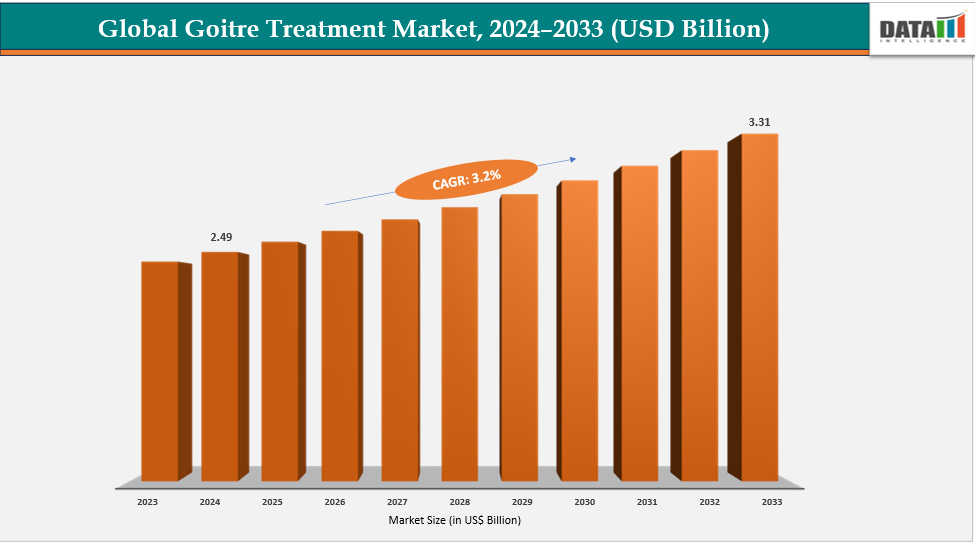
The global goitre treatment market reached US$ 2.42 Billion with a rise of US$ 2.49 Billion in 2024 and is expected to reach US$ 3.31 Billion by 2033, growing at a CAGR of 3.2% during the forecast period 2025-2033.
The rising prevalence of thyroid disorders, including hypothyroidism, hyperthyroidism, and multinodular goitre, is significantly driving the global goitre treatment market. The number of patients is increased by factors such autoimmune disorders, aging populations, and iodine deficit. Increased knowledge, regular screenings, and early diagnosis promote prompt hormone therapy, minimally invasive surgery, or other forms of intervention. Levothyroxine therapy and other cutting-edge interventions are among the new treatment choices being offered by hospitals and pharmaceutical businesses, while government programs and better healthcare infrastructure increase accessibility.
Key Highlights
- Based on treatment, the thyroid hormone replacement therapy segment is leading the market with strong growth potential, with a 42.3% share in 2024
- Based on the goitre type, simple goitre is dominating the cardiac biomarker market with a 48.3% share in 2024
- North America is dominating the goitre treatment market with the largest revenue share of 42.8% in 2024.
- Asia Pacific is the fastest-growing region and is expected to grow over the forecast period with a CAGR of 7.6% during 2024
- Top companies in the goitre treatment market are Abbott, GSK plc, Macleods Pharmaceuticals Ltd, Pfizer Inc, AstraZeneca, Wellona Pharma, Avet Pharmaceuticals Inc, AbbVie, Cipla, Guerbet LLC, and Merck KGaA, among others.
Market Dynamics
Drivers: Rising clinical trials for novel therapeutics are significantly driving the goitre treatment market growth
The global market is anticipated to be driven throughout the forecast period by the growing demand for innovative therapies. There are still clinical trials being conducted to identify new treatments that will improve patient outcomes. Because they are based on thyroid enlargement and thyroid hormone levels, the current treatments and therapeutics are not always effective for all individuals. New therapies and therapeutics are also required in order to improve and increase treatment outcomes.
Furthermore, clinical trials are crucial for the creation of novel treatment alternatives since they allow for the evaluation of both the efficacy and safety concerns of generating novel therapies. The prevalence of goitre is steadily rising; for example, the Cleveland Clinic organization estimates that 2.2 billion individuals are afflicted by the condition. More research may be conducted thanks to its rising occurrence. Numerous comparative studies also aid in the development of novel treatments and treatments with improved outcomes and distinct modes of action.
For instance, on July 2, 2023, the National Taiwan University Hospital completed phase 1 of a clinical trial for a prospective comparison of the effect of antiadhesive barriers during thyroid or parathyroid surgery. The study is being performed to develop the treatment or intervention of drugs such as oxidized regenerated cellulose drugs and hyaluronic acid drugs for the treatment of goitre, thyroid cancer, and thyroidectomy conditions.
Restraints: High dependency on lifelong treatment of goitre treatment is hampering the growth of the goitre treatment market
High dependency on lifelong treatment is hampering the growth of the goitre treatment market because managing goitre often requires continuous medication or surgical interventions. After a thyroidectomy or radioactive iodine therapy, many patients depend on hormone replacement therapy, such as levothyroxine (LT4). Patients may need ongoing medication or surgical procedures. This chronic illness necessitates daily medicine, frequent checkups with the doctor, and continuing monitoring, which can be very expensive and logistically taxing, especially in low- and middle-income nations. Accessibility, affordability, and patient adherence are all hampered by the expenses, intricacy of treatment, and requirement for dose modifications. Consequently, these obstacles prevent the broad use of therapies and restrict the growth of the industry as a whole, even though goitre is very common.
For instance, according to the Cleveland Clinic, most patients who undergo thyroid surgery or radioactive iodine therapy need lifelong thyroid hormone replacement to survive and maintain quality of life. This dependency creates a continuous treatment cycle with regular dosage adjustments, laboratory monitoring, and doctor visits, making management costly and inconvenient for many patients.
For more details on this report, see Request for Sample
Segmentation Analysis
The global goitre treatment market is segmented based on goitre type, thyroid hormone levels, treatment, end user, and region.
By Treatment: Thyroid hormone replacement therapy is leading the goitre treatment market with strong growth potential, with a 42.3% share in 2024
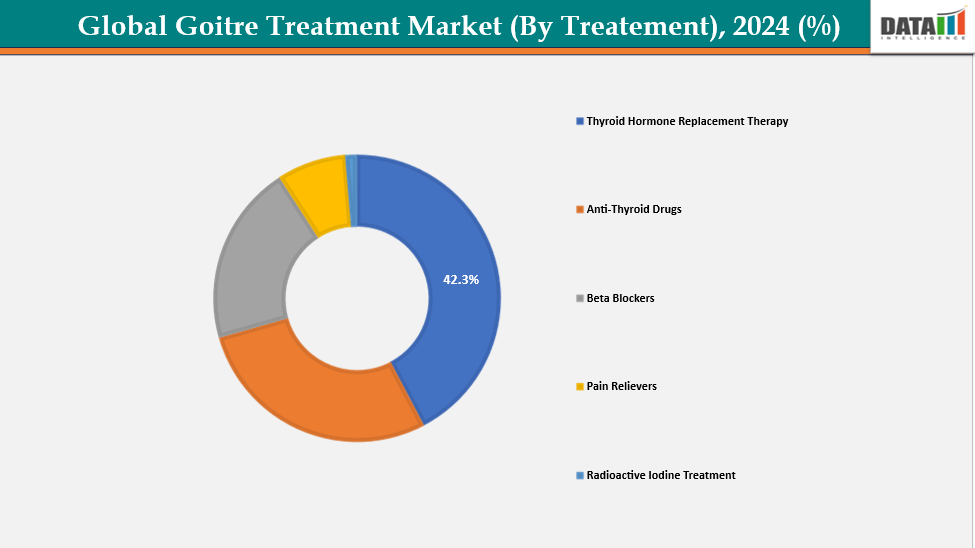
Thyroid hormone replacement therapy (THRT) is the leading treatment for goitre, primarily because it is the gold standard for managing hypothyroid-related goitre, the most common type. Synthetic levothyroxine (LT4) and liothyronine (LT3) are the primary choices; levothyroxine efficiently reduces thyroid enlargement and is appropriate for long-term oral usage. Due to improved screening, improving patient awareness, and the increasing prevalence of hypothyroidism, the market is developing. While advancements like liquid and soft-gel formulations improve absorption and patient adherence, lifetime therapy guarantees continued demand. Wider acceptance is also facilitated by better access to and infrastructure for healthcare in emerging markets. All things considered, THRT is the most popular and rapidly expanding market because to its shown effectiveness, ease of use, adherence to guidelines, and appropriateness for long-term treatment.
By Goitre Type:The simple (diffuse) goitre segment is goitre type dominating the goitre treatment market with a 48.3% share in 2024
Simple (diffuse) goitre is the most common type of thyroid enlargement, characterized by uniform, non-nodular swelling. Clinical practice places a lot of emphasis on it because of its high prevalence, particularly in areas with low iodine levels. TSH is suppressed and thyroid size is decreased using thyroid hormone replacement therapy (levothyroxine), which is a simple and efficient treatment. Complications can be decreased by treating diffuse goitre early on to stop it from developing into nodular or multinodular forms. It is given priority in guidelines and market trends because of its high therapeutic responsiveness, ease of diagnosis, and potential for prevention.
The simple goitre is more common, affecting about 5% of people in the U.S. Globally, the leading cause is iodine deficiency, which impacts around 2.2 billion people. The likelihood of developing a goitre rises with the severity of deficiency: 5–20% with mild deficiency, 20–30% with moderate deficiency, and over 30% with severe deficiency.
Geographical Analysis
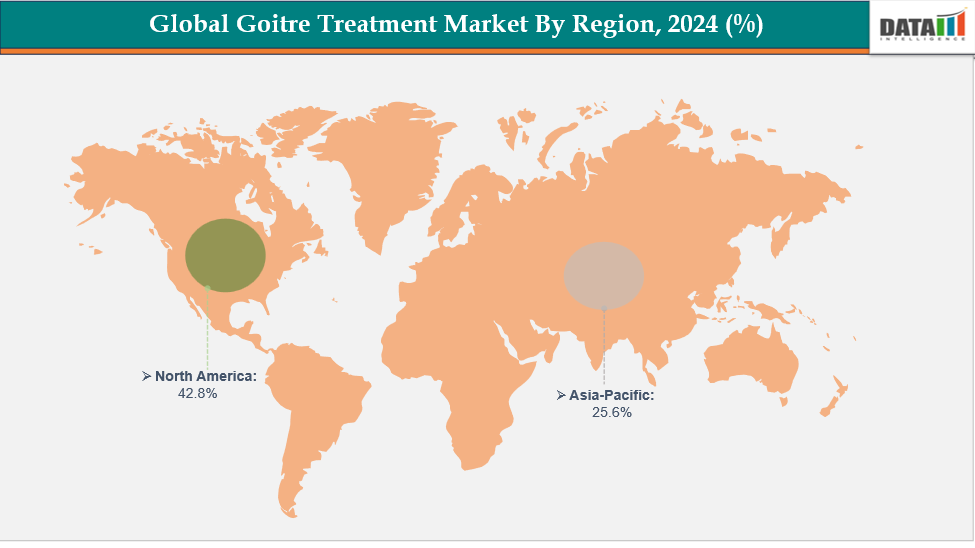
North America is dominating the global goitre treatment market share with 42.8% in 2024
North America dominates the global goitre treatment market due to its advanced healthcare infrastructure, high public awareness, and widespread access to standard treatments like levothyroxine therapy, surgery, and radioactive iodine. Early diagnosis is facilitated by regular health check-ups and specialist endocrinologists, increasing treatment demand. Strong regulatory support and health insurance coverage make therapies affordable and readily available. Additionally, the region leads in research and clinical trials, driving innovation in thyroid disorder management.
Moreover, in the United States, the prevalence of goitre is estimated to be between 4% and 7%. The condition is more common among women, with a female-to-male ratio of approximately 4:1. While iodine deficiency was historically a significant cause of goitre, its prevalence has decreased due to widespread use of iodized salt. Currently, autoimmune diseases such as Hashimoto's thyroiditis and Graves' disease are more prevalent causes of goitre in the U.S.
Europe is the second-largest region to dominate the global goitre treatment market share with 35.2% in 2024
Europe represents a significant market for goitre treatment. This is supported by its robust healthcare infrastructure, well-defined regulatory frameworks, and widespread access to thyroid diagnostic and treatment options, including levothyroxine therapy, anti-thyroid drugs, radioiodine therapy, and surgical interventions. The rising prevalence of thyroid disorders, including hypothyroidism, hyperthyroidism, and multinodular goitre, is driving demand for innovative and effective treatment options across the region.
Countries such as Germany, the UK, France, and Spain lead in goitre treatment adoption due to robust healthcare infrastructure, supportive reimbursement policies, a rise in clinical trials, and access to specialized endocrine and thyroid care centers. Meanwhile, Eastern and Southern Europe are gradually increasing treatment uptake as healthcare modernization and awareness of advanced thyroid diagnostics and therapies expand.
Owing to factors such as the rise in clinical trials, the Royal Berkshire NHS Foundation Trust initiated a clinical trial in the UK for the Thyroid Artery Goitre Embolization Trial, a pilot study investigating Thyroid Artery Embolisation as a treatment for large thyroid nodules (TArGET).
The Asia Pacific region is the fastest-growing region in the global goitre treatment market, with a CAGR of 7.6% during 2024
The Asia-Pacific (APAC) region is the fastest-growing market for goitre treatment due to a combination of high disease prevalence, expanding healthcare infrastructure, and rising awareness. Countries like India and China still have areas with iodine deficiency, contributing to higher goitre rates. Rapid investments in hospitals and diagnostic centers, along with public screening programs, drive early diagnosis and treatment demand. Adoption of advanced therapies such as radioactive iodine, radiofrequency ablation, and thyroid artery embolization is increasing.
India has a significant population affected by thyroid disorders, including goitre, largely due to iodine deficiency in certain regions. Growing healthcare infrastructure, government initiatives promoting iodine supplementation, and awareness campaigns are driving early detection and effective management of thyroid disorders. For instance, an awareness program conducted by Pace Hospital in India on World Iodine Deficiency Day in October 2024 highlighted that over 61 million people in India suffered from endemic goitre, emphasizing the importance of continued public education and prevention efforts. Moreover, the country has recently witnessed the adoption of advanced diagnostic and treatment approaches, such as high-resolution ultrasound, fine-needle aspiration (FNA) biopsy, levothyroxine therapy, and minimally invasive interventions like radiofrequency ablation.
Competitive Landscape
Top companies in the goitre treatment market are Abbott, GSK plc, Macleods Pharmaceuticals Ltd, Pfizer Inc, AstraZeneca, Wellona Pharma, Avet Pharmaceuticals Inc, AbbVie, Cipla, Guerbet LLC, and Merck KGaA, among others.
Abbott: Abbott Laboratories is a global healthcare company headquartered in Illinois, USA, producing levothyroxine and other thyroid hormone therapies for goitre and hypothyroidism. The company focuses on high-quality, widely accessible medications, supporting thyroid disorder management worldwide through research, innovation, and extensive distribution across North America, Europe, and Asia-Pacific regions.
Key Development
- In July 2024, AstraZeneca completed the acquisition of Amolyt Pharma, a clinical-stage biotechnology company focused on developing novel treatments for rare endocrine diseases. This acquisition expands AstraZeneca's pipeline in rare endocrinology.
Market Scope
| Metrics | Details | |
| CAGR | 3.2% | |
| Market Size Available for Years | 2022-2033 | |
| Estimation Forecast Period | 2025-2033 | |
| Revenue Units | Value (US$ Bn) | |
| Segments Covered | By Goitre Type | Simple (Diffuse) Goitre, Nodular Goitre, Multinodular Goitre |
| By Thyroid Hormone Level | Hyperthyroidism, Hypothyroidism | |
| By Treatment | Thyroid Hormone Replacement Therapy, Anti-Thyroid Drugs, Beta Blockers, Pain Relievers, Radioactive Iodine Treatment | |
| By End User | Hospitals, Specialty Clinics, ENT Clinics | |
| Regions Covered | North America, Europe, Asia-Pacific, South America and the Middle East & Africa | |
The Global Goitre Treatment Market report delivers a detailed analysis with 73 key tables, more than 65 visually impactful figures, and 159 pages of expert insights, providing a complete view of the market landscape.
Suggestions for Related Reports
For more pharmaceutical-related reports, please click here




























































