


Hormone Replacement Therapy (HRT) Market Size
The Global Hormone Replacement Therapy (HRT) Market reached US$ 31.73 billion in 2025 and is expected to reach US$ 50.95 billion by 2033, growing at a CAGR of 6.1% during the forecast period 2026-2033.
Hormone Replacement Therapy (HRT) is a treatment that involves the use of hormones to address symptoms linked to hormonal imbalances, particularly during menopause, as well as in conditions like hypogonadism or gender transition. With increasing demand for more tailored and minimally invasive therapies, options such as bioidentical hormones and transdermal delivery methods are gaining popularity.
HRT is widely used to relieve menopause-related symptoms like hot flashes, night sweats, and mood changes by replenishing estrogen, progesterone, and occasionally testosterone. It is also used to manage conditions such as hypoestrogenism and hypogonadism and plays a crucial role in gender-affirming treatments for transgender individuals.
Executive Summary
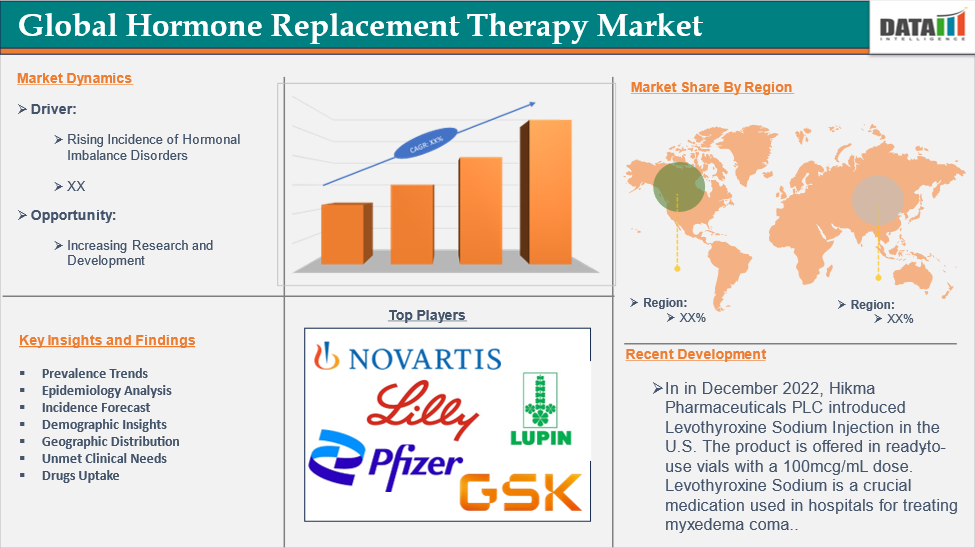
For more details on this report – Request for Sample material
Hormone Replacement Therapy (HRT) Market Dynamics: Drivers & Restraints
Rising incidence of hormonal imbalance disorders
The growing prevalence of hormonal imbalance disorders is significantly boosting the demand for hormone replacement therapy (HRT), fueled by increased awareness of these conditions and their effects on quality of life.
Disorders like polycystic ovary syndrome (PCOS), which affects roughly 8–13% of women of reproductive age, often remain undiagnosed, creating a greater need for treatments like HRT to manage symptoms and improve overall health. Additionally, thyroid disorders are common, impacting 30% to 40% of patients seen in endocrine practices, further driving the demand for therapies to regulate hormone levels.
As the global population ages, more individuals are entering menopause, increasing the need for HRT to address related symptoms. This combination of factors highlights the growing demand for effective hormonal treatments. It reflects a broader understanding among healthcare providers and patients about the benefits and safety of HRT, thereby contributing to significant market expansion.
Complications associated with hormonal replacement therapies
The potential side effects and health risks associated with long-term hormone replacement therapy (HRT) use are expected to significantly hinder the growth of the HRT market. Concerns about adverse health outcomes, such as an increased risk of breast cancer, blood clots, stroke, and cardiovascular diseases, have made both patients and healthcare providers cautious about prescribing HRT, particularly for extended periods. These risks are expected to decline in the widespread adoption of HRT.
Hormone Replacement Therapy (HRT) Market Segment Analysis
The global hormone replacement therapy market is segmented based on product, route of administration, indication, distribution channel, and region.
Type:
Thyroid hormone replacement therapy segment is expected to dominate the global hormone replacement therapy market share
The Thyroid Hormone Replacement Therapy (THRT) segment is expected to dominate the Hormone Replacement Therapy (HRT) market due to the high prevalence of thyroid disorders, which affect a significant portion of the global population. Conditions like hypothyroidism, which is characterized by insufficient thyroid hormone production, are widespread and commonly treated with thyroid hormone replacement.
The increasing focus on the development of innovative formulations with the growing demand for thyroid replacement therapies is contributing to the segment growth. For instance, in December 2022, Hikma Pharmaceuticals PLC introduced Levothyroxine Sodium Injection in the U.S. The product is offered in ready-to-use vials with a 100mcg/mL dose. Levothyroxine Sodium is a crucial medication used in hospitals for treating myxedema coma.
As thyroid dysfunction is often diagnosed early and requires ongoing treatment, the demand for effective and reliable hormone replacement therapies is substantial. Additionally, thyroid hormone therapy has a well-established safety profile, which contributes to its continued preference among both patients and healthcare providers. As awareness of thyroid disorders grows and the global incidence of these conditions increases, the THRT segment is anticipated to experience sustained demand.
Hormone Replacement Therapy (HRT) Market Geographical Share
North America is expected to hold a significant position in the global hormone replacement therapy market share
North America is likely to lead the Hormone Replacement Therapy (HRT) market due to several important factors, including its large and aging population, growing awareness of hormone-related health issues, and a well-developed healthcare system. There is a growing incidence of hormonal imbalance disorders in the region which is increasingly allowing individuals to adopt hormonal replacement therapeutics.
The increasing prevalence of conditions like menopause, thyroid disorders, and polycystic ovary syndrome (PCOS) in the region has created a consistent demand for HRT treatments. For instance, according to the American Thyroid Association, it is stated that around 20 million Americans have some form of thyroid disease.
Competitive Landscape
The major global players in the hormone replacement therapy market include Bayer AG, Teva Pharmaceuticals USA, Inc., Dr. Reddy’s Laboratories Ltd., Hikma Pharmaceuticals PLC, Lupin, Cipla, Sanofi, AdvaCare Pharma, Wellona Pharma, and Montage Laboratories Pvt. Ltd. among others.
| Metrics | Details | |
| CAGR | 6.1% | |
| Market Size Available for Years | 2023-2033 | |
| Estimation Forecast Period | 2026-2033 | |
| Revenue Units | Value (US$ Bn) | |
| Segments Covered | Product | Thyroid Hormone Replacement Therapy, Estrogen Hormone Replacement Therapy, Testosterone Hormone Replacement Therapy, Human Growth Hormone Replacement Therapy, Others |
| Route of Administration | Oral, Parenteral, Others | |
| Indication | Menopause, Hypothyroidism, Male Hypogonadism, Growth Hormone Deficiency, Others | |
| Distribution Channel | Hospital Pharmacies, Retail Pharmacies, Online Pharmacies, Others | |
| Regions Covered | North America, Europe, Asia-Pacific, South America, and Middle East & Africa | |
Recent Developments
- March 2026 – Bayer and Sanofi strengthen women’s health portfolios
Leading pharmaceutical companies continue to expand their estrogen and progesterone therapy offerings, focusing on improved formulations and delivery systems for menopausal symptom relief. - February 2026 – Growth in transdermal and non-oral delivery systems
Transdermal patches, gels, and sprays are gaining preference over oral therapies due to lower risk of cardiovascular side effects and improved hormone absorption consistency. - February 2026 – Generic drug manufacturers expand cost-effective HRT options
Companies such as Teva Pharmaceutical Industries, Dr. Reddy’s Laboratories, and Cipla are increasing availability of affordable generic HRT drugs, improving accessibility in emerging markets. - January 2026 – Increasing clinical focus on long-term safety and risk stratification
Recent studies emphasize personalized risk assessment (age, cardiovascular health, cancer risk) to guide HRT use, addressing historical concerns around hormone therapy safety. - January 2026 – Expansion of HRT use beyond menopause into broader endocrine disorders
HRT is increasingly used for hypogonadism, gender-affirming therapy, and thyroid-related hormonal imbalances, expanding the therapeutic scope of the market.
Why Purchase the Report?
- Pipeline & Innovations: Reviews ongoing clinical trials, and product pipelines, and forecasts upcoming advancements in medical devices and pharmaceuticals.
- Product Performance & Market Positioning: Analyzes product performance, market positioning, and growth potential to optimize strategies.
- Real-World Evidence: Integrates patient feedback and data into product development for improved outcomes.
- Physician Preferences & Health System Impact: Examines healthcare provider behaviors and the impact of health system mergers on adoption strategies.
- Market Updates & Industry Changes: Covers recent regulatory changes, new policies, and emerging technologies.
- Competitive Strategies: Analyzes competitor strategies, market share, and emerging players.
- Pricing & Market Access: Reviews pricing models, reimbursement trends, and market access strategies.
- Market Entry & Expansion: Identifies optimal strategies for entering new markets and partnerships.
- Regional Growth & Investment: Highlights high-growth regions and investment opportunities.
- Supply Chain Optimization: Assesses supply chain risks and distribution strategies for efficient product delivery.
- Sustainability & Regulatory Impact: Focuses on eco-friendly practices and evolving regulations in healthcare.
- Post-market Surveillance: Uses post-market data to enhance product safety and access.
- Pharmacoeconomics & Value-Based Pricing: Analyzes the shift to value-based pricing and data-driven decision-making in R&D.
The Global Hormone Replacement Therapy Market report delivers a detailed analysis with 60+ key tables, more than 50 visually impactful figures, and 176 pages of expert insights, providing a complete view of the market landscape.
Target Audience
- Manufacturers: Pharmaceutical, Medical Device, Biotech Companies, Contract Manufacturers, Distributors, Hospitals.
- Regulatory & Policy: Compliance Officers, Government, Health Economists, Market Access Specialists.
- Technology & Innovation: AI/Robotics Providers, R&D Professionals, Clinical Trial Managers, Pharmacovigilance Experts.
- Investors: Healthcare Investors, Venture Fund Investors, Pharma Marketing & Sales.
- Consulting & Advisory: Healthcare Consultants, Industry Associations, Analysts.
- Supply Chain: Distribution and Supply Chain Managers.
- Consumers & Advocacy: Patients, Advocacy Groups, Insurance Companies.
- Academic & Research: Academic Institutions.



























































