


Market Size
The global four-legged robot market reached US$1.70 billion in 2025 and is expected to reach US$10.90 billion by 2035, growing with a CAGR of 18.54% during the forecast period 2026-2035.
Increasing deployment across defense, utilities, logistics, manufacturing, agriculture, healthcare, and public safety is accelerating commercialization. Buyers are focusing on robots capable of autonomous navigation, intelligent inspection, data collection, and remote operation while reducing workforce exposure to hazardous environments. Continuous advances in artificial intelligence, machine vision, LiDAR, edge computing, and actuator technologies are further improving mobility, perception, and decision making, strengthening the long-term investment case for quadruped robotic systems.
Key Takeaways
• Defense and aerospace remain the largest revenue-generating applications due to high procurement budgets and demand for autonomous surveillance.
• North America continues to lead global adoption through sustained military research programs, advanced robotics companies, and industrial automation investments.
• AI-powered navigation, SLAM, LiDAR integration, and intelligent perception systems are becoming standard capabilities across premium robotic platforms.
• Although acquisition costs remain high, long-term automation ROI is improving through predictive maintenance, workforce optimization, and continuous operation capabilities.
• The four-legged robot vendor landscape is becoming increasingly competitive as established robotics companies compete with emerging Asian manufacturers offering lower-cost platforms.
Market Scope
| Metric | Details |
| Market Size (2025) | US$1.70 Billion |
| Market Size (2035) | US$10.90 Billion |
| CAGR (2026 to 2035) | 18.54% |
| Historic Years | 2023 to 2024 |
| Base Year | 2025 |
| Forecast Period | 2026 to 2035 |
| Segments Covered | Type, Mobility & Navigation Technology, Payload Capacity, Application, Region |
| Leading Region | North America |
| Fastest Growing Region | Asia Pacific |
Global Four-Legged Robot Market Trends
One of the most prominent trends in the four-legged robot market is the growing integration of AI and real-time perception systems, enabling these robots to operate autonomously in unpredictable environments. For instance, Boston Dynamics’ Spot robot is being used by utility companies for the automated inspection of power stations and offshore oil rigs, showcasing how AI-enabled navigation is transforming industrial maintenance.
Another key trend is the militarization and defense deployment of quadruped robots-Ghost Robotics’ Vision 60 is currently being tested by the US Air Force for perimeter security and surveillance, illustrating their potential in reducing human risk in hostile zones. Additionally, there is a noticeable rise in commercial and research adoption in Asia; Chinese companies like Unitree Robotics have launched consumer-grade quadruped robots like Go1, which are used in education, robotics research, and even personal entertainment, highlighting growing accessibility.
For more details on this report, Request for Sample
Market Dynamics
Advancements in Robotics & AI Technology
Continuous innovations in AI, machine learning, and sensor technologies have made four-legged robots more intelligent, agile, and adaptive, increasing their commercial and industrial applications. For instance, in 2025, Kawasaki Heavy Industries unveiled "CORLEO," a four-legged bionic robot powered by a hydrogen fuel cell system, showcasing future-ready mobile platform technologies.
Featuring advanced off-road mobility, integrated hydrogen storage, and human-machine collaboration controls, CORLEO merges robotics with Kawasaki’s motorcycle and energy innovations. The Four-Legged Robot Market is being driven by technological innovation, cross-industry applications, and rising investments from both public and private sectors.
High Cost of Development and Deployment
The high cost of development and deployment significantly restrains the growth of the four-legged robot market by limiting accessibility and scalability, especially for small and medium enterprises (SMEs). Developing a four-legged robot requires advanced hardware, such as precision actuators, high-resolution sensors, and robust power systems, coupled with sophisticated software for navigation and AI-driven decision-making.
For instance, Boston Dynamics’ Spot robot costs around US$74,500, excluding additional accessories like robotic arms or software licenses, which can push the total price even higher. Moreover, maintenance, periodic upgrades, and skilled personnel for operation and troubleshooting add to the overall cost burden, thereby restricting widespread adoption and slowing market penetration beyond large corporations and government agencies.
Market Segment Analysis
The global four-legged robot market is segmented based on type, mobility/navigation technology, payload capacity, application and region.
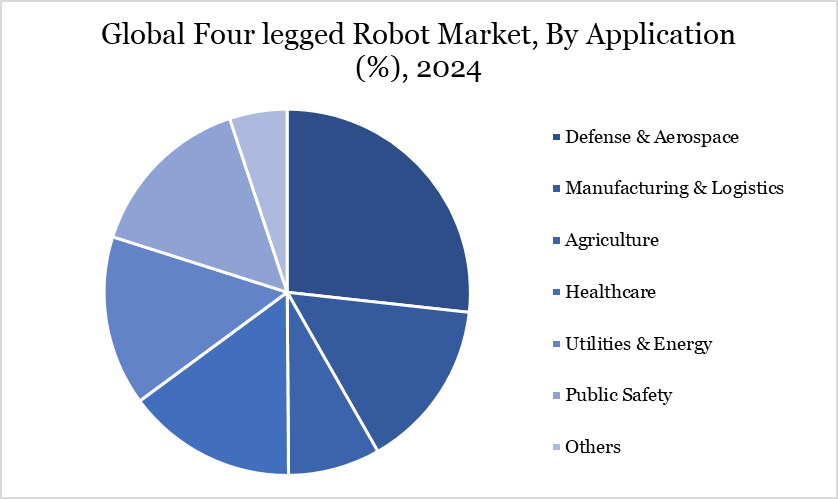
Strategic Dominance of Four-Legged Robots in Defense & Aerospace Applications
The defense & aerospace segment dominates the four-legged robot market due to its early adoption, high funding capacity, and critical need for advanced mobility solutions in complex and hazardous environments. Military organizations prioritize technologies that can enhance surveillance, reconnaissance, and logistics while reducing risk to human soldiers, areas where four-legged robots excel.
These robots can navigate rough terrains, climb stairs, and operate in environments that are inaccessible or dangerous for wheeled robots or humans. For instance, the US Air Force and Department of Homeland Security have deployed Ghost Robotics’ Vision 60 for perimeter security and autonomous patrolling of air bases.
Industrial Automation Creates New Commercial Opportunities
Manufacturers, energy operators, logistics providers, and infrastructure companies are adopting autonomous robotic inspection to improve operational efficiency while reducing manual inspections in hazardous environments.
Routine inspection of oil and gas facilities, electrical substations, warehouses, transportation infrastructure, and manufacturing plants represents a growing revenue opportunity as organizations prioritize predictive maintenance and digital asset management.
Pricing and Adoption Trends
Premium quadruped robots continue to command relatively high purchase prices because of sophisticated hardware, intelligent software, ruggedized components, and advanced sensing capabilities.
Boston Dynamics' Spot platform, with a starting price around US$74,500 before additional hardware and software modules, illustrates the premium positioning of enterprise-grade robotic systems. Beyond acquisition costs, customers evaluate software subscriptions, maintenance contracts, payload upgrades, cloud analytics, and lifecycle support as part of total ownership costs.
Despite higher upfront investment, organizations increasingly justify procurement through reduced inspection downtime, lower safety incidents, improved asset monitoring, and higher workforce productivity.
Deployment ROI and Service Revenue Model
Deployment ROI extends beyond labor savings. Four-legged robots generate measurable value through continuous inspection schedules, predictive maintenance data, digital twin integration, and reduced operational interruptions.
Vendors are also expanding recurring revenue opportunities by offering the following:
- Software licensing
- Fleet management platforms
- AI analytics subscriptions
- Preventive maintenance services
- Remote diagnostics
- Payload customization
- Operator training
- Technical support agreements
This shift toward software and services improves long-term customer retention while creating stable recurring revenues for robotics manufacturers.
Market Geographical Share
North America's Leading Role in the Four-Legged Robot Market
North America dominates the four-legged robot market, driven by strong technological infrastructure, robust defense spending, and active participation from leading robotics companies. The United States, in particular, plays a central role due to its early adoption of advanced robotics for both military and industrial applications.
Major players such as Boston Dynamics, Ghost Robotics, and Agility Robotics are headquartered in the US, contributing to continuous innovation and the commercialization of four-legged robots. The region’s well-funded defense sector, supported by organizations like DARPA and the US Department of Defense, has heavily invested in robotic platforms for surveillance, reconnaissance, and load-carrying missions.
Major Global Players
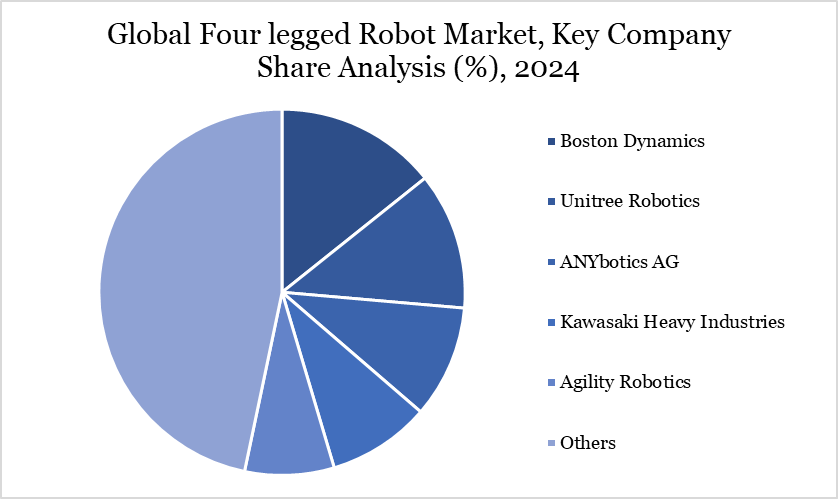
The major global players in the market include Hangzhou Yunshenchu Technology Co., Ltd., Boston Dynamics, Unitree Robotics, ANYbotics AG, Kawasaki Heavy Industries, Agility Robotics, VEX Robotics, MAB Robotics, Ghost Robotics, Génération Robots and among others.
Key Developments
June 2026: The United States increased investments in four-legged robotic platforms for defense, public safety, and industrial inspection applications, supporting autonomous mobility, situational awareness, and mission-critical operations.
May 2026: Japan accelerated development of AI-enabled quadruped robots, expanding their deployment in industrial automation, infrastructure inspection, disaster response, and healthcare support applications.
April 2026: Leading robotics companies expanded investments in advanced perception systems, autonomous navigation software, and edge AI capabilities to improve the performance and reliability of four-legged robots in complex environments.
March 2026: Industrial automation providers strengthened partnerships with robotics developers to integrate four-legged robots into manufacturing facilities, warehouses, and energy infrastructure for inspection, monitoring, and predictive maintenance.
February 2026: Robotics manufacturers increased production capacity and research activities focused on lightweight materials, high-efficiency actuators, and extended battery life, supporting broader commercial adoption of quadruped robots.
January 2026: Governments and research organizations across North America, Europe, and Asia-Pacific expanded funding for autonomous robotic technologies, accelerating innovation in four-legged robots for defense, emergency response, agriculture, and industrial automation.
Why Choose DataM?
- Data-Driven Insights: Dive into detailed analyses with granular insights such as pricing, market shares and value chain evaluations, enriched by interviews with industry leaders and disruptors.
- Post-Purchase Support and Expert Analyst Consultations: As a valued client, gain direct access to our expert analysts for personalized advice and strategic guidance, tailored to your specific needs and challenges.
- White Papers and Case Studies: Benefit quarterly from our in-depth studies related to your purchased titles, tailored to refine your operational and marketing strategies for maximum impact.
- Annual Updates on Purchased Reports: As an existing customer, enjoy the privilege of annual updates to your reports, ensuring you stay abreast of the latest market insights and technological advancements. Terms and conditions apply.
- Specialized Focus on Emerging Markets: DataM differentiates itself by delivering in-depth, specialized insights specifically for emerging markets, rather than offering generalized geographic overviews. This approach equips our clients with a nuanced understanding and actionable intelligence that are essential for navigating and succeeding in high-growth regions.
- Value of DataM Reports: Our reports offer specialized insights tailored to the latest trends and specific business inquiries. This personalized approach provides a deeper, strategic perspective, ensuring you receive the precise information necessary to make informed decisions. These insights complement and go beyond what is typically available in generic databases.
Target Audience
- Manufacturers/ Buyers
- Industry Investors/Investment Bankers
- Research Professionals
- Emerging Companies



























































