


Firming Agents Market Size and Forecast
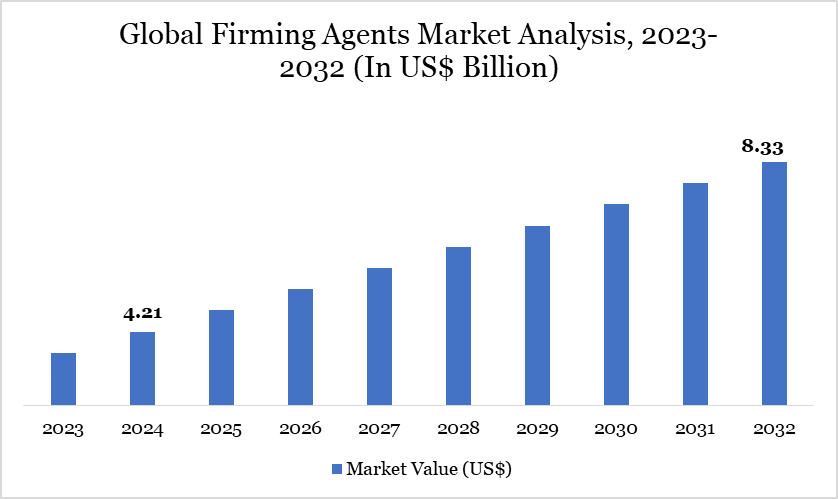
The Firming Agents Market will reach US$ 4.99 billion in 2026, up from US$ 4.58 billion in 2025, and is projected to reach US$ 10.79 billion by 2035, registering steady growth at a CAGR of 8.91% during the forecast period from 2026 to 2035.
The global firming agents market is expanding, driven by increasing demand across sectors like food & beverage, cosmetics, and pharmaceuticals. Firming agents are crucial additives that enhance texture, stability, and shelf life in food products and provide firmness in cosmetic and pharmaceutical formulations.
The adoption of firming agents is further influenced by regulatory frameworks that ensure food and product safety. Agencies such as US Food and Drug Administration (FDA) and the European Food Safety Authority (EFSA) have set standards to regulate firming agents in food and other products, thereby establishing quality and safety benchmarks. The move towards sustainable and clean-label components is transforming the market, prompting manufacturers to create innovative natural firming agents sourced from plants and minerals.
Asia-Pacific is becoming one of the fastest-growing markets for home healthcare due to the increasing elderly population, adoption of technology and government efforts to decrease hospital congestion. Countries such as Japan, China and India are witnessing a surge in demand for home healthcare services, supported by government policies promoting elderly care at home. Japan, with one of the world's most rapidly aging populations, has seen significant investment in home healthcare technologies.
Firming Agents Market Trend
A notable trend in the firming agents market is the increasing regulatory emphasis on ensuring the safety and quality of these additives in processed fruits and vegetables. In the US, the Food and Drug Administration (FDA) classifies firming agents like calcium chloride and calcium lactate as substances that maintain crispness and firmness in processed produce. These agents are regulated under Title 21 of the Code of Federal Regulations (CFR), which specifies their approved uses and maximum allowable concentrations in food products.
Similarly, in the European Union, the European Food Safety Authority (EFSA) provides scientific advice to support the authorization process of food additives, including firming agents. EFSA's assessments ensure that these substances meet stringent safety standards before being approved for use in the EU market. This regulatory focus underscores the importance of firming agents in maintaining the quality and safety of processed fruits and vegetables, aligning with consumer expectations for high-quality, safe food products.
For more details on this report - Request for Sample
Firming Agents Market Key Takeaways
- North America accounts for approximately 35-40% of the global market share, driven by the expanding processed food industry, increasing consumption of canned fruits and vegetables, and growing demand for texture-enhancing food additives.
- Calcium-based firming agents contribute over 50% of total market demand, owing to their widespread utilization in food processing applications for improving texture, firmness, and shelf-life stability.
- Fruits and vegetables applications account for nearly 45% of total market revenue, supported by increasing consumer demand for high-quality processed and convenience foods.
- Food and beverage manufacturers collectively represent more than 60% of end-user consumption, leveraging firming agents to enhance product consistency, processing efficiency, and storage stability.
- Natural and clean-label firming agent formulations are witnessing annual adoption growth exceeding 12%, driven by increasing consumer preference for minimally processed and naturally sourced ingredients.
- Asia-Pacific is expected to register the fastest market growth, supported by expanding food processing industries, rising disposable incomes, and increasing investments in packaged food production across emerging economies.
- Advanced food preservation technologies integrated with firming agents are improving texture retention and extending product shelf life across multiple applications.
- Strategic collaborations among food ingredient manufacturers and processed food companies are accelerating product innovation and commercialization globally.
- Growing investments in clean-label food ingredients, sustainable food processing technologies, and specialty texture-enhancing solutions are expected to drive long-term market expansion.
Firming Agents Market Scope
| Metrics | Details |
| By Type | Aluminum Sulphate, Ammonium Aluminum Sulphate, Calcium Chloride, Calcium Citrate, Calcium Gluconate, Calcium Lactate, Calcium Phosphate (Dibasic), Calcium Phosphate (Monobasic), Calcium Sulphate, Potassium Aluminum Sulphate, Sodium Aluminum Sulphate, Others |
| By Application | Fruits and Vegetables, Meat and Fish Products, Others |
| By Region | North America, South America, Europe, Asia-Pacific and Middle East and Africa |
| Report Insights Covered | Competitive Landscape Analysis, Company Profile Analysis, Market Size, Share, Growth |
Firming Agents Market Dynamics
Technological Advancements and Clean-Label Trends
Innovations in firming agents are key growth drivers, particularly with the shift toward clean-label products. Innovative technologies are facilitating the creation of plant-derived and natural firming agents that are equally effective as their synthetic counterparts. The demand for clean-label and sustainable products has prompted manufacturers to focus on plant-derived agents like agar-agar and pectin.
Furthermore, clean label has increased by 25% year-over-year with meat substitutes, baking ingredients and flavoring, dry food and dairy as the leading categories driving the conversation, largely due to consumer preference for transparency in food labeling. Similarly, the World Bank estimates that by 2030, urban populations will make up nearly 60% of the global demographic, amplifying the need for ready-to-consume and preserved foods.
Regulatory Challenges and Costs Fluctuation
Stringent regulations governing food additives, particularly in regions like North America and Europe, present a barrier to market growth. Compliance with food safety standards from agencies like the European Food Safety Authority (EFSA) and the US Food and Drug Administration (FDA) imposes high costs on manufacturers. Additionally, ongoing regulatory updates necessitate frequent adaptations in production processes, driving up operational costs and impacting market expansion.
Furthermore, Fluctuations in the prices of agricultural goods, influenced by climatic conditions and geopolitical tensions, impact the demand and affordability of firming agents used in preserving produce. With rising costs of fruits, vegetables and other perishables, food producers are increasingly cost-sensitive, which can limit the adoption of firming agents and hinder market growth in cost-competitive regions.
Firming Agents Market Segment Analysis
The global firming agents market is segmented based on type, application and region.
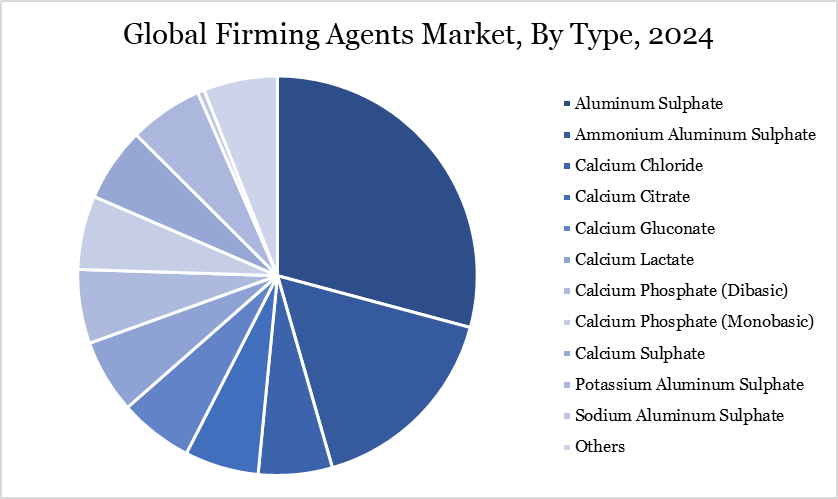
Calcium Chloride Segment Driving Firming Agents Market
In 2024, firming agents like calcium chloride continue to be essential in the fruits and vegetables segment, preserving texture, appearance, and shelf life, especially in canned and packaged products. The European Union's agri-food imports reached a record US$ 193.47 billion, with significant contributions from processed fruits and nuts, underscoring the growing demand for long-lasting food products. This surge is particularly notable in regions prioritizing food security and supply chain stability.
In the US, the Food and Drug Administration (FDA) enforces the Produce Safety Rule under the Food Safety Modernization Act (FSMA), establishing science-based standards for the safe growing, harvesting, packing, and holding of fruits and vegetables. Meanwhile, the European Food Safety Authority (EFSA) continues to regulate food improvement agents, ensuring that firming agents used in produce meet stringent safety and quality standards across the European Union. These regulatory frameworks are crucial in maintaining the quality of processed produce, aligning with consumer preferences for ready-to-eat and durable food options.
Firming Agents Market Geographical Share
Demand for Firming Agents in North America
North America leads the firming agent market, largely due to its established food processing industry and stringent food safety regulations. US Food and Drug Administration (FDA) strictly oversees the utilization of firming agents in food items, maintaining elevated levels of safety and quality. This regulatory supervision lays a solid groundwork for market expansion, as it encourages consumer trust and upholds uniformity among processed food products. Additionally, the presence of large food brands in North America creates a sustained market demand.
In Canada, the Canadian Food Inspection Agency (CFIA) oversees firming agents’ use in food manufacturing, setting rigorous safety standards that bolster market expansion. The regulation assists in guaranteeing that firming agents are utilized properly to maintain food texture, aiding in market expansion in both retail and industrial sectors. Together, the FDA and CFIA's comprehensive regulatory frameworks reinforce the quality of processed foods in North America, strengthening the firming agents’ market across the region.
Firming Agents Market Latest Trends and Insights
Rising Demand for Clean-Label Firming Solutions
Food manufacturers are increasingly looking for firming agents that fit clean-label formulations. This is encouraging development of naturally derived and plant-based alternatives alongside conventional calcium salts.
Ingredients such as pectin and agar-based systems are attracting attention because they can contribute to texture and structural stability while supporting clean-label positioning.
Growing Use in Processed Fruits and Vegetables
Processed fruits and vegetables remain one of the most important application areas. Firming agents help maintain crispness, firmness, appearance, and structural integrity during blanching, canning, freezing, and other processing operations.
This trend is supported by increasing consumption of convenient, ready-to-eat, canned, frozen, and packaged foods.
Calcium Chloride Remains a Key Commercial Ingredient
Calcium chloride continues to be widely used because of its strong ability to interact with pectic substances and strengthen plant tissue.
It is particularly relevant in canned fruits and vegetables, pickles, processed produce, and other texture-sensitive foods, where maintaining firmness after processing is commercially important.
Natural and Sustainable Ingredient Development
Sustainability is becoming a stronger consideration in food-ingredient development. Manufacturers are exploring plant-derived and naturally sourced ingredients that can provide functional performance while supporting environmental and clean-label objectives.
This trend is creating opportunities for ingredient suppliers to develop multifunctional solutions combining firming, stabilization, preservation, and texture enhancement.
Integration with Food Preservation Technologies
Firming agents are increasingly being incorporated into broader food-preservation systems rather than being used solely as texture enhancers.
Combining firming agents with controlled-atmosphere packaging, cold-chain management, preservatives, edible coatings, and other preservation approaches can help maintain product quality throughout distribution and storage.
Firming Agents Market Regulatory Landscape
Firming agents used in food applications are subject to strict requirements governing food safety, permitted applications, maximum usage levels, purity, labeling, and consumer protection.
In the United States, the FDA regulates food additives and establishes conditions under which substances such as calcium chloride and calcium lactate can be used as firming agents. Relevant requirements are established under Title 21 of the Code of Federal Regulations.
In Europe, food additives must comply with the applicable European Union authorization framework, with scientific safety assessments playing an important role in determining permitted uses.
Key regulatory considerations include:
- Food-grade purity
- Permitted applications
- Maximum usage concentrations
- Manufacturing standards
- Contaminant limits
- Labeling requirements
- Allergen considerations
- Nutritional claims
- Product traceability
- Environmental and sustainability requirements
Regulatory compliance is becoming increasingly important as food manufacturers expand across international markets with different additive-approval systems.
Firming Agents Market Value Chain Analysis
The Firming Agents value chain begins with raw-material suppliers, including producers of calcium salts, aluminum salts, phosphates, organic acids, minerals, and plant-derived functional ingredients.
The next stage involves chemical processing, purification, formulation, quality testing, and food-grade certification. Manufacturers must ensure consistent particle size, purity, solubility, concentration, and functional performance.
Products are then distributed through specialty food-ingredient distributors, chemical distributors, direct sales channels, and ingredient suppliers.
Downstream customers include canned-food manufacturers, fruit and vegetable processors, meat and seafood companies, beverage manufacturers, pickle producers, frozen-food companies, and other food-processing businesses.
At the final stage, firming agents contribute to the quality characteristics of finished products by improving firmness, crispness, structural stability, appearance, processing resistance, and shelf-life performance.
The value chain is increasingly influenced by clean-label requirements, sustainability targets, raw-material price fluctuations, food-safety regulations, and the development of multifunctional ingredient systems.
Firming Agents Market Major Players
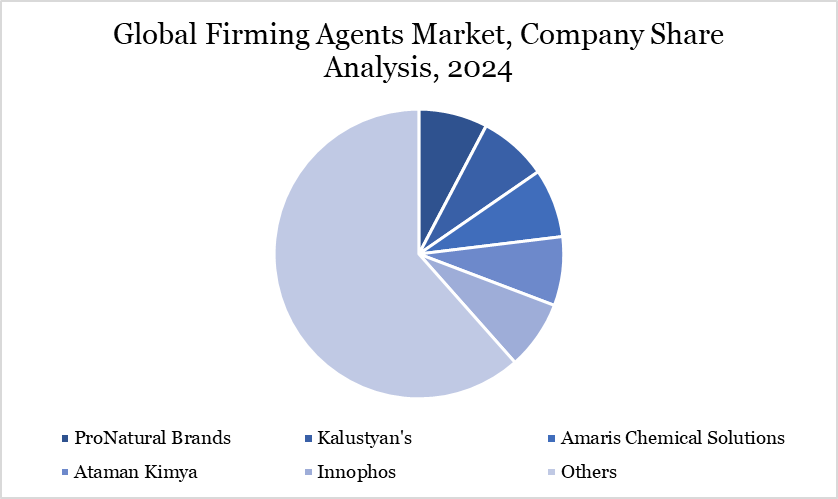
The major global players in the market include ProNatural Brands, Kalustyan's, Amaris Chemical Solutions, Ataman Kimya and Innophos, Food Ingredient Technology Co., Ltd., Hefei TNJ Chemical Industry Co., Ltd., Liaoyang Fuqiang Food Chemical Co., Ltd., Ronas Chemicals Ind.Co.,Ltd. and Zhejiang Wecan Biotechnology Co., Ltd.
Key Developments in the Firming Agents Market
- June 2026: Innophos Holdings, Inc. expanded its specialty food ingredient portfolio by advancing clean-label phosphate solutions used in food texture enhancement and firmness applications.
- June 2026: Ataman Kimya A.Ş. strengthened its global specialty chemicals business by expanding the supply of food-grade additives and ingredients for food processing applications.
- May 2026: Food Ingredient Technology Co., Ltd. enhanced its product offerings by increasing the availability of food-grade firming agents for the processed fruits, vegetables, and beverage industries.
- May 2026: Hefei TNJ Chemical Industry Co., Ltd. expanded its portfolio of food additives and specialty chemicals to support growing demand from global food manufacturers.
- April 2026: Zhejiang Wecan Biotechnology Co., Ltd. continued investing in food ingredient innovations focused on improving product stability, texture, and shelf life across food applications.
- April 2026: Kalustyan's broadened its specialty food ingredients portfolio by expanding the distribution of food-grade additives for culinary and industrial applications.
- March 2026: Liaoyang Fuqiang Food Chemical Co., Ltd. strengthened its production capabilities for food additives used in texture enhancement and food preservation applications.
- March 2026: Ronas Chemicals Ind. Co., Ltd. expanded its supply of specialty food chemicals and additives for international food processing markets.
- February 2026: Amaris Chemical Solutions continued developing customized ingredient solutions to support functional food and specialty chemical applications.
Why Choose DataM?
Data-Driven Insights: Dive into detailed analyses with granular insights such as pricing, market shares and value chain evaluations, enriched by interviews with industry leaders and disruptors.
Post-Purchase Support and Expert Analyst Consultations: As a valued client, gain direct access to our expert analysts for personalized advice and strategic guidance, tailored to your specific needs and challenges.
White Papers and Case Studies: Benefit quarterly from our in-depth studies related to your purchased titles, tailored to refine your operational and marketing strategies for maximum impact.
Annual Updates on Purchased Reports: As an existing customer, enjoy the privilege of annual updates to your reports, ensuring you stay abreast of the latest market insights and technological advancements. Terms and conditions apply.
Specialized Focus on Emerging Markets: DataM differentiates itself by delivering in-depth, specialized insights specifically for emerging markets, rather than offering generalized geographic overviews. This approach equips our clients with a nuanced understanding and actionable intelligence that are essential for navigating and succeeding in high-growth regions.
Value of DataM Reports: Our reports offer specialized insights tailored to the latest trends and specific business inquiries. This personalized approach provides a deeper, strategic perspective, ensuring you receive the precise information necessary to make informed decisions. These insights complement and go beyond what is typically available in generic databases.
Target Audience 2026
The Firming Agents Market Report is designed for food-ingredient manufacturers, specialty chemical companies, food-processing companies, canned and frozen food producers, fruit and vegetable processors, meat and seafood companies, and beverage manufacturers seeking opportunities in texture-enhancing ingredients.
The report is particularly useful for R&D professionals, product managers, procurement teams, business development executives, investors, and corporate strategists evaluating new formulations, product positioning, sourcing strategies, and regional expansion.
Food-safety regulators, ingredient distributors, research institutions, sustainability professionals, and food-industry consultants can use the report to assess regulatory developments, clean-label trends, technology adoption, competitive strategies, and emerging opportunities in the global firming agents industry.



























































