


Farming and Agriculture Finance Market Size
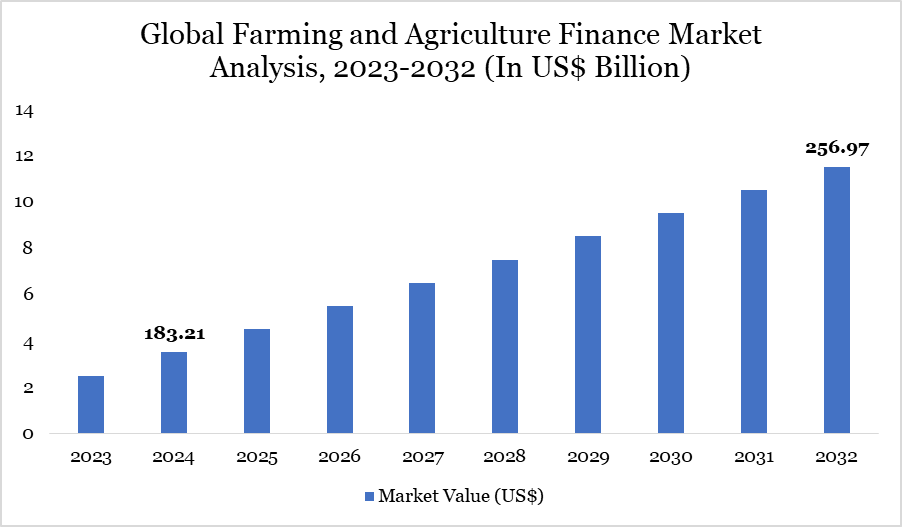
The Farming and Agriculture Finance Market is directly strengthened by the scale, performance, and structural evolution of global agriculture, as reflected in land usage, production growth, and regional transformations. Globally, the presence of nearly 4.8 billion hectares of agricultural land, including 1.6 billion hectares of cropland, creates sustained demand for farm credit to finance seeds, fertilizers, irrigation systems, machinery, storage, and working capital across cropping cycles.India’s 5.4% agricultural growth in FY25, coupled with a 17.8% GDP contribution and rising exports, improves farm incomes and repayment capacity, thereby encouraging banks, NBFCs, and fintech lenders to expand credit penetration. At the global level, a 3% rise in crop production in 2023 and output of 9.9 billion tonnes of primary crops reinforces the importance of production-linked financing models, warehouse receipt financing, and post-harvest credit.Major producers such as China, which lead global output of rice, wheat, and corn, rely heavily on institutional finance to support large-scale cultivation, mechanization, and supply-chain integration. Meanwhile, structural shifts in advanced economies further influence finance demand patterns. In South Korea, the transition from traditional farming to smart agriculture has increased the role of technology-driven financing, including loans for automation, sensors, precision equipment, and data-enabled farming systems.Although agriculture contributes only ~1.75% of Korea’s GDP, declining farm populations and productivity pressures are driving targeted credit support, government-backed financing, and innovation-focused lending. Overall, large land bases, rising production volumes, export growth, and technological transformation directly expand the scope, diversity, and sophistication of the Farming and Agriculture Finance Market, positioning it for steady growth through crop-based lending, infrastructure finance, risk-mitigated credit, and digital agri-finance solutions in the coming years.Global farming and agriculture finance market size reached US$1409.85 Billion in 2025 and is expected to reach US$ XX billion by 2033, growing with a CAGR of XX % during the forecast period 2026-2033.
Source- DataM Intelligence
For more details on this report, Request for Sample
Market Scope
| Metrics | Details |
| By Type | Lease, Loan, Line of Credit |
| By Farm Size | Small, Medium, Large. |
| By Distribution Channel | Brokers, Agents, Banks and Others. |
| By Region | North America, South America, Europe, Asia-Pacific and Middle East and Africa |
| Report Insights Covered | Competitive Landscape Analysis, Company Profile Analysis, Market Size, Share, Growth |
Global Farming and Agriculture Finance Market Trends
Driver – Expansion of Climate-Resilient Agricultural Financing Solutions
The expansion of climate-resilient agricultural financing solutions is significantly driving the farming and agriculture finance market. In the United States, the Biden-Harris Administration has allocated an unprecedented $3 billion for climate-smart practices on agricultural lands, enhancing support for programs like the Environmental Quality Incentives Program (EQIP) and the Conservation Stewardship Program (CSP).
Similarly, the World Bank has committed to doubling its annual agricultural financing to $9 billion by 2030, aiming to address challenges such as food production, water scarcity, and infrastructure, thereby bolstering climate resilience in agriculture. These substantial investments reflect a global shift towards integrating climate adaptation and mitigation strategies within agricultural financing, ensuring the sustainability and productivity of farming systems in the face of climate change.
Restraint - High Volatility in Agricultural Commodity Prices Impacting Loan Repayment
High volatility in agricultural commodity prices is restraining the farming and agriculture finance market by increasing risks in loan repayment. In 2023, the USDA reported that U.S. farm income is projected to decline by 25.4% to $136.9 billion due to fluctuating crop and livestock prices, impacting farmers' ability to meet debt obligations. Similarly, the European Commission noted that wheat and corn prices dropped by over 30% in 2023, creating financial strain for farmers and increasing default risks on agricultural loans.
Market Segmentation Analysis
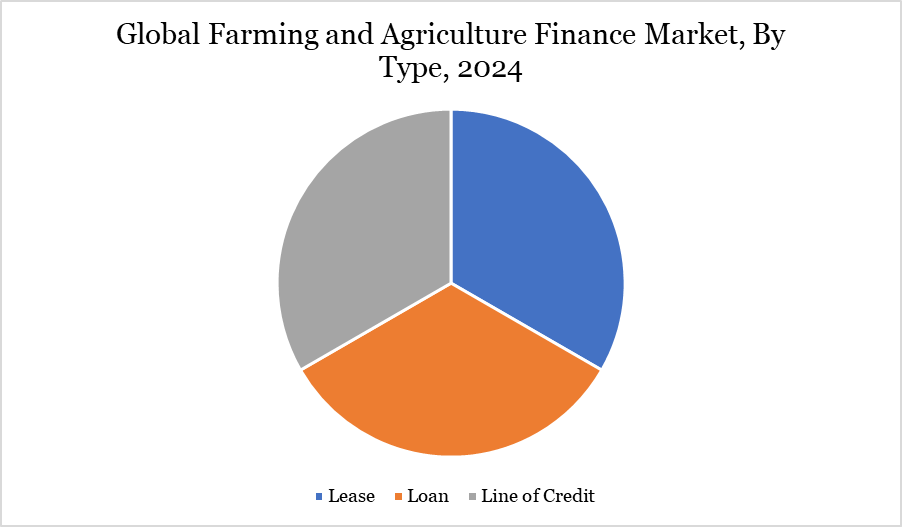
The global farming and agriculture finance market is segmented based on type, farm-size, distribution channel and region.
Source- DataM Intelligence
Revolutionizing Sustainable and Ethical Farming Finance
The farming and agriculture finance market is significantly influenced by the segmentation of loan types, catering to the diverse financial needs of the agricultural community. In India, for instance, the government has set an ambitious agriculture credit disbursement target of ₹27.5 lakh crore (approximately USD 330 billion) for the fiscal year 2024-25. This includes ₹16 lakh crore (approximately USD 192 billion) earmarked for short-term crop loans and ₹11.5 lakh crore (approximately USD 138 billion) allocated to term loans. Notably, ₹4.2 lakh crore (approximately USD 51 billion) is designated for short-term loans specifically for the livestock sector, encompassing dairy, fisheries, and poultry.
The Kisan Credit Card (KCC) scheme exemplifies the emphasis on loan type segmentation. As of August 2022, the scheme has covered approximately 3.46 crore (34.6 million) farmers, with a sanctioned credit limit of ₹3.95 lakh crore (approximately US$47 billion). This initiative provides timely and adequate credit for agricultural needs, including crop production and ancillary activities. The segmentation into short-term and long-term loans ensures that farmers have access to appropriate financial products, enabling them to manage operational expenses and invest in capital improvements, thereby driving growth in the agriculture finance market.
Market Regional Analysis
Growing Financial Strain and High Interest Rates Drive Demand for Agriculture Financing in North America.
The demand for farming and agriculture finance in North America is influenced by various economic factors impacting the agricultural sector. In the US, net farm income declined by 4% in 2024, continuing a downward trend from the previous year. This reduction is attributed to lower commodity prices and increased operational costs, leading farmers to seek financial assistance to manage cash flow and sustain operations. In response, the US government approved a multibillion-dollar bailout as part of a larger federal spending bill to support the agricultural sector.
Additionally, rising interest rates have further complicated the financial landscape for farmers. In the third quarter of 2023, agricultural loan interest rates approached 9%, the highest since 2007. This increase has tempered enthusiasm for real estate and capital investments, with lenders reporting decreased loan volumes and a dip in repayment rates. Despite these challenges, the Farm Credit System (FCS) continues to play a pivotal role, providing over $373 billion in loans and related services as of 2022, representing more than 45% of the total market share of U.S. farm business debt.
Technology Analysis
Technological advancements are significantly transforming the farming and agriculture finance market, enhancing both productivity and sustainability. In the United Kingdom, the government has committed approximately US$340 million (£270 million) through the Farming Innovation Programme to support the development of cutting-edge technologies. For instance, in September 2023, US$15.7 million (£12.5 million) was allocated to 19 projects focusing on automation and robotics, including systems for predicting strawberry yields and improving vineyard productivity.
Additionally, in March 2023, US$11.5 million (£9.13 million) was awarded to initiatives such as robotic crop harvesting and autonomous cow bedding systems, aiming to boost agricultural efficiency and reduce environmental impact. In Uganda, the integration of financial technology has improved access to credit for smallholder farmers. In April 2023, the Food and Agriculture Organization (FAO) and the Uganda Development Bank launched AgriConnect, a digital platform offering savings and lending options tailored for farmers. This initiative aims to reach over 18,000 farmers, facilitating digital loans to enhance production and household incomes.
Major Global Players
The major global players in the market include Rabobank Group, Wells Fargo & Company, Bank of America Corporation, JPMorgan Chase & Co., The Goldman Sachs Group, Inc., BNP Paribas SA, Deutsche Bank AG, Barclays PLC, Mitsubishi UFJ Financial Group, Inc., and Australia and New Zealand Banking Group Limited (ANZ).
Why Choose DataM?
- Data-Driven Insights: Dive into detailed analyses with granular insights such as pricing, market shares and value chain evaluations, enriched by interviews with industry leaders and disruptors.
- Post-Purchase Support and Expert Analyst Consultations: As a valued client, gain direct access to our expert analysts for personalized advice and strategic guidance, tailored to your specific needs and challenges.
- White Papers and Case Studies: Benefit quarterly from our in-depth studies related to your purchased titles, tailored to refine your operational and marketing strategies for maximum impact.
- Annual Updates on Purchased Reports: As an existing customer, enjoy the privilege of annual updates to your reports, ensuring you stay abreast of the latest market insights and technological advancements. Terms and conditions apply.
- Specialized Focus on Emerging Markets: DataM differentiates itself by delivering in-depth, specialized insights specifically for emerging markets, rather than offering generalized geographic overviews. This approach equips our clients with a nuanced understanding and actionable intelligence that are essential for navigating and succeeding in high-growth regions.
- Value of DataM Reports: Our reports offer specialized insights tailored to the latest trends and specific business inquiries. This personalized approach provides a deeper, strategic perspective, ensuring you receive the precise information necessary to make informed decisions. These insights complement and go beyond what is typically available in generic databases.
Target Audience 2026
- Manufacturers/ Buyers
- Industry Investors/Investment Bankers
- Research Professionals
- Emerging Companies



























































