


Eye Tracking Market Size
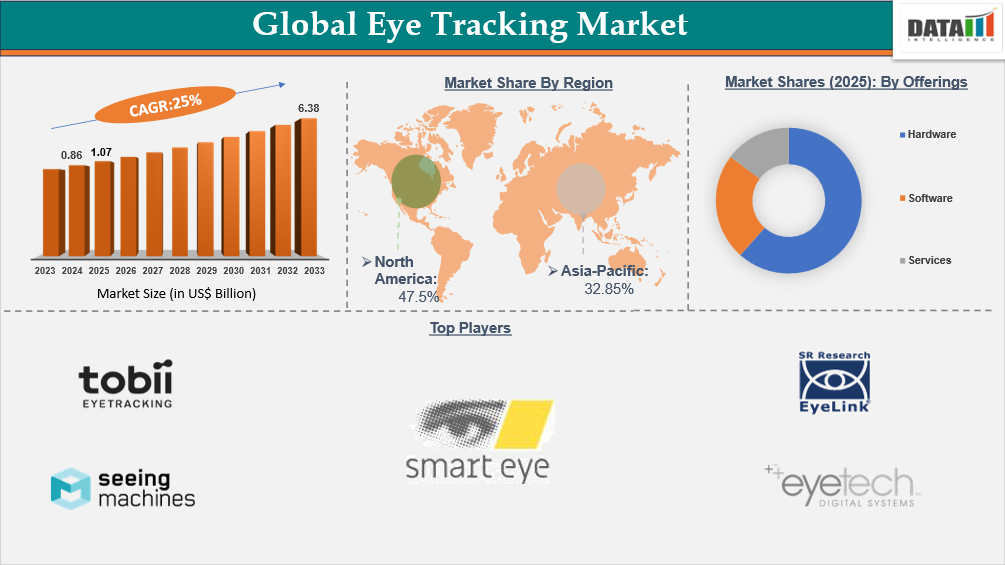
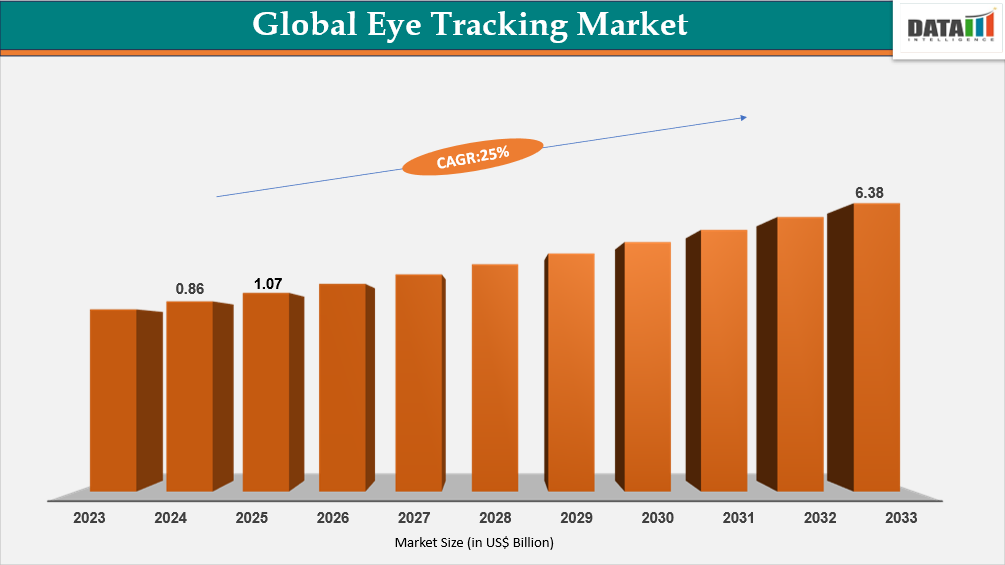
The Eye Tracking Market is estimated to reach USD 1.34 Billion in 2026 and is projected to grow to USD 9.97 Billion by 2035, registering exceptional growth at a CAGR of 25.0% during the forecast period from 2026 to 2035. The global eye tracking market is expanding as demand grows for enhanced human-machine interaction, AR/VR experiences, and advanced driver monitoring systems that rely on accurate gaze detection and behavioral insights. Consumer electronics brands and automotive OEMs are integrating eye tracking to enable foveated rendering, intuitive controls, and improved safety compliance.
For example, leading AR/VR headset makers have embedded eye tracking to optimize performance and reduce power use, while automakers deploy gaze‑based monitoring to detect driver distraction. Technology suppliers are forging partnerships with AI and semiconductor firms to deliver higher accuracy, lower latency solutions across devices. This reflects a broader industry view of eye tracking as a strategic enabler of immersive, intelligent systems. Recent product launches and platform enhancements underscore the shift toward deeper integration in XR devices, mobile platforms, and intelligent vehicles. Market growth is also driven by investments in healthcare and research applications. As ecosystems evolve, eye tracking is positioned as a core interface technology for next‑generation computing and safety solutions.
Eye Tracking Industry Trends and Strategic Insights
- Asia-Pacific is the fastest-growing region in the eye tracking market, capturing a share of 25% in 2025.
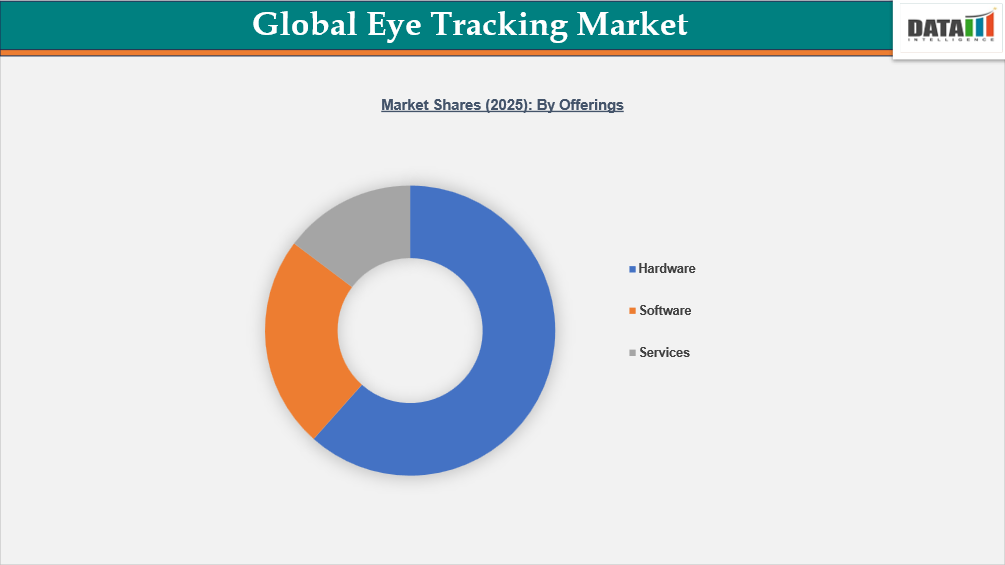
- By offerings, hardware is projected to be the largest market, holding a significant share of about 58.5% in 2025.
For More Detailed Information, Request for Sample
Market Scope
| Metrics | Details |
| By Offerings | Hardware, Software, Services |
| By Tracking Type | Remote or Screen-Based Eye Tracking, Wearable Eye Tracking, Embedded Eye-Tracking Modules |
| By Application | Research and Usability Testing, Healthcare and Medical Diagnostics, Marketing and Advertising, Automotive, Retail Analytics, Augmented Reality or Virtual Reality (AR or VR) and Gaming, Aerospace and Defense, Education and Training, Assistive Communication, Others |
| By Region | North America, South America, Europe, Asia-Pacific, Middle East and Africa |
| Report Insights Covered | Competitive Landscape Analysis, Company Profile Analysis, Market Size, Share, Growth |
Key Takeaways
- The market is expected to expand by nearly 6 times its current size by 2033, driven by increasing adoption across healthcare, automotive, consumer electronics, gaming, AR/VR, and enterprise analytics applications.
- The hardware segment accounted for approximately 58.5% of total market share in 2025, highlighting the critical role of eye-tracking cameras, infrared sensors, and embedded tracking modules in driving industry revenue.
- Asia-Pacific captured around 25% of the global market in 2025 and is emerging as the fastest-growing region due to expanding investments in XR technologies, smart devices, AI applications, and automotive innovation.
- North America remains the largest regional market, supported by strong adoption of advanced technologies, substantial R&D investments, and the presence of major eye-tracking solution providers.
- AR/VR applications are becoming one of the strongest growth drivers as eye-tracking enables foveated rendering, enhanced user interaction, and improved device performance.
Market Dynamics
Rising Adoption of AI-Enabled Behavioral Intelligence
The rapid expansion of AR/VR applications, behavioral analytics, and AI-powered human-computer interaction is a key driver of growth in the eye tracking market worldwide. Advanced deployments require scalable, hardware-agnostic software engines that enable seamless integration across devices, operating systems, and edge platforms. As enterprises increasingly adopt gaze-based interaction and real-time analytics, demand is rising for flexible deployment frameworks that simplify integration while maintaining performance accuracy.
For instance, in June 2025, Harmoneyes Inc., a Japan-based eye-tracking technology company, introduced Theia, an advanced eye-tracking deployment engine, to enable seamless integration of gaze-tracking capabilities across multiple hardware platforms and accelerate scalable deployment in AR/VR, research, and smart device applications. Such innovations highlight the industry's shift toward software-driven, adaptable eye-tracking ecosystems to accelerate adoption across commercial and industrial applications.
Supply Chain Disruptions Hindering Production and Distribution
Despite strong demand, the eye tracking market is facing pressure from ongoing semiconductor shortages and component supply constraints. Eye tracking systems rely on specialized infrared sensors, microcontrollers, optical modules, and precision cameras, many of which are sourced from a limited supplier base. Disruptions in chip fabrication and optical component manufacturing have increased lead times and procurement costs for device manufacturers. Smaller XR and automotive technology vendors are particularly vulnerable, as they depend on third-party suppliers for critical hardware integration.
Logistics bottlenecks and geopolitical trade restrictions further complicate the cross-border distribution of high-value sensing components. These supply chain challenges can delay product launches, especially in AR/VR headsets and advanced driver monitoring systems. OEMs are increasingly seeking diversified sourcing strategies and long-term supplier agreements to mitigate risk. However, continued volatility in semiconductor availability may constrain production scalability in the near term.
Segmentation Analysis
The global eye tracking market is segmented based on offerings, tracking type, applications, and region.
High Demand for Advanced Sensor-Based Driver Monitoring Systems Strengthens Hardware Segment Dominance
The hardware segment is dominating the eye-tracking market with approximately 58.5% share, driven by the essential requirement for dedicated sensors, infrared cameras, and embedded processing units that ensure high accuracy and real-time gaze detection. Hardware-based systems provide superior precision, environmental adaptability, and low-latency performance, which are critical for applications in automotive safety, aviation, research, and industrial human-machine interaction. These systems maintain reliable eye movement detection even under variable lighting conditions and extreme head angles, making them indispensable in safety-critical environments.
Automotive technology providers are continuously strengthening hardware capabilities to comply with evolving safety regulations and performance standards. For instance, Smart Eye AB, a Sweden-based driver monitoring technology company, launched the world’s first driver monitoring system with alcohol impairment detection, integrating advanced eye-tracking sensors and AI processing directly into vehicle cabins. Such developments highlight how sensor-centric hardware innovation enhances operational safety and reinforces the segment’s revenue dominance.
Rapid Expansion of AI-Powered, Platform-Agnostic Solutions Accelerates Software Segment Growth
The software segment is witnessing rapid growth in the eye-tracking market, driven by increasing adoption of AI-powered gaze analytics, behavioral intelligence, and platform-agnostic integration capabilities. Software-based eye-tracking solutions enable attention analysis, cognitive assessment, and user interaction without requiring proprietary hardware, significantly lowering deployment barriers across education, healthcare, gaming, and enterprise applications. These platforms leverage computer vision and machine learning algorithms to deliver accurate gaze estimation using standard cameras, expanding accessibility beyond traditional sensor-dependent systems.
The flexibility, scalability, and cost-efficiency of software solutions are accelerating their adoption across consumer and professional environments. For instance, Tobii AB, a Sweden-based eye-tracking technology company, launched Tobii Nexus, a webcam-based eye-tracking integration platform that enables developers to embed gaze functionality into virtually any device or application. Such innovations demonstrate how AI-driven software platforms are broadening the addressable market and positioning the segment for strong future growth.
Geographical Penetration
Rising Government and Industrial Investments Accelerate Asia-Pacific Eye-Tracking Market Growth
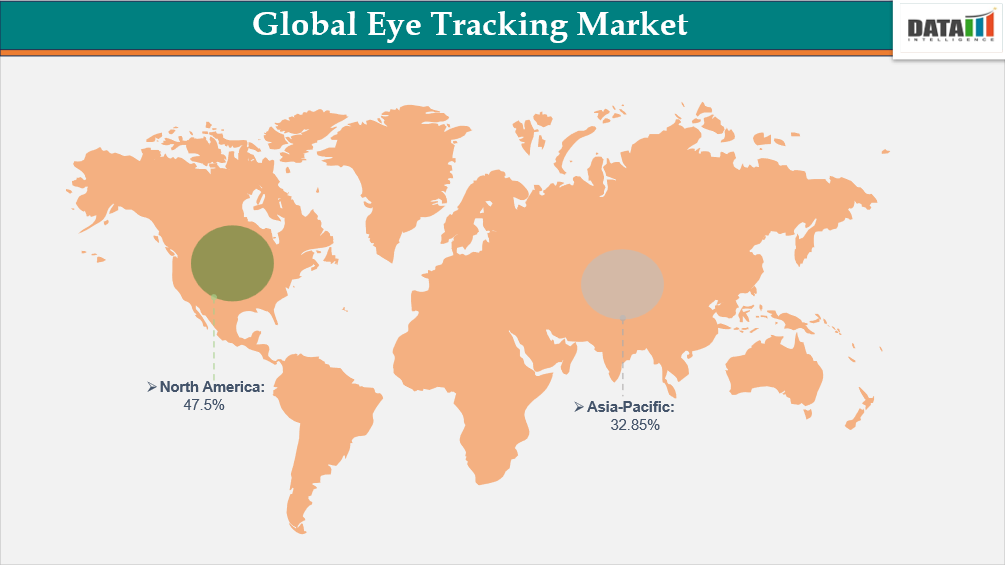
The Asia-Pacific eye-tracking market is the fastest-growing region globally with 32.85% share, driven by rising government-backed innovation programs, domestic technology development, and expanding adoption across automotive, XR, and research sectors. Regional governments are actively supporting advanced sensor technologies, AI integration, and smart mobility ecosystems to strengthen technological sovereignty and reduce reliance on imported high-precision components. This has led to the increasing commercialization of locally developed wearable eye-tracking systems and AI-powered gaze analytics platforms. Domestic players are expanding hardware and software capabilities to support research institutions, automotive OEMs, and immersive technology developers.
Japan Eye Tracking Market Outlook
Japan’s eye-tracking market is gaining traction due to its strong electronics manufacturing base and growing focus on AR/VR, smart glasses, and advanced human-machine interface technologies. The country’s expertise in precision sensors and semiconductor technologies supports the integration of compact, low-power eye-tracking modules into next-generation wearable and mobility platforms.
Strategic acquisitions and collaborations are further strengthening Japan’s capabilities in gaze-tracking innovation. For instance, TDK Corporation, a Japan-based electronics and sensor technology company, acquired SoftEye to enhance its eye-tracking capabilities for smart glasses and AR/VR applications. This strategic move reinforces Japan’s position in advancing embedded eye-tracking solutions for immersive and wearable technologies
China Eye Tracking Market Trends
China is emerging as a major growth contributor in the Asia-Pacific eye-tracking market, supported by strong domestic innovation, expanding XR adoption, and government-backed advancements in sensor technologies. The country is increasingly focusing on developing indigenous eye-tracking hardware and AI-enabled gaze analytics solutions to strengthen technological self-reliance and reduce dependency on imported components. Growing applications across research institutions, automotive monitoring, and immersive technologies are accelerating the commercialization of locally developed systems.
For instance, 7invensun, a China-based eye-tracking technology company, launched a next-generation wearable eye tracker integrated with advanced event-based vision sensors to deliver high-speed and high-accuracy gaze tracking for research and industrial applications. This development highlights China’s strategic push toward strengthening its domestic eye-tracking hardware ecosystem.
Strong R&D Ecosystem and Advanced Technology Adoption Reinforce North America’s Market Dominance
North America is the largest eye-tracking market, holding a share of roughly 47.5%, driven by strong R&D investments, the presence of top-tier technology firms, and rapid adoption across healthcare, automotive, research, and consumer sectors. Eye-tracking technology is increasingly being integrated into scalable analytics platforms and UX research tools, expanding beyond traditional hardware applications into cloud-enabled software solutions that support large-scale behavioral insights. At the same time, strategic acquisitions and partnerships reflect sustained interest from global technology leaders in strengthening their eye-tracking capabilities.
For instance, Tobii AB, a Sweden-based eye-tracking technology company, launched UX Explore, a cloud-based platform designed to make eye-tracking-based mobile UX research more scalable and accessible to enterprises seeking deeper behavioral insights.
U.S. Eye Tracking Market Insights
The U.S. accounts for nearly 78% of the North American market, supported by significant R&D investments, a strong base of leading technology companies, and rapid adoption across healthcare, automotive, defense, and consumer technology sectors. The country benefits from a mature innovation ecosystem, advanced AI capabilities, and widespread integration of eye-tracking into UX research, driver monitoring systems, AR/VR platforms, and medical diagnostics. Increasing demand for behavioral analytics and human-machine interface optimization is further strengthening market growth. For instance, EyeTech Digital Systems, an Illinois-based eye-tracking technology company, launched a new eye-tracking device in September 2025 specifically designed for rehabilitation and healthcare applications, expanding assistive technology options for patients with motor impairments.
Canada Eye Tracking Industry Growth
Canada is playing a growing role in the North American eye-tracking ecosystem through innovation in low-power sensor development and strategic technology initiatives. The country’s emerging tech startups are attracting global interest, particularly from major U.S. and international firms looking to accelerate capabilities in human-computer interaction and wearable interfaces.
For instance, AdHawk Microsystems, a Canada-based eye-tracking technology company, became the subject of advanced acquisition talks with Google, highlighting the strategic value of Canadian eye-tracking expertise in wearable and AR/VR markets.
Regulatory Analysis
The eye tracking market is influenced by strict data privacy, biometric protection, and medical device regulations across major regions, as the technology collects sensitive gaze and behavioral data.
In the EU, GDPR requires explicit user consent and secure handling of biometric data, increasing compliance obligations for companies. The EU Medical Device Regulation (MDR) applies to eye-tracking systems used for clinical or diagnostic purposes, requiring CE certification. Emerging AI regulations also demand transparency and risk assessment for gaze-based analytics systems. In the US, laws such as CCPA mandate disclosure and consent for collecting eye-movement data. The FDA regulates eye-tracking devices used in healthcare or assistive communication, requiring premarket approvals where applicable. Automotive safety authorities are also promoting driver monitoring systems, raising validation and testing standards.
In India, the Digital Personal Data Protection Act (DPDP Act) governs the processing of personal data, including biometric information. Electronics and safety certifications are required to ensure device quality and consumer protection. These regulations improve privacy and safety but increase operational and compliance costs for manufacturers while encouraging responsible innovation in the eye tracking market.
Analyst Viewpoint
The Eye Tracking Market is transitioning from a niche research technology into a mainstream human-machine interaction platform. Advances in sensor technology, artificial intelligence, and computer vision are significantly expanding the range of applications across healthcare, automotive, consumer electronics, and enterprise environments.
The increasing demand for personalized digital experiences, immersive computing, and advanced analytics is driving adoption across multiple industries. Eye tracking is becoming a critical component of next-generation interfaces, enabling more intuitive interactions between users and digital systems.
As AR, VR, mixed reality, and intelligent computing platforms continue to evolve, eye-tracking technology is expected to play an increasingly important role in enhancing usability, accessibility, and overall user engagement.
Latest Industry Intelligence & Future Growth Catalysts (2026)
AI-Powered Eye Tracking Is Expanding Application Scope
Artificial intelligence is enabling more accurate gaze estimation, behavioral analysis, fatigue detection, and cognitive assessment, unlocking new opportunities across healthcare and enterprise sectors.
AR and VR Ecosystems Are Driving Technology Adoption
The growth of immersive technologies is increasing demand for eye-tracking solutions that improve rendering efficiency, user interaction, and overall experience quality.
Driver Monitoring Systems Are Becoming Standard Features
Automotive manufacturers are increasingly deploying eye-tracking technologies to monitor driver attention, detect fatigue, and enhance road safety.
Healthcare Applications Continue to Expand
Eye tracking is gaining importance in neurological diagnostics, autism research, cognitive testing, rehabilitation programs, and assistive communication devices.
Smart Wearables Create New Revenue Opportunities
The integration of eye-tracking capabilities into smart glasses and wearable devices is expected to create significant growth opportunities over the forecast period.
Human Behavior Analytics Gains Strategic Importance
Organizations are increasingly leveraging eye-tracking insights to understand consumer behavior, improve product design, optimize marketing effectiveness, and enhance customer experiences.
Accessibility Technologies Drive Social Impact
Eye-tracking systems are becoming essential tools for individuals with physical disabilities, enabling communication, device control, and improved digital accessibility.
Market Opportunities and Investment Hotspots
The most attractive opportunities within the Eye Tracking Market are emerging at the intersection of artificial intelligence, immersive technologies, and healthcare innovation. Companies developing AI-enhanced eye-tracking platforms are expected to benefit from increasing demand for intelligent behavioral analytics and human-machine interaction solutions.
Healthcare applications represent a particularly promising growth area as eye-tracking technologies gain acceptance for diagnostic, therapeutic, and assistive applications. Investments in cognitive assessment tools, neurological monitoring systems, and communication technologies are expected to accelerate significantly.
The growing adoption of AR, VR, and mixed reality environments is also creating strong demand for advanced eye-tracking solutions capable of supporting immersive experiences and performance optimization. In addition, automotive safety systems, smart wearables, and enterprise analytics platforms are emerging as key investment destinations.
Competitive Landscape
- The global eye tracking market is characterized by a competitive landscape that includes both established and regional players.
- Key players include Tobii AB, Seeing Machines Ltd., Smart Eye AB, SR Research Ltd., EyeTech Digital Systems, EyeTracking Inc., iMotions, PRS IN VIVO, LC Technologies, Ergoneers GmbH
Key Developments
- June 2026 - Tobii and Smart Eye advancing AI-powered eye tracking solutions
Tobii AB and Smart Eye AB enhanced their eye tracking platforms with AI-driven analytics, improving applications in automotive driver monitoring, human-machine interaction, gaming, and behavioral research. - May 2026 - Seeing Machines expanding driver monitoring system deployments
Seeing Machines Ltd. increased adoption of its eye and face tracking technologies across automotive safety programs, supporting compliance with evolving vehicle safety regulations and advanced driver assistance systems (ADAS). - April 2026 - iMotions and SR Research strengthening research and behavioral analytics capabilities
iMotions and SR Research Ltd. expanded eye tracking solutions for neuroscience, psychology, consumer behavior, and UX research, integrating advanced data visualization and multimodal analytics tools. - April-June 2026 - Growing adoption across automotive, healthcare, and immersive technologies
Companies including EyeTech Digital Systems, EyeTracking Inc., PRS IN VIVO, LC Technologies, and Ergoneers GmbH advanced innovations in wearable eye tracking, virtual reality (VR), augmented reality (AR), accessibility solutions, and healthcare diagnostics.
Why Choose DataM?
- Data-Driven Insights: Dive into detailed analyses with granular insights such as pricing, market shares and value chain evaluations, enriched by interviews with industry leaders and disruptors.
- Post-Purchase Support and Expert Analyst Consultations: As a valued client, gain direct access to our expert analysts for personalized advice and strategic guidance, tailored to your specific needs and challenges.
- White Papers and Case Studies: Benefit quarterly from our in-depth studies related to your purchased titles, tailored to refine your operational and marketing strategies for maximum impact.
- Annual Updates on Purchased Reports: As an existing customer, enjoy the privilege of annual updates to your reports, ensuring you stay abreast of the latest market insights and technological advancements. Terms and conditions apply.
- Specialized Focus on Emerging Markets: DataM differentiates itself by delivering in-depth, specialized insights specifically for emerging markets, rather than offering generalized geographic overviews. This approach equips our clients with a nuanced understanding and actionable intelligence that are essential for navigating and succeeding in high-growth regions.
- Value of DataM Reports: Our reports offer specialized insights tailored to the latest trends and specific business inquiries. This personalized approach provides a deeper, strategic perspective, ensuring you receive the precise information necessary to make informed decisions. These insights complement and go beyond what is typically available in generic databases.
Why Buy This Report?
This report provides comprehensive intelligence on one of the fastest-evolving human-machine interaction technologies. It helps stakeholders identify growth opportunities, understand technology developments, evaluate investment prospects, and anticipate future market trends.
The study supports strategic planning, market entry initiatives, product development, partnership decisions, and investment evaluations by delivering actionable insights across the global eye-tracking ecosystem.
Target Audience 2026
- Manufacturers/ Buyers
- Industry Investors/Investment Bankers
- Research Professionals
- Emerging Companies


























































