


Global Endometriosis Therapeutics Market
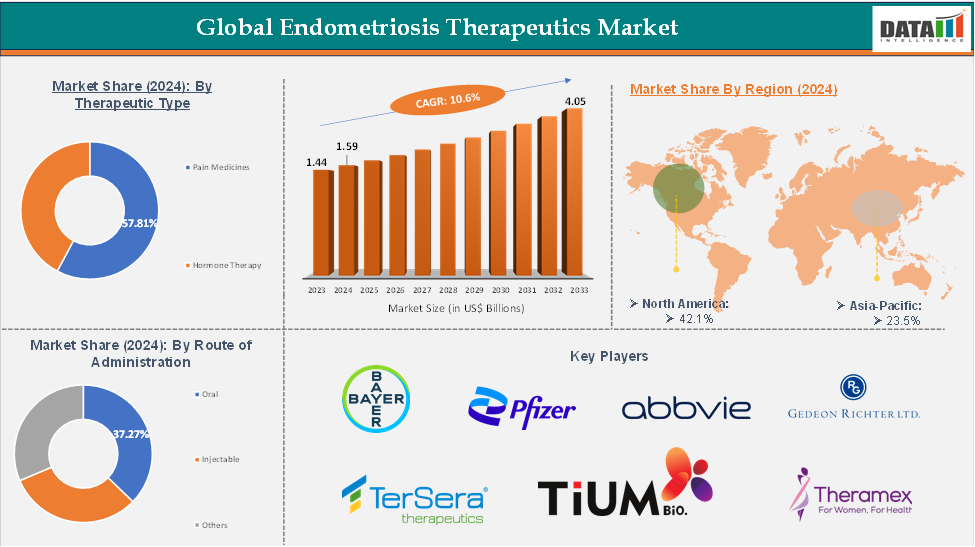
The global endometriosis therapeutics market reached US$ 1.59 billion in 2024, and is expected to reach US$ 4.05 billion by 2033, growing at a CAGR of 10.6% during the forecast period 2026-2033.
The global endometriosis therapeutics market is experiencing significant growth due to increased awareness of women's reproductive health, increased diagnosis rates, and the introduction of advanced treatment options. The market is being reshaped by novel oral gonadotropin-releasing hormone antagonists, established hormonal therapies, and long-acting GnRH agonists. Despite challenges like high treatment costs and side effects, leading pharmaceutical companies and emerging biotech players are expanding product portfolios, enhancing patient compliance, and investing in disease-modifying research. North America leads the market due to early adoption of innovative therapies, while Asia-Pacific is expected to experience the fastest growth.
Executive Summary
Dynamics: Drivers & Restraints
Driver: Rising Prevalence of Endometriosis
The global increase in endometriosis cases is driving market expansion due to increased demand for effective treatment options. Increased awareness among women, improved diagnostic capabilities, and broader healthcare access have led to earlier detection and more patients seeking medical intervention. This has prompted pharmaceutical companies to develop innovative therapies for symptom management and long-term disease control.
For instance, in endometriosis is a painful gynaecological condition affecting over 190 million girls and women globally. India alone represents 25 percent of the burden with an estimated 43 million women enduring the pain.
Restraint: High Developmental Costs
The high costs of research, development, and commercialization of new endometriosis therapeutics, particularly hormonal modulators and biologics, pose a significant market challenge. These expenses often result in high drug prices, limiting accessibility in cost-sensitive regions and burdening healthcare systems, slowing adoption rates and restricting market penetration, especially in developing economies.
For instance, endometriosis surgery in the U.S. is typically expensive, ranging from $15,000 to $60,000 or more. The cost can vary based on factors like surgery Therapeutic Type, hospital, and insurance coverage. Despite the availability of advanced medical technology and skilled surgeons, the cost of care remains a significant concern.
For more details on this report, Request for Sample
Segmentation Analysis
The global endometriosis therapeutics market is segmented based on therapeutic type, route of administration, distribution channel, and region.
Therapeutic Type:
The hormone therapy from the therapeutic type segment the expected to have 57.81% of the endometriosis therapeutics market share.
Hormone-therapy plays a significant role in the global endometriosis therapeutics market due to various clinical, commercial, and patient-centric factors. Rising diagnostic rates have expanded the treated population, which prefers medical over surgical management. Newer oral GnRH-antagonist regimens and improved progestin/LNG-IUS formulations offer long-term symptom control and fertility-preserving care.
For instance, in March 2025, the NHS in England has approved Gedeon Richter's Ryeqo, the first long-term pill for endometriosis, marking a significant breakthrough in treatment, but only for patients who have tried all other options.
Moreover, clinical guidelines increasingly endorse stepped medical therapy before or after conservative surgery, promoting hormonal maintenance. Cost-effective, outpatient hormonal strategies are preferred by payers and health systems, improving reimbursement and uptake. Patient demand for non-invasive treatments sustains investment in formulation innovation and delivery systems.
Geographical Share Analysis
The North America global endometriosis therapeutics market was valued at 42.1% market share in 2025
The North American endometriosis therapeutics market is experiencing growth due to a high diagnosed patient pool, improved access to gynecological care, leading pharmaceutical companies, favorable reimbursement frameworks, FDA approvals, orphan drug incentives, robust clinical research infrastructure, and a cultural emphasis on early diagnosis, fertility preservation, and quality-of-life improvement. This has led to faster adoption of innovative treatment regimens and sustained demand for first-line and maintenance treatments.
For instance, in January 2025, Celmatix Therapeutics announced its latest drug program, a novel Jun-N-terminal kinase (JNK) inhibitor that targets pain and inflammation. The therapeutic drug candidate, developed using the DNA-Encoded Chemistry Technology (DEC-Tec) platform at the Center for Drug Discovery, Baylor College of Medicine (BCM), aims to address a critical unmet need in first-line treatments for a range of women’s health indications, starting with endometriosis and potentially extending to Polycystic Ovary Syndrome (PCOS) and ovarian aging.
Major Players
The major players in the endometriosis therapeutics market include Bayer AG, AbbVie, Inc, Pfizer Inc, Gedeon Richter Plc, Teva Pharmaceuticals, Theramex, Tiumbio, and TerSera Therapeutics LLC and among others.
Key Developments
February 2026: Rising prevalence of endometriosis and increasing awareness of women’s health significantly accelerated demand for advanced therapeutics across North America and Europe, where early diagnosis and access to innovative treatments are well established.
January 2026: Advancements in oral GnRH antagonists and non-hormonal therapies gained traction in the United States and Germany, improving symptom control and patient compliance compared to traditional hormone therapies.
December 2025: Leading companies such as AbbVie Inc. (United States), Bayer AG (Germany), Pfizer Inc. (United States), AstraZeneca (United Kingdom), and Teva Pharmaceutical Industries Ltd. (Israel) expanded their portfolios with next-generation hormonal and targeted therapies.
November 2025: Increasing adoption of minimally invasive and long-term management therapies across North America and Europe boosted demand for effective pain management and fertility-preserving treatment options.
October 2025: Rapid growth in awareness programs and healthcare infrastructure in Asia-Pacific, particularly in India, China, and Japan, improved diagnosis rates and expanded access to treatment.
September 2025: Regulatory approvals and ongoing clinical trials in the United States and the United Kingdom strengthened the pipeline for innovative therapies, including biologics and immunomodulators.
August 2025: Increasing investments in research and development across Europe and Japan supported the development of novel drug candidates and personalized treatment approaches.
The market is evolving toward targeted, patient-friendly, and long-term management therapies, where North America leads with over 40% market share, Europe focuses on clinical expansion, and Asia-Pacific emerges as the fastest-growing region driven by rising awareness, improving healthcare access, and increasing treatment adoption.
Report Scope
Metrics | Details | |
CAGR | 10.6% | |
Market Size Available for Years | 2023-2033 | |
Estimation Forecast Period | 2026-2033 | |
Revenue Units | Value (US$ Bn) | |
Segmentation | Therapeutic Type | Pain Medicines, Hormone Therapy |
Route of Administration | Oral, Injectable, Others | |
Distribution Channel | Hospital Pharmacies, Retail Pharmacies, Online Pharmacies | |
Regions Covered | North America, Europe, Asia-Pacific, South America, and the Middle East & Africa | |
The global endometriosis therapeutics market report delivers a detailed analysis with 59 key tables, more than 56 visually impactful figures, and 195 pages of expert insights, providing a complete view of the market landscape.
Suggestions for Related Report
For more pharmaceuticals-related reports, please click here



























































