


Global Duckweed Protein Market Overview
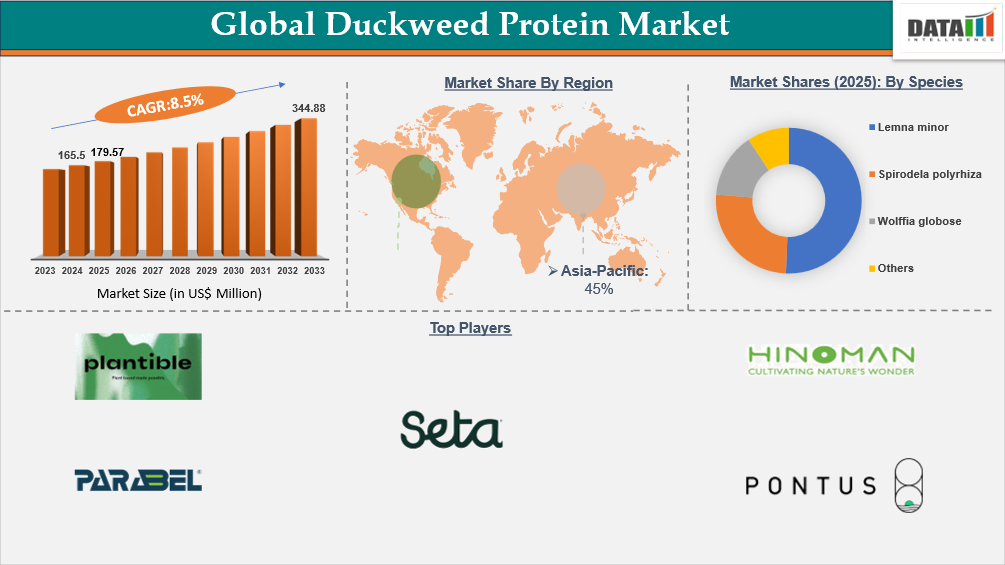
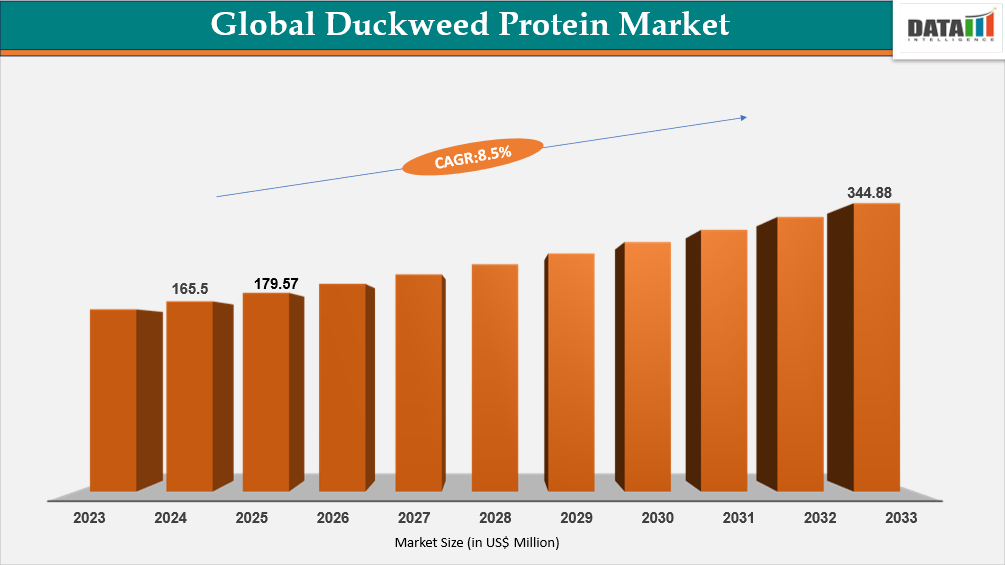
Global Duckweed Protein Market reached US$ 179.57 million in 2025 and is expected to reach US$ 344.88 million by 2033, growing with a CAGR of 8.5% during the forecast period 2026-2033. The global duckweed protein market is expanding due to rising demand for sustainable, high-protein plant ingredients that offer strong functionality, clean-label positioning, and lower environmental impact compared to conventional protein sources. Food manufacturers are increasingly adopting duckweed-based proteins for applications in plant-based meat, bakery, beverages, and sugar-reduction formulations, driven by consumer preference for nutrient-dense and climate-resilient crops.
Ingredient innovators are actively scaling capacity to meet this demand. For instance, in 2024, Plantible Foods, a U.S.-based plant protein company, secured USD 30 million in Series B funding to expand production of its duckweed-derived Rubi Protein, strengthen commercial operations, and accelerate partnerships with major food brands. The funding round highlights growing investor confidence in Lemna-based proteins as a scalable and sustainable alternative in the global plant-protein ecosystem, supporting broader commercialization and supply chain expansion.
Duckweed Protein Industry Trends and Strategic Insights
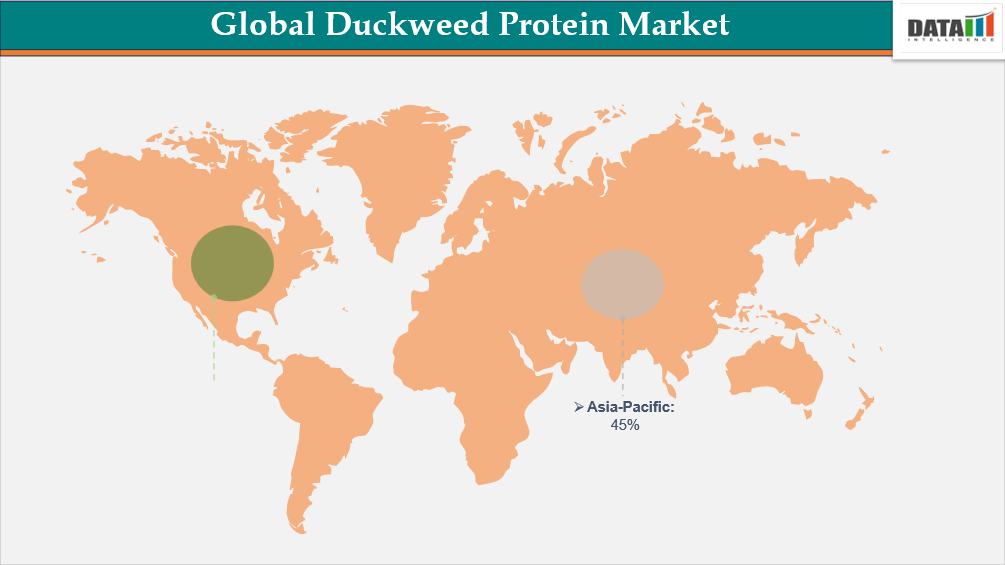
Asia-Pacific is the dominating region in the duckweed protein market, capturing the share of 45% in 2025.
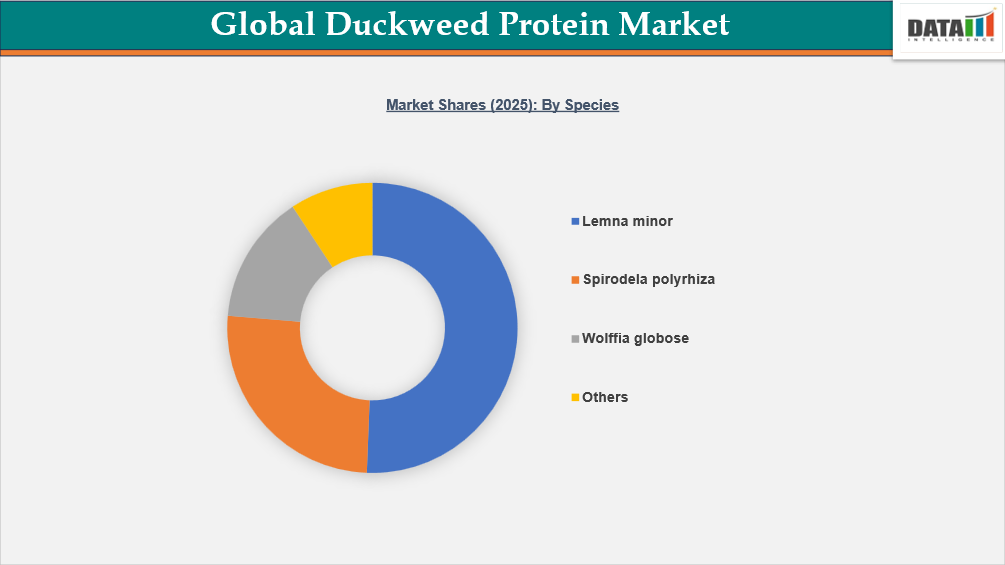
By species, the Lemna minor is projected to be the largest market, holding a significant share of about 49.2% in 2025.
Global Duckweed Protein Market Size and Future Outlook
- 2025 Market Size: US$ 179.57 Million
- 2033 Projected Market Size: US$ 344.88 Million
- CAGR (2026-2033): 8.5%
- Largest Market: Asia-Pacific
- Fastest Market: Asia-Pacific
Duckweed Protein Market Scope
| Metrics | Details |
| By Species | Lemna minor, Spirodela polyrhiza, Wolffia globose, Others |
| By Form | Powder, Liquid, Paste, Whole Plant |
| By Application | Food processing, Animal and Fish feed, Pharmaceuticals, Others |
| By Distribution Channel | B2B, B2C |
| By Region | North America, South America, Europe, Asia-Pacific, Middle East, and Africa |
| Report Insights Covered | Competitive Landscape Analysis, Company Profile Analysis, Market Size, Share, Growth |
For More Detailed Information, Request for Sample
Duckweed Protein Market Dynamics
Integration of Wastewater Treatment with Sustainable Protein Production
Rising regulatory pressure on nitrogen and phosphorus discharge from agriculture, aquaculture, and food processing industries is emerging as a major driver for the duckweed protein market in 2025. Duckweed rapidly absorbs excess nutrients from wastewater while generating high-protein biomass, enabling a dual-benefit system that combines environmental remediation with alternative protein production. This integrated approach reduces wastewater treatment costs, supports ESG and carbon-reduction goals, and creates new revenue streams from recovered biomass. As industries increasingly adopt circular bioeconomy models, duckweed cultivation is gaining traction as a scalable wastewater-to-protein solution.
For instance, in 2025, Wageningen University & Research has demonstrated duckweed cultivation on nutrient-rich water streams for simultaneous purification and protein extraction. Plantible Foods produces its Rubi Protein™ using controlled aquatic growing systems designed for sustainability and commercial scalability. In addition, publications from the FAO highlight duckweed’s effectiveness in nutrient recovery and integrated aquaculture, reinforcing its viability in circular protein production models.
High Sensitivity to Contamination
Despite its rapid cultivation potential, duckweed protein production faces significant contamination and quality control challenges that complicate large-scale commercial adoption. Open pond and controlled cultivation systems are highly susceptible to microbial infestation, algae proliferation, heavy metals, and nutrient imbalances, any of which can compromise biomass quality, safety, and regulatory compliance, leading to batch losses and increased operational costs. Effective contamination prevention requires sophisticated monitoring, water quality management, and strict biosecurity protocols, which can elevate R&D and production expenses compared with more established protein crops.
Moreover, the complexity of maintaining optimal water chemistry and preventing microbial contamination can slow scale-up and discourage investment, especially where regulatory frameworks demand consistent quality standards. These production constraints highlight the need for advanced cultivation controls and robust quality assurance systems to support broader market commercialization.
Duckweed Protein Market Segmentation Analysis
The global duckweed protein market is segmented based on species, form, application, distribution channel, and region.
Commercial Expansion of Lemna Minor in Food and Feed Applications
Lemna minor is dominating the species segment with 49.2% share in 2025 due to its rapid growth, high protein yield, and adaptability for scalable controlled cultivation. The species’ biomass can double in a few days and contains 35–45% protein by dry weight, supporting industrial demand in food processing, nutraceuticals, and sustainable feed supply chains. Its efficiency and adaptability reduce resource intensity and align with industry infrastructure trends toward controlled aquaculture systems and continuous harvesting technologies. Regulatory recognitions such as EU novel food approvals for Lemna minor protein concentrates have further legitimized commercial pathways and expanded market adoption.
Commercial scaling is reinforced by strategic investments from industry players. For instance, in 2025, Plantible Foods, a U.S.‑based biotechnology company, announced that its first commercial facility producing duckweed protein from a proprietary Lemna strain in Texas became fully operational, enhancing scalable extraction infrastructure. This reflects broader trends of investing in large‑scale cultivation, processing technologies, and supply chain partnerships to meet growing protein demand. Lemna minor’s dominance underscores its role as a commercially viable, high-yield species meeting both food and feed industry requirements.
Wolffia globosa Growth Catalysed by Innovation in Protein Product Commercialization
Wolffia globosa is the fastest‑growing emerging species, with rising adoption driven by its high protein density and nutritional profile that meet expanding industrial demand for clean‑label plant proteins. Market uptake is tied to its potential in functional foods and feed, encouraging investment in advanced cultivation and processing infrastructure to meet food sector requirements. For instance, in 2026, Plantible Foods, a U.S.‑based biotechnology company, received US FDA “no questions” approval for its Rubi Protein derived from duckweed biomass, bolstering validation for food industry integration and expanding commercial pathways. Such regulatory progress and commercial endorsements are accelerating Wolffia globosa’s scalability and integration into global protein value chains.
Duckweed Protein Market Geographical Penetration
Rising Government & Commercial Momentum in Asia-Pacific Duckweed Protein
Asia-Pacific is the dominating and fastest-growing region in the global duckweed protein market, accounting for an estimated 45% share in 2025, supported by favorable cultivation conditions, expanding aquaculture industries, and rising demand for sustainable plant proteins. Governments across Southeast Asia and Japan are encouraging the commercialization of alternative crops to strengthen food security and reduce dependence on imported soy and animal proteins. Increasing consumer interest in climate-resilient “superfoods” and functional beverages is further accelerating regional adoption and product innovation.
For example, in January 2026, Flo, a Thailand-based food brand, introduced Wolffia duckweed-based protein drinks and flavor enhancers using locally sourced raw materials to address growing demand for sustainable nutrition solutions in Southeast Asia. The initiative highlights the commercialization of traditional aquatic crops into modern functional food formats, reinforcing the Asia-Pacific’s leadership in duckweed-derived consumer products.
Japan Duckweed Protein Market Outlook
Japan is emerging as a technology-driven innovation hub within the Asia-Pacific duckweed protein ecosystem, backed by strong agri-biotech research infrastructure and a national focus on food resilience. The country is promoting high-efficiency cultivation of Wolffia duckweed as a climate-adaptive protein source, aligning with sustainability targets and future food supply strategies. Rising consumer awareness of nutrient-dense, low-environmental-impact foods is supporting pilot-scale commercialization and export-oriented production models.
For instance, in 2025, Floatmeal Co., Ltd., a Japan-based company, advanced large-scale cultivation techniques for Wolffia to enhance protein yield and nutritional density, positioning duckweed as a next-generation sustainable superfood. The company’s expansion efforts reflect Japan’s strategic push toward alternative-protein innovation and regional supply-chain development.
Southeast Asia (SEA) Duckweed Protein Trends
Thailand has become a focal point for duckweed research and early application development within the Asia-Pacific, combining traditional dietary use with modern science to create sustainable food and feed solutions. Locally known edible duckweed species such as Wolffia globosa — rich in protein, vitamins, and minerals — are being revisited through academic and developmental programs aimed at scaling production and improving nutritional output for both human consumption and animal feed contexts.
For instance, in 2025, researchers from organizations involved in the DHbRC and related academic networks organized workshops and outreach to promote Wolffia as an economic plant, disseminating cultivation insights and potential product pathways to farmers and SMEs, with support under the Japanese Be-HoBiD research initiative. These initiatives reinforce Thailand’s role as a research and demonstration center for duckweed’s role in sustainable protein systems within the Asia-Pacific
Regulatory Analysis
The duckweed protein market is influenced by food safety, novel food, and feed regulations across major regions, as the ingredient is positioned for both human consumption and aquaculture use. In the European Union, the European Food Safety Authority evaluates duckweed under the Novel Food Regulation (EU) 2015/2283, requiring pre-market authorization, toxicological assessment, and labeling compliance before commercialization. In the United States, the U.S. Food and Drug Administration oversees duckweed protein under GRAS (Generally Recognized as Safe) pathways, while feed applications must align with AAFCO ingredient definitions and safety standards.
In the Asia-Pacific, regulatory pathways vary by country but generally fall under food safety and agricultural product laws. In China, the National Health Commission of the People's Republic of China manages novel food ingredient approvals, while feed uses are regulated under the Feed and Feed Additive Regulations administered by the Ministry of Agriculture and Rural Affairs. In India, the Food Safety and Standards Authority of India governs approval and labeling of novel plant proteins under the Food Safety and Standards Act, 2006, requiring safety validation before market entry. These evolving frameworks enhance consumer protection and traceability but increase compliance costs and documentation requirements for duckweed protein producers globally.
Duckweed Protein Market Competitive Landscape
The global duckweed protein market is characterized by a competitive landscape that includes both established and regional players.
Key players include Plantible Foods, Parabel USA, Hinoman Ltd., Pontus Water Lentils, Lempro Inc., Seta Organics, GreenOnyx Ltd., DryGro Limited, Lemna Corporation, and Rubisco Foods BV.
Key Developments in the Duckweed Protein Market
July 2026: UOW Malaysia & Zanadu launched Malaysia’s first duckweed-protein beverage series, introducing Mocha Duckweed, Strawberry Duckweed Matcha, and Raspberry Chocolate Duckweed. The launch demonstrated the commercialization of duckweed protein in functional beverages and consumer nutrition.
- April 2026: Floatmeal advanced its Wolffia commercialization strategy by presenting its duckweed-based protein technology and cultivation approach at Sushi Tech Tokyo 2026. The company continues developing scalable production through proprietary vertical hydroponic farming and computational quality-management technologies.
- February 2026: Floatmeal & JICA initiated a Thailand-focused investigation into sustainable contract cultivation and processing of Wolffia, targeting stable production of its nutrient-rich duckweed ingredient. The project is designed to evaluate scalable cultivation and processing models for rural food-supply applications.
Why Choose DataM?
- Technological Innovations: Explores advancements in duckweed protein production, including controlled cultivation of Lemna and Wolffia species, mechanical protein separation, acid precipitation, pasteurization, spray drying, and protein-concentrate processing technologies. The analysis evaluates how improvements in cultivation control, protein extraction, purification, drying, and biomass processing can improve consistency, functionality, scalability, and food-grade quality. The European Union has authorized a protein concentrate from Lemna gibba and Lemna minor, with a defined manufacturing process involving mechanical separation, acidic precipitation, pasteurization, and spray drying.
- Product Performance & Market Positioning: Evaluates duckweed protein based on protein concentration, amino-acid composition, digestibility, functionality, nutritional profile, and suitability for food and feed applications. Evidence submitted to the U.S. FDA for Mankai™ (Wolffia globosa) reported approximately 43% protein on a dry-weight basis and an amino-acid profile containing adequate levels of essential amino acids, while a recent 2026 study found that water-lentil protein characteristics and digestibility vary according to processing and protein-concentration methods.
- Real-World Evidence: Highlights commercial and regulatory evidence for duckweed-derived ingredients across food, plant-protein, nutritional, and animal-feed applications. FDA records show that duckweed powder from the Lemnoideae subfamily received a “no questions” response under GRAS Notice 742, with intended uses spanning plant-protein products, meat and fish substitutes, beverages, cereals, baked goods, snacks, soups, and other food categories. Research has also evaluated duckweed as a protein feed ingredient for poultry, demonstrating the relevance of the ingredient to animal nutrition while highlighting the importance of consistent biomass composition.
- Market Updates & Industry Changes: Tracks regulatory developments, commercial protein launches, cultivation expansion, technology transfers, research advances, and strategic developments across the duckweed-protein ecosystem. Recent developments include the EU authorization of protein concentrate from Lemna gibba and Lemna minor, new research comparing water-lentil protein digestibility with commercial protein isolates, and the transfer of intellectual-property assets formerly associated with Parabel/Lemnature Aquafarms to LemnaPro in 2025.
- Competitive Strategies: Analyzes how companies differentiate through proprietary duckweed strains, controlled cultivation systems, protein-extraction technologies, intellectual property, ingredient functionality, regulatory approvals, and application-specific product development. Competitive positioning is assessed across food ingredients, plant-based protein formulations, functional foods, and animal nutrition rather than relying only on production capacity. LemnaPro, for example, states that its 2025 acquisition included 95 patents, 17 trademarks, and operational data assets related to sustainable protein extraction and duckweed cultivation.
- Pricing & Market Access: Examines pricing factors including duckweed species and strain, cultivation system, biomass yield, protein concentration, extraction and purification requirements, drying technology, processing scale, formulation characteristics, regulatory status, and application. The analysis also evaluates market access through ingredient manufacturers, food and beverage companies, plant-based protein developers, feed manufacturers, distributors, and specialized functional-ingredient suppliers. Regulatory pathways are considered an important component of commercial access, including the U.S. GRAS framework and European Union novel-food requirements.
- Market Entry & Expansion: Identifies opportunities created by demand for alternative protein ingredients, interest in diversified plant-protein sources, development of functional food formulations, and growing research into aquatic plant proteins. Expansion strategies include controlled-environment cultivation, species and strain optimization, scalable extraction and drying systems, regulatory approvals, partnerships with food manufacturers, and development of application-specific protein ingredients. DataM also evaluates the technical challenges that can affect commercialization, including variability in biomass composition, processing effects on digestibility, cultivation controls, and the need for stable and standardized raw materials.
Target Audience
- Duckweed Protein Producers & Cultivators
- Plant-Based Protein Manufacturers
- Food & Beverage Ingredient Companies
- Functional Food & Nutraceutical Manufacturers
- Alternative Protein & Meat-Substitute Companies
- Animal Feed & Aquaculture Feed Manufacturers





























































