


Digital Twins in the Oil and Gas Market Overview
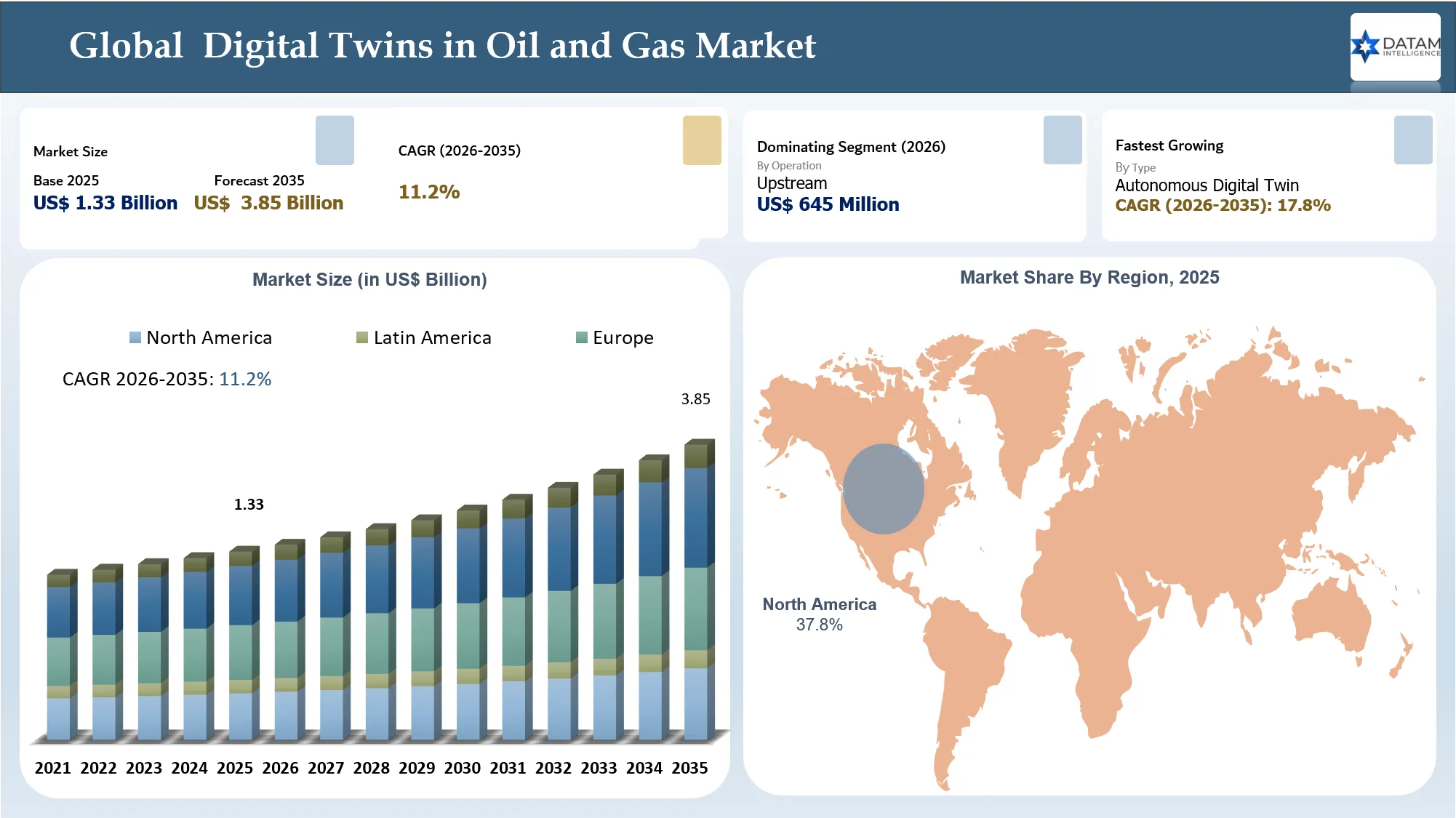
The global digital twins in the oil and gas market reached US$ 1.33 billion in 2025 and is expected to reach US$ 3.85 billion by 2035, growing with a CAGR of 11.2% during the forecast period 2026-2035.
The market is expected to witness strong growth as upstream, midstream and downstream operators increase adoption of digital twin platforms for predictive maintenance, drilling performance optimization, production surveillance, offshore integrity, refinery process control and emissions monitoring. Buyer intent is being driven by practical operating pressure rather than software experimentation. Rig counts are a leading business barometer for demand across drilling, completion, production and processing services, while U.S. crude output reached about 13.6 million barrels per day in 2025 despite a 5% decline in active drilling rigs. This shows why operators are prioritizing digital tools that raise productivity per rig, improve uptime and reduce non-productive time.
A key reason this market is becoming strategically important is the need to improve output from existing assets while controlling capex and service cost. IEA expects fossil fuel supply investment to remain above US$1 trillion in 2026, with oil and gas upstream investment rising only marginally as declines in North America and the Middle East are offset by growth in Central and South America and Africa. In this environment, operators need digital twins that help extract more value from mature fields, compress field development cycles, reduce shutdowns and improve equipment reliability without requiring a proportional increase in rigs, crews or new facilities.
North America is the largest market due to strong digital oilfield investment, shale productivity pressure, Gulf of Mexico offshore operations, LNG infrastructure and the presence of major industrial software, cloud and oilfield service providers. Asia-Pacific is the fastest-growing region because national oil companies and independents are digitizing production assets, refineries and LNG networks while expanding domestic energy security programs. Rystad Energy estimates that digitalization and AI can create close to US$500 billion in cumulative value for E&P companies between 2026 and 2030, including more than US$80 billion of additional annual value in 2030 compared with 2025. Digital twins are one of the operating layers that convert that value into field-level decisions.
Digital Twins in Oil and Gas Market Scope
| Metrics | Details |
| 2025 Market Size | US$ 1.33 Billion |
| 2035 Projected Market Size | US$ 3.85 Billion |
| CAGR (2026-2035) | 11.20% |
| Largest Market | North America |
| Fastest Growing Market | Asia-Pacific |
| By Offering | Product Digital Twin, Process Digital Twin, System Digital Twin |
| By Type | Descriptive Twin, Informative Twin, Predictive Twin, Comprehensive Twin, Autonomous Twin |
| By Deployment Mode | Cloud, On-premises |
| By Operation | Upstream, Midstream, Downstream |
| By Application | Exploration & Production, Drilling Operations, Reservoir Management, Pipeline Management, Refining Operations, Asset Performance Management, Others |
| Report Insights Covered | Competitive Landscape Analysis, Company Profile Analysis, Market Size, Share, Growth, Pricing, Trade and Investment Analysis |
| Company Coverage | AVEVA, Emerson, Halliburton, Honeywell, IBM, SLB, Microsoft, GE, Schneider Electric, Siemens Energy, Baker Hughes, Yokogawa, AspenTech, Akselos, Palantir and others |
Digital Twins in the Oil and Gas Market Key Takeaways
- Overall market size: The Digital Twins in Oil and Gas market reached US$1.33 billion in 2025 and is forecast to reach US$3.11 billion by 2033 in the DataM Report, growing at 11.20% CAGR. The extended 2035 forecast is estimated at US$3.85 billion using the same trajectory.
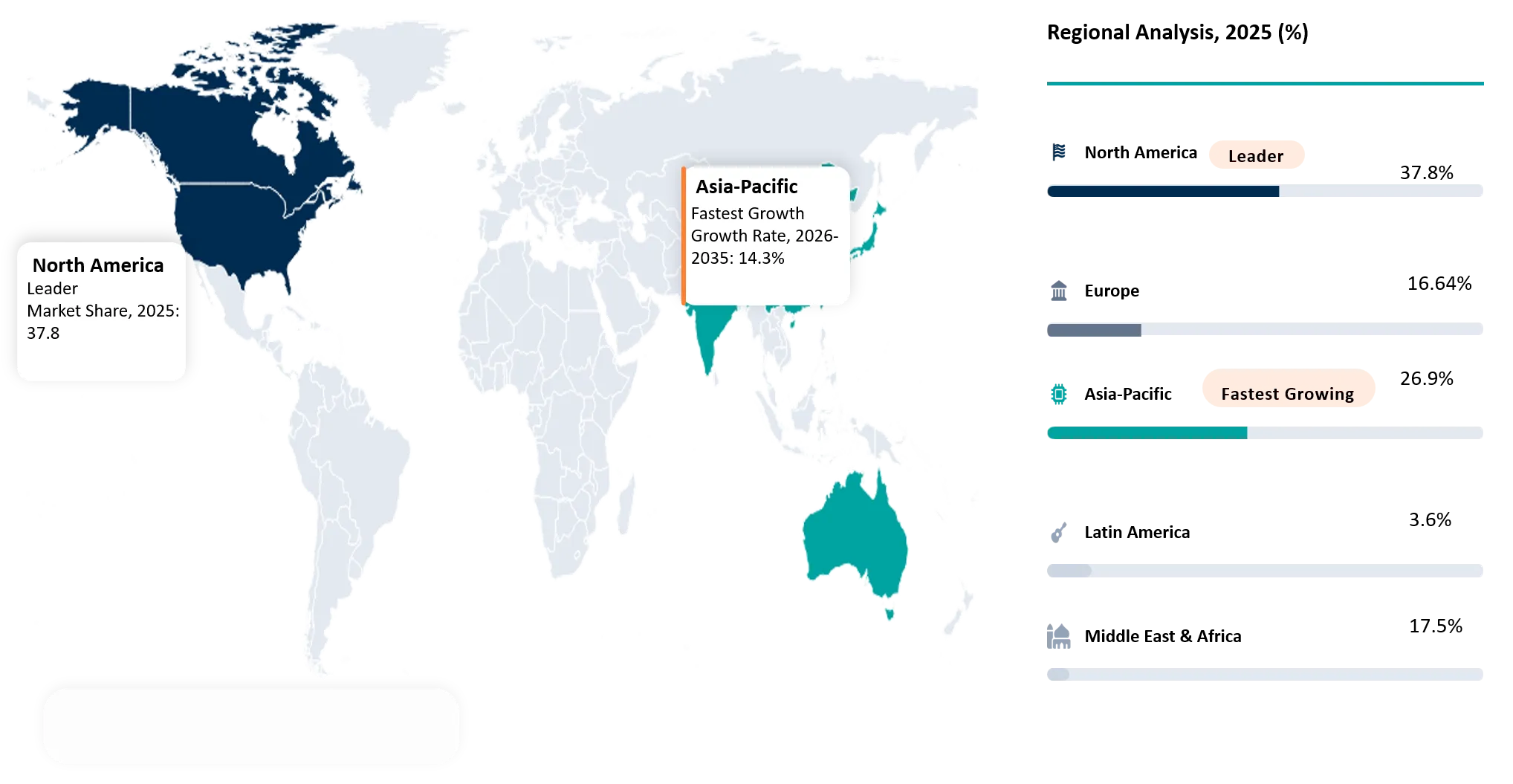
- North America is the largest region with an estimated 37.8% share in 2025, supported by shale productivity pressure, Gulf of Mexico offshore assets, LNG infrastructure, strong cloud adoption and advanced oilfield service ecosystems.
- Asia-Pacific is the fastest growing region, supported by digital oilfield projects in India, China, Australia, Malaysia and Indonesia, with Oil India deploying a digital oilfield platform across 77 production wells on 46 plinths in 2026. The region is projected to grow at 14.3% CAGR through 2035
- Upstream operations are the largest operation segment with 40.3% share in 2025 because digital twins directly support drilling efficiency, reservoir surveillance, well optimization, artificial lift performance and production uptime. The case is reinforced by U.S. crude output reaching about 13.6 million barrels per day in 2025 despite fewer active rigs.
- Aautonomous digital twins are the fastest growing type segment growing at 17.8% CAGR through 2035 because buyers are shifting from visualization to recommendations that reduce failures, improve maintenance planning and compress response time across rotating equipment, wells, pipelines and process units.
- Actionable buyer value: Operators are using digital twins to reduce unplanned downtime, extend asset life, optimize production per rig, improve compressor and pump reliability, support remote operations and convert sensor data into field actions that affect daily operating cost.
- Supporting investment signal: IEA expects fossil fuel supply investment to remain just over US$1 trillion in 2026, while upstream oil and gas investment rises only marginally. This creates buyer demand for digital solutions that improve production efficiency from existing assets rather than depending only on new drilling.
- Competitive direction: April, 2026 activity such as SLB’s agreement to acquire S&P Global Energy’s geoscience and petroleum engineering software portfolio shows that oilfield service companies are consolidating software, data and AI capabilities to serve digital twin workflows.
Digital Twins in Oil and Gas Industry Trends and Strategic Insights
- Digital twins are shifting from stand-alone simulation models to enterprise operating layers that integrate engineering data, operations data, AI and workflow execution. Operators are seeking actionable market intelligence that shows where digital twin investments can raise production per rig, shorten maintenance cycles and improve asset availability.
- Oil and gas companies are expanding digital twin deployments from selected flagship assets to multi-asset portfolios covering wells, drilling rigs, offshore platforms, pipelines, compressor stations, LNG trains and refineries. This reflects a broader allied industry impact where sensors, OT cybersecurity, cloud computing, simulation software and data engineering services become part of oilfield modernization budgets.
- Cloud-based digital twin platforms are gaining adoption because operators want cross-asset benchmarking, remote expert collaboration and faster AI model deployment. This is especially important when rig activity is uneven, skilled labor is constrained and operators must optimize brownfield assets without adding large numbers of field personnel.
- Physics-based twins are being combined with machine learning models to improve predictive accuracy for rotating equipment, reservoirs, pipelines and production systems. Rystad Energy estimates digitalization and AI can create close to US$500 billion in cumulative E&P value between 2026 and 2030, making model accuracy and operational adoption direct buyer priorities.
- Operators are increasing demand for digital twins that support emissions monitoring, methane leak detection, energy efficiency and decarbonization performance tracking. The opportunity extends into allied industries such as emission sensors, drones, satellite analytics, inspection robotics, leak detection equipment and environmental compliance software.
- Technology partnerships between operators, industrial software vendors, cloud providers, oilfield service companies and automation suppliers are becoming central to commercialization. Buyers increasingly prefer ecosystems that can integrate historians, SCADA, CMMS, engineering documents, AI models, cybersecurity controls and field workflows rather than isolated digital models.
Why does this report matter in 2026?
In 2026, digital twins in oil and gas are moving from innovation projects to operational decision systems. The industry is under pressure to improve production reliability, reduce costs, manage aging assets, lower emissions and operate more safely with fewer people on hazardous sites. Digital twins directly address these priorities by connecting real-time data from sensors, control systems, engineering models and AI analytics into decision-ready operating views.
The report matters because oil and gas companies are making strategic decisions about where digital twins should be deployed first, how they should be integrated with existing SCADA, DCS, historians, CMMS and ERP systems and which vendors can support long-term operating reliability. The market is also changing rapidly as cloud providers, oilfield service companies, automation suppliers, AI companies and engineering software players compete to control the digital twin operating layer.
This report assists oil and gas operators, technology vendors, investors and policymakers by mapping market size, high growth segments, regional adoption, competitive positioning, technology advancement, investment options and commercial white space across the digital twin value chain.
Digital Twins in Oil and Gas Market White Space & Investment Opportunities
- Expansion of physics-based structural digital twins for offshore platforms, FPSOs, subsea equipment and aging asset integrity management.
- Growth of AI-enabled predictive maintenance twins for compressors, pumps, turbines, heat exchangers and rotating equipment across upstream and refining operations.
- Deployment of reservoir and production optimization twins to raise output from mature fields and improve water, gas lift and pressure management decisions.
- Development of pipeline digital twins for corrosion monitoring, leak detection, integrity management, throughput optimization and compliance documentation.
- Adoption of refinery and LNG process twins that support energy optimization, operational scenario testing and planned shutdown reduction.
- Investment in cybersecurity, data quality and interoperability platforms that enable secure digital twin integration across legacy oil and gas systems.
Digital Twins in Oil and Gas Future Market Transformation
The market is expected to transform from asset visualization and simulation toward decision intelligence and semi-autonomous operations. Early digital twins were often used for engineering visualization, scenario modeling or monitoring specific assets. During the forecast period, operators will increasingly use digital twins as integrated operating systems that monitor performance, predict failures, recommend interventions and support automated workflows.
The next phase will integrate industrial AI, edge computing, hybrid cloud, high performance computing, domain simulation and cybersecurity controls. Digital twins will increasingly act as the bridge between physical assets and enterprise decision-making. This will reshape maintenance planning, production optimization, safety management, emissions tracking and capital project execution.
Digital Twins in Oil and Gas Market Buyer Decision-Making Criteria
Buyer decision-making is shaped by the ability of a digital twin platform to integrate with existing operational systems, deliver measurable value and maintain reliability in complex industrial environments. Operators assess vendors based on data integration capability, model accuracy, deployment speed, cybersecurity posture, cloud or on-premises flexibility, interoperability and technical support. In upstream operations, buyers prioritize reservoir, well, production and equipment modelling depth. In midstream, they focus on pipeline integrity, leak detection and throughput optimization. In downstream, they emphasize process optimization, turnaround planning and energy efficiency.
Long-term procurement decisions also depend on vendor ecosystem strength. Oil and gas operators prefer platforms that can connect with historians, DCS, SCADA, CMMS, ERP, 3D engineering data and AI tools. Vendors that can demonstrate reduced downtime, improved production, faster maintenance planning and validated asset models will have stronger buying influence.
Digital Twins in Oil and Gas Market Economic & Investment Analysis
Digital twins have become an attractive investment area because they convert operational data into recurring value across production optimization, asset reliability, safety, emissions and maintenance planning. The investment case is becoming stronger as upstream spending remains disciplined while output expectations remain high. Baker Hughes notes that active rigs are a leading indicator of demand for drilling, completion, production and processing products, which means lower or volatile rig counts put more pressure on operators to improve production per asset. Digital twins help allied suppliers sell higher-value sensors, connectivity, analytics, inspection and field automation services around that productivity goal.
Investment trends include enterprise software platforms, AI-enabled analytics, structural performance twins, predictive maintenance applications, cloud integration, data quality services, edge devices and OT cybersecurity. Rystad Energy estimates more than US$80 billion in additional annual digital and AI value in 2030 compared with 2025 for E&P companies. This creates a strong buyer-intent case for platforms that demonstrate payback through lower downtime, faster troubleshooting, fewer field visits, better production allocation and reduced maintenance deferral risk.
Digital Twins in Oil and Gas Investment Trends in the Market
- Increasing investments in AI-enabled industrial software that can integrate sensor data, engineering models and operator workflows.
- Growing investment in hybrid cloud platforms that can support offshore, remote and high-security oil and gas environments.
- Greater funding toward structural digital twins for asset integrity and life extension of offshore platforms, FPSOs and subsea structures.
- Increased focus on digital twins for emissions, energy efficiency and methane monitoring as operators strengthen ESG reporting and decarbonization plans.
- Strategic partnerships between operators and technology vendors to scale enterprise digital twin programs across asset portfolios.
- Growing demand for implementation partners that can convert raw operations data into validated, operationally useful digital twin models.
Strategic Indicators For Digital Twins in Oil and Gas Market
High Regulation Impact
The oil and gas industry is highly regulated across process safety, pipeline integrity, environmental monitoring, emissions reporting and asset inspection. Digital twins support compliance by providing traceable operating data, simulation-based risk assessment, condition monitoring and maintenance documentation.
High Investment Activity
Investment activity is high because operators are under pressure to reduce downtime and improve output from existing assets. Digital twin platforms are becoming part of broader AI, cloud, digital oilfield and enterprise transformation programs.
Supply Chain Disruption
The market depends on industrial sensors, edge devices, cloud infrastructure, cybersecurity tools, domain simulation software and skilled integration teams. Delays in equipment upgrades, data migration or cybersecurity approvals can slow deployment.
Pricing Volatility
Pricing varies according to deployment scale, number of assets, complexity of models, software licensing, cloud usage, engineering integration and analytics scope. Enterprise programs can involve multimillion-dollar implementation budgets, while single asset pilots are smaller but less scalable.
Procurement Pressure
Oil and gas buyers are increasingly demanding proven ROI, asset-specific model validation, integration with legacy systems and cybersecurity assurances before committing to enterprise digital twin vendors.
New Technology Adoption
Adoption is shifting toward AI-enabled twins, executable digital twins, edge-connected twins, 3D operational visualization, AR/VR inspection, cloud-native digital twin platforms and autonomous decision support.
Regional Expansion Opportunity
Regional opportunity is strongest in North America, the Middle East, Asia-Pacific and North Sea operators where production optimization, offshore operations and digital transformation budgets are high.
Government Policy Support
Government policy support is indirect but strong through digital energy strategies, methane regulation, industrial safety requirements, emissions reporting and national oil company digital transformation programs.
Pricing Intelligence
Digital twin pricing is generally structured through software subscriptions, enterprise licenses, implementation services, model development fees, data integration charges and ongoing support contracts.
HS Code Reporter Trade Flow
| HS Code | Reporter | Trade Flow | 2025 Trade Value | Interpretation |
| 8523 | United States | Export | High | Strong export base for software, industrial platforms and cloud-enabled digital tools used in oil and gas digitalization. |
| 8471 | Singapore | Import | High | Demand for servers, data processing equipment and edge computing infrastructure supporting industrial digital twin deployments. |
| 9032 | Germany | Export | High | Major exporter of automatic regulating and controlling instruments used in process automation and digital twin data feeds. |
| 9026 | Japan | Export | Medium-High | Important supplier of flow, level, pressure and measurement instruments used in oil and gas asset monitoring. |
| 8537 | United States | Export | Medium-High | Control panels and industrial automation systems support integration of digital twins with plant control environments. |
AI Impact Analysis of Digital Twins in Oil and Gas Market
AI increases the value of oil and gas digital twins by converting sensor data, historical operations data and simulation outputs into predictions and recommendations. AI models can detect anomalies, forecast failures, optimize production parameters, identify energy inefficiencies and prioritize maintenance actions. In large facilities, AI can help engineers move from manual dashboard monitoring to exception-based decision-making.
Generative AI is also changing the user experience. Operators can query asset status, maintenance histories, engineering documents and simulation outputs through natural language. BP’s strategic relationship with Palantir illustrates this direction, where AI capabilities are being added on top of a model-based digital twin built from real-time data and dynamic physical asset models. AI-enabled twins will become more valuable as they move from passive monitoring to decision support and workflow automation.
Disruption Analysis of Digital Twins in Oil and Gas Market
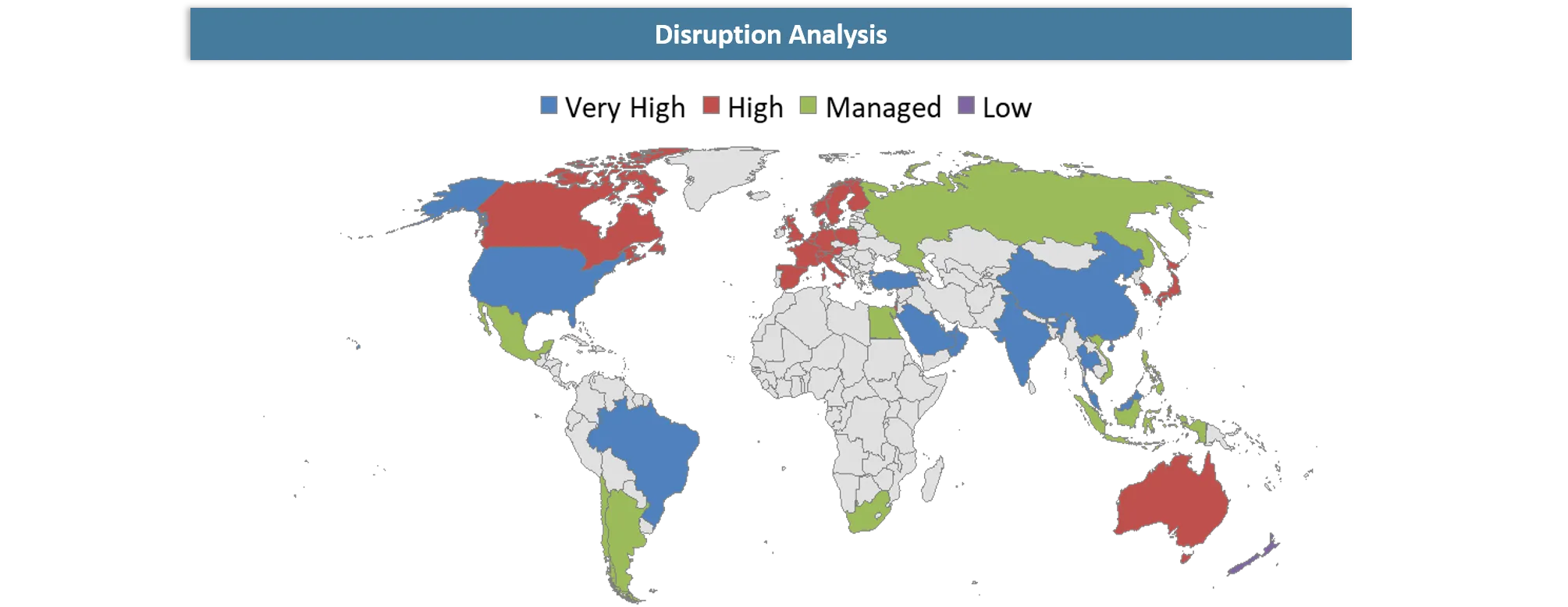
Digital twins are disrupting the oil and gas operating model by moving decision-making from periodic inspections and reactive maintenance toward continuous monitoring and predictive action. In offshore and remote operations, this reduces the need for physical inspection visits and enables experts to support multiple assets from centralized operation centers. In refining and LNG, digital twins allow operators to test process changes virtually before applying them to live plants.
The second disruption is vendor ecosystem convergence. Industrial software companies, oilfield service providers, automation suppliers, hyperscale cloud providers and AI companies are competing to own the digital operating layer. This is changing procurement from single-point software purchases to platform partnerships.
Digital Twins in Oil and Gas Market BCG Matrix: Company Evaluation
STAR
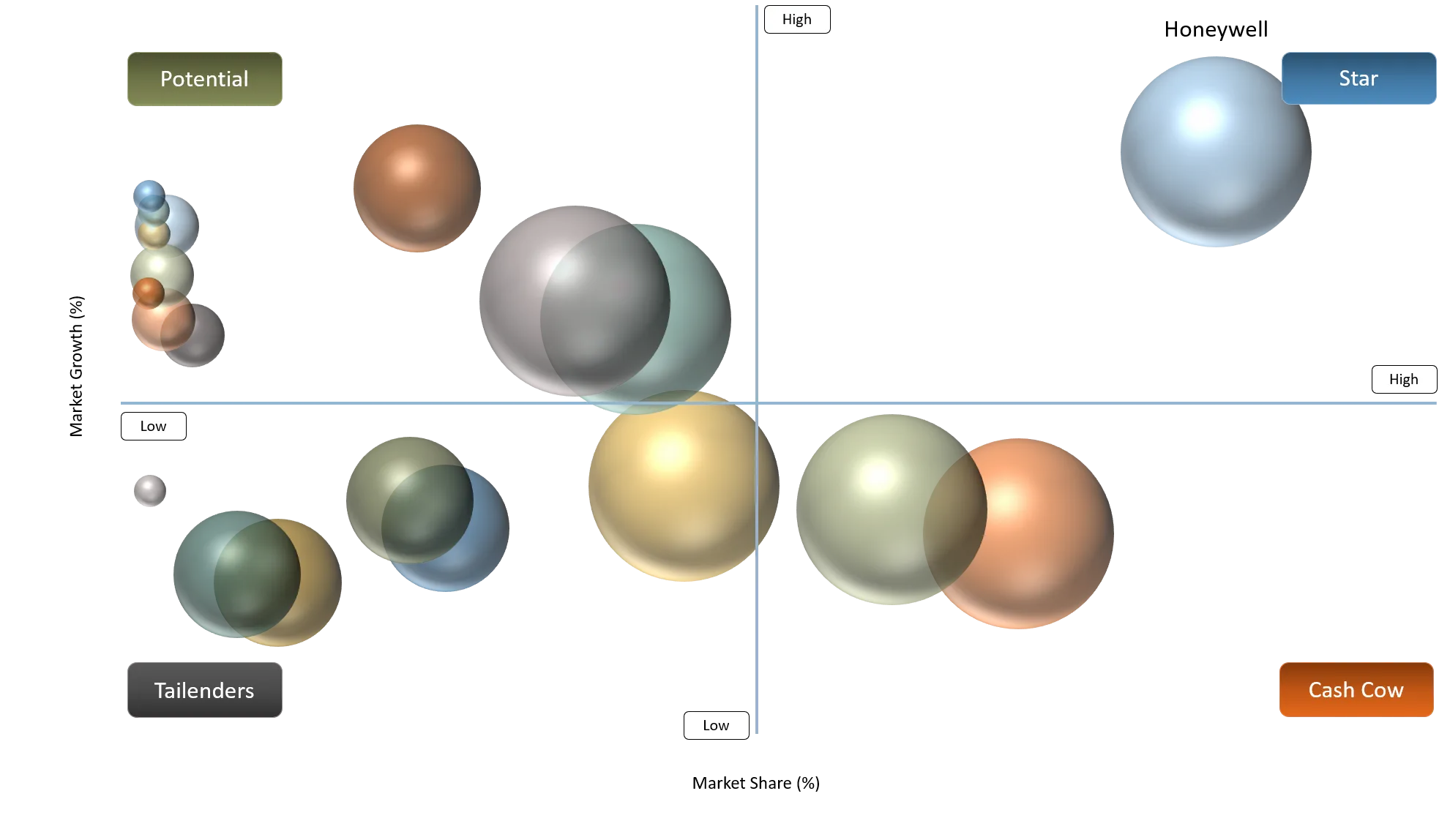
AVEVA, Siemens Energy, Schneider Electric, SLB, Emerson, Honeywell and Microsoft are positioned as Star players because they combine strong industrial software, automation, cloud or oilfield domain capabilities with global oil and gas customer relationships.
POTENTIAL
Akselos, Kongsberg Digital, C3 AI, Palantir, AspenTech and specialized digital twin providers are positioned as Potential players because they address high growth areas such as structural twins, AI-enabled optimization and enterprise operating intelligence.
CASH COWS
Large automation and controls vendors with installed bases in refineries, pipelines and upstream facilities act as Cash Cows because their existing systems are natural integration points for digital twin expansion.
TAILENDERS
Niche visualization, simulation or consulting-only providers without scalable integration capability are at risk of being Tailenders unless they develop stronger partnerships or specialized use case depth.
Digital Twins in Oil and Gas Market Dynamics
Driver Impact Analysis
| Driver | Market Growth Impact (%) | Demand Concentration | Impacted Use Case | Strategic Impact |
Increasing Demand for Operational Efficiency and Cost Reduction | 27% | Global, highest in upstream and refining | Production Optimization and Asset Performance | Expands demand for digital twins that reduce downtime, improve output and optimize operating parameters. |
Growing Adoption of IoT, AI and Big Data Analytics | 24% | North America, Middle East, Europe | Predictive Maintenance and Real-Time Monitoring | Improves model accuracy and enables data-driven decision-making across large asset portfolios. |
Rising Need for Remote Operations and Safety | 18% | Offshore, subsea and remote fields | Remote Monitoring and Worker Safety | Supports fewer site visits, safer inspection planning and centralized operational support. |
| Sustainability 'and Emissions Management Pressure | 15% | Europe, North America, Middle East | Energy Efficiency and Methane Monitoring | Drives digital twin use for emissions tracking, leak detection and energy optimization. |
Driver: Increasing Demand for Operational Efficiency and Cost Reduction
One major factor propelling the market is the need to improve asset productivity while controlling costs. Oil and gas assets are capital intensive, technically complex and often located in remote environments. Digital twins allow operators to simulate operating conditions, detect anomalies, schedule maintenance before failure and optimize production. Even a 1% production improvement in offshore operations can create meaningful financial value, which explains why operators are moving from pilot projects to enterprise deployment.
Restraint Impact Analysis
| Restraint | Drag on Market Growth (%) | Primary Impact Area | Impacted Use Case | Strategic Impact |
| High Implementation Cost and Integration Complexity | 22% | Capital and IT Infrastructure | Enterprise Digital Twin Rollout | Delays adoption among smaller operators and limits scale when ROI is unclear. |
| Cybersecurity and Data Governance Risk | 18% | Operational Technology and Cloud Connectivity | Remote Operations and AI Integration | Raises approval barriers for cloud, external access and autonomous decision support. |
| Legacy System Fragmentation | 16% | Data Integration | Real-Time Asset Monitoring | Increases model build time and reduces data quality across older assets. |
| Shortage of Domain and Data Talent | 12% | Workforce and Operations | Advanced Simulation and AI Analytics | Slows deployment because teams need both oil and gas domain expertise and data science skills. |
Restraint: High Implementation Cost and Integration Complexity
High implementation cost remains a restraint because digital twin programs require sensors, historians, cloud or server infrastructure, integration with control systems, model development, cybersecurity validation and skilled personnel. Legacy assets often have incomplete engineering data, inconsistent tag naming and fragmented operations data. This increases deployment cost and extends the time required to prove ROI.
Digital Twins in Oil and Gas Market Segment Analysis
By Offering
Product Digital Twin Will Support Equipment and Asset-Level Buyer Decisions
Product digital twins are virtual replicas of wells, compressors, turbines, pumps, separators, drilling systems, subsea trees, offshore structures and pipeline components. Buyer intent is strongest when product twins directly support maintenance prioritization, spares planning, asset life extension and failure avoidance. In 2025, U.S. crude output reached about 13.6 million barrels per day even as active drilling rigs declined by 5%, showing that operators are extracting more output from fewer active rigs through productivity and operating discipline. Product twins support that same agenda by helping teams monitor equipment condition, simulate operating stress and identify where field intervention produces the highest value. The strongest supplier opportunity is in twins connected to rotating equipment, high-pressure systems, subsea assets and aging offshore infrastructure where downtime carries high production and safety consequences.
By Type
Predictive Digital Twins Will Witness the Fastest Adoption
Predictive digital twins are the most buyer-relevant type because they convert live operating data into failure forecasts, production alerts and recommended actions. The value is clearest in pumps, compressors, gas lift systems, artificial lift, turbines, heat exchangers and pipeline integrity systems where early detection can prevent shutdowns or expensive emergency maintenance. Rystad Energy estimates digitalization and AI can create close to US$500 billion in cumulative E&P value between 2026 and 2030, with value coming from cost reductions, production increases and compressed development timelines. Predictive twins help operators convert this potential into asset-level actions by identifying anomaly patterns, calculating remaining useful life and recommending maintenance windows. Buyers will favor solutions that can show reduced non-productive time, lower maintenance backlog and better field crew planning rather than dashboards alone.
By Deployment Mode
Cloud Deployment Will Grow Faster Due to Multi-Asset Scaling
Cloud deployment is gaining momentum because operators want to benchmark wells, platforms, pipelines and processing assets across regions while enabling remote collaboration between operations teams, engineers and OEM specialists. Cloud also lowers the barrier for AI model updates, large-scale sensor data storage and cross-asset performance analytics. The buyer case is especially strong for companies managing geographically dispersed shale pads, offshore platforms, LNG assets or refinery networks. However, oil and gas buyers still require hybrid deployment options for high-security OT environments and remote assets with intermittent connectivity. The fastest-growing opportunity is therefore cloud plus edge digital twins, where data is processed locally for operational continuity and synchronized to the cloud for enterprise analytics. Vendors that address cybersecurity, latency, data residency and integration with historians will win larger platform procurements.
By Operation
Upstream Segment Will Continue to Lead Adoption
Upstream operations represent the largest adoption area because reservoirs, wells, drilling systems, production facilities and subsea assets are data-rich, capital-intensive and highly sensitive to uptime. Digital twins support well performance monitoring, drilling parameter optimization, artificial lift tuning, production allocation, reservoir scenario testing and offshore integrity management. The strongest buyer need is no longer basic visualization. Operators need actionable workflows that improve production per rig, shorten response time and reduce avoidable field interventions. The U.S. production example is important: output reached about 13.6 million barrels per day in 2025 despite fewer active rigs, indicating that productivity gains are central to upstream economics. Digital twins help sustain that model by linking sensor data, engineering models and operational recommendations into daily production decisions.
By Application
Asset Performance Management Will Lead Recurring Value Creation
Asset performance management is the most commercially durable application because it creates recurring value across pumps, compressors, turbines, valves, heat exchangers, pipelines and offshore structures. Buyers evaluate APM twins through measurable outcomes such as avoided downtime, fewer urgent work orders, better shutdown planning and reduced maintenance deferral. The allied industry impact is significant because APM twins pull demand for condition monitoring sensors, vibration analytics, inspection services, reliability engineering, CMMS integration and remote operations centers. EY’s 2025 Future of Energy Survey found that 50% of oil and gas and chemicals companies were already using digital twins to help manage assets, showing that the use case has moved into mainstream asset management. Suppliers that connect digital twin recommendations to maintenance execution systems will capture higher recurring value.
By End User
IOCs, NOCs and Large Integrated Operators Will Drive Platform Procurement
Integrated oil companies, national oil companies and large independents are the most important buying group because they operate complex portfolios where small improvements in uptime, energy efficiency or production allocation can create large value. NOCs are especially important because many are running large-scale digital transformation programs across upstream, refining and petrochemical assets. Buyers are asking for vendor roadmaps that link digital twins with AI, data governance, emissions monitoring, cybersecurity and operational workflows. The procurement decision increasingly involves operations, IT, maintenance, safety and corporate digital teams together. This creates demand for partners that can deliver enterprise scale rather than asset pilots only. The highest-value opportunities are multi-year platform programs that cover production optimization, integrity management, remote operations and workforce productivity.
By Technology
AI, IoT and Physics-Based Simulation Will Define Platform Differentiation
Technology differentiation is moving toward hybrid digital twins that combine IoT sensor streams, historian data, physics-based models, AI, edge computing, 3D visualization and cybersecurity controls. A pure visualization twin has limited buyer value if it cannot support decisions. The strongest platforms are those that merge engineering fidelity with operational analytics and workflow automation. AI is becoming central because it detects anomalies, predicts failures, optimizes setpoints and turns unstructured engineering data into usable operational context. This is also where allied industries benefit: sensor manufacturers, OT cybersecurity vendors, cloud providers, data engineering firms, simulation software companies and automation specialists are pulled into the digital twin stack. Vendors that can prove secure integration across SCADA, DCS, historians and CMMS systems will have an advantage in oil and gas procurement.
By Asset Type
Offshore Platforms and Subsea Infrastructure Will Require High-Integrity Twins
Offshore platforms and subsea infrastructure represent a high-value asset type because inspection access is expensive, downtime is costly and structural integrity risk is high. Digital twins support fatigue tracking, corrosion monitoring, inspection planning, subsea layout visibility, riser monitoring and life extension decisions. FutureOn’s 2026 launch of FieldTwin Operate shows the direction of the market: subsea operators want unified geospatial environments that integrate engineering, inspection and operational data. This creates backend demand for subsea data models, ROV inspection feeds, integrity analytics, asset registries and offshore communication infrastructure. Buyer value is strongest where digital twins reduce unnecessary inspection trips, improve campaign planning and provide an auditable integrity record for regulators, insurers and asset owners.
Digital Twins in Oil and Gas Market Geographical Penetration
North America Digital Twins in Oil and Gas Market Landscape
North America is the largest regional market, with an estimated 37.8% share in 2025. The buyer case is strongest in shale production, offshore Gulf of Mexico operations, LNG terminals, refinery networks and pipeline infrastructure. The U.S. produced about 13.6 million barrels per day of crude oil in 2025 even as active drilling rigs declined by 5%, which highlights the region’s focus on productivity gains rather than simply adding rigs. Digital twins support this operating model by improving well surveillance, production optimization, drilling efficiency and asset reliability. Baker Hughes rig data remains a leading indicator for drilling and service demand, so operators and service companies use digitalization to protect margins when rig activity is volatile. North America also benefits from hyperscale cloud availability, strong industrial software adoption and a large ecosystem of oilfield service providers.
Europe Digital Twins in Oil and Gas Market Outlook
Europe is a high-maturity market driven by North Sea offshore operations, Norwegian Continental Shelf digitalization, refinery modernization, asset integrity needs and strict safety and emissions expectations. Mature offshore fields require life extension, structural monitoring, corrosion management and remote operating support, making digital twins valuable for aging infrastructure. The regional buyer focus is on integrity assurance, emissions transparency, energy efficiency and safe offshore operations rather than production growth alone. North Sea operators are also using digital twins to reduce inspection costs and improve turnaround planning because offshore logistics and skilled labor are expensive. Europe’s digital twin demand is closely linked with allied industries such as inspection robotics, drones, methane monitoring, OT cybersecurity, engineering simulation and industrial cloud services. Vendors with strong compliance, auditability and integration with asset integrity workflows will be better positioned.
Asia-Pacific Digital Twins in Oil and Gas Market Trends
Asia-Pacific is the fastest growing region because operators in India, China, Australia, Malaysia, Indonesia and other markets are expanding digital oilfield programs while managing energy security, mature fields, offshore assets and refinery growth. Oil India’s 2026 deployment of a digital oilfield platform across 77 wells on 46 plinths in northeast India illustrates how regional operators are moving from pilot digital tools to production surveillance at field scale. Australia and Malaysia support offshore and LNG twin use cases, while China and India support refinery, petrochemical and upstream digitalization. The buyer need is practical: improve output, reduce field visits, optimize maintenance and support remote operations in complex geography. Asia-Pacific creates strong demand for implementation partners, local systems integrators, sensor suppliers, edge connectivity and cloud platforms that can operate under varied data residency and cybersecurity rules.
Middle East and Africa Digital Twins in Oil and Gas Market Trends
Middle East and Africa growth is driven by national oil companies seeking higher throughput, lower emissions and stronger safety performance across upstream, LNG, refining and petrochemical assets. Large-scale NOC programs create enterprise opportunities because operators want to standardize digital twin architectures across fields, plants and pipelines. AI and digital investment is especially relevant in the region because production systems are large, asset bases are complex and uptime improvements have high financial impact. Rystad notes that ADNOC has committed US$1.5 billion in digital capital expenditure targeting US$1 billion in annual value creation, which shows how NOCs are linking digital investment with measurable operating value. The region’s allied industry impact includes demand for OT cybersecurity, control system upgrades, methane monitoring, inspection automation and integrated operations centers.
South America's Digital Twins in Oil and Gas Market Trends
South America is a selective but attractive market because offshore Brazil, Argentina’s unconventional activity, Guyana’s fast-growing offshore production base and regional pipeline networks create clear digital twin use cases. IEA expects upstream oil and gas investment growth in 2026 to be supported partly by Central and South America, which increases the need for engineering software, integrity management and production optimization tools. Brazil’s deepwater and pre-salt assets require high-value digital twins for FPSOs, subsea infrastructure, flow assurance, rotating equipment and inspection planning. Argentina’s shale development supports drilling and production optimization twins. The buyer case is strongest where digital twins reduce offshore intervention cost, improve well uptime and support project execution discipline. Suppliers that can localize implementation, integrate with existing control systems and support Portuguese and Spanish operations teams will have an advantage.
Digital Twins in Oil and Gas Market Competitive Landscape
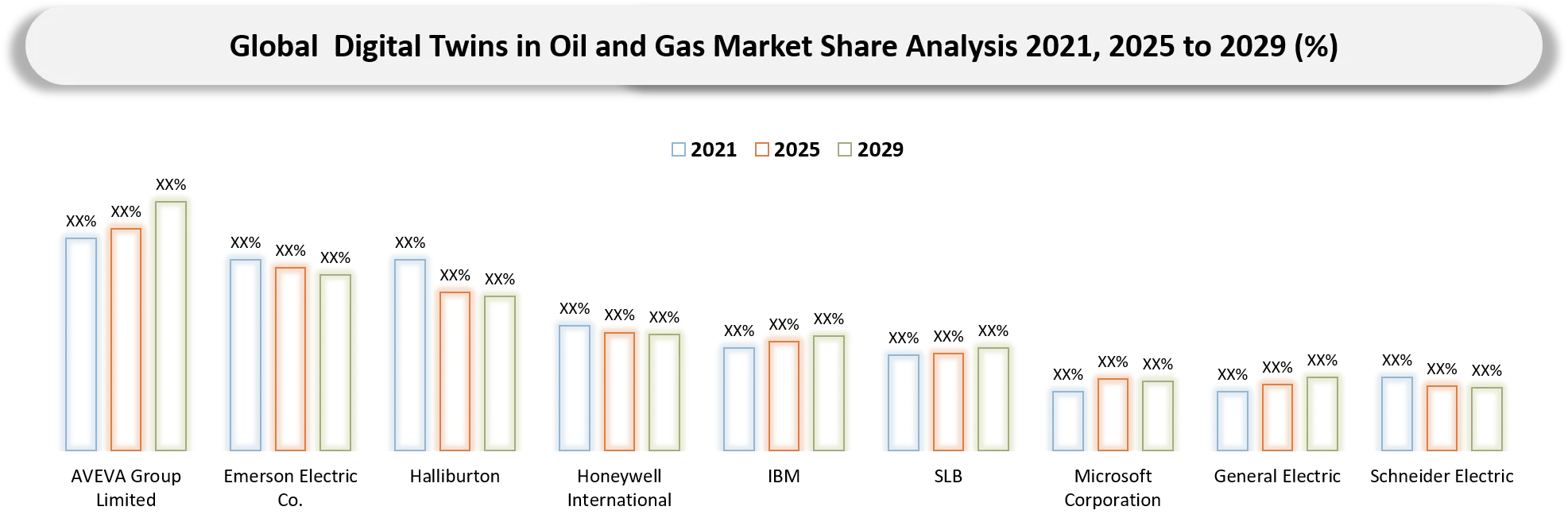
- Competition is shifting from basic visualization and monitoring toward AI-enabled decision support, structural performance management and autonomous optimization.
- Industrial software vendors differentiate through deep process simulation, asset performance management, engineering data management and operator workflow integration.
- Oilfield service companies differentiate through upstream domain expertise, reservoir knowledge, drilling data, production optimization and field service relationships.
- Cloud providers and AI companies are becoming more influential because enterprise-scale digital twins require data storage, compute, AI model operations and secure collaboration.
- Specialist companies are gaining traction in structural digital twins, emissions monitoring, pipeline integrity, offshore asset models and physics-based simulation.
- The market is increasingly partnership-driven because operators need combined capabilities across engineering, IT, operations technology and analytics.
Key Companies of Digital Twins in Oil and Gas Market
- AVEVA Group Limited
- Emerson Electric Co.
- Halliburton
- Honeywell International Inc.
- IBM
- SLB
- Microsoft Corporation
- General Electric
- Schneider Electric
- Siemens Energy
- Baker Hughes
- Yokogawa Electric Corporation
- AspenTech
- Akselos
- Palantir Technologies
- C3 AI
- Kongsberg Digital
- ABB
- Dassault Systemes
- Rockwell Automation
Digital Twins in Oil and Gas Market Major Pain Points
- High cost of building validated digital twin models for complex assets.
- Fragmented data across engineering files, historians, SCADA, maintenance systems and spreadsheets.
- Cybersecurity concerns when connecting operational technology systems to cloud and AI platforms.
- Limited availability of workers who understand both oil and gas operations and advanced analytics.
- Difficulty in proving ROI when pilot projects are too narrow or disconnected from maintenance and production workflows.
- Need for model governance, version control and regular calibration to keep digital twins reliable.
- Interoperability challenges among competing vendor platforms and legacy industrial systems.
- Resistance to adoption when operations teams do not trust model recommendations.
Digital Twins in Oil and Gas Market Recent Developments
- April, 2026: SLB entered into a definitive agreement to acquire S&P Global Energy’s geoscience and petroleum engineering software portfolio. The deal strengthens SLB’s digital subsurface, reservoir modeling and petroleum engineering software position, which is directly relevant to upstream digital twin workflows.
- April, 2026: Wipro partnered with Kongsberg Digital to transform the energy and utilities sector with AI-powered digital twins. The agreement supports operator demand for integrated digital twin implementation, cloud scale-up and AI-enabled decision workflows.
- May, 2026: FutureOn launched FieldTwin Operate, a subsea operations digital twin platform that integrates engineering, inspection and operational data into a unified geospatial environment for offshore assets. The launch supports subsea integrity, inspection planning and offshore operations visibility.
- June, 2026: Oil India deployed Kellton’s Optima Digital Oilfield Platform across 77 oil production wells on 46 plinths in northeast India. The deployment gives the operator real-time visibility into well performance and creates a regional benchmark for field-scale production digitalization.
- January, 2026: Siemens launched Digital Twin Composer on the Siemens Xcelerator Marketplace and expanded its NVIDIA partnership to support industrial AI and digital twin workflows. The launch is relevant for oil and gas buyers evaluating scalable industrial digital twin development environments.
Analyst View / Opinion on Digital Twins in Oil and Gas Market
- The market is expected to shift from visualization-focused digital twins to predictive and autonomous operating twins that influence production, maintenance and safety decisions.
- Upstream operations will remain the leading adoption area because reservoir, drilling, well and offshore production systems offer high-value optimization opportunities.
- The next stage of competition will transition from software features to operational proof, where vendors must demonstrate uptime improvement, production gains and emissions reduction.
- Firms that combine engineering simulation, AI analytics, cloud scalability and workflow integration will hold a stronger position than single-function software vendors.
- Long-term market leadership will be shaped by cybersecurity, data interoperability, model governance and ability to scale across multi-asset portfolios.
Digital Twins in Oil and Gas Market Target Audience
| Industry | Who Should Buy This Report? | Reason to Buy This Report |
| Oil and Gas Operators | Digital transformation leaders, operations heads, asset managers, reservoir teams | To understand market trends, technology adoption, competitive landscape and implementation priorities. |
| Industrial Software Vendors | Product managers, strategy teams, business development teams | To identify demand for digital twin platforms, AI analytics, process simulation and asset performance software. |
| Oilfield Service Companies | Technology teams, drilling service groups, production optimization teams | To evaluate digital twin opportunities across upstream, drilling, reservoir and production operations. |
| Automation and Controls | Control system providers, OT integration teams, plant automation vendors | To assess how digital twins connect with DCS, SCADA, PLC, historians and plant data systems. |
| Cloud and AI Providers | Energy industry teams, cloud architects, AI product teams | To identify cloud-native digital twin needs and enterprise partnership opportunities. |
| Pipeline and Midstream Operators | Integrity managers, operations teams, compliance teams | To understand pipeline digital twin use cases for leak detection, corrosion, pressure management and throughput optimization. |
| Refining and LNG Operators | Refinery managers, process engineers, reliability teams | To evaluate process twin and energy optimization opportunities in complex downstream assets. |
| Government and Regulators | Energy agencies, safety bodies, environmental regulators | To assess how digital twins support safety, emissions, asset integrity and compliance reporting. |
| Investment and Consulting | Investors, private equity firms, market consultants | To identify high-growth segments, target vendors and investment opportunities in oil and gas digitalization. |
Why Choose DATAM?
- Data-Driven Insights: Dive into detailed analyses with granular insights such as pricing, market shares and value chain evaluations, enriched by interviews with industry leaders and disruptors.
- Post-Purchase Support and Expert Analyst Consultations: As a valued client, gain direct access to expert analysts for personalized advice and strategic guidance tailored to specific needs and challenges.
- White Papers and Case Studies: Benefit quarterly from in-depth studies related to purchased titles, tailored to refine operational and marketing strategies.
- Annual Updates on Purchased Reports: Existing customers receive annual updates to reports, ensuring they stay updated on market insights and technological advancements. Terms and conditions apply.
- Specialized Focus on Emerging Markets: DataM delivers in-depth specialized insights for emerging markets rather than generalized geographic overviews.
- Value of DataM Reports: Reports offer specialized insights tailored to the latest trends and specific business inquiries, providing strategic perspective beyond generic databases.
What DATAM Uniquely Provides
- Detailed 10-year market predictions by offering, type, deployment mode, operation, application and region, underpinned by strong market sizing and forecasting techniques.
- Thorough competitive analysis encompassing industrial software vendors, oilfield service providers, cloud platforms and specialist digital twin companies.
- Comprehensive evaluation of technology, including AI, IoT, edge computing, cloud, process simulation, structural twins, asset performance management and autonomous twins.
- Strategic market insights through AI impact evaluation, disruption assessment, BCG Matrix analysis, pricing intelligence, import-export evaluation and investment trend analysis.
- Tangible analysis of white-space and investment prospects, identifying high-growth applications, vendor opportunities, implementation gaps and changing customer needs.
- Country-level recommendations that help operators, software vendors, oilfield service companies, investors and policymakers make informed strategic and investment choices




























































