


Digital Identity Solutions Market Size
Digital identity is becoming a core trust layer for financial services, government platforms, healthcare systems, telecom networks, e-commerce, travel, workforce access and public digital infrastructure. As more services move online, organizations need identity systems that can verify users securely, reduce fraud, meet regulatory requirements and deliver a smooth digital experience.
Digital Identity Solutions Market is valued at US$ 47.6 billion in 2025 and is projected to reach US$ 282.67 billion by 2035, growing at a CAGR of 19.5% during 2026–2035.
The market’s urgency is clear. Around 1.25 billion people still lack a digitally verifiable identity while more than 3.3 billion people live in countries without interoperable digital identity infrastructure. At the same time, the FTC reported 1.7 million identity theft and fraud complaints in 2024. Digital identity solutions are therefore moving from an IT access tool to a strategic foundation for digital inclusion, fraud control, customer onboarding and regulatory trust.
Key Takeaways
- The Digital Identity Solutions Market is projected to grow from US$47.6 billion in 2025 to US$282.67 billion by 2035.
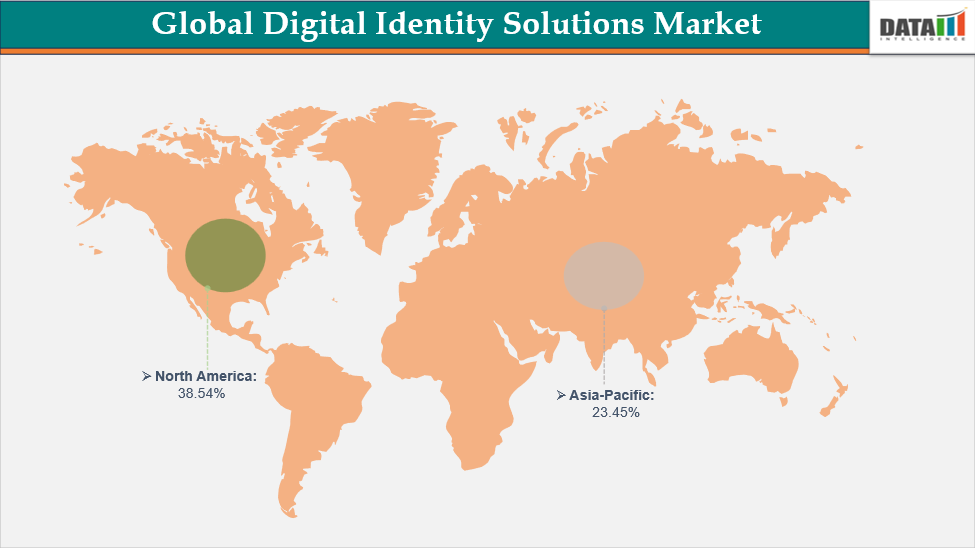
- North America leads with 38.54% Digital Identity Solutions Market Share, supported by cybersecurity investment, regulatory maturity and enterprise digital transformation.
- Asia-Pacific is the fastest-growing region, with a CAGR of 25.40%, supported by digital payments, national ID systems and mobile-first service adoption.
- The solutions segment leads with 64.45% share, driven by demand for identity verification, authentication, fraud prevention and identity management platforms.
- Cloud-based digital identity solutions are gaining faster adoption as enterprises need scalable identity infrastructure for SaaS, remote access and digital customer onboarding.
- Zero-trust security frameworks are increasing demand for MFA, biometric verification, identity governance, privileged access management and AI-driven fraud analytics.
- High implementation and operational costs remain a barrier, especially for SMEs and emerging-market organizations integrating advanced identity systems with legacy infrastructure.
Digital Identity Solutions Market Scope
| Report Attribute | Details |
| Market Size in 2025 | US$ 47.6 billion |
| Market Size by 2035 | US$ 282.67 billion |
| CAGR | 19.50% |
| Historic Years | 2023 to 2024 |
| Base Year | 2025 |
| Forecast Period | 2026 to 2035 |
| Segments Covered | Offering, Identity Type, Deployment Mode, Organization Size, End-User and Region |
| Leading Region | North America |
| Fastest Growing Region | Asia-Pacific |
Market Dynamics
Regulatory Codification of Digital KYC and Identity Assurance
Regulation is one of the strongest forces behind Digital Identity Solutions Market Growth. Governments and standards bodies are establishing clearer rules for identity proofing, authentication assurance, federation and digital KYC.
In the U.S., NIST SP 800-63 digital identity guidelines influence identity proofing and authentication requirements across federal and private sector deployments. In Europe, eIDAS 2.0 and the European Digital Identity Wallet are creating legally recognized identity ecosystems across borders and sectors. Private and public sector actors are expected to support strong digital authentication under the framework.
KYC rules are also tightening in markets such as India, Singapore and the UAE. Enhanced identity checks, biometric liveness detection and stronger onboarding requirements are increasing demand for digital identity platforms across banking, payments, crypto, government services and telecom.
Fraud, Cyber Risk and Zero-Trust Security
Identity fraud is pushing enterprises to replace traditional authentication models with risk-based and AI-enabled identity systems. The FTC’s 1.7 million identity theft and fraud complaints in 2024 highlight the scale of the challenge.
Enterprises are increasingly adopting biometric authentication, MFA, phishing-resistant login, device intelligence, behavioral analytics and continuous assurance. Digital identity is also becoming central to zero-trust architecture because every user, device and session must be verified before access is granted.
High Implementation and Operational Costs
Advanced digital identity systems can be expensive to deploy. Biometric scanners, secure servers, blockchain-based identity tools, AI verification engines and legacy system integration require meaningful upfront investment. Ongoing costs include maintenance, cybersecurity updates, compliance management and employee training.
SMEs often struggle to scale these systems across multiple branches or markets. Cost-sensitive industries may delay adoption unless vendors provide modular, cloud-based or managed identity models.
Market Opportunities
The largest opportunity is in interoperable identity infrastructure. Governments and enterprises need digital identity systems that work across platforms, borders and sectors while protecting user privacy.
Financial institutions can use digital identity to improve onboarding, reduce KYC friction and prevent fraud. Healthcare providers can secure patient access and protect sensitive records. Retail and e-commerce companies can reduce account takeover and payment fraud. Governments can expand access to public benefits, citizen services and digital wallets.
Technology companies have strong opportunities in AI-powered verification, decentralized identity, verifiable credentials, mobile identity wallets and cloud-native identity orchestration. Vendors that combine security, privacy, interoperability and user experience will be best positioned.
Economic and Investment Analysis
Digital identity investment is being driven by fraud losses, compliance pressure, digital public infrastructure and enterprise cloud migration. The business case is no longer limited to authentication. Buyers are evaluating identity systems based on onboarding conversion, fraud reduction, compliance readiness, customer trust and operational efficiency.
Capital spending is moving into biometric systems, AI identity analytics, digital wallet infrastructure, identity governance, cloud IAM and decentralized identity frameworks. ROI depends on reduced manual verification, lower fraud exposure, faster onboarding and improved secure access across digital services.
Economic risks include high deployment cost, regulatory fragmentation, user privacy concerns and uneven digital infrastructure in emerging markets.
Segmentation Analysis
Segmented by offering (Solutions and Services), by identity type (Biometrics and Non-Biometrics), by deployment mode (On-Premises and Cloud), by organization size (Large Enterprises and Small & Medium Enterprises), by end-user (BFSI, IT & Telecom, Retail & E-commerce, Government & Defense, Healthcare, Energy & Utilities and Others), and by Region - Share, Trends, and Forecast to 2035.
The solutions segment leads the market with 64.45% share. Demand is driven by platforms that support identity verification, authentication, fraud intelligence, identity lifecycle management and access governance. Hardware such as biometric scanners, smart cards and mobile authentication devices remains important in government, BFSI and healthcare use cases.
Biometrics is gaining strong traction because facial recognition, fingerprint verification, liveness detection and multimodal authentication improve identity assurance. Non-biometric identity tools remain relevant for credentials, passwords, OTP, device-based authentication and federated access.
Cloud deployment is growing quickly as enterprises need scalable identity infrastructure for remote work, SaaS applications, digital customer onboarding and cross-platform access. On-premises deployment remains relevant for highly regulated government, defense and financial environments.
Regional Analysis
North America
North America leads the Digital Identity Solutions Market with 38.54% share. The region benefits from strong cybersecurity investment, early technology adoption and mature enterprise digital infrastructure.
The U.S. is the core market, supported by NIST digital identity guidelines, high fraud exposure and rising adoption of AI-enabled identity security. Cybersecurity pressure is high, with 59% of U.S. businesses reporting successful cyberattacks in the past 12 months and 33.5% attributing attacks to AI-enabled threats.
Canada is also expanding digital identity demand through online commerce and secure transaction needs. More than 27 million eCommerce users were recorded in 2022 and penetration is expected to rise to 77.6% by 2025, supporting demand for scalable identity verification and fraud prevention.
Europe
Europe’s market is shaped by eIDAS 2.0, the European Digital Identity Wallet and strong data privacy expectations. The region is building a standardized digital identity ecosystem that can support cross-border verification, public services, banking, travel and enterprise authentication.
European buyers are expected to prioritize interoperability, legal recognition, privacy-preserving identity models and secure credential exchange. Vendors must align with regulatory standards and support wallet-based identity use cases to gain traction.
Asia-Pacific
Asia-Pacific is the fastest-growing region, with a CAGR of 25.40%. Growth is driven by mobile-first populations, digital banking, government ID programs, digital payments and e-commerce expansion.
India is a major growth market due to Aadhaar-linked digital infrastructure and rapid payment adoption. IMPS transactions increased from 407.92 million in November 2024 to 441 million in December 2024. UPI processed over 16.73 billion transactions recently and around 172 billion transactions in 2024, a 46% increase from 2023.
China strengthened the regional outlook with the July 2025 launch of its voluntary Cyberspace ID system, which provides internet IDs and digital certificates for secure access across websites and apps. Japan, South Korea and Southeast Asia are also expected to support growth through digital government, banking security and mobile identity adoption.
Competitive Landscape
The major players in the Digital Identity Solutions Market include Thales Group, NEC Corporation, IDEMIA, Samsung SDS, Telus, GB Group plc, Tessi, Daon, Inc., ForgeRock, Inc. and IBM.
Thales Group is strongly positioned through biometric authentication, smart cards, identity management and secure credentialing solutions for governments, financial institutions and enterprises. NEC is recognized for biometric and identity verification technologies. IDEMIA is active across citizen identity, financial services, border management and digital credentials. IBM supports enterprise identity security through AI, governance and cybersecurity platforms. ForgeRock is positioned in identity and access management, while GBG, Daon, Samsung SDS, Telus and Tessi address verification, authentication and enterprise identity workflows.
Vendor differentiation is moving toward interoperability, AI-powered fraud analytics, cloud-native identity, biometric accuracy, decentralized identity support and integration with existing IT and security systems.
Recent Developments
In May 2026, Thales Group expanded its digital identity and biometric authentication portfolio, supporting secure access management, e-government services and enterprise identity verification worldwide.
In April 2026, Okta, Inc. enhanced AI-driven identity security capabilities, strengthening zero-trust architectures, phishing-resistant authentication and workforce identity management solutions.
In March 2026, Microsoft Corporation advanced decentralized identity and verifiable credential technologies through its Entra platform, supporting privacy-centric digital identity ecosystems and enterprise security modernization.
In February 2026, World Bank expanded support for digital public infrastructure initiatives, accelerating adoption of inclusive digital identity systems across emerging economies.
In January 2026, IDEMIA strengthened biometric identity solutions and digital credential offerings, supporting border management, financial services and citizen identity programs globally.
Regulatory and Policy Analysis
Digital identity is directly influenced by regulation, data protection laws, KYC rules, digital public infrastructure strategies and cybersecurity standards. eIDAS 2.0 in Europe, NIST SP 800-63 in the U.S. and national digital identity initiatives in Asia-Pacific are setting stronger requirements for assurance, authentication and interoperability.
Government initiatives are also supporting inclusive digital identity. World Bank digital public infrastructure support and ID4D-related priorities highlight the role of identity in financial inclusion, public services and economic participation.
Expected regulatory changes will increase demand for privacy-preserving identity, verified credentials, auditability and cross-sector interoperability. Companies that build compliance-ready platforms will have stronger procurement positioning.
Strategic Insights and Analyst Perspective
Digital Identity Solutions Market Trends show a clear move toward identity platforms that combine security, compliance and user experience. Buyers are moving beyond standalone authentication toward integrated identity ecosystems.
Market participants should prioritize cloud-native deployment, biometric assurance, decentralized identity, mobile wallets, fraud analytics and interoperability. Risk mitigation should focus on privacy, cybersecurity, consent management, system resilience and regulatory compliance.
Investors should track providers that can serve multiple end users across BFSI, government, healthcare, telecom and e-commerce because identity infrastructure is becoming a recurring enterprise and public sector investment category.
Report Benefits
This Digital Identity Solutions Market Report helps technology vendors identify growth opportunities across identity verification, biometrics, digital wallets, IAM, decentralized identity and managed identity services. Enterprises can use the report to benchmark deployment models, vendor capabilities and regulatory requirements.
Investors can assess Digital Identity Solutions Market Growth across cloud identity, AI verification and national digital ID ecosystems. Procurement teams can evaluate cost, interoperability, security and compliance readiness. Strategy teams can track regional demand, competitive positioning and digital identity investment priorities through 2035.
Why Purchase the Report?
- To visualize the global Digital Identity Solutions market segmentation based on offering, identity type, deployment mode, organization size, end-user industry, and region, as well as understand key commercial assets and leading players.
- Identify commercial opportunities by analyzing emerging trends, technological developments, partnerships, and strategic initiatives.
- Excel data sheet with numerous market-level data points covering all segments and sub-segments.
- PDF report consists of comprehensive analysis after exhaustive qualitative interviews and an in-depth industry study.
- Product mapping available in Excel format consisting of key products and solution portfolios of major market participants.
- The global Digital Identity Solutions market report provides approximately 82 tables, 79 figures, and 190 pages of detailed market intelligence.
Target Audience
- Identity and access management (IAM) solution providers
- Cybersecurity companies
- Biometric technology firms
- Cloud IAM vendors
- BFSI institutions
- Government agencies
- Healthcare providers
- Telecom operators
- E-commerce platforms
- IT service providers
- Digital wallet providers
- Investors in cybersecurity and digital identity sector
- Procurement teams
- Chief Information Officers (CIOs)
- Chief Information Security Officers (CISOs)
- Chief Technology Officers (CTOs)
- Compliance leaders
- Strategy and planning teams
The global Digital Identity Solutions market report delivers a detailed analysis with 78 key tables, more than 72 visually impactful figures, and 267 pages of expert insights, providing a complete view of the market landscape.
Suggestions for Related Report
For more related reportsclick here




























































