


Digital Health & AI Tools in Neuroscience Market Size& Industry Outlook
The global digital health & AI tools in neuroscience market is expected to grow from US$ 37.47 billion in 2025 to US$ 79.73 billion by 2033, growing at a CAGR of 9.9% during the forecast period 2026-2033.
A major driving factor propelling this market is the surge in partnerships between big technology firms, healthcare providers, and pharma companies to develop integrated AI-driven neuroscience solutions. Instead of isolated apps or devices, stakeholders are co-creating full digital ecosystems that combine imaging, biomarker analysis, remote monitoring, and personalized interventions. For instance, in 2024, Biofourmis has teamed up with major hospital networks and life-science companies to deploy its AI-enabled remote patient monitoring platform for neurological and cardiac patients, showing how cross-sector partnerships can bring advanced digital health tools into real-world care pathways more quickly and at scale.
Key Highlights
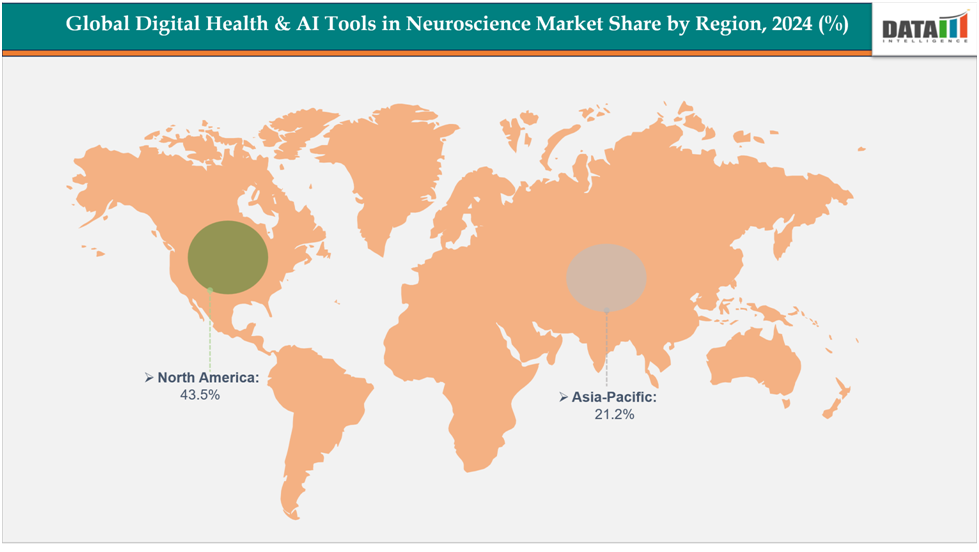
- North America dominates the digital health & AI tools in neuroscience market with the largest revenue share of 43.5% .
- The Asia Pacific is the fastest-growing region and is expected to grow at the fastest CAGR of8.1% over the forecast period.
- Based on component, software segmented the market with the largest revenue share of 45.1% .
The major market players in the Akili Interactive, Pear Therapeutics, Biofourmis, Emphatical, Neuroelectric, Neural ink, Blackrock Neurotech, Synchrony, MindMaze, Precision Neuroscience and among others.
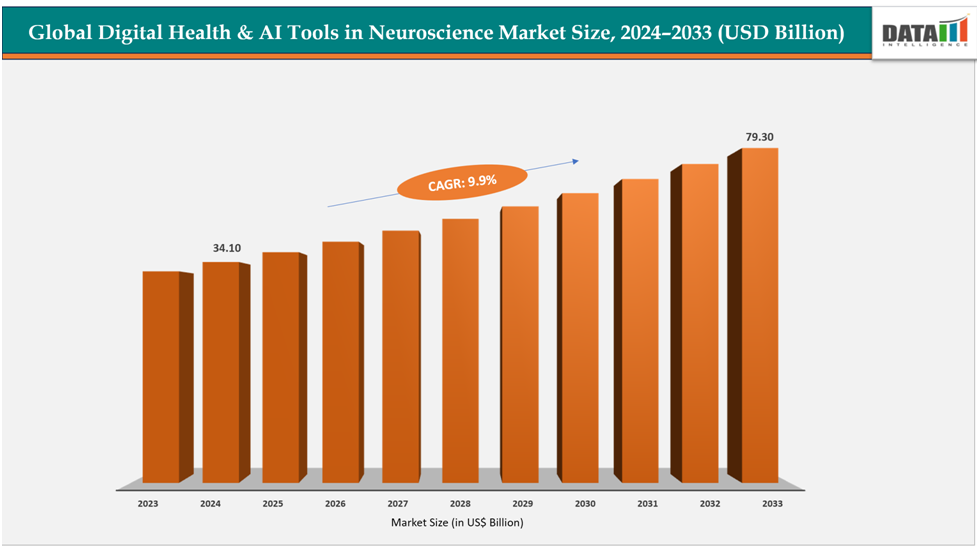
Source : Datam Intelligence Email : [email protected]
Market Dynamics
Drivers:
Rising prevalence of neurological and psychiatric disorders worldwide is significantly driving the Digital Health & AI Tools in Neuroscience market growth
The rising prevalence of neurological and psychiatric disorders is a major driver for the growth of digital health and AI tools in neuroscience. These technologies enable early diagnosis, continuous monitoring, personalized treatment, and remote management of complex brain disorders, which traditional methods often struggle to provide at scale. AI algorithms can analyze brain imaging, EEG signals, and behavioral data, while digital therapeutics offer targeted interventions for conditions like ADHD, depression, and cognitive decline. By improving clinical outcomes and accessibility, these tools address a critical unmet need in global healthcare systems.
Globally, more than 3.4 billion people (~43% of the population) were living with at least one neurological condition in 2021, resulting in 443 million disability‑adjusted life years (DALYs) lost. Mental health conditions affect over 1 billion people worldwide, with anxiety and depression among the most common disorders. In low‑ and middle‑income countries, treatment gaps are substantial, exceeding 50–75%, highlighting the urgent need for scalable AI- and digital-based interventions.
Restraints:
High cost of advanced neuro-AI tools are hampering the growth of the Digital Health & AI Tools in Neuroscience market
One of the biggest barriers to wider adoption of digital health and AI tools in neuroscience is their high upfront and operating costs, which limit access for smaller clinics and emerging markets. Advanced braincomputer interface implants and AI-driven neurodiagnostic platforms can cost anywhere from USD 50,000–100,000 per unit for hospital-grade systems, while cloud-based analytics and subscription fees for AI platforms can add USD 500–1,500 per patient per month. These high costs slow down reimbursement approvals and make it harder for providers to scale such solutions beyond pilot programs.
For more details on this report – Request for Sample
Segmentation Analysis
The global digital health & AI tools in neuroscience market is segmented based on component, technology, application, end user, and region.
Component:
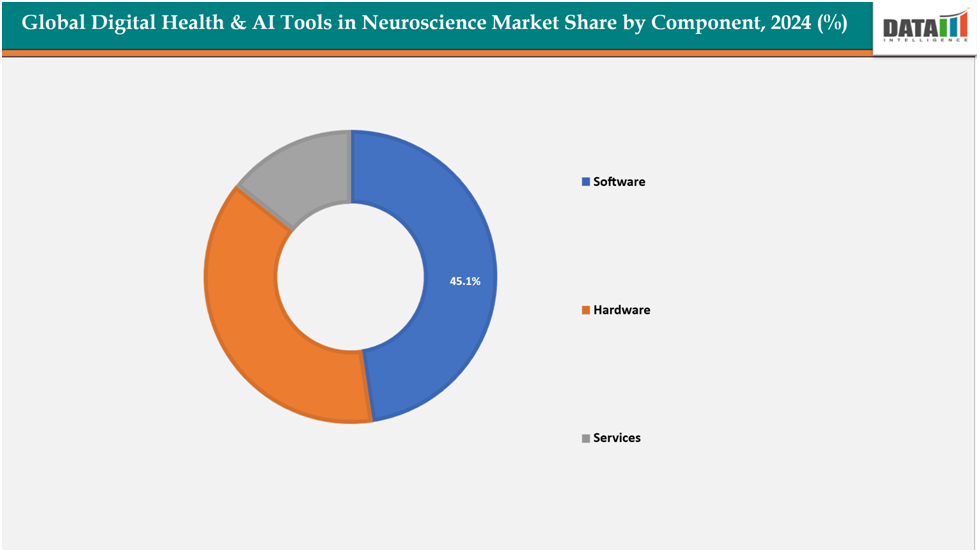
The software segment from component segment to dominate the digital health & AI tools in neuroscience market with a 45.1%
The software segment drives the growth of the neuroscience digital health market by enhancing accessibility, efficiency, and precision in the management of neurological disorders. AI-powered applications and digital platforms allow clinicians to remotely monitor patients, track cognitive performance, and analyze patterns in real time, which is particularly valuable for chronic conditions like Alzheimer’s, Parkinson’s, and epilepsy.
Additionally, software solutions facilitate integration of multi-modal data including imaging, biomarkers, and patient reported outcomes into actionable insights for treatment planning. For example, platforms developed by Neuroelectric and Pear Therapeutics help deliver personalized interventions and adaptive therapies, improving patient engagement while reducing the strain on healthcare systems. By enabling continuous, data-driven care, the software segment accelerates the adoption of digital health tools across hospitals, clinics, and home-based care settings.
Application:
The Alzheimer's / dementia segment is estimated to have a 41.2% of the digital health & AI tools in neuroscience market share
The Alzheimer’s and dementia segment is a major driver of the digital health and AI tools market due to the growing global burden of cognitive disorders and the urgent need for early detection and personalized care. With millions of patients affected worldwide and limited treatment options, healthcare systems are increasingly adopting AI-powered software, digital therapeutics, and remote monitoring platforms to improve diagnosis, track disease progression, and manage symptoms effectively.
Applications such as cognitive assessment tools, memory training programs, and AI-based imaging analytics allow clinicians to identify subtle cognitive changes early, personalize interventions, and reduce hospital visits. Companies like Alto Neuroscience and BrainSightAI are leveraging these applications to provide actionable insights for clinicians and caregivers, making Alzheimer’s and dementia management a key growth area in the neuroscience digital health market.
Geographical Analysis
North America dominates the global Digital Health & AI Tools in Neuroscience market with a 43.5%
The North American market is driven by high healthcare expenditure, advanced healthcare infrastructure, and early adoption of innovative digital technologies. The region has strong R&D capabilities and supportive government initiatives promoting AI in healthcare, leading to widespread deployment of neurodiagnostic software, digital therapeutics, and remote monitoring solutions. Rising awareness of neurological disorders among clinicians and patients’ further fuels market growth.
In the USA specifically, the market growth is propelled by robust investment in AI research, high prevalence of neurological and psychiatric disorders, and favorable reimbursement policies. Healthcare providers are increasingly adopting AI-based platforms for early diagnosis, personalized treatment, and continuous monitoring, while collaborations between tech companies and academic institutions accelerate innovation and commercialization.
For instance, in July 2025, Linus Health, an AI-focused brain health company specializing in early detection of cognitive impairment and personalized interventions, has announced the expanded launch of Anywhere powered by Linus Health. This clinically validated cognitive assessment platform leverages artificial intelligence to provide accessible and scalable brain health solutions for both in-clinic and remote use, reaching a wide range of users, including payers, pharmaceutical companies, wellness providers, and consumers.
Europe is the second region after North America which is expected to dominate the global Digital Health & AI Tools in Neuroscience market with a 34.5%
Europe’s growth is supported by an aging population, increasing incidence of cognitive and neurological disorders, and well-established healthcare systems. Government policies encouraging digital health adoption, along with cross-border research collaborations, are enabling hospitals and clinics to integrate AI-powered diagnostics and digital therapeutics into standard care for brain disorders.
Germany, country in this market, is driven by advanced healthcare infrastructure, supportive digital health regulations, and high adoption of AI-based clinical solutions. Hospitals and specialized clinics are leveraging AI software for Alzheimer’s, dementia, stroke, and neurorehabilitation applications, supported by strong public and private funding for neuroscience research and innovation.
The Asia Pacific region is the fastest-growing region in the global Digital Health & AI Tools in Neuroscience market, with a CAGR of 8.1%
The Asia-Pacific market is experiencing growth due to rapidly aging populations, increasing prevalence of neurological disorders, and government initiatives promoting digital and AI-based healthcare solutions. Countries in the region are adopting remote monitoring, digital therapeutics, and AI-powered diagnostic tools to manage the growing burden of cognitive and psychiatric disorders efficiently, especially in urban centers.
Japan’s market expansion is driven by the world’s highest proportion of elderly citizens, rising dementia cases, and strong government support for smart healthcare technologies. AI-driven neurodiagnostics, cognitive assessment software, and remote patient monitoring are increasingly deployed in hospitals and long-term care facilities to improve early detection, disease management, and patient outcomes, positioning Japan as a key regional leader in neuroscience digital health adoption.
Digital Health & AI Tools in Neuroscience Market Competitive Landscape
Top companies in the Digital Health & AI Tools in Neuroscience market includeAkili Interactive, Pear Therapeutics, Biofourmis, Empatica, Neuroelectric, Neural ink, Blackrock Neurotech, Synchron, MindMaze, Precision Neuroscience and among others.
Akili Interactive:
Akili Interactive primarily operates in the software segment of the neuroscience digital health market, leveraging AI-driven digital therapeutics to treat cognitive and neurological disorders. Its flagship product, EndeavorRx, is a prescription-based, gamified therapeutic software designed to improve attention in children with ADHD, demonstrating how software alone can serve as a clinically validated intervention. While Akili’s focus is on software, it complements hardware indirectly by being compatible with tablets, PCs, and other devices, allowing scalable deployment across home and clinical settings.
Recent Development-
- July 2025: NeuroPace expanded its AI-enabled RNS System clinical platform in the U.S., enhancing real-time seizure prediction algorithms using cloud-based neural data analysis, improving epilepsy treatment personalization.
- June 2025: MindMaze (Switzerland) expanded its AI-powered neuro-rehabilitation platform across European hospitals, integrating machine learning-based motor recovery tracking for stroke and traumatic brain injury patients.
- May 2025: Blackrock Neurotech advanced its neural interface AI stack for brain-computer interface (BCI) systems, focusing on high-resolution neural decoding to support paralysis and motor function restoration trials in the U.S.
- April 2025: Kernel (USA/Global operations) advanced its neuroimaging AI platform "Kernel Flow," improving non-invasive brain activity mapping resolution for cognitive and neurological research applications.
Market Scope
| Metrics | Details | |
| CAGR | 9.9% | |
| Market Size Available for Years | 2023-2033 | |
| Estimation Forecast Period | 2026-2033 | |
| Revenue Units | Value (US$ Bn) | |
| Segments Covered | Component | Software, Hardware, Services |
| Technology | Machine Learning , Signal Processing, Virtual Reality , Cloud / Compute & GPU Providers | |
| Application | Alzheimer’s / Dementia, Stroke & Neurorehabilitation, Epilepsy / Seizure Monitoring, Mental Health / Psychiatric Disorders | |
| End User | Hospitals, Clinics, Specialty Centers | |
| Regions Covered | North America, Europe, Asia-Pacific, South America and the Middle East & Africa | |
The global Digital Health & AI Tools in Neuroscience market report delivers a detailed analysis with 62 key tables, more than 57visually impactful figures, and 159 pages of expert insights, providing a complete view of the market landscape.
Suggestions for Related Report
For more healthcare IT-related reports, please click here




























































